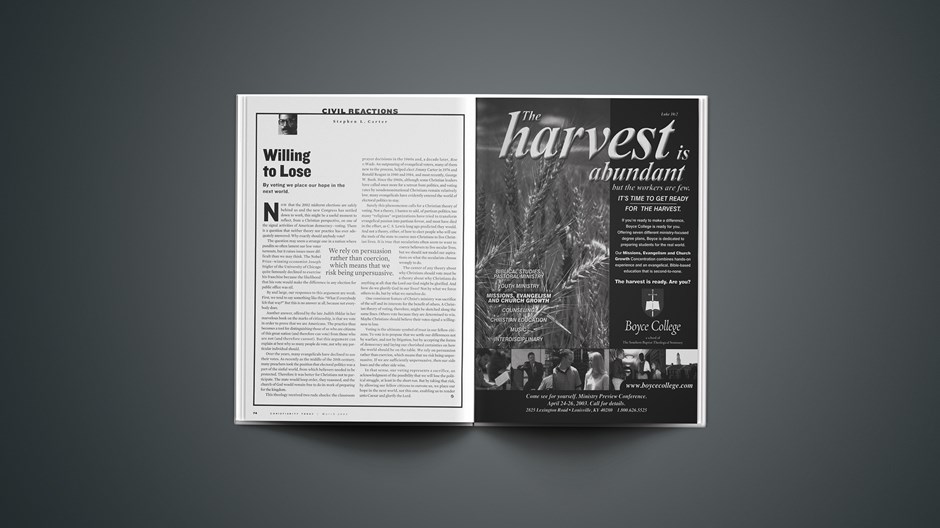
Now that the 2002 midterm elections are safely behind us and the new Congress has settled down to work, this might be a useful moment to reflect, from a Christian perspective, on one of the signal activities of American democracy—voting. There is a question that neither theory nor practice has ever adequately answered: Why exactly should anybody vote?
The question may seem a strange one in a nation where pundits so often lament our low voter turnouts, but it raises issues more difficult than we may think. The Nobel Prize-winning economist Joseph Stigler of the University of Chicago quite famously declined to exercise his franchise because the likelihood that his vote would make the difference in any election for public office was nil.
By and large, our responses to this argument are weak. First, we tend to say something like this: "What if everybody felt that way?" But this is no answer at all, because not everybody does.
Another answer, offered by the late Judith Shklar in her marvelous book on the marks of citizenship, is that we vote in order to prove that we are Americans. The practice thus becomes a tool for distinguishing those of us who are citizens of this great nation (and therefore can vote) from those who are not (and therefore cannot). But this argument can explain at best why so many people do vote, not why any particular individual should.
Over the years, many evangelicals have declined to use their votes. As recently as the middle of the 20th century, many preachers took the position that electoral politics was a part of the sinful world, from which believers needed to be protected. Therefore it was better for Christians not to participate. The state would keep order, they reasoned, and the church of God would remain free to do its work of preparing for the kingdom.
This theology received two rude shocks: the classroom prayer decisions in the 1960s and, a decade later, Roe v. Wade. An outpouring of evangelical voters, many of them new to the process, helped elect Jimmy Carter in 1976 and Ronald Reagan in 1980 and 1984, and most recently, George W. Bush. Since the 1960s, although some Christian leaders have called once more for a retreat from politics, and voting rates by nondenominational Christians remain relatively low, many evangelicals have evidently entered the world of electoral politics to stay.
Surely this phenomenon calls for a Christian theory of voting. Not a theory, I hasten to add, of partisan politics; too many "religious" organizations have tried to transform evangelical passion into partisan fervor, and most have died in the effort, as C. S. Lewis long ago predicted they would. And not a theory, either, of how to elect people who will use the tools of the state to coerce non-Christians to live Christian lives. It is true that secularists often seem to want to coerce believers to live secular lives, but we should not model our aspirations on what the secularists choose wrongly to do.
The center of any theory about why Christians should vote must be a theory about why Christians do anything at all: that the Lord our God might be glorified. And how do we glorify God in our lives? Not by what we force others to do, but by what we ourselves do.
One consistent feature of Christ's ministry was sacrifice of the self and its interests for the benefit of others. A Christian theory of voting, therefore, might be sketched along the same lines. Others vote because they are determined to win. Maybe Christians should believe their votes signal a willingness to lose.
Voting is the ultimate symbol of trust in our fellow citizens. To vote is to propose that we settle our differences not by warfare, and not by litigation, but by accepting the forms of democracy and laying our cherished certainties on how the world should be on the table. We rely on persuasion rather than coercion, which means that we risk being unpersuasive. If we are sufficiently unpersuasive, then our side loses and the other side wins.
In that sense, our voting represents a sacrifice, an acknowledgment of the possibility that we will lose the political struggle, at least in the short run. But by taking that risk, by allowing our fellow citizens to outvote us, we place our hope in the next world, not this one, enabling us to render unto Caesar and glorify the Lord.
Previous articles by Christianity Today sister publication Books & Culture on American voting include:
The Right to Vote | The controversy over the vote this November is nothing new, scholar Alexander Keyssar explains; the history of voting in the United States is much messier than we have been led to believe. (Nov. 15, 2000)
Stephen Carter is the William Nelson Cromwell Professor of Law at Yale University. He is the author of The Impeachment of Abraham Lincoln (2012), The Violence of Peace, The Emperor of Ocean Park, and many other books. His column, "Civil Reactions," ran from 2001 until 2007.















 While we pray for peace, we need moral clarity about this war.
 A Christian reconciliation group in Israel and Palestine warned that war would come. Now the war threatens their relevance.españolالعربيةFrançaisрусскийУкраїнська
 The plan would organize UMC churches in four global regions, with each given more leeway around same-sex marriage and other theological issues.






