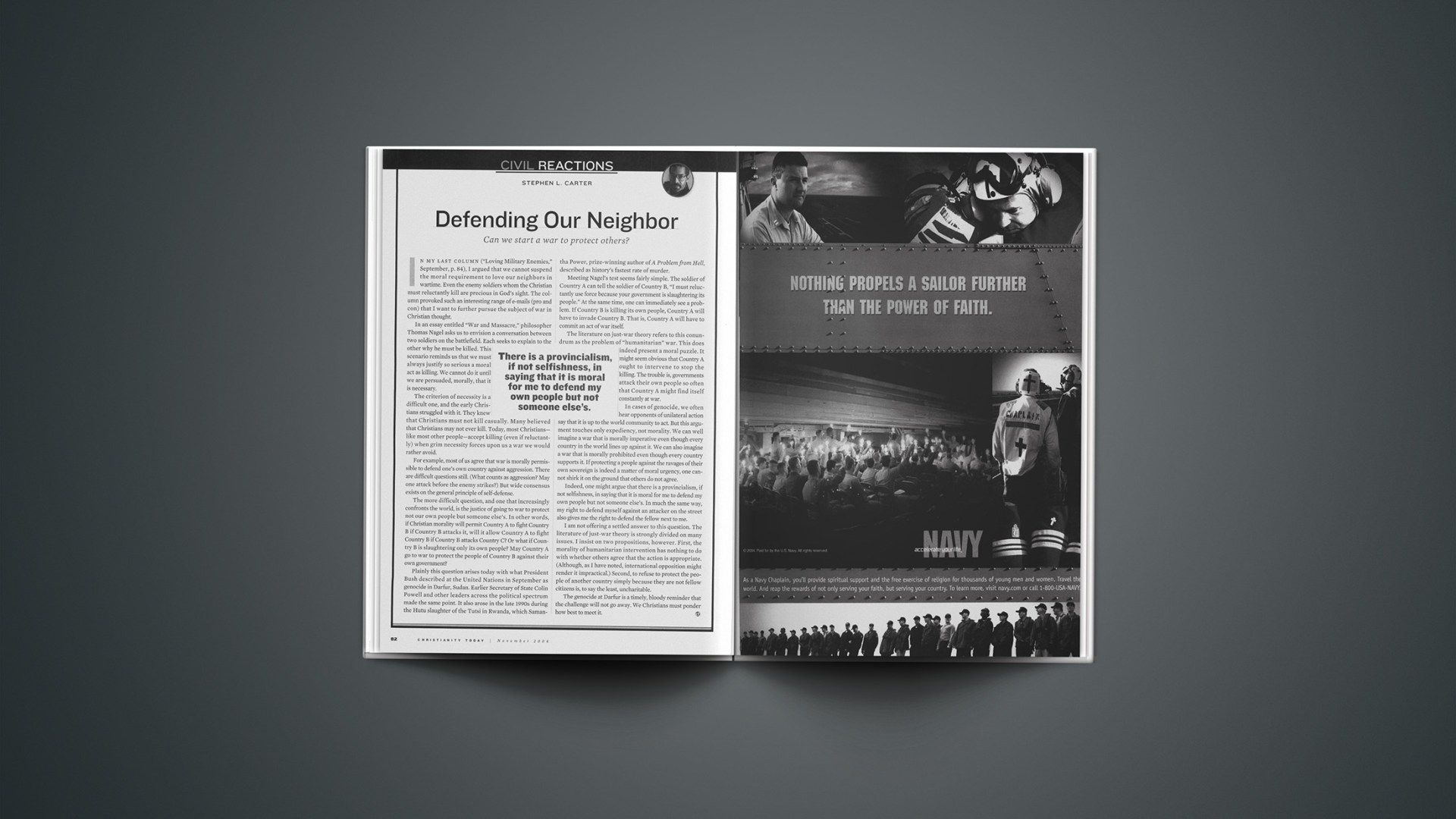
In my last column, I argued that we cannot suspend the moral requirement to love our neighbors in wartime. Even the enemy soldiers whom the Christian must reluctantly kill are precious in God’s sight. The column provoked such an interesting range of e-mails (pro and con) that I want to further pursue the subject of war in Christian thought.
In an essay entitled “War and Massacre,” philosopher Thomas Nagel asks us to envision a conversation between two soldiers on the battlefield. Each seeks to explain to the other why he must be killed. This scenario reminds us that we must always justify so serious a moral act as killing. We cannot do it until we are persuaded, morally, that it is necessary.
The criterion of necessity is a difficult one, and the early Christians struggled with it. They knew that Christians must not kill casually. Many believed that Christians may not ever kill. Today, most Christians—like most other people—accept killing (even if reluctantly) when grim necessity forces upon us a war we would rather avoid.
For example, most of us agree that war is morally permissible to defend one’s own country against aggression. There are difficult questions still. (What counts as aggression? May one attack before the enemy strikes?) But wide consensus exists on the general principle of self-defense.
The more difficult question, and one that increasingly confronts the world, is the justice of going to war to protect not our own people but someone else’s. In other words, if Christian morality will permit Country A to fight Country B if Country B attacks it, will it allow Country A to fight Country B if Country B attacks Country C? Or what if Country B is slaughtering only its own people? May Country A go to war to protect the people of Country B against their own government?
Plainly this question arises today with what President Bush described at the United Nations in September as genocide in Darfur, Sudan. Earlier Secretary of State Colin Powell and other leaders across the political spectrum made the same point. It also arose in the late 1990s during the Hutu slaughter of the Tutsi in Rwanda, which Samantha Power, prize-winning author of A Problem from Hell, described as history’s fastest rate of murder.
Meeting Nagel’s test seems fairly simple. The soldier of Country A can tell the soldier of Country B, “I must reluctantly use force because your government is slaughtering its people.” At the same time, one can immediately see a problem. If Country B is killing its own people, Country A will have to invade Country B. That is, Country A will have to commit an act of war itself.
The literature on just-war theory refers to this conundrum as the problem of “humanitarian” war. This does indeed present a moral puzzle. It might seem obvious that Country A ought to intervene to stop the killing. The trouble is, governments attack their own people so often that Country A might find itself constantly at war.
In cases of genocide, we often hear opponents of unilateral action say that it is up to the world community to act. But this argument touches only expediency, not morality. We can well imagine a war that is morally imperative even though every country in the world lines up against it. We can also imagine a war that is morally prohibited even though every country supports it. If protecting a people against the ravages of their own sovereign is indeed a matter of moral urgency, one cannot shirk it on the ground that others do not agree.
Indeed, one might argue that there is a provincialism, if not selfishness, in saying that it is moral for me to defend my own people but not someone else’s. In much the same way, my right to defend myself against an attacker on the street also gives me the right to defend the fellow next to me.
I am not offering a settled answer to this question. The literature of just-war theory is strongly divided on many issues. I insist on two propositions, however. First, the morality of humanitarian intervention has nothing to do with whether others agree that the action is appropriate. (Although, as I have noted, international opposition might render it impractical.) Second, to refuse to protect the people of another country simply because they are not fellow citizens is, to say the least, uncharitable.
The genocide at Darfur is a timely, bloody reminder that the challenge will not go away. We Christians must ponder how best to meet it.
Copyright © 2004 Christianity Today. Click for reprint information.
Related Elsewhere:
More articles about the war in Iraq, Iraq, Abu Ghraib, and the situation in Darfur, Sudan, are available on our website.
More articles about just war theory include:
Speaking Out: Where Do We Go From Here? | Now that the bombs are falling, we’ll need to repair Iraq—and our nation’s moral standing. (March 21, 2003)
Just War in Iraq | Sometimes going to war is the charitable thing to do. (Charles Colson, Dec. 10, 2002)
Just War, Just Nation? | World War II preacher points America back to the nation’s soul. (Nov. 01, 2002)
Christian Leaders Respond to Bush’s National Security Strategy | The White House outlines foreign policy in a changing world. (September 25, 2002)
Is Attacking Iraq Moral? | Christian leaders disagree, too. (September 4, 2002)
Christian Ethicists: Afghan War Is Just | Society of Christian Ethics gives cautious support to military effort. (Feb. 21, 2002)
Bully Culprit | Can a pre-emptive strike against the tyrant of Baghdad be justified? (Sept. 30, 2001)
A Time For War? | Augustine’s “just war” theory continues to guide the West. (Sept. 21, 2001)
Does Kosovo Pass the Just-War Test? | The military intervention introduces moral questions that the church ought to raise now, not waiting until the body bags start coming home. (Charles Colson, May 24, 1999)
Recent Christianity Today columns by Stephen L. Carter include:
Hope Deferred | Christians are uniquely positioned to further racial equality. (June 29, 2004)
A Politics of Gratitude | Stop whining, count your blessings, and love your global neighbors. (March 08, 2004)
Sports Mobs and Manners | There’s a difference between cheering the home team and being boorish. (Aug. 25, 2003)
Roe vs. Judicial Sense | Forget briefly its immorality—it’s just bad law (July 1, 2003)
Willing to Lose | By voting we place our hope in the next world. (March 4, 2003)
Virtue via Vouchers | The Supreme Court’s recent decision can help prevent more corporate scandals. (Dec. 4, 2002)
Remedial History | The educational establishment seems confused about our spiritual heritage. (July 10, 2002)
Uncle Sam Is Not Your Dad | The separation of church and state protects families too. (March 22, 2002)
A Quiet Compromise | Why a moment of silence is better than school prayer. (Feb. 25, 2002)
Leaving ‘Normal’ Behind | Life before September 11 seemed more secure, but do we really want it back? (Dec. 4, 2001)
Rudeness Has a First Name | Instant informality actually sabotages true friendship. (Nov. 2, 2001)
Why Rules Rule | Debates on the Ten Commandments expose our culture’s ultimate rift. (Sept. 6, 2001)
We Interrupt This Childhood | Parents who raise their children to do right face a barrage of resistance. (July 11, 2001)
And the Word Turned Secular | Christians should count the cost of the state’s affirmation. (May 29, 2001)
Vouching for Parents | Vouchers are not an attack on public schools but a vote of trust in families. (Apr. 2, 2001)