



From January to April, we live between the times—between Christmas and Easter, Bethlehem and Golgotha, Incarnation and Resurrection. What strikes me about the Gospel accounts of Christmas and Easter are the varied ways in which God works. In the Incarnation, God masterminds the announcement of the good news of the birth of Christ. He sends prophets well in advance to foretell the coming of the Messiah. He commissions an angel to announce the birth to a virgin. He sets a new star in the heavens to summon wise men from the East. He sends a company of singing angels to pronounce Christ’s birth to the shepherds in the fields. He quickens Anna the prophetess to declare the arrival of the Messiah on his day of circumcision. Though Christ was born in a lowly manger, there was nothing quiet about his birth.
Quite the contrary with the Resurrection. Yes, an angel comes to roll away the stone from Jesus’ tomb, but this grand miracle takes place with little pomp and circumstance. No angels sing hymns in the heavens, no stars appear in the East, no wise men set out on pilgrimage, no prophetess pronounces the good news. For 40 days after the Resurrection, Christ flits in and out of space and time, appearing only occasionally to a few followers. Then he ascends quietly into heaven.
What is even more striking is how his followers consistently fail to recognize him, and, more importantly, the variety of ways in which God makes it possible for them to apprehend him.
Mary Magdalene, weeping outside the empty tomb, has to be called by name before she recognizes Christ. Before that, she thought he was a gardener.
Ten disciples, gathered in a room in sorrow and fear, need Christ to breathe his peace on them before they recognize him. Before that, they thought he was a ghost.
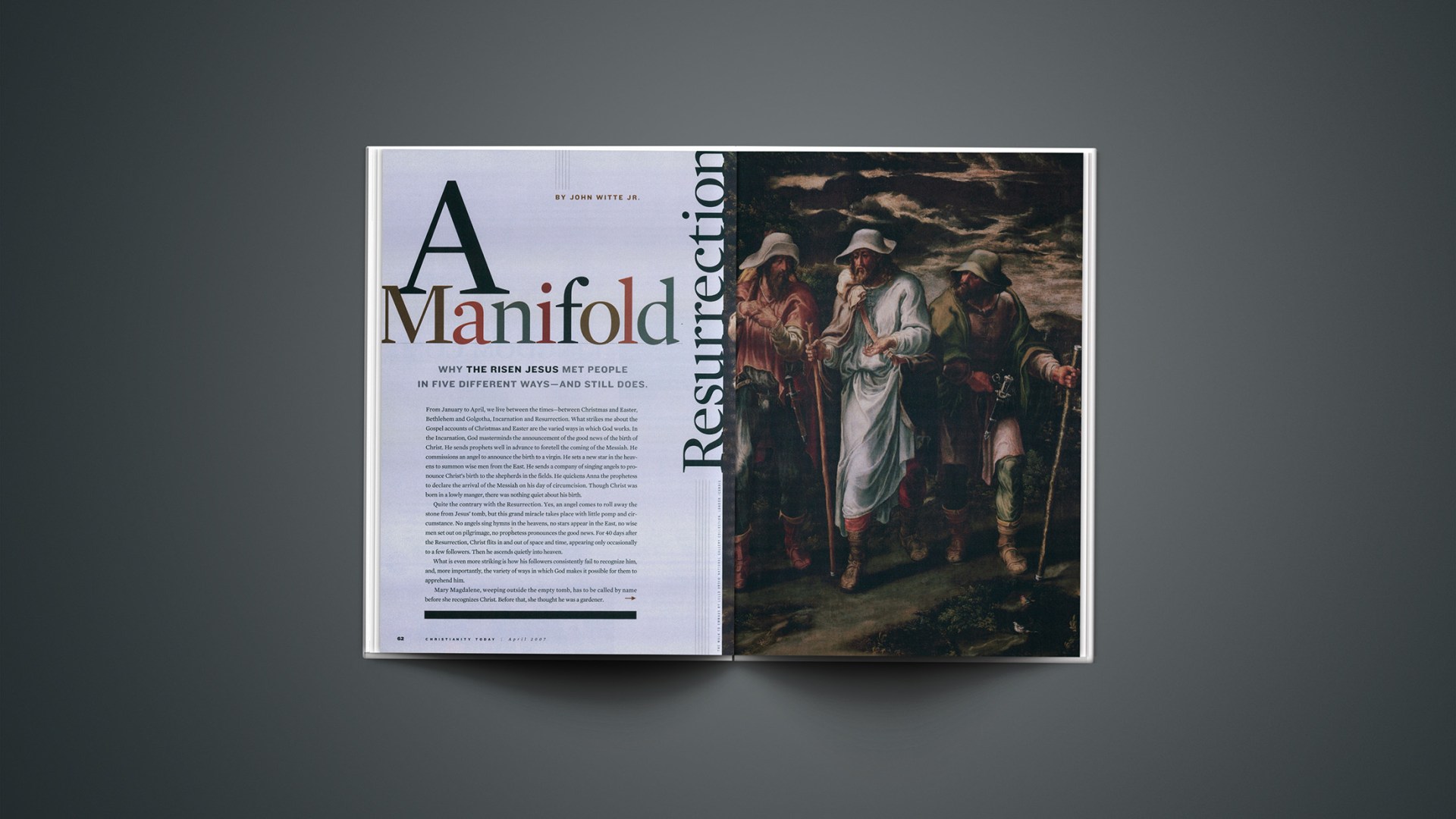
Two travelers from Emmaus walked with Christ and talked with him about salvation history all the way to their city, but recognized him only when he held up some bread and blessed it. Before that, they thought he was simply a learned traveler.
Thomas, the great doubter, wanted to put his fingers in the nail holes of the Cross and his hand in the pierced side of Christ before accepting him. Prior to that, he thought Christ was a fraud.
And Peter, that enigmatic rock of the church, recognized Christ only after he performed the miracle of filling Peter’s nets with fish. Then Peter had to sit through a threefold cross-examination as to whether he really believed in the resurrected Lord whom he had just denied: “Simon Barjona, do you love me?” “Do you love me?” “Do you love me?”
In these Gospel accounts, we see five ways in which Christ is experienced and understood after the Resurrection: A calling by name. A delivery of peace. A sacramental vision. A physical encounter. A miracle and conversation with God. I see both a budding psychology and a budding ecclesiology at work in these passages.
How Christ Meets Us Personally
The Gospels record these stories and encounters of the newly resurrected Christ, in part, for our spiritual comfort.
There is a little bit of Mary Magdalene in all of us: times when we swoon with pain and grief and need God’s call to comfort us. There is a little bit of the Emmaus travelers in all of us: times when we talk idly about divine matters but see God only in the sublime simplicity of the sacrament. There is a little bit of the huddled disciples in all of us: times when our faith puts us in jeopardy and fear, and we need God’s peace to be breathed on us. There is a little bit of Thomas in all of us: times that we are so overcome by doubt and skepticism that we need God’s touch to assure and anchor us. And there is a little bit of Peter in all of us: times when we deny and betray our Lord and need a miracle to remind us of God’s majesty or a divine conversation to move us to confess our faith unflinchingly.
The Gospel narratives of the resurrected Christ meet us at different stages in life and assure us that God comes to us in various ways, accommodating our pain, fear, doubt, abstraction, and pride as needed.
How Christ Meets Us in Church
The Gospels also record these stories for our corporate edification, to help us appreciate the diversity of ways in which we meet Christ in the church.
Christ can be experienced in multiple forms and multiple forums, and we may respond to him individually and collectively in multiple ways. Some are called by name. Some are touched by God. Some receive the breath of the Holy Spirit. Some experience miracles and hierophanies. Some see God in the sacraments.
Each type of divine encounter and experience creates its own liturgy, community, and tradition of confession, creed, and catechism.
Some traditions emphasize a personal calling, a moment of rebirth before membership is sealed. Some focus on an event, an icon, or a site or rite of divine vision. Some emphasize the pulpit, the homiletic exposition of God’s Word. Some emphasize the altar, the Eucharistic celebration of the death and resurrection of Christ. All are legitimate ways to serve and celebrate Christ, and all are legitimate foundations for understanding what the church is.
The Gospel stories of Christmas and Easter remind us of our fundamental unity in Christ. They also remind us of the plurality of ways God makes himself known and the variety of ways Christ is experienced by his people.
John Witte Jr. is Jonas Robitscher professor of law and director of the Center for the Study of Law and Religion at Emory University. He is the author of a number of books, most recently God’s Joust, God’s Justice: Law and Religion in the Western Tradition (Eerdmans, 2006).
Copyright © 2007 Christianity Today. Click for reprint information.
Related Elsewhere:
ChristianBibleStudies.com has a new study on encounters with the risen Lord.
Emory has a professional profile of John Witte Jr.
Witte has written several articles for First Things, including ‘The Meanings of Marriage,’ ‘Confessions of a Christian Historian,’ and ‘Publick Religion: Adams v. Jefferson.’
Other Christianity Today articles on the Resurrection include:
Life in a Country of Death | Experiencing Christ’s resurrection comes in ordinary moments, like sitting down to a meal. (April 12, 2006)
Reflections: He Is Risen | Easter quotations to stir heart and mind. (April 1, 2004)
You Can’t Keep a Justified Man Down | An interview with N. T. Wright, author of The Resurrection of the Son of God. (April 1, 2003)
Life After Life After Death | The Resurrection of the Son of God is a ground-clearing exercise of historiographical obstacles. (April 1, 2003)
Easter in an Age of Terror | Living and dying—and living again—after September 11. (April 1, 2002)
The Benefit of the Doubt | The disciple Thomas reveals an important truth about faith. (April 3, 2000)
Easter Sunday | Part four of The Great Reversal, a CT Classic article (April 1, 2000)
‘Hell Took a Body and Discovered God’ | One of the oldest and best Easter sermons, now 1,600 years old, is still preached today. (John Chrysostom, April 1, 2000)
Stuck on the Road to Emmaus | The secret to why we are not fulfilled. (July 12, 1999)
How Green Is Easter? | Celebration of Jesus’ resurrection is more than being glad about the return of spring. (April 5, 1999)
Books: If Christ Be Not Risen … | Scholars debate the meaning of the Resurrection. (July 13, 1998)
Grave Matters | Take away the Resurrection and the center of Christianity collapses. (N. T. Wright, April 6, 1998)