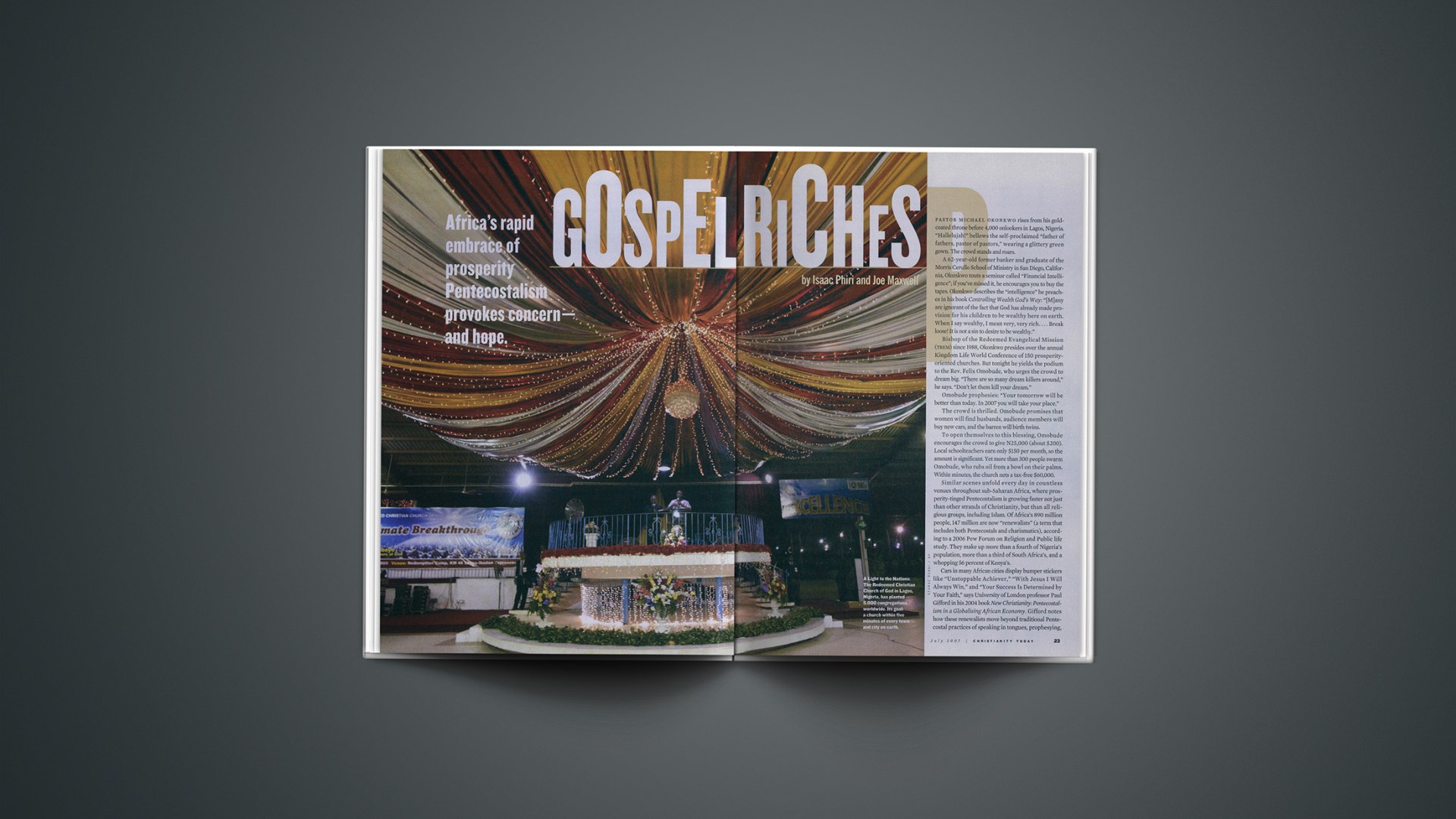

Pastor Michael Okonkwo rises from his gold-coated throne before 4,000 onlookers in Lagos, Nigeria. "Hallelujah!" bellows the self-proclaimed "father of fathers, pastor of pastors," wearing a glittery green gown. The crowd stands and roars.
A 62-year-old former banker and graduate of the Morris Cerullo School of Ministry in San Diego, California, Okonkwo touts a seminar called "Financial Intelligence"; if you've missed it, he encourages you to buy the tapes. Okonkwo describes the "intelligence" he preaches in his book Controlling Wealth God's Way: "[M]any are ignorant of the fact that God has already made provision for his children to be wealthy here on earth. When I say wealthy, I mean very, very rich. … Break loose! It is not a sin to desire to be wealthy."
Bishop of the Redeemed Evangelical Mission (TREM) since 1988, Okonkwo presides over the annual Kingdom Life World Conference of 150 prosperity-oriented churches. But tonight he yields the podium to the Rev. Felix Omobude, who urges the crowd to dream big. "There are so many dream killers around," he says. "Don't let them kill your dream."
Omobude prophesies: "Your tomorrow will be better than today. In 2007 you will take your place."
The crowd is thrilled. Omobude promises that women will find husbands, audience members will buy new cars, and the barren will birth twins.
To open themselves to this blessing, Omobude encourages the crowd to give N25,000 (about $200). Local schoolteachers earn only $150 per month, so the amount is significant. Yet more than 300 people swarm Omobude, who rubs oil from a bowl on their palms. Within minutes, the church nets a tax-free $60,000.
Similar scenes unfold every day in countless venues throughout sub-Saharan Africa, where prosperity-tinged Pentecostalism is growing faster not just than other strands of Christianity, but than all religious groups, including Islam. Of Africa's 890 million people, 147 million are now "renewalists" (a term that includes both Pentecostals and charismatics), according to a 2006 Pew Forum on Religion and Public life study. They make up more than a fourth of Nigeria's population, more than a third of South Africa's, and a whopping 56 percent of Kenya's.
Cars in many African cities display bumper stickers like "Unstoppable Achiever," "With Jesus I Will Always Win," and "Your Success Is Determined by Your Faith," says University of London professor Paul Gifford in his 2004 book New Christianity: Pentecostalism in a Globalising African Economy. Gifford notes how these renewalists move beyond traditional Pentecostal practices of speaking in tongues, prophesying, and healing to the belief that God will provide money, cars, houses, and even spouses in response to believers' faith—if not immediately, then soon.
In its 2006 survey, Pew asked participants if God would "grant material prosperity to all believers who have enough faith." Eighty-five percent of Kenyan Pentecostals, 90 percent of South African Pentecostals, and 95 percent of Nigerian Pentecostals said yes. Similarly, when Pew asked if religious faith was "very important to economic success," about 9 out of 10 Kenyan, Nigerian, and South African renewalists said it was.
"I preach prosperity and the message of salvation, too," says Joe Imakando, a former cessationist Baptist who now pastors the 6,500-person Bread of Life Church in Lusaka, Zambia. The church has sprouted 53 branches around the country, as well as church plants in the Democratic Republic of Congo, South Africa, Malawi, and Tanzania. Like many successful megachurch pastors in Africa, Imakando headlines his own local television show.
But he scoffs at the "prosperity preacher" label sometimes given him. "Our churches are growing," he says, referring to his critics, "theirs are shrinking."
Allan H. Anderson, professor of Global Pentecostal Studies at the University of Birmingham, says African renewalists are, indeed, eclipsing denominationally based churches and missions. "The older churches," he says, "are struggling to keep up with the jet-setting entrepreneurs who head up these new organizations."
"If you're not willing to play that [prosperity] game," says Vince Bacote, associate professor of theology at Wheaton College, "get ready to get steamrolled."
Yet wholesale dismissals of African renewalism as a gospel of materialism—one made possible by Elmer Gantry–style hucksterism and backwater superstition, perhaps—are short-sighted, says J. Lee Grady, editor of Charisma magazine. "Many of the renewalist leaders in Nigeria preach prosperity as a biblical concept based on the promises of Deuteronomy," he says, "proclaiming that when people serve Jesus Christ and renounce other gods, God blesses their nation and economy."
Grady stresses the need to distinguish between the various strains of material blessing preached in Africa. Many, if not most, African pastors preach a version of the prosperity gospel. But where some proclaim opulence, others simply uphold God's provision for basic needs. "When you look deeper," Grady says, "you see God moving in the details and in spite of the greed of certain individuals."
Made in the U.S.A.
The worst brand of African prosperity teaching is, perhaps unsurprisingly, an American export. Experts cite various reasons for the spread of this kind of renewalism, better known as health-and-wealth, including:
• American lifestyles have led African believers to equate Christian faith with wealth.
• Traditional African values often link material success and spiritual success.
• The African "Big Man" ideal honors rich, powerful leaders such as prosperity preachers.
And then there is television. As Pentecostal-charismatic programming has flooded Africa, renewalist numbers have risen from 17 million in 1970 to 147 million in 2005. The continent's largest religious broadcaster is Santa Ana, California–based Trinity Broadcasting Network (TBN), followed by Europe's GOD TV.
As TV sets grow common in African cities, these broadcasters are gaining huge audiences. People who lack a TV often watch with neighbors, and viewing options are limited. In Zambia, only three stations click on: MUVI TZ, which airs reruns of U.S. shows and old movies; ZNBC, the Zambian National Broadcasting Company; and TBN. Television is becoming the continent's religious classroom.
"People turn it on and assume that TBN is American Christianity, and Americans know everything, so why not listen to it?" says Bonnie Dolan, founder and director of Zambia's Center for Christian Missions, a Reformed school for pastors. "[W]e have Zambians looking to the West for direction, and they associate TBN with the West. And it's killing our churches."
Back in the U.S., TBN broadcasts mainstream Pentecostal and charismatic teachers like Joyce Meyer and megachurch pastor John Hagee alongside health-and-wealth preachers like Kenneth Copeland and Kenneth Hagin Jr. But Dolan says the network doesn't bother with mainstream preachers in Africa. Instead, TBN Africa airs wall-to-wall peddlers of plenty.
Prominent African health-and-wealthers, such as Matthew Ashimolowo of Kingsway International Christian Centre in London, also buy time on TBN and GOD TV.
While Christians of all types and times have relied on God's material provision, the kind of blessings that such preachers often promise—such as divine expectation of abundant wealth, runaway professional success, and unassailable physical and emotional health—spring from a relatively recent, American brand of religious thought.
The earliest proponents of positive thinking were spiritual innovators like Phineas P. Quimby and Mary Baker Eddy, founders of the New Thought movement and Christian Science, respectively. By the turn of the 20th century, Essek William Kenyon, a pastor and founder of Bethel Bible Institute, had incorporated similar ideas into his preaching on the finished work of Christ. Kenyon wrote that Christians could make a "positive confession" to bring emotional and physical desires into being. "What I confess," he is purported to have said, "I possess."
In the 1930s, Kenneth Hagin added Kenyon's teachings to his Pentecostal beliefs to create what would become the Word-Faith movement. An Assemblies of God pastor, Hagin taught Christians that they could get rich by mustering enough faith. "Say it, do it, receive it, tell it," he said. He touted a "Rhema doctrine," which held that words spoken in faith must be fulfilled, spawning slogans like "name it and claim it." In the 1960s, a young associate of Oral Roberts, Kenneth Copeland, began teaching that faith is a "force" which, when confessed out loud, brings material results. Within a couple decades, Word-Faith had grown into a sizable offshoot of charismatic faith.
Traditional Pentecostalism and the indigenous renewalism of African Initiated Churches (AICs) took root in Africa long before Word-Faith was imported. But health-and-wealth teaching (holding that material blessing is the gospel, or at least a key component of the gospel) and its pernicious Word-Faith cousin (holding that spoken words of faith create such blessing) have now infected African Christianity.
About 15 years ago, Hagin, his son Kenneth Hagin Jr., and Kenneth Copeland visited AICs in Nigeria. "They did teaching missions all over Nigeria, teaching the prosperity gospel," says Vinson Synan, Regent University emeritus professor of theology. "Churches exploded after that into millions of members."
Once relegated to the periphery of American religious thought, the gospel of wealth now pierces the heart of Africa's dynamic, growing church.
Follow the Leader
"[The prosperity gospel] is the most sweeping movement within the continent of Africa," says Dolan. "The African people at large in the church have bought into it hook, line, and sinker. It offers tremendous promise to an economically deprived people."
And little wonder: A religion of hope gleams brightly against the bleak backdrop of African poverty. Currently, about 315 million sub-Saharan Africans live on less than a dollar a day. According to Africa 2015's "Facts on Poverty in Africa," the average life expectancy throughout the continent is 41 years. One in three Africans suffers malnutrition.
But there is a change in this dismal picture: Rural Africans are moving to cities. As they do, some are brushing up against economic opportunity. In Nigeria, for instance, only 14.5 percent of the population lived in cities in 1960; today, that number has grown to 43 percent. Correspondingly, financial optimism is on the rise. Half of Nigerian renewalists now say their finances are in "excellent or good shape."
The prosperity phenomenon is so widespread in Nigeria that the government has taken notice. In 2004, according to a BBC report, Nigeria's National Broadcasting Commission banned TV claims by AIC preachers of miracles not "provable and believable."
In this climate, teaching about the Cross and suffering can be unappealing. Preachers who focus on such topics often lack eye-catching accoutrements. Some walk city streets hawking pencils to raise funds, says Dolan, leaving locals unimpressed. Their cultural history tells them to put stock in "Big Men."
Pastors like Okonkwo are the Big Men in modern-day Africa, adorned with all the trappings of a successful tribal chief. As big as Okonkwo's church is, though, it pales next to another Lagos prosperity oasis: David Oyedepo's Winners Chapel International, with its 54,000-seat auditorium, reputed to be the world's largest Christian center of worship.
Like a chief leading his followers toward better lives, Oyedepo is a larger-than-life figure whose largess proves he is worth heeding. Churches like his are "very personality driven," says Wheaton's Bacote. "You have a dynamic personality who is also an authority figure. People aren't exactly thinking about democracy."
Oyedepo teaches that "the Word of Faith is the key to triumphant living," and he lists "prosperity" as one of the 12 "pillars" of his ministry (others include "healing," "success," and "the supernatural"). But he also preaches salvation through Jesus Christ to millions and has launched a dizzying array of ministries offering hope and a better future to Nigerians.
Last December, the world's largest Christian gathering—about 3 million people—assembled at Oyedepo's pyramid-shaped Winners Chapel on the pristine Canaan Land estate. Every Sunday, traffic crawls as thousands flock to multiple services, and the college Oyedepo founded, Covenant University, was judged Nigeria's best private university in 2005. The school's motto is "the birthplace of kings and queens"; Charisma's Grady says he felt like he "was watching history in the making" at a recent matriculation ceremony.
In every endeavor, Winners Chapel maintains its ultimate goal: to help the faithful rise above Nigeria's malaise. "If you go the Nigerian way," warns Oyedepo, "you will suffer Nigerian affliction."
Yet University of Calgary theology professor Irving Hexham suggests that an ancient African urge, trumping even promises of material provision, animates the continent's prosperity movement: a desire for communication with the supernatural.
A wife and mother who attends Okonkwo's church tells the following story: "My husband dreamed on Thursday, December 5, 2002, of armed robbers digging through the wall to enter our flat. They said they wanted our second daughter." Four days later, robbers did attack their flat. Gunshots "shattered my right arm with seven bullets," the woman says. But the woman's daughter recalled her father's dream and hid safely. God saved the girl by divine warning, her mother says. "We thank God for his gifts, our parents-in-the-Lord Bishop Mike and Dr. (Mrs.) Peace Okonkwo, the pastors, and the entire TREM family. [Their] support, spiritually and materially … enhanced the miracles of God in our lives."
On a trip to the Durbin Christian Center in South Africa, Hexham noticed bookstore shelves full of Kenneth Hagin titles. Locals told Hexham they loved Hagin.
"What do you like about him?" Hexham asked.
"He has wonderful dreams," they routinely replied.
Hexham asked about Bishop Desmond Tutu, but received tepid response. "He never talks about dreams," they said.
For many, divine provision in the face of lawlessness, ramshackle living conditions, and other urban quagmires makes intellectual faith alone seem stale. Prosperity teachers describe the Christian faith as a lifestyle of direct communication with God. This kind of connection is "the key to the success of the prosperity gospel in Africa," Hexham maintains. "In traditional African religion, healing and prosperity are already there anyway. … Once this idea [of African interest in dreams] catches on, everything else follows."
Wheat and Chaff
Africa has its share of indigenous critics of the health-and-wealth message. Bishop Joseph Ojo, national secretary of the Pentecostal Fellowship of Nigeria and pastor of Calvary Kingdom Church, says certain pastors have "invaded the pulpit but do not have the calling. Their god is their belly."
Ojo does not believe Christians should meekly accept poverty. "I have labeled poverty my life's enemy," he says, "and I fight it with the same ferocity as I would fight a plague. Poverty stinks—it kills, demeans, and destroys." On the other hand, he says, "If you say, 'God has called me to preach prosperity,' there is something wrong with you."
David Oginde, senior pastor of the 10,000-member Nairobi Pentecostal Church, believes he could triple his membership by promising wealth. "But if that is all I am teaching, then I have lost the message," he says. "The kingdom of God is built on the Cross, not on bread and butter."
Oginde sometimes counsels Christians burned by health-and-wealth preachers. One student "planted" his school money as a seed offering, then was thrown out of college for not paying tuition. "I gave my money to God, but it has not come back," the student said. Oginde replied, gently, "You did not give your money to God."
Oginde warns that unethical preachers turn God's provision into "a sweepstakes," "distorting a good thing."
Still, both he and Ojo admit that many prosperity teachers do much good. Ojo says such pastors often inspire members to aim high, work hard, and avoid vices—and he sees Nigerians' standard of living improving. "God has been gracious to this country," he says. Oginde credits prosperity ministries for humanitarian work such as building schools and colleges, supplying food and medicine to the poor, and supporting HIV/AIDS prevention programs.
According to the University of Birmingham's Anderson, only the uninformed label all African prosperity leaders "unscrupulous manipulators greedy for wealth and power." Anderson, author of The Pentecostal Gospel, Religion, and Culture in African Perspective, says many preach conversion and repentance. Their members are increasingly educated, giving because "their needs are met."
Grady attended a January prayer meeting of 700 pastors in Lagos and heard many of them repent for their nation's shallow faith. In light of African pastors' ambivalence toward the prosperity gospel label, weighing the movement requires context. "Prosperity [for most Africans] means to have a roof over their heads and clothes," says Regent's Synan. Pastors inspire followers with the admirable "idea that if they serve God, don't throw their money away, and don't live immoral lives, they can and will prosper."
Aware of abuses in their circles, many prosperity preachers put extra effort into maintaining a biblical perspective on material blessing. The Economist recently reported that 1 million Kenyans attended a T. D. Jakes conference in Nairobi. While some have called Jakes a prosperity preacher, Jakes claims he teaches God's blessing holistically.
Kenyan Pastor David Muriithi—a Jakes disciple—leads a five-year-old, upscale congregation of 3,000 called House of Grace. Muriithi eschews Word-Faith and health-and-wealth teaching, and he says the word prosperity needs clarifying. "People have a shallow definition of prosperity. It is a very big word. It is not just about money; it is about a whole life. You can have a million dollars, but if you are sick and dying or your marriage is falling apart, is that prosperity?"
Proper teaching about prosperity leads to transformation, Muriithi says, and he laments the practice of promising people results. "What if it does not happen?"
Similarly, Zambian pastor George Mbulo advocates "generating wealth using business skills." "God will show you how to make wealth," he says, so there is no need to gamble. Even so, he is building a $320 million campus outside Lusaka, Zambia, for his 700-member church, but does not yet know how he will pay for it. "I know that God will fund it," he says.
If that sounds like a contradiction, it is one that many Africans feel. They want to walk in financial faith, but sense it can be an unclear proposition. They bounce between churches, parsing an array of messages on money and belief. If nothing else, the popularity of prosperity teaching highlights Africans' longing for a gospel that embraces a supernatural, body-and-soul faith.
Spiritual insight is needed to judge the movement, says Synan. But skeptical Westerners should re-examine their own attitudes before criticizing Africa's church. We're just as prone to materialism, says Bacote, and to the "illusion of controlling our own destiny versus merely surviving."
"It seems hypocritical for Western Christians who live in their nice suburbs to criticize Africans who want to 'prosper'—when many of those Africans are just beginning to leave grass huts and experience for the first time the joys of owning a car, holding a decent job, or enrolling in college," Grady says. "Do we really believe it is wrong for them to want those things?"
In his first letter to the Corinthians, the apostle Paul wrote, "And now these three remain: faith, hope, and love. But the greatest of these is love." Africa's young renewalist church is discovering that the line between preaching hope and turning it into an idol can be a fine one. The love of the rest of the body of faith will help it find its way.
Isaac Phiri is a freelance writer living in Zambia. Joe Maxwell is a former Christianity Today news editor and journalist-in-residence at Belhaven College in Jackson, Mississippi.
Copyright © 2007 Christianity Today. Click for reprint information.
Related Elsewhere:
"First Church of Prosperidad" and "Inside CT" accompanied this article.
Okonkwo posts a weekly reflection on TREM's website.
Joe Imakando preaches a televised sermon for the Hour of Blessing program, a service of the Bread of Life Church.
Other churches and people mentioned in the article include David Oyedepo Ministries International, Joseph Ojo at Calvary Kingdom Church, David Muriithi at House of Grace, and George Mbulo.
Charisma 's article, "Another View of the Prosperity Gospel," focused on the pitfalls of giving to receive.
The Pew Forum's section on Pentecostalism has the results of a 10-country survey of Pentecostalism.
Mainstream media coverage of the prosperity gospel includes:
Does God want you to be rich? | A growing number of Protestant evangelists raise a joyful Yes! But the idea is poison to other, more mainstream pastors (Time)
Pastor Hinn in Nigerian money row | Whatever disappointment he felt on the first and second days of the miracle crusade, Hinn kept to himself – but he opened up with anger on the final day. (BBC News)
Black Baptists eschew 'prosperity preaching' | Thirty-five thousand Baptists are visiting Dallas this week. They represent the nation's largest African-American organization, the National Baptist Convention (WFAA, Dallas)
Pay the Lord! | The Universal Church of the Kingdom of God has no visible doctrine or moral message and is almost silent on the Bible, but it believes passionately in generous "sacrifices" to the sect by its followers (Mail & Guardian, South Africa)
Our special section on Pentecostalism has more articles on the prosperity gospel, including:
What Really Unites Pentecostals? | It's not speaking in tongues. It may be the prosperity gospel. (December 5, 2006)
Full Gospel's Fractured Thinking | The problems with shunning the life of the mind. (Mar. 30, 2006)
Grading the Movement | Three leaders talk frankly about Pentecostalism: the good, the bad, and the unpredictable.(Mar. 31, 2006)
Pentecostal Connections | Full Gospel's forbidden fruit. (April 1, 2006)
Other Christianity Today articles on the Global South include:
Global Ultimatum | The larger meaning of Anglican leaders' demand that the Episcopal Church change its ways. (March 16, 2007)
"Shall the Fundamentalists Win?" | An excerpt from Philip Jenkins' new book, The New Faces of Christianity: Believing the Bible in the Global South. (December 5, 2006)
God's Word in an Old Light | Philip Jenkins on how global South Christians read the Bible. (December 5, 2006)
Out of Africa | The leader of nearly 18 million Nigerian Anglicans challenges the West's theology and control. (July 2005)
It's a Small Church After All | Globalization is changing how Christians do ministry.(November 6, 1998)
Turning the World Upside Down | The coming of global Christianity. (March 1, 2002)