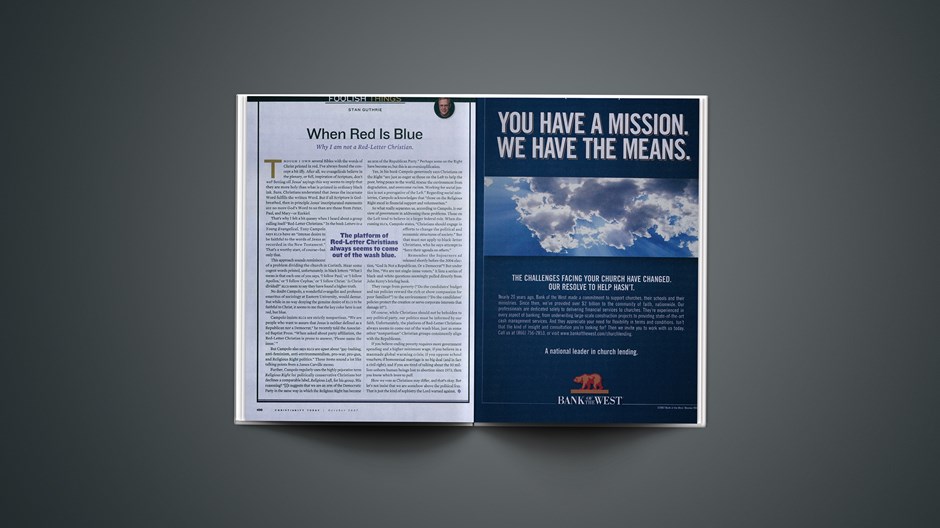
Though I own several Bibles with the words of Christ printed in red, I've always found the concept a bit iffy. After all, we evangelicals believe in the plenary, or full, inspiration of Scripture, don't we? Setting off Jesus' sayings this way seems to imply that they are more holy than what is printed in ordinary black ink. Sure, Christians understand that Jesus the incarnate Word fulfills the written Word. But if all Scripture is God-breathed, then in principle Jesus' inscripturated statements are no more God's Word to us than are those from Peter, Paul, and Mary—or Ezekiel.
That's why I felt a bit queasy when I heard about a group calling itself "Red-Letter Christians." In the book Letters to a Young Evangelical, Tony Campolo says RLCs have an "intense desire to be faithful to the words of Jesus as recorded in the New Testament." That's a worthy start, of course—but only that.
This approach sounds reminiscent of a problem dividing the church in Corinth. Hear some cogent words printed, unfortunately, in black letters: "What I mean is that each one of you says, 'I follow Paul,' or 'I follow Apollos,' or 'I follow Cephas,' or 'I follow Christ.' Is Christ divided?" RLCs seem to say they have found a higher truth.
No doubt Campolo, a wonderful evangelist and professor emeritus of sociology at Eastern University, would demur. But while in no way denying the genuine desire of RLCs to be faithful to Christ, it seems to me that the key color here is not red, but blue.
Campolo insists RLCs are strictly nonpartisan. "We are people who want to assure that Jesus is neither defined as a Republican nor a Democrat," he recently told the Associated Baptist Press. "When asked about party affiliation, the Red-Letter Christian is prone to answer, 'Please name the issue.' "
But Campolo also says RLCs are upset about "gay-bashing, anti-feminism, anti-environmentalism, pro-war, pro-gun, and Religious Right politics." These items sound a lot like talking points from a James Carville memo.
Further, Campolo regularly uses the highly pejorative term Religious Right for politically conservative Christians but declines a comparable label, Religious Left, for his group. His reasoning? "[I]t suggests that we are an arm of the Democratic Party in the same way in which the Religious Right has become an arm of the Republican Party." Perhaps some on the Right have become so, but this is an oversimplification.
Yes, in his book Campolo generously says Christians on the Right "are just as eager as those on the Left to help the poor, bring peace to the world, rescue the environment from degradation, and overcome racism. Working for social justice is not a prerogative of the Left." Regarding social ministries, Campolo acknowledges that "those on the Religious Right excel in financial support and volunteerism."
So what really separates us, according to Campolo, is our view of government in addressing these problems. Those on the Left tend to believe in a larger federal role. When discussing RLCs, Campolo states, "Christians should engage in efforts to change the political and economic structures of society." But that must not apply to black-letter Christians, who he says attempt to "force their agenda on others."
Remember the Sojourners ad released shortly before the 2004 election, "God Is Not a Republican. Or a Democrat"? But under the line, "We are not single-issue voters," it lists a series of black-and-white questions seemingly pulled directly from John Kerry's briefing book.
They range from poverty ("Do the candidates' budget and tax policies reward the rich or show compassion for poor families?") to the environment ("Do the candidates' policies protect the creation or serve corporate interests that damage it?").
Of course, while Christians should not be beholden to any political party, our politics must be informed by our faith. Unfortunately, the platform of Red-Letter Christians always seems to come out of the wash blue, just as some other "nonpartisan" Christian groups consistently align with the Republicans.
If you believe ending poverty requires more government spending and a higher minimum wage; if you believe in a manmade global warming crisis; if you oppose school vouchers; if homosexual marriage is no big deal (and in fact a civil right); and if you are tired of talking about the 50 million unborn human beings lost to abortion since 1973, then you know which lever to pull.
How we vote as Christians may differ, and that's okay. But let's not insist that we are somehow above the political fray. That is just the kind of sophistry the Lord warned against.
* * *
Tony Campolo's Response:
Dear Stan,
I have to say, "You got us right!"
While we, like you, have a very high view of the inspiration of Scripture and believe the Bible was divinely inspired, you are correct in accusing Red Letter Christians of giving the words of Jesus priority over all other passages of Scripture. What is more, we believe that you really cannot rightly interpret the rest of the Bible without first understanding who Jesus is, what he did, and what he said.
Article continues below
Likewise, we believe the morality in the red letters of Jesus transcends that found in the black letters set down in the Pentateuch, and I'm surprised you don't agree. After all, Stan, didn't Jesus himself make this same point in the Sermon on the Mount, when he said his teachings about marriage and divorce were to replace what Moses taught? Don't you think his red-letter words about loving our enemies and doing good to those who hurt us represent a higher morality than the "eye for an eye and a tooth for a tooth" kind of justice that we find in the Hebrew Testament? Is it really so hard to accept that, as God incarnate, Jesus set forth the highest law in the Bible, and therefore that law is more important than the Kosher dietary regulations we find in Leviticus and Deuteronomy?
You got us RLCs right again when you suggested we were anti-war, pro-environment, and deeply committed to ending poverty primarily because we believe Jesus is anti-war, pro-environment, and deeply committed to ending poverty. The only mistake you made was to imply that thinking this way—or trying to influence our government according to these values—makes us the Religious Left:
That you think asking questions such as, "Do the candidates' budget and tax policies reward the rich or show compassion for poor families?," or "Do the candidates' policies protect the creation or serve corporate interests that damage it?," is partisan saddens us. We believe these are the questions that every Christian should be asking, no matter which political party or candidate has the better answers at a given time in history.
I'm sorry you don't want to be one of us, Stan. In the struggle to convince our fellow believers to think, act, give, and vote according to the teachings of Jesus, we Red Letter Christians could really use a bright, articulate guy like you.
Sincerely,
Tony Campolo
Professor of Sociology, Eastern University
St. Davids, Pennsylvania
Stan Guthrie is an editor at large for Christianity Today and author of Missions in the Third Millennium and All That Jesus Asks. His column, "Foolish Things," ran from 2006 to 2007.















 While we pray for peace, we need moral clarity about this war.
 A Christian reconciliation group in Israel and Palestine warned that war would come. Now the war threatens their relevance.españolالعربيةFrançaisрусскийУкраїнська
 The rage of the mob is a poor substitute for real community.






