A recent book on the missional church argues that we need to "reinvent the church" in "revolutionary" ways so that we can "incarnate the gospel within a specific cultural context."
I found one example of such a church on the Internet, a congregation in Florida whose very name is Relevant.
Relevant is a casual, contemporary, Christian church meeting at the Italian Club in Ybor City, Florida. Our service is designed specifically for college students, urban professionals and young families. At Relevant, we feel that it's our responsibility to "clear the way" for you to come to church. We want you to be able to experience the great music, encouraging messages, friendly people and enjoyable atmosphere that are a part of Relevant.
The church recently made a media splash with its "30-Day Sex Challenge," encouraging marrieds to have sex every day for a month—a reverse Lenten discipline, I suppose. This church, like many others, is no doubt making a difference in the lives of "urban professionals" and "young families" in large part because it appears to be relevant.
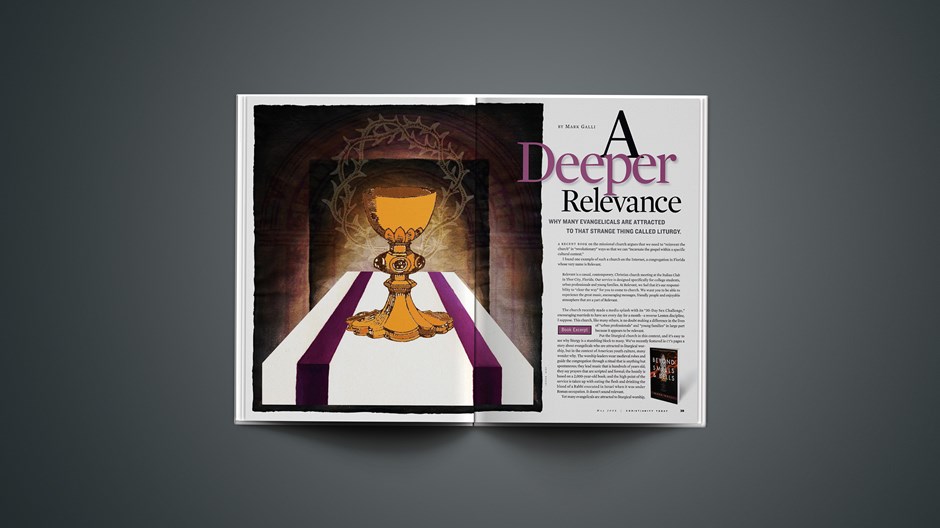
Put the liturgical church in this context, and it's easy to see why liturgy is a stumbling block to many. We've recently featured in CT's pages a story about evangelicals who are attracted to liturgical worship, but in the context of American youth culture, many wonder why. The worship leaders wear medieval robes and guide the congregation through a ritual that is anything but spontaneous; they lead music that is hundreds of years old; they say prayers that are scripted and formal; the homily is based on a 2,000-year-old book; and the high point of the service is taken up with eating the flesh and drinking the blood of a Rabbi executed in Israel when it was under Roman occupation. It doesn't sound relevant.
Yet many evangelicals are attracted to liturgical worship, and as one of those evangelicals, I'd like to explain what the attraction is for me, and perhaps for many others. A closer look suggests that something more profound and paradoxical is going on in liturgy than the search for contemporary relevance. "The liturgy begins … as a real separation from the world," writes Orthodox theologian Alexander Schmemann. He continues by saying that in the attempt to "make Christianity understandable to this mythical 'modern' man on the street," we have forgotten this necessary separation.
It is precisely the point of the liturgy to take people out of their worlds and usher them into a strange, new world—to show them that, despite appearances, the last thing in the world they need is more of the world out of which they've come. The world the liturgy reveals does not seem relevant at first glance, but it turns out that the world it reveals is more real than the one we inhabit day by day.
Relevant for Whom?
By "the liturgy," I mean the prayers, responses, and shape of worship one finds in Anglican, Catholic, and Orthodox services, and to a lesser degree, in Presbyterian, Methodist, Lutheran, and other mainline churches. If you examine the full service of each of these traditions, you'll find a surprisingly common worship order, and prayers and responses that are identical in many places. The shape of this liturgy has its origin in the early church, and has been molded by the history of the church up to the present.
Worshiping in the liturgical tradition is no panacea. When not approached wisely, it can be misused and abused; it can tempt participants to substitute mere religious ritual for a vital, personal faith in Jesus Christ. Nonetheless, this tradition does have much to offer contemporary evangelicalism. Take our fascination with relevance: the first thing this liturgy asks us to rethink is what we mean by "relevant" worship.
It is not an accident that when we think about making church more relevant, we usually mean meaningful for one particular group. In North America, that usually means 20-somethings and young families. For one, 20-somethings are some of the hardest people to attract to church—we evangelicals love the challenge of reaching them. Two, when they start raising families, they begin to return to church—we also love a field ripe for harvest. It's a perfect "target audience" for a new church to aim at.
Unfortunately, churches that perceive themselves as relevant often by their nature limit a full-bodied expression of the church—that is, they "target" 20- and maybe 30-somethings, and usually those of that group who are middle- and upper-middle-class white-collar types rising in income and influence. Few churches that consciously seek relevance want to clear the way to church for the poor, the homeless, welfare moms, drug-addicted men, or those trapped in nursing homes and convalescent hospitals. These "target audiences" are not very relevant to many "casual, contemporary" churches.
Article continues below
Liturgical churches know that as profound a reality as is the surrounding culture, there is an even more profound reality waiting to be discovered.
This is one reason I thank God for the liturgy. The liturgy does not target any age or cultural subgroup. It does not even target this century. (It does not imagine, as we moderns and postmoderns are tempted to do, that this is the best of all possible ages, the most significant era of history.) Instead, the liturgy draws us into worship that transcends our time and place. Its earliest forms took shape in ancient Israel, and its subsequent development occurred in a variety of cultures and subcultures—Greco-Roman, North African, German, Frankish, Anglo-Saxon, and so on. It has been prayed meaningfully by bakers, housewives, tailors, teachers, philosophers, priests, monks, kings, and slaves. As such, it has not been shaped to meet a particular group's needs. It seeks only to enable people—people in general—to see God.
This may seem obvious—of course church is a place where we want people to see God! But we do get distracted. I was a pastor for ten years, an editor at a pastoral journal for four (at sister publication Leadership), and have been involved in leadership at my local church for 19 years. I can't tell you the number of times I've argued that the church have a "clear vision" or "passion for the lost" or "empowered laity" or "more spirituality" or "creative worship" and so on—all great things! How difficult it is to remember the fundamental need of our churches and the people who attend them: to see God.
Theologian and pastor Eugene Peterson talked about our desire for relevance in a CT interview a couple of years ago: "I don't think people care a whole lot about what kind of music you have or how you shape the service. They want a place where God is taken seriously, where they're taken seriously."
In this regard, the liturgy is more relevant than we can imagine, because it's a place where God is taken seriously, and therefore where we are taken seriously. A liturgical service is by no means the only service that does this, but it is a form of worship that is especially suited to not getting distracted. The Anglican liturgy I participate in begins and ends like this:
Celebrant: Blessed be God, Father, Son, and Holy Spirit. People: And blessed be his kingdom, now and forever.
Article continues below
Deacon: Go in peace to love and serve the Lord. People: Thanks be to God.
The liturgy, from beginning to end, is not about meeting our needs. The liturgy is about God. It's not even about God-as-the-fulfiller-of-our-need-for-spiritual-meaning. It's about God as he is himself: Father, Son, and Holy Spirit. It is not about our blessedness but his. The liturgy immediately signals that our needs are not nearly as relevant as we imagine. There is something infinitely more worthy of our attention—something, someone, who lies outside the self.
With talk of "God" and "kingdom," it announces another order of reality we are being called into. We are in the habit of thinking that our culture—the reality we strive to be relevant to—is the measure of meaning. That's why we're tempted to shape our churches to look like that culture, because that is what people in this culture will find meaningful. It is logical on one level, and there is no question that we have to be culturally sensitive in our outreach. But the liturgy wants to show us a deeper logic and relevance.
The liturgy begins by saying that our culture needs not so much to have its "presenting needs" met as to be gently and calmly invited into a wiser culture—the culture of a Trinitarian God and his kingdom. This is what is blessed, now and forever. Our culture is the transitory thing, an apparition that will someday have to pass away, just as childhood has to pass away. The liturgy says to us as we enter, "You're in the culture of God and his kingdom now. Things will be different from now on."
The Tangible Other
Before he became Pope, Cardinal Joseph Ratzinger wrote, "The grandeur of the liturgy does not rest upon the fact that it offers an interesting entertainment, but in rendering tangible the Totally Other, whom we are not capable of summoning. He comes because He wills."
How exactly does God render himself tangible in the liturgy? Certainly in the Eucharist itself, in which he makes himself known in the breaking of the bread: "When he was at table with them, he took the bread and blessed and broke it and gave it to them. And their eyes were opened, and they recognized him" (Luke 24:30–31, ESV).
Then there is the reading and preaching of the Word, the revelation of God to his people. It is not just a dramatic reading of an ancient and beautiful text, followed by an inspirational talk. It is God speaking afresh to his people through the preached and spoken Word. As Jesus told the disciples before he sent them out to preach, and as he essentially tells every preacher: "The one who hears you, hears me."
Article continues below
Less obviously, God makes himself known through the words and drama of the liturgy. The words of the liturgy, as a quick glance shows, are Scripture-saturated, and thus carry the same revelatory power as the formal reading of the biblical lessons.
In addition, the very rhythm of the service—the liturgy of the Word followed by the liturgy of the Sacrament, the praise that prepares us for the Word, and the confessions and prayers that guide our response to the Word—is a pattern that has not so much been created by the church as discovered. It was a holy pattern that within a couple of centuries began to seem (to take a phrase from the Book of Common Prayer) "very meet, right, and our bounden duty" to practice in just this way.
It was as early as the second century that the shape of the service took the form we use today. Let's look at one service in Rome as described by the church father Justin Martyr:
And on the day called Sunday, all who live in cities or in the country gather together to one place, and the memoirs of the apostles or the writings of the prophets are read, as long as time permits; then, when the reader has ceased, the president verbally instructs, and exhorts to the imitation of these good things. Then we all rise together and pray, and, as we before said, when our prayer is ended, bread and wine and water are brought, and the president in like manner offers prayers and thanksgivings, according to his ability, and the people assent, saying Amen; and there is a distribution to each, and a participation of that over which thanks have been given.
One might assume that this was especially relevant to Roman culture of that day, and in some ways it probably was. But what is interesting is that this liturgical shape became the standard shape of the Western liturgy for the following centuries—which prompts wonder at how this liturgy fit the thousands of cultures the church encountered over the centuries. How in the world has it been relevant in the Middle East, North Africa, Europe, the Americas, and Asia? Yet it has been the basic outline in Catholic, Orthodox, Anglican, Lutheran, Presbyterian, and other communions, in many cultures and eras.
Why this liturgy? Why this form? Because not only its content but also its shape have ushered people into a transcendent culture, where they meet the Trinitarian God and take their first baby steps in his kingdom.
Article continues below
Deeper Reality
In what's now an old essay, F. H. Brabant put it this way: "All liturgical acts … have a double function: one directed Godwards, expressing in outward form the thoughts and feelings of the worshippers, the other directed manwards, teaching worshippers how they ought to think and feel by setting before them the Church's standard of worship."
We have to pay attention to cultural context, no question. The history of liturgy has been in part about finding words and ritual that help people in a given culture express their thoughts and feelings to God in ways that make cultural sense. The liturgy has always had freedom and variety within its basic structure.
But it has steadfastly refused to let the culture determine its shape or meaning. Liturgical churches know that as profound a reality as is the surrounding culture, there is an even more profound reality waiting to be discovered. The liturgy gently and calmly gets us to open our eyes to the new reality, showing us the "necessary separation" from the old. Suddenly, in the blink of an eye, we find our gaze directed away from ourselves and toward God and his kingdom. When we return to our homes, we are never the same.

















 While we pray for peace, we need moral clarity about this war.
 A Christian reconciliation group in Israel and Palestine warned that war would come. Now the war threatens their relevance.españolالعربيةFrançaisрусскийУкраїнська
 How groups like Hillsong learned to let go of the literal in favor of creative collaboration.españolPortuguês






