In the face of a confusing and complex culture, Christians tend, as Brian Godawa points out in his book Hollywood Worldviews: Watching Film with Wisdom and Discernment, to be either "cultural gluttons," mindlessly indulging in what they deem to be innocuous entertainment, or "cultural anorexics," hastily dismissing popular culture as unhealthy for the soul.
Godawa rightly argues that Christians need a more moderate and informed way to encounter popular culture. This is not to say that certain elements in the culture do not merit repudiation; indeed, some do. Meanwhile, some believers, relieved to find films without crudity, with happy endings, and even perhaps some Christian allusions, readily embrace such inoffensive material. But is this enough?
Certainly clean films with happy endings and Christian messages are not inherently objectionable; given the alternatives, they may even signal a welcome return to sanity. But superficially happy stories may obfuscate features of the human condition that an unhappy story better illuminates. And we should be wary of labeling as "Christian" a film that does no more than include a few Christian allusions.
One recent phenomenon that Christians sometimes overlook is the surge in dark films of spiritual quest. From science fiction films such as Dark City and the recently re-issued Blade Runner through the films of M. Night Shyamalan, and on to Christopher Nolan's Batman movies and even Harry Potter films, we can detect the way an ongoing dissatisfaction with modern Enlightenment themes of progress through knowledge and power opens a path to a recovery of pre-modern conceptions of human life as a quest.
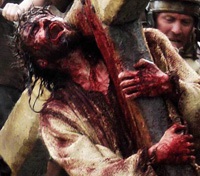
The Passion' was incredibly dark
What should Christians make of the preponderance of dark tales in our culture? What should we make of the astonishing success of The Passion of the Christ, by far the darkest American film about Christ ever made, so dark that one might be tempted to call it a religious horror film? If nothing else, its popularity indicates a hunger for something more and other than the superficial optimism of most Hollywood romantic comedies—or the equally superficial versions of the Gospel of Success on offer in so many of our churches.
These dark films of spiritual quest recover for us an understanding of the human condition with resonance in the Christian tradition, particularly in the work of the Christian apologist Blaise Pascal. Taking his cue from the scriptural claim that "God is hidden," Pascal argued that human life itself has the shape of a quest amid darkness to discern clues to our alienated condition, clues latent within the troubling paradoxes of our lives. Of course, it is only through grace that the apparent contradictions of our condition can be fully unraveled and that life can be seen as part of the divine drama of redemption. Pascal commends those who "seek with groans," who resist the temptation to despair and see their "chief duty" as the pursuit of enlightenment on the question of the purpose of life.
Such seekers, I would argue, permeate contemporary film. As a way of illustrating how Christians might think creatively about contemporary films of spiritual quest, I will concentrate on three relatively recent movies: The Dark Knight, Children of Men, and The Orphanage, each of which features characters on dark quests for a kind of redemption.
The Dark Knight
Christopher Nolan's Batman films—Batman Begins and The Dark Knight—present us with a Gotham void of any ultimate basis for, or hope in, justice and goodness. The modern city, the promised locus of Enlightenment bliss, is corrupt, a city dominated by fear with mores that destroy innocence in its infancy.
Bruce Wayne's 'elemental symbol,' the bat
By way of response to those who rule through intimidation, Bruce Wayne crafts an "elemental symbol," the bat, to combat fear with fear. In the first film, Batman, resembling the gargoyles on medieval cathedrals, is frequently depicted silently watching over Gotham from his perch on the spires of its skyscrapers. With the demise of the modern framework, medieval symbols—the gargoyle and the knight—reappear in a new key. In a telling scene, Batman apprehends a criminal and asks information regarding a drug deal. Claiming he has told Batman everything he knows, the criminal shouts, "I swear to God." Batman demands, "Swear to me."
Batman insists "Gotham is not beyond redemption." But his is not a religious redemption. From the spires of its skyscrapers, Batman is a dark knight, a gargoyle, in godless Gotham.
Nolan's Batman films exhibit what the world might look like in the absence of any foundation for justice or hope. What sense, in such a world, can one make of the residual longing in the human heart for justice or for the desire to protect the innocent? What possible basis can there be for hope? Interestingly, the film recovers the language of the knight, who makes inordinate and, by modern standards, irrational sacrifices for the sake of the common good. Can the image of the knight, without a shared understanding of justice or sacrifice, redeem anything? At the end of the second film, in which Batman/Bruce embraces his role as dark knight, he seems to set himself on a path of unending flight. In godless Gotham, justice is neither restored nor fully vanquished.
Article continues below
Children of Men
Dark films of spiritual quest surface in many genres, perhaps the most popular of which is the science fiction thriller. The most artistically celebrated such film in recent years is Alfonso Cuaron's version of P. D. James's novel Children of Men (2006).
Assisted by splendid cinematography, superb performances, and a lean script, Children of Men depicts a world in which humans have been rendered rapidly and bafflingly infertile. In James's novel, infertility operates as a symbol of mankind's despair, of the nihilism that lurks just beneath the surface of modern life. The questions made explicit in the infertile world are: For what are we living? Why do we have children? What do we want to hand on to them? But, as is so often the case in science fiction, disaster and despair arise out of our greatest boasts, our technological and scientific mastery of nature.
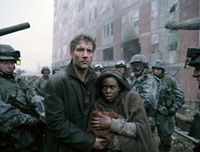
Yet, in the midst of this world, there suddenly appears a pregnant young woman. Theo (Clive Owen) finds himself called upon to protect the girl and her child from all of those who would have political and financial designs on new life. His dark quest will transform an indifferent, reluctant seeker—himself—into someone willing to make sacrifices for others.
Theo escorts mother and child through a war zone
Both film and book highlight religious themes and symbols. When the baby is born in the midst of a battle between rebel and army forces, the soldiers cease fighting and either bow or cross themselves as the baby passes. Cuaron links the unexpected birth of the child to Christian symbols. Cuaron, who in interviews has lamented our loss of symbols, offers us a collage of symbols, but it seems that in the end the governing symbol evokes the Romantic faith in the power of the innocent child to overcome the alienation of the civilized, adult world. Commenting on the film, Cuaron has said, "I have a grim view not of the future but of the present. … The young generation is the one that is getting some new perspective of reality of what's going on in the world." Cuaron fails to see that this vision of the child as father of the man is one of the greatest disorders in the world of the novel.
It is not surprising that other elements from James's more explicitly Christian novel do not find their way into Cuaron's script.
Article continues below
The Orphanage
A genre often seen as offering nothing more than scares to adolescent audiences, the horror film is nonetheless capable of featuring dark quests of great spiritual significance. Perhaps the most compelling example in recent years is the neglected Spanish language ghost story, The Orphanage (2007). Juan Antonio Bayona's debut film features a spectacular setting for a ghost story—a large, old house, surrounded by thick woods, and just yards from the coast, where the sea has carved out hidden caves along the strand of an isolated cove. With echoes of The Sixth Sense and The Others, The Orphanage, which focuses on the intersections of fantasy and history, the dead and the living, is a magnificent example of a dark film of spiritual quest.
The film opens with Laura (Belen Rueda), her husband Carlos (Fernando Cayo), and young son Simon (Roger Princep) moving into a seaside home, which at one time had been the orphanage where Laura had lived happily as a child before her adoption. There, Laura and Carlos intend to establish a home for disabled children. Simon is increasingly lured away by encounters with imaginary friends, who, he claims, inform him that he was adopted. In fact, he was adopted—though Laura and Carlos had planned to tell him the truth only when he was older.
Not long after Simon takes his mother on a frighteningly elaborate treasure hunt that he alleges he plays with his secret friends, he disappears.
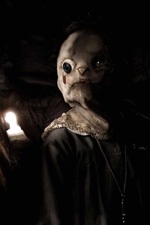
Even horror films like 'The Orphanage' can point to truth and light
The story picks up six months later, with Laura unwilling to accept her son's death and inviting a medium to the house to see whether the presence of ghosts can be detected. In a marvelous sequence, the medium traces the sounds of children to a bedroom where she confronts unspeakable horrors. Before leaving, she informs Laura that those who are close to death, as her son was at the time of his disappearance, can see the other world: "Seeing isn't believing. Believe and you will see." What might seem merely a standard cliché is in fact an invitation to see in the clues latent in our ordinary experience signs of another order of reality, to see through the separation and loss of death the prospect of a living community beyond the grave.
The film moves toward its resolution as Laura, noticing that certain objects in the house are inexplicably out of place, decides to play Simon's game of treasure hunting. The question is, Who planted the clues? In a desperate attempt at communication with the dead, Laura, now alone in the house, attempts to recreate the orphanage in the details of her childhood. Yet, from this point, the film moves not so much backward as forward and upward, from time to eternity. "Can I wake up now?" is a question Simon poses to his mother early in the film. That question resonates throughout the entire story, a convincing portrait of souls caught between two lives, in the short sleep that is death.
Article continues below
In its meditation on a communion between the dead and the living, The Orphanage puts one in mind of lines from John Donne's poem Death Be Not Proud:
"One short sleep past, we wake eternally,
And death shall be no more; death, thou shalt die."
Seeing the signs and symbols
Signs, both in the form of clues and explicitly Christian symbols, operate in The Orphanage not so much as means of re-articulating a lingering hunger for justice (The Dark Knight) or as vehicles for transformation through a return to childhood innocence (The Children of Men), but rather as instruments of seeing one order through another: the dead through the living and the spiritual through the physical.
All three films considered here feature characters on quests for a kind of redemption amid a dark and ominous world, but the films take various stances toward, or exhibit certain kinds of silence about, the traditional Christian understanding of the human condition and redemption.
Trying to spell out these differences is, to my mind, one of the important tasks for a contemporary Christian approach to film. In doing so, we will no doubt learn a great deal about contemporary films and be better able to offer distinctively Christian interpretations of them. We might also learn something about how to bring to bear on our culture the rich resources of the Christian tradition, how to craft images, vocabulary, and stories that are at once, even ancient and ever new.
Thomas Hibbs, a contributor to National Review Online, is dean of the Honors College at Baylor University, where an earlier version of this essay was delivered in a talk in October 2008.
The Passion' was incredibly darkBruce Wayne's 'elemental symbol,' the batTheo escorts mother and child through a war zoneEven horror films like 'The Orphanage' can point to truth and light













 While we pray for peace, we need moral clarity about this war.
 A Christian reconciliation group in Israel and Palestine warned that war would come. Now the war threatens their relevance.españolالعربيةFrançaisрусскийУкраїнська
 How groups like Hillsong learned to let go of the literal in favor of creative collaboration.españolPortuguês