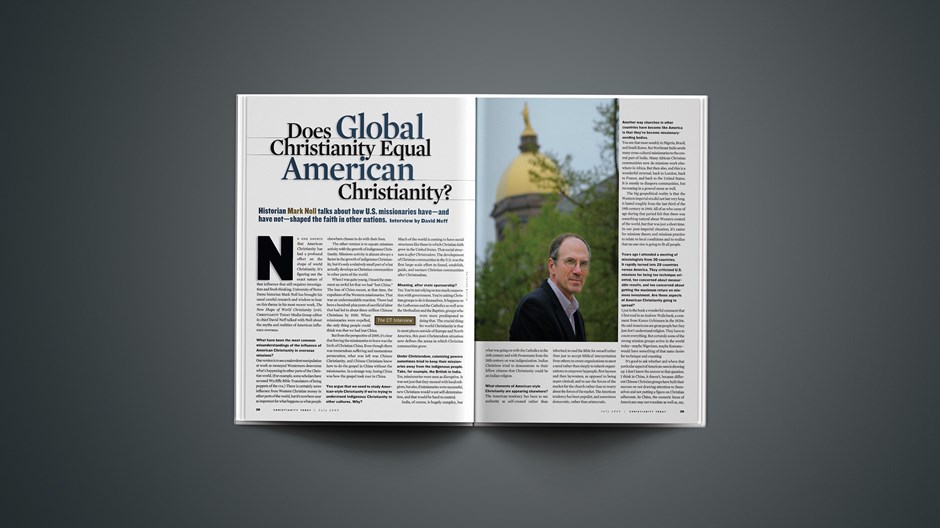
No one doubts that American Christianity has had a profound effect on the shape of world Christianity. It's figuring out the exact nature of that influence that still requires investigation and fresh thinking. University of Notre Dame historian Mark Noll has brought his usual careful research and wisdom to bear on this theme in his most recent work, The New Shape of World Christianity (IVP). Christianity Today Media Group editor in chief David Neff talked with Noll about the myths and realities of American influence overseas.
What have been the most common misunderstandings of the influence of American Christianity in overseas missions?
One version is to see a malevolent manipulation at work as moneyed Westerners determine what's happening in other parts of the Christian world. (For example, some scholars have accused Wycliffe Bible Translators of being puppets of the CIA.) There is certainly some influence from Western Christian money in other parts of the world, but it's nowhere near as important for what happens as what people elsewhere choose to do with their lives.
The other version is to equate missions activity with the growth of indigenous Christianity. Missions activity is almost always a factor in the growth of indigenous Christianity, but it's only a relatively small part of what actually develops as Christian communities in other parts of the world.
When I was quite young, I heard the statement an awful lot that we had "lost China." The loss of China meant, at that time, the expulsion of the Western missionaries. That was an understandable reaction. There had been a hundred-plus years of sacrificial labor that had led to about three million Chinese Christians by 1950. When missionaries were expelled, the only thing people could think was that we had lost China.
But from the perspective of 2009, it's clear that forcing the missionaries to leave was the birth of Christian China. Even though there was tremendous suffering and momentous persecution, what was left was Chinese Christianity, and Chinese Christians knew how to do the gospel in China without the missionaries. In a strange way, losing China was how the gospel took root in China.
You argue that we need to study American-style Christianity if we're trying to understand indigenous Christianity in other cultures. Why?
Much of the world is coming to have social structures like those in which Christian faith grew in the United States. That social structure is after Christendom. The development of Christian communities in the U.S. was the first large-scale effort to found, establish, guide, and nurture Christian communities after Christendom.
Yes. You're not relying on too much cooperation with government. You're asking Christian groups to do it themselves. It happens to the Lutherans and the Catholics as well as to the Methodists and the Baptists, groups who were more predisposed to doing that. The crucial thing for world Christianity is that in most places outside of Europe and North America, this post-Christendom situation now defines the arena in which Christian communities grow.
Under Christendom, colonizing powers sometimes tried to keep their missionaries away from the indigenous people. Take, for example, the British in India.
Yes, missionaries were seen as disruptive. It was not just that they messed with local religions, but also, if missionaries were successful, new Christians would want self-determination, and that would be hard to control.
India, of course, is hugely complex, but what was going on with the Catholics in the 16th century and with Protestants from the 18th century on was indigenization. Indian Christians tried to demonstrate to their fellow citizens that Christianity could be an Indian religion.
What elements of American-style Christianity are appearing elsewhere?
The American tendency has been to see authority as self-created rather than inherited; to read the Bible for oneself rather than just to accept biblical interpretation from others; to create organizations to meet a need rather than simply to inherit organizations; to empower laypeople, first laymen and then laywomen, as opposed to being super-clerical; and to use the forces of the market for the church rather than to worry about the forces of the market. The American tendency has been populist, and sometimes democratic, rather than aristocratic.
Another way churches in other countries have become like America is that they've become missionary-sending bodies.
You see that most notably in Nigeria, Brazil, and South Korea. But Northeast India sends many cross-cultural missionaries to the central part of India. Many African Christian communities now do missions work elsewhere in Africa. But then also, and this is a wonderful reversal, back to London, back to France, and back to the United States. It is mostly to diaspora communities, but increasing in a general sense as well.
The big geopolitical reality is that the Western imperial era did not last very long. It lasted roughly from the last third of the 19th century to 1960. All of us who came of age during that period felt that there was something natural about Western control of the world, but that was just a short time. In our post-imperial situation, it's easier for missions theory and missions practice to relate to local conditions and to realize that no one size is going to fit all people.
Article continues below
Years ago I attended a meeting of missiologists from 30 countries. It rapidly turned into 29 countries versus America. They criticized U.S. missions for being too technique oriented, too concerned about measurable results, and too concerned about getting the maximum return on missions investment. Are those aspects of American Christianity going to spread?
I put in the book a wonderful comment that I first read in an Andrew Walls book, a comment from Kanzo Uchimura in the 1920s. He said Americans are great people but they just don't understand religion. They have to count everything. But certainly some of the strong mission groups active in the world today—maybe Nigerians, maybe Koreans—would have something of that same desire for technique and counting.
It's good to ask whether and where that particular aspect of American-ness is showing up. I don't know the answer to that question. I think in China, it doesn't, because different Chinese Christian groups have built their success on not drawing attention to themselves and not putting a figure on Christian adherents. In China, the numeric focus of Americans may not translate as well as, say, the lay empowerment aspect does.
How has missions strategy changed over the decades, in America and abroad?
In the first half of the 19th century in the U.S., there was not a whole lot of strategic thinking. Rather, there was a lot of activity simply trying to respond to need. There was a lot of successful organizing on the run. But it was not until the 1840s, '50s, and '60s that more systematic strategizing began. Today, in many places around the world with new Christian communities, activity, meeting felt needs, and organizing on the run are all more prominent than systematic thinking about how to go from A to B.
Does this shift have something to do with the rise of the church-growth movement in Southern California in the 1970s?
Actually, missions historian Dana Robert has shown that by the 1880s and '90s, maybe early 20th century, a business model began to prevail in American mission societies that feeds into what you just said about the mid-20th century.
Article continues below
American missionary efforts today are mostly the work of evangelical denominations and interdenominational agencies. How does that shape missions strategy today?
One of the things I'm most encouraged by in modern American missions history is how sophisticated the evangelism-minded groups have become. Sophisticated cultural analysis is now proceeding alongside a strong evangelism missions mandate. The 19th-century missionary pioneers in the U.S. were quite sophisticated in understanding culture and cross-cultural communications, compared to their own day and age. At the height of the imperial era, by contrast, say 1880—1950, there was a serious decline in cultural awareness and sensitivity in all the groups. But since World War II, there's been a strong awareness among everybody, including the strongly evangelistic groups, of the need for language training and cultural understanding, as well as for gospel urgency.


















 While we pray for peace, we need moral clarity about this war.
 A Christian reconciliation group in Israel and Palestine warned that war would come. Now the war threatens their relevance.españolالعربيةFrançaisрусскийУкраїнська
 The rage of the mob is a poor substitute for real community.






