In full view of drivers whizzing by on Interstate 75 near Atlanta, the Church of the Apostles is majestic, stately, and soaring. It's also daring: the building looks unmistakably and instantly like a church.
This decade-old neo-Gothic Anglican megachurch is layered with stone walls, a thick tower that hoists a cross, and half-oval windows in the shape universally known as "church window." While its original building plan called for theater seating—the sanctuary seats about 3,000—the church instead opted for pews.
"When we built it, there was a lot of movement towards the warehouse look, with black ceilings," says Dana Blackwood, Church of the Apostles' director of facilities. "The church leadership understood that that look was going to fade. People wanted to have a sense of tradition, something that looked like a church."
The Church of the Apostles suggests a new trend in church design, one in which some congregations are rejecting the slimmed-down, boxy buildings of the last half-century and embracing a look some would call antiquated, following the ancient-future dictum that old is the new new.
"The average person is not at all repelled by Gothic or Romanesque architecture," says Robert Jaeger, executive director of Partners for Sacred Places, a nondenominational nonprofit that preserves and renews historic church buildings in the U.S. "The average person finds the symbolism and the craftsmanship compelling, beautiful, and comforting."
"There's a desire out there to connect with something ancient, something transcendent," says Ed Stetzer, director of LifeWay Research and author of Lost and Found: The Younger Unchurched and the Churches That Reach Them. "There's a hunger to move beyond a bland evangelicalism into something with more historic roots."
Last year, a LifeWay survey commissioned by the Cornerstone Knowledge
Network found that unchurched adults prefer Gothic church buildings to utilitarian ones, challenging the conventional wisdom that medieval-looking churches feel out-of-touch and stuffy to seekers. LifeWay showed over 1,600 unchurched adults four pictures of church buildings, ranging from mall-like to Gothic. The majority preferred the most ornate church.
"The study probably tells us that the appearance of a traditional church might not be the turnoff that people assumed in the seeker age," Stetzer says.
Of course, Stetzer also notes that in North America and Europe, the congregations with the oldest buildings are the ones struggling the most to retain members. There's a difference between admiring a building from the street and going inside to connect with a congregation.
"Buildings don't reach people, people reach people," says Stetzer. "We can't tell from the survey if there's a connection between the two."
"I think we need to be cautious about an excessive focus on buildings," adds Gerardo Marti, a sociologist at Davidson University. Marti studied Los Angeles's innovative Mosaic community for his book A Mosaic of Believers: Diversity and Innovation in a Multiethnic Church. "These discussions [about architecture] often lead us away from a core insight: that ministry is about how we can actualize God's love through community."
Marti says that even in non-churchlike settings, most leaders carefully consider how the space can be set apart as sacred. He recalls Mosaic's decision in 1998 to move its Sunday evening service to a downtown nightclub.
"When Mosaic first stepped into the nightclub, its leaders asked, 'Can we make this into a church?'"Marti recalls. "There was a lot of prayer about how to arrange the space so that it evoked worship. Even in the most boxlike space, every church leader I've talked to still asks, 'How do we make this a place of worship?'"
Creating Sacred Space
Jaeger says Gothic buildings have a built-in capacity to evoke the sacred. "The shelters that churches have made for themselves have accumulated so much significance and have been cherished for so long," he says, "that they have beauty, symbolism, and power."
Jaeger's work with Partners for Sacred Places aims to get neighborhoods, not just congregations, to recognize the value of historic church buildings.
Churches "are de facto community centers," Jaeger says. "Neighbors instinctively love an older church building's place on the streetscape. It stands out and says, 'In the midst of all the change, this is a place of continuity and stability.'"
This ties into a larger architectural trend, says Eric Jacobsen, author of Sidewalks in the Kingdom: New Urbanism and the Christian Faith. "Traditional church buildings may be more attractive to the unchurched because they want to see something that is different from other aspects of their lives," which are often shaped by narrow demographic branding strategies.
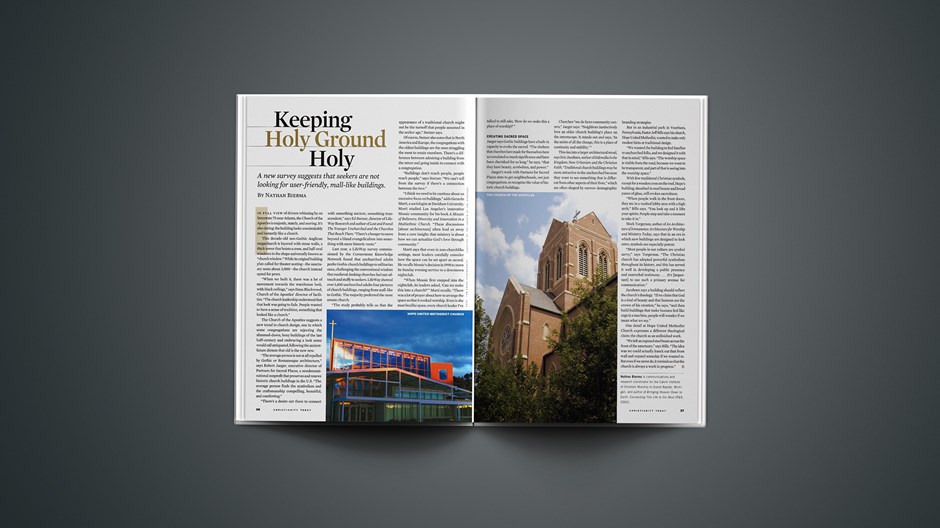
But in an industrial park in Voorhees, Pennsylvania, Pastor Jeff Bills says his church, Hope United Methodist, wanted to make only modest hints at traditional design.
"We wanted the building to feel familiar to unchurched folks, and we designed it with that in mind," Bills says. "The worship space is visible from the road, because we want to be transparent, and part of that is seeing into the worship space."
Article continues below
With few traditional Christian symbols, except for a wooden cross on the roof, Hope's building, sheathed in steel beams and broad panes of glass, still evokes sacredness.
"When people walk in the front doors, they are in a vaulted lobby area with a high arch," Bills says. "You look up and it lifts your spirits. People stop and take a moment to take it in."
Mark Torgerson, author of An Architecture of Immanence: Architecture for Worship and Ministry Today, says that in an era in which new buildings are designed to look retro, symbols are especially potent.
"Most people in our culture are symbol savvy," says Torgerson. "The Christian church has adopted powerful symbolism throughout its history, and this has served it well in developing a public presence and nonverbal testimony. … It's [important] to use such a primary avenue for communication."
Jacobsen says a building should reflect the church's theology. "If we claim that God is a God of beauty and that humans are the crown of his creation," he says, "and then build buildings that make humans feel like cogs in a machine, people will wonder if we mean what we say."
One detail at Hope United Methodist Church expresses a different theological claim: the church as an unfinished work.
"We left an exposed steel beam across the front of the sanctuary," says Bills. "The idea was we could actually knock out that front wall and expand someday if we wanted to. But even if we never do, it reminds us that the church is always a work in progress."
















 While we pray for peace, we need moral clarity about this war.
 A Christian reconciliation group in Israel and Palestine warned that war would come. Now the war threatens their relevance.españolالعربيةFrançaisрусскийУкраїнська
 Beyoncé’s right. Whether listening to Cowboy Carter or reading theology, diversity is a good thing.






