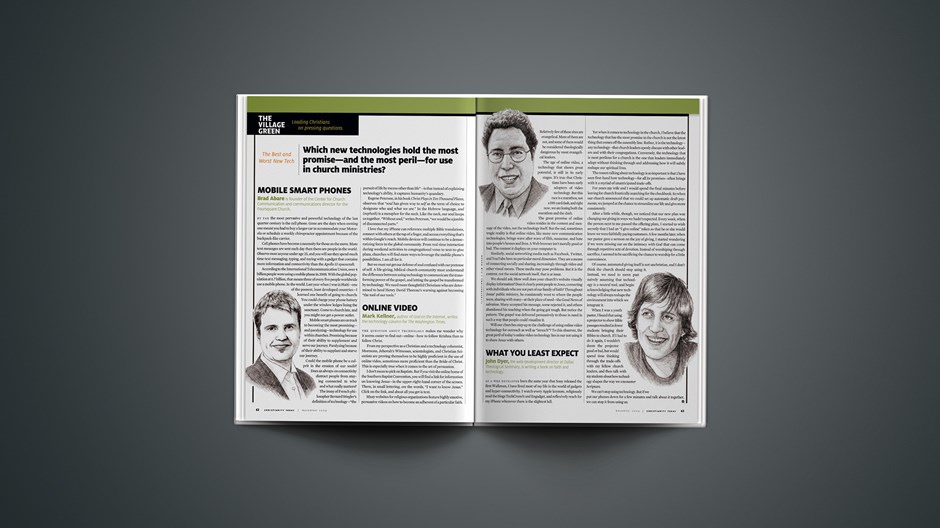
Which new technologies hold the most promise—and the most peril—for use in church ministries? Brad Abare, founder of the Center for Church Communication, Mark Keller, author of God on the Internet, and John Dyer, web development director at Dallas Theological Seminary, suggest the best and worst new tech.
Mobile Smart Phones
Phones are on track to becoming the most promising—and paralyzing—technology.
Brad Abare, founder of the Center for Church Communication
By far the most pervasive and powerful technology of the last quarter century is the cell phone. Gone are the days when owning one meant you had to buy a larger car to accommodate your Motorola or schedule a weekly chiropractor appointment because of the backpack-like carrier.
Cell phones have become a necessity for those on the move. More text messages are sent each day than there are people in the world. Observe most anyone under age 25, and you will see they spend much time text messaging, typing, and toying with a gadget that contains more information and connectivity than the Apollo 13 spacecraft.
According to the International Telecommunication Union, over 4 billion people were using a mobile phone in 2008. With the global population at 6.7 billion, that means three of every five people worldwide use a mobile phone. In the world. Last year when I was in Haiti—one of the poorest, least developed countries—I learned one benefit of going to church: You could charge your phone battery under the window ledges lining the sanctuary. Come to church late, and you might not get a power outlet.
Mobile smart phones are on track to becoming the most promising—and paralyzing—technology for use within churches. Promising because of their ability to supplement and serve our journey. Paralyzing because of their ability to supplant and starve our journey.
Could the mobile phone be a culprit in the erosion of our souls? Does an always-on connectivity distract people from staying connected to who and what really matters? The irony of French philosopher Bernard Stiegler's definition of technology—"the pursuit of life by means other than life"—is that instead of explaining technology's ability, it captures humanity's quandary.
Eugene Peterson, in his book Christ Plays in Ten Thousand Places, observes that "soul has given way to self as the term of choice to designate who and what we are." In the Hebrew language, soul (nephesh) is a metaphor for the neck. Like the neck, our soul keeps us together. "Without soul," writes Peterson, "we would be a jumble of disconnected parts."
I love that my iPhone can reference multiple Bible translations, connect with others at the tap of a finger, and access everything that's within Google's reach. Mobile devices will continue to be a democratizing force in the global community. From real-time interaction during weekend activities to congregational votes to text-to-give plans, churches will find more ways to leverage the mobile phone's possibilities. I am all for it.
But we must not get our defense of soul confused with our pretense of self. A life-giving, biblical church community must understand the difference between using technology to communicate the transforming power of the gospel, and letting the gospel be transformed by technology. We need more thoughtful Christians who are determined to heed Henry David Thoreau's warning against becoming "the tool of our tools."
Online Video
The gospel was delivered in a way that people could visualize it.
Mark Kellner, author of God on the Internet
The question about technology makes me wonder why it seems easier to find out—online—how to follow Krishna than to follow Christ.
From my perspective as a Christian and a technology columnist, Mormons, Jehovah's Witnesses, scientologists, and Christian Scientists are proving themselves to be highly proficient in the use of online video, sometimes more proficient than the Bride of Christ. This is especially true when it comes to the art of persuasion.
I don't mean to pick on Baptists. But if you visit the online home of the Southern Baptist Convention, you will find a link for information on knowing Jesus—in the upper-right-hand corner of the screen. There, in small lettering, are the words, "I want to know Jesus." Click on the link, and about all you get is text.
Many websites for religious organizations feature highly emotive, persuasive videos on how to become an adherent of a particular faith. Relatively few of these sites are evangelical. More of them are not, and some of them would be considered theologically dangerous by most evangelical leaders.
The age of online video, a technology that shows great potential, is still in its early stages. It's true that Christians have been early adopters of video technology. But this race is a marathon, not a 100-yard dash, and right now, we are losing both the marathon and the dash.
The great promise of online video resides in the content and message of the video, not the technology itself. But the sad, sometimes tragic reality is that online video, like many new communication technologies, brings wave after wave of filth, nonsense, and hate into people's homes and lives. A Web browser isn't morally good or bad. The content it displays on your computer is.
Article continues below
Similarly, social networking media such as Facebook, Twitter, and YouTube have no particular moral dimension. They are a means of connecting socially and sharing, increasingly through video and other visual means. These media may pose problems. But it is the content, not the social network itself, that is at issue.
We should ask: How well does your church's website visually display information? Does it clearly point people to Jesus, connecting with individuals who are not part of our family of faith? Throughout Jesus' public ministry, he consistently went to where the people were, sharing with many—at their place of need—the Good News of salvation. Many accepted his message, some rejected it, and others abandoned his teaching when the going got tough. But notice the pattern: The gospel was delivered persuasively to those in need in such a way that people could visualize it.
Will our churches step up to the challenge of using online video technology for outreach as well as "inreach"? To this observer, the great peril of today's online video technology lies in our not using it to share Jesus with others.
What You Least Expect
Technology often brings a myriad of trade-offs.
John Dyer, web development director at Dallas Theological Seminary
As a web developer born the same year that Sony released the first Walkman, I have lived most of my life in the world of gadgets and hyper-connectivity. I watch every Apple keynote, religiously read the blogs TechCrunch and Engadget, and reflexively reach for my iPhone whenever there is the slightest lull.
Yet when it comes to technology in the church, I believe that the technology that has the most promise in the church is not the latest thing that comes off the assembly line. Rather, it is the technology—any technology—that church leaders openly discuss with other leaders and with their congregations. Conversely, the technology that is most perilous for a church is the one that leaders immediately adopt without thinking through and addressing how it will subtly reshape our spiritual lives.
The reason talking about technology is so important is that I have seen first-hand how technology—for all its promises—often brings with it a myriad of unanticipated trade-offs.
Article continues below
For years my wife and I would spend the final minutes before leaving for church frantically searching for the checkbook. So when our church announced that we could set up automatic draft payments, we jumped at the chance to streamline our life and give more consistently.
After a little while, though, we noticed that our new plan was changing our giving in ways we hadn't expected. Every week, when the person next to me passed the offering plate, I started to wish secretly that I had an "I give online" token so that he or she would know we were faithfully paying customers. A few months later, when our pastor gave a sermon on the joy of giving, I started wondering if we were missing out on the intimacy with God that can come through repetitive acts of devotion. Instead of worshiping through sacrifice, I seemed to be sacrificing the chance to worship for a little convenience.
Of course, automated giving itself is not unchristian, and I don't think the church should stop using it. Instead, we need to move past naively assuming that technology is a neutral tool, and begin acknowledging that new technology will always reshape the environment into which we integrate it.
When I was a youth pastor, I found that using a projector to show Bible passages resulted in fewer students bringing their Bibles to church. If I had to do it again, I wouldn't deem the projector good or bad, but would spend time thinking through the trade-offs with my fellow church leaders, and then talk with my students about how technology shapes the way we encounter Scripture.
We can't stop using technology. But if we put our phones down for a few minutes and talk about it together, we can stop it from using us.
Brad Abare is founder of the Center for Church Communication and communications director for the Foursquare Church. Mark Kellner is author of God on the Internet and writes the technology column for The Washington Times. John Dyer is the web development director at Dallas Theological Seminary and is writing a book on faith and technology.
Previous articles on how churches use technology include:
The Art of Cyber Church | Joel Hunter is known by many as part of President Obama's inner circle of pastors. Fewer know him as one of America's most innovative church planters. (September 16, 2009)















 While we pray for peace, we need moral clarity about this war.
 A Christian reconciliation group in Israel and Palestine warned that war would come. Now the war threatens their relevance.españolالعربيةFrançaisрусскийУкраїнська
 The plan would organize UMC churches in four global regions, with each given more leeway around same-sex marriage and other theological issues.






