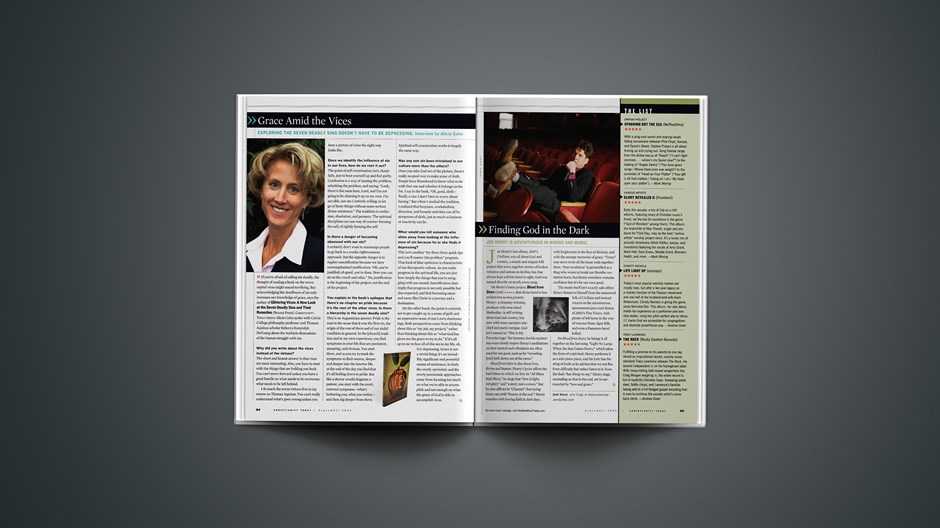
if you're afraid of calling sin deadly, the thought of reading a book on the seven capital vices might sound terrifying. But acknowledging the deadliness of sin only increases our knowledge of grace, says the author of Glittering Vices: A New Look at the Seven Deadly Sins and Their Remedies (Brazos Press). Christianity Today intern Alicia Cohn spoke with Calvin College philosophy professor and Thomas Aquinas scholar Rebecca Konyndyk DeYoung about the multiple dimensions of the human struggle with sin.
Why did you write about the vices instead of the virtues?
The short and honest answer is that vices are more interesting. Also, you have to start with the things that are holding you back. You can't move forward unless you have a good handle on what needs to be overcome, what needs to be left behind.
I do teach the seven virtues first in my course on Thomas Aquinas. You can't really understand what's gone wrong unless you have a picture of what the right way looks like.
Once we identify the influence of sin in our lives, how do we root it out?
The point of self-examination isn't, thankfully, just to beat yourself up and feel guilty. Confession is a way of naming the problem, admitting the problem, and saying, "Look, there's this mess here, Lord, and I'm not going to be cleaning it up on my own. I'm not able, nor am I entirely willing, to let go of these things without some serious divine assistance." The tradition is confession, absolution, and penance. The spiritual disciplines are one way of counter-forming the self, of rightly forming the self.
Is there a danger of becoming obsessed with our sin?
I certainly don't want to encourage people to go back to a works-righteousness approach. But the opposite danger is to neglect sanctification because we have overemphasized justification: "Oh, you're justified; oh good, you're done. Now you can sit on the couch and relax." No, justification is the beginning of the project, not the end of the project.
You explain in the book's epilogue that there's no chapter on pride because it's the root of the other vices. Is there a hierarchy in the seven deadly sins?
This is an Augustinian answer: Pride is the root in the sense that it was the first sin, the origin of the rest of them and of our sinful condition in general. In the [church] tradition and in my own experience, you find symptoms in your life that are persistent, annoying, and obvious. You start there, and as you try to track the symptoms to their source, deeper and deeper into the interior life, at the end of the day you find that it's all boiling down to pride. But like a doctor would diagnose a patient, you start with the overt, external symptoms—what's bothering you, what you notice—and then dig deeper from there. Spiritual self-examination works in largely the same way.
Has any one sin been trivialized in our culture more than the others?
Once you take God out of the picture, there's really no good way to make sense of sloth. People have floundered to know what to do with that one and whether it belongs on the list. I say in the book, "Oh, good, sloth—finally a vice I don't have to worry about having." But when I studied the tradition, I realized that busyness, workaholism, diversion, and frenetic activities can all be symptoms of sloth, just as much as laziness or inactivity can be.
What would you tell someone who shies away from looking at the influence of sin because he or she finds it depressing?
This isn't another "try these three quick tips and you'll master this problem" program. That kind of false optimism is characteristic of our therapeutic culture. As you make progress in the spiritual life, you see just how deeply the things that you're struggling with are rooted. Sanctification does imply that progress is not only possible but also expected, and that becoming more and more like Christ is a journey and a destination.
On the other hand, the point is certainly not to get caught up in a sense of guilt and an oppressive sense of one's own shortcomings. Both perspectives come from thinking about this as "my job, my project," rather than thinking about this as "what God has given me the grace to try to do." If it's all up to me to face all of this sin in my life, oh, it is depressing. Grace is not a trivial thing; it's an incredibly significant and powerful means of assistance. So both the overly optimistic and the overly pessimistic approaches come from focusing too much on what we're able to accomplish and not enough on what the grace of God is able to accomplish in us.
Abram Van Engen looked at Oxford University Press' Seven Deadly Sins book series for Christianity Today. Stephen Prothero read the series for Books & Culture.


















 While we pray for peace, we need moral clarity about this war.
 A Christian reconciliation group in Israel and Palestine warned that war would come. Now the war threatens their relevance.españolالعربيةFrançaisрусскийУкраїнська
 The rage of the mob is a poor substitute for real community.






