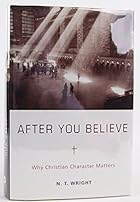
After You Believe: The Forgotten Role of Virtue in the Christian Life
Author
Zondervan
Publisher
HarperOne
Release Date
March 2, 2010
Pages
304
Price
30.17
Against the backdrop of the recent economic crisis, N.T. Wright, Anglican Bishop of Durham, opens with a persuasive call to recover character. Many Christians focus on "getting saved," but what about the rest of the Christian life? Often we get stuck between two extremes: an antinomian ("against law") spontaneity, and a rule-focused legalism. Instead, argues Wright in After You Believe: Why Christian Character Matters (HarperOne), we need to develop virtuous character.
At first, the author's prescription sounds like a popular version of Aristotle's ethics: Virtue is formed by self-consciously adopting new habits, countless daily decisions, with the goal of becoming a just person. Do the right thing (which feels odd at first, not spontaneous) long enough, and it becomes second nature. The main means of attaining this virtue is "following Jesus."
By the second chapter, however, Wright begins to show how the valid concerns of pagan wisdom are taken up by the New Testament writers (especially Paul) and, in the process, are transformed by the gospel. We do not live toward the human-centered goal of virtue formation for the sake of happiness or even "human flourishing," but ultimately as priests and rulers who anticipate the restoration of the whole cosmos. "[W]e urgently need to recapture the New Testament's vision of a genuinely 'good' human life as a life of character formed by God's promised future, as a life with that future-shaped character lived within the ongoing story of God's people, and, with that, a freshly worked notion of virtue." And "you don't get that character just by trying. You get it by following Jesus."
Wright points out the tendency of Christians to assume the wider culture's romantic, existential, and therapeutic view of the self. Essentially Gnostic, this view assumes that Jesus came to put us in touch with our inner selves, the divine spark that just does what comes naturally to it: "you have to be true to yourself." Moral action is therefore all about being "authentic," "spontaneous," and "free," without any connection to habits, rituals, external authorities, and, especially, rules. We see this in the free-for-all approach to worship today. "All of this life of worship is something to be learned," says Wright, and it has to be learned together. It's "a team sport."
Crucial to character formation, Wright argues, is mind renewal. Prizing "spontaneity," the "low-grade romanticism" that many Christians have adopted from the culture has colluded "with an anti-intellectual streak in our culture, generating the assumption that the more spiritual you are, the less you need to think." In contrast to both rule following and spontaneity, growing up into Christ is hard work, not least of all hard thinking.
There is some tension between Wright's emphasis on character formation by following Jesus' example and his later insistence that "holding up Jesus as an example of how to live a moral life seems rather like holding up Tiger Woods as an example of how to hit a golf ball." In fact, "Jesus as 'moral example' is a domesticated Jesus, a kind of religious mascot …. If all we need is a good example, we can't be in quite such a bad state as some people (including Jesus himself) have suggested."
He continues: "He doesn't go about saying, 'This is how it's done; copy me.' He says, 'God's kingdom is coming; take up your cross and follow me.'" We do encounter Jesus' humility and other virtues. "But these are not 'examples of how to do it.' They are indications that a new way of being human has been launched upon the world."
Ruffled by the Reformation
In spite of a few quibbles, I was impressed by this book's popular presentation of themes that I have come to appreciate in Reformed theology. The eschatological emphasis on cosmic renewal (resurrection, not escape) as the impetus for our lives here and now, the emphasis on the church—in fact, just about everything in After You Believe was a fresh way of exploring many familiar truths.
Hence my surprise at the jarring, frequent caricatures of the Reformation, even when the author articulates long-standing emphases in that tradition. As in his other works, indictments of the Reformation rarely come with footnotes. Wright seems to read the Reformers through the distorted lens of liberal existentialists (Rudolf Bultmann and company) or evangelical pietism. Oddly, he blames the Reformation for the romantic, spontaneous, and existentialist view of the Christian life.
In spite of the rich and varied discussions of virtue by the Reformers, the Puritans, and a host of Protestants since, Wright asserts, "Basically, the whole idea of virtue has been radically out of fashion in much of Western Christianity ever since the sixteenth-century Reformation." Since we are justified through faith apart from works, "why bother with all this morality? … That, in fact, is more or less what Martin Luther declared, thumbing his nose at the long medieval tradition of virtue." A footnote to Shakespeare's Hamlet is brought in as a witness, but there is no footnote for Luther's alleged proposal.
Article continues below
Grace not only justifies but also renews and transforms, Wright properly insists—apparently unaware that Luther argued precisely the same point, and repeatedly. Undaunted, Wright repeats the charge as if it had been demonstrated with actual evidence: "As we saw earlier, Martin Luther, writing nearly five centuries ago, reckoned that all 'virtue' was really 'hypocrisy.'" And this: "The normal Protestant objection to virtue, as we've seen, is that it's just hypocrisy," that "moral effort is a sign that you're still on the wrong track. All you have to do is to go with the flow of the Spirit!"
Yet the "let go and let God" view of sanctification Wright challenges is the approach that Reformed writers like J.I. Packer (Keep in Step with the Spirit) identify as a more Wesleyan-oriented, Keswick movement emphasis. In any case, the view that Wright attributes to the Reformation, and especially to Luther, was actually excoriated by the Reformers as antinomian "enthusiasm." It's true enough that Lutheran views of sanctification seem more passive than Reformed approaches, but in addition to caricaturing Luther's positions, the criticisms lack any nuance in distinguishing between Reformation traditions.
Wright says the goal of sanctification is "to grow in looking away from oneself and toward God on the one hand and one's neighbors on the other." This is nearly a verbatim formula from Luther. So is this one: "The Christianly virtuous person is not thinking about his or her own moral performance. He or she is thinking of Jesus Christ, and of how best to love the person next door." He complains that the Westminster Shorter Catechism's first question and answer is inadequate when it says that our chief end is "to glorify God and to enjoy him forever." Yet he goes on to flesh out what is essentially the same point. The author emphasizes the Christian pilgrimage as a theology of the Cross, suffering with Christ in the hope of the Resurrection, without recognizing that this too was a major theme in Luther's and Calvin's works.
While there are many good biblical-theological studies that make the same points, Wright—ever the master of metaphor and turns of phrase—is especially effective in communicating the richness of the Bible's eschatological horizon to a wide audience. Nevertheless, his imprecision about the views that he targets for criticism is careless, depriving him—and his readers—of resources and allies for a message that is on so many points a vital and necessary corrective.
Article continues below
Michael Horton is J. Gresham Machen Professor of Systematic Theology and Apologetics at Westminster Seminary in Escondido, California, and author of The Gospel-Driven Life (Baker).
The Making of the Christian | Richard J. Foster and Dallas Willard on the difference between discipleship and spiritual formation. (September 16, 2005)
Three Temptations of Spiritual Formation | "When seeking to be shaped by Christ, It is all too easy to veer from a fully Christian approach." (December 9, 2002)
Have something to add about this? See something we missed? Share your feedback here.
Our Rating
Book Title
After You Believe: The Forgotten Role of Virtue in the Christian Life

















 While we pray for peace, we need moral clarity about this war.
 A Christian reconciliation group in Israel and Palestine warned that war would come. Now the war threatens their relevance.españolالعربيةFrançaisрусскийУкраїнська
 The rage of the mob is a poor substitute for real community.






