
During the past year, The Obama administration has been subjected to strenuous criticism for its perceived hostility, or at best cavalier indifference, to the cause of religious freedom in the United States.
First there was the Supreme Court’s decision in the Hosanna-Tabor case. The Obama administration’s lawyers sought to deny church-run schools a longstanding exemption from antidiscrimination laws, meant to safeguard religious schools’ freedom to hire and fire employees according to their own faith-based criteria. The Court delivered a stinging and unanimous rebuke, reaffirming the exemption.
Then, more famously, came the still-simmering case of the Department of Health and Human Services (HHS) mandate requiring all employers, including church-run schools, hospitals, and charities, to provide their employees with health-insurance plans covering contraceptives, abortifacients, and sterilization procedures.
What is so special about religion, that it should receive any ‘special privileges’? Why should we regard a church or other religious association diff erently than we regard any other social club or cultural organization?
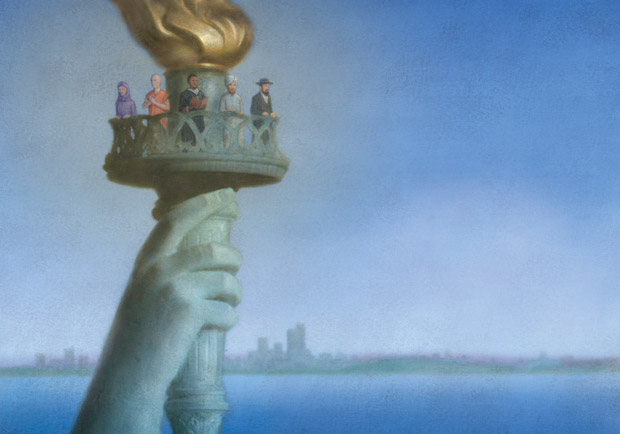
Religious leaders quickly realized that this requirement would necessitate the violation of core moral teachings, particularly for the Roman Catholic Church. Opposition was swift and unequivocal, taking the form of a remarkably ecumenical coalition. The often fractious Catholic bishops achieved an unprecedented degree of unity. They were joined soon enough by a broad array of evangelical leaders, such as the president of Wheaton College, as well as eminent figures from across the full spectrum of American religious communities: Jews, Muslims, Mormons, Sikhs, and so on. Everywhere the rallying cry was directed, not to the support of specific Catholic doctrines, but to the general defense of religious freedom.
Secular supporters of the administration seemed both annoyed and mystified by the protests. How, wondered Ed Kilgore, writing in Washington Monthly, did “religious freedom” ever come to mean “the right to have one’s particular religious views explicitly reflected in public policy”? What gives Catholic bishops the right to “contend they should be able to operate a wide range of quasi-public services and also enjoy the use of public subsidies, while refusing to comply with laws and regulations that contradict their religious or moral teachings”? Were they not in fact seeking “a broad zone of immunity from laws they choose to regard as offensive”? Were they not seeking “special privileges”?
Notwithstanding the combative tone, these are important questions, which deserve a thoughtful and respectful response. Religious believers need to prepare themselves to hear such questions asked again and again in the years to come, and contemplate how they will answer them. For beneath the controversy about religious liberty is a deeper controversy about the nature and status of religion itself in the American legal and political order.
That controversy is nothing new, of course. It runs through much of American history, taking on different guises and embracing different antagonists and issues at different times. But it has achieved a unique importance and potency at this historical moment, when we are more intent than ever upon upholding the principle of neutrality in all things. What is so special about religion, that it should receive any “special privileges”? Why should we regard a church or other religious association differently than we regard any other social club or cultural organization? Why treat the rights and expressive liberties of religious adherents any differently than we would treat those of other individuals?
Such questions are a fairly recent development in our history, and perhaps a sign of the growing secularity of so much of our public life. But there is no denying the fact that, in some sense, religion and religious institutions are not treated according to a principle of strict neutrality. To be sure, the recognition and support of “religion” is something dramatically different from the establishment of any particular religion, an important distinction that the First Amendment sought to codify. The fact remains, though, that something like a generic monotheism enjoys a privileged public status in present-day America.
Examples abound. One still encounters the name of God on American currency, in the Pledge of Allegiance, in the oaths we take in court, and in the concluding words of presidential speeches. Chaplains are still employed by the armed services and Congress, and the latter still duly commences its sessions with prayer. The tax exemption of religious institutions remains intact and seemingly impregnable. We hold our most solemn observances, such as the National Day of Prayer and Remembrance in the wake of 9/11, in the Washington National Cathedral, and they draw heavily on the liturgical and musical heritage of Western Christianity.
One could compose a long list of similar examples. We are a long way from being officially secular, even if we may be tending in that direction. And however much we accept, or claim to accept, a principle of church-state separation, it’s better to candidly admit that the two realms are, for better or worse, highly resistant to complete separation.
No Place to Hide
Secular critics worry that privileging religion in any way flies in the face of church-state separation and represents an illegitimate coercion of conscience. Some religious believers see merit in these contentions, particularly the second, in a country where freedom of the individual is so often taken to be the very sum and essence of religious freedom.
And indeed, there are respectable religious arguments against religion being granted a privileged status. Some of them recall the views of Roger Williams, the great American dissenter. One of the central arguments against established religion is that it inevitably leads, in the long run, to superficiality, faithlessness, coercion, atrophy, and spiritual death. In other words, the establishment of religion is bad for religion. When one looks at the sad and irrelevant state of the empty established churches of Europe today, one sees the power of the argument. The bride of Christ has all too often ended up a kept woman.
By contrast, Alexis de Tocqueville was able to see as early as the 1830s that the American style of religious freedom, far from diminishing the hold of religion, kept it vital and energetic, precisely by making it voluntary. Indeed, many Christians, particularly those drawing on the Anabaptist tradition, would contend that churches are better off cut loose from entanglement in the polity and its civil religion, and freed to be more radical, sacrificial, and faithful.
But the HHS mandate shows the limits of this approach. With an act of comprehensive public policy, designed to be universal in character, one does not have the option of declaring one’s independence. There is nowhere to go and no place to hide. This shows why the common mischaracterization of the Catholic bishops’ grievance is so wrongheaded. They are not, in fact, seeking to use public policy to bar Americans, or even Catholics, from using and paying for contraceptives. Instead, they are merely opposing the use of government’s coercive power to compel Catholic organizations to subsidize a practice about which they have grave moral objections. But it was apparently impermissible to grant even such a seemingly small accommodation to the long-settled and fundamental religious identity of the Catholic Church—an organization that, ironically, has a long and consistent record in support of universal health care.
The bishops are not insisting that their religious views should dominate public policy. They are, however, insisting upon being dealt with separately, with respect shown for their particular commitments. They are presuming that religious freedom transcends mere do-what-you-want neutrality—that it entails a kind of deference paid to religion per se. And that is precisely the point at issue. What’s so special about religion, that it should be granted such deferential attention? Many people deem religion’s “special privileges” needless, embarrassing, or downright illegitimate. Can we offer them any arguments they’ll find compelling, or at least persuade them to see things in a different light?
To the skeptics, let me offer five such arguments in what follows. These surely do not exhaust all the possibilities. But they begin to explain why discussion about religious freedom needs to move beyond the sterile logic of abstract neutrality.
1. Our Tradition
First, there is an argument based on America’s historical and constitutional roots: Our founding tradition links religion, and the active encouragement of religious belief, to the success of the American experiment. The Founders had diverse views about a variety of matters, very much including their own personal religious convictions, but they were in complete and emphatic agreement about the inescapable importance of religion.
Examples are plentiful. John Adams insisted that “[m]an is constitutionally, essentially and unchangeably a religious animal. Neither philosophers or politicians can ever govern him any other way.” And the universally respected George Washington was particularly eloquent in explaining that religion was essential to the maintenance of public morality, without which a republican government could not survive. The familiar words of his Farewell Address in 1796—”Of all the dispositions and habits which lead to political prosperity, Religion and morality are indispensable supports”—could have been endorsed by countless others, like Adams, Benjamin Rush, and John Jay.
This high regard for religion clearly extended to institutions as well as individual beliefs. “If I could have entertained the slightest apprehension,” remarked Washington in 1789, “that the Constitution framed in the Convention, where I had the honor to preside, might possibly endanger the religious rights of any ecclesiastical society, certainly I would never have placed my signature to it.”
2. American Pluralism
Very well, you may respond, but that was then and this is now. Why should we feel bound by the Founders’ beliefs or their 18th-century mentalities? None of the Founders could possibly have envisioned the diversity of America in the 21st century. Their vision assumed a degree of cultural uniformity beyond our power to restore, even if we wanted to.
True enough. But the very fact of that diversity itself leads to a second argument for deference to religion, an argument rooted in American pluralism: The free flourishing of diverse religious identities provides a powerful source of moral order and social cohesion.
There is a reason why histories of American immigration and histories of American religion so often end up covering the very same territory. From the mid-19th century on, every new wave of immigration to America brought peoples for whom a set of distinct religious beliefs and practices formed the core of their identity. Some of the worst examples of religious prejudice in our nation’s history come out of the cultural clashes and anxieties of these years, but so too did the idea of pluralism as a central feature of American life. As Richard John Neuhaus and Peter Berger came to formulate it, “This nation is constituted as an exercise in pluralism, as the unum within which myriad plures are sustained.”
We can cheer the persistence of regional, religious, ethnic, and other differences, so long as they are not patently unjust in character. A society flourishes best when the moral communities within which consciences are formed—churches, synagogues, mosques, and the like—remain healthy. In America, the national purpose rightly understood ought not to undermine such particular affinities or purposes, but to strengthen them.
Hence it is essential that religious freedom be understood not only as an individual liberty, but also as a corporate liberty, a liberty that applies to and inheres in groups, and defends the integrity and self-governance of such groups. How could it be otherwise? After all, religion, like language, is an inherently social thing, quintessentially an activity of groups rather than the property of isolated individuals. Religious freedom must be understood in this dual aspect, protecting not only the liberty of individuals, but also the liberty of churches and other religious institutions and communities; protecting their freedom to define what they are and what they are not, to control the meaning and terms of their membership, to freely exercise their faith in the way they choose to raise their children and order their community life.
There are, of course, limits to this autonomy, as there must be to all liberties. Religious liberty is not an all-purpose get-out-of-jail card. Nor can its limits be defined once and for all by invoking some pristine abstract principle. But its essential place in the healthy life of our pluralistic society should guarantee it a high degree of respect. Government should not, therefore, burden religious free exercise without an overwhelmingly compelling justification. Congress and the federal courts have generally affirmed this principle.
3. Human Nature
A third argument for religion’s special place is anthropological: Human beings are naturally inclined toward religion. We are driven to relate our understanding of the highest things to our lives lived in community with others. Whether our “theotropic” impulses derive from in-built endowment, evolutionary adaptation, or some other source, the secular order ought not to inhibit their expression.
If believers sense a general willingness to acknowledge their legitimate role in public life, they will likely feel a stronger and deeper loyalty to the American experiment. But if they encounter instead a rigid insistence upon a rigorously secularist public square, the result could very well alienate religious subcultures, whose sectarian disaffection could become so profound as to threaten the very cohesion of the nation. Secularists who worry about religion taking an outsized role in public life would be better advised to give a little strategic ground on that issue, and acknowledge the spiritual dimension in our makeup, even if they think it an all-too-human shortcoming.
Acknowledging our natural religious tendencies has an added social benefit: it gives room for the development of a healthy civil religion. We have an incorrigible need to relate secular things to ultimate purposes. Civil religion serves this need, promoting political and social cohesion by linking the ongoing life of the nation to a community of memory, and to transcendent moral and spiritual order. Of course, there are better and worse ways of doing this. Civil religion can be extremely dangerous, a form of playing with fire. It borrows from the energy of specific faiths, but always carries the danger of usurping and displacing them, and underwriting a pernicious national idolatry. Believers (and nonbelievers) understandably view it with suspicion, and it needs to be kept on a short leash.
Even a world-class skeptic like Thomas Jeff erson understood that erasing the name of God from the foundations of the American order could lead to fearful consequences.
But properly understood, the American civil religion also draws upon sources of moral authority that transcend the state. As such, it can hold the state accountable to a standard higher than itself. A civil religion can be, as Yale sociologist Philip Gorski recently argued, “a mediating tradition that allows room for both religious and political values.” And the more we accord respect to the activities of specific religions in the public sphere, the less likely it is that an idolatrous civil religion will displace them.
4. Social Benefits
A fourth argument might be called the “meliorist” argument: Religion deserves an exalted place in American life because of the extensive good works religious institutions reliably perform. Consider the vast scope of charitable, medical, and educational activities still undertaken by religious groups today, not least the Catholic Church. It operates nearly 7,500 primary and secondary schools, enrolling 2.5 million students. It runs 5,600 hospitals (composing nearly 13 percent of American hospitals and 15 percent of hospital beds), 400 health centers, and 1,500 specialized homes. All told, the Church’s institutional network encompasses the largest private educational and health-care systems in the country. Catholic Charities USA is the seventh-largest charity in the nation (the second largest being the Salvation Army).
In addition, a growing body of social-science research correlates religious belief very persuasively with the fostering of generosity, law-abidingness, helpfulness to others, civic engagement, social trust, and many other essential traits. High-profile scholars as diverse as Byron Johnson, Arthur Brooks, Jonathan Haidt, and Robert Putnam have testified to these findings. Of course, there will always be hypocrites, charlatans, fakes, and abusers in religious organizations, as in all walks of life. But it would appear that, far from religion being a poison, as the late Christopher Hitchens liked to argue, it has, at least in America, been an antidote. It seems both inaccurate and counterproductive to disparage or downplay its many benefits.
5. Ultimate Meaning
Last but not least, there is the “metaphysical” argument: Religion should have a high place in public life because religion is humanity’s single most important body of reflection regarding the ultimate meaning of the universe and the proper conduct of human life. It is often said that religious freedom is the “first freedom,” since it provides the grounding for all our other rights, and empowers us to seek and embrace the truth about our existence, and to live our lives in accordance with that understanding. This is, or should be, a universal freedom, because the great questions of human existence are not the exclusive province of professors and savants. They belong to us all. Seeking to answer them in fidelity to our hearts and consciences is one of the noblest of all human activities. Any good society, committed to the flourishing of its members, should recognize and encourage that search. To publicly recognize the valuable place of religion is to declare, emphatically, that society values this search, and values the spiritual and moral aspirations of its members. And it inscribes at the core of our public lives a profound sense of mystery, a humbling acknowledgment of those things we cannot know.
But there is even more to the metaphysical argument. Indeed, there is a growing recognition that religion serves as an indispensible bulwark for human dignity. In our postmodern world, immense bureaucratic governments and sprawling global corporations, answerable neither to democratic restraints nor any well-established code of behavior, threaten to devour both liberty and dignity. When these behemoths operate in tandem, as increasingly seems the case, they can dissolve the delicate fabric of personal freedoms and ennobling obligations of which honorable lives and humane societies are made. In an era dominated by such massive, impersonal, brutishly powerful forces, religion forms an increasingly vital counterweight. It is, more than ever, an essential resource for upholding human dignity and moral order, for speaking truth to power, for giving support to the concept of human rights, and for insisting upon the infinite value of the individual person. It lends a voice of moral urgency—whether celebrating, exhorting, or rebuking—to the otherwise cold logic of instrumental rationality. We would be foolish to discard or marginalize it.
Religion has often played this countervailing role, and has done so heroically. Evangelical religious conviction provided the animating force behind what was arguably the greatest reform movement in American history: the 19th-century movement to abolish slavery. The moral leadership of Pope John Paul II played a key role in bringing about the end of communist tyranny in Eastern Europe. We will need religion to play a similar role in the years to come. As the sociologist José Casanova eloquently argued in his 1994 book Public Religions in the Modern World, the modern world runs the risk of being “devoured by the inflexible, inhuman logic of its own creations” unless it restores a “creative dialogue” with the very religious traditions it has eviscerated or abandoned. Religion can help save and preserve a precious space within which the dignity of the individual can still stand and the splendid mystery of our freedom can still flourish. But that dialogue will not be fruitful unless we sustain and protect the special public standing that religion has hitherto enjoyed.
Can the West Survive Without Religion?
There is, however, an even deeper question. Can our freedom itself, and more generally the rights-based liberalism we have come to embrace in the modern West, survive without the Judeo-Christian religious assumptions that have hitherto accompanied and upheld it? Though himself an atheist, the Italian writer Marcello Pera has argued that it cannot—that it is impossible to uproot such ideas as human dignity from the Christian intellectual soil in which, historically, they were nourished. It’s a dangerous illusion, he says, to imagine that modern liberal values can be sustained apart from religious presuppositions about the nature and destiny of man. Ironically, the very possibility of a “secular” realm of politics—which we embrace in the West as both inherently good and a necessary precondition of religious freedom—may depend upon the presence of certain distinctively Christian beliefs, embodied in culture as much as in doctrine.
Thoughtful secularists ought to find this assertion at least plausible. Indeed, Pera’s concerns had been precisely anticipated by one of the most religiously heterodox figures of early American history, Thomas Jefferson. On one of the panels decorating the walls of the Jefferson Memorial in Washington, D.C., appear these searing words: “God who gave us life gave us liberty. Can the liberties of a nation be secure when we have removed a conviction that these liberties are the gift of God? Indeed I tremble for my country when I reflect that God is just, that his justice cannot sleep forever.”
Jefferson was speaking in this passage of the moral scourge of slavery, and asking, rhetorically, whether there could be any moral justification for failing to extend the blessings of liberty to all people. But there was a larger implicit point: Jefferson was saying that the very possibility of liberty itself, the liberty of every man and woman, depends upon our prior willingness to understand liberty as a gift of God rather than a dispensation of man. In this context, the name of God serves as far more than a mere rhetorical device. Even a world-class skeptic like Jefferson understood that erasing the name of God from the foundations of the American order could lead to fearful consequences. Which provides yet another reason why upholding the special status of religion is not merely reasonable and defensible, but of fundamental importance.
Wilfred McClay holds the SunTrust Bank Chair of Excellence in Humanities at the University of Tennessee at Chattanooga.