





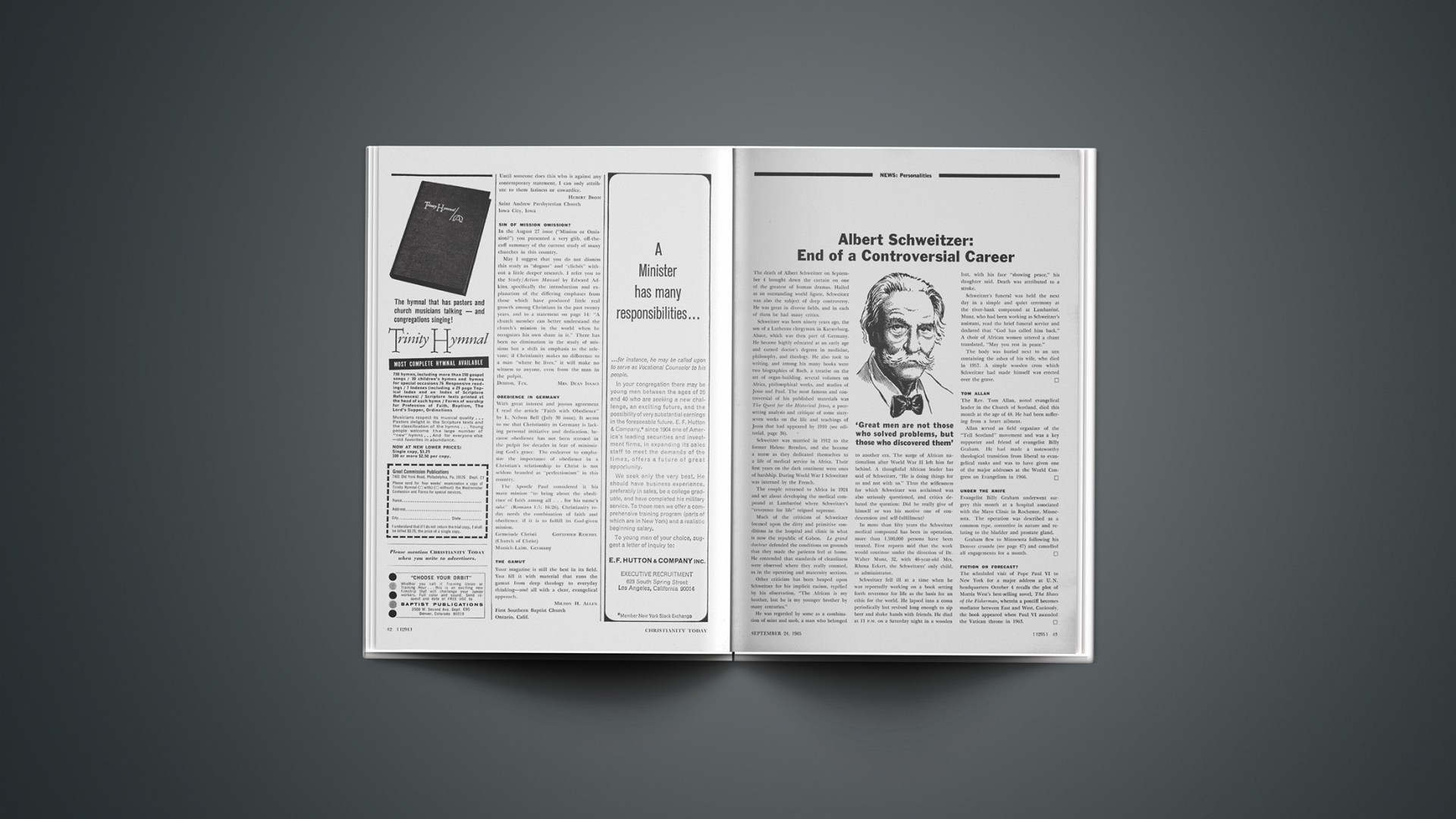

The death of Albert Schweitzer on September 4 brought down the curtain on one of the greatest of human dramas. Hailed as an outstanding world figure, Schweitzer was also the subject of deep controversy. He was great in diverse fields, and in each of them he had many critics.
Schweitzer was born ninety years ago, the son of a Lutheran clergyman in Kayserburg, Alsace, which was then part of Germany. He became highly educated at an early age and earned doctor’s degrees in medicine, philosophy, and theology. He also took to writing, and among his many books were two biographies of Bach, a treatise on the art of organ-building, several volumes on Africa, philosophical works, and studies of Jesus and Paul. The most famous and controversial of his published materials was The Quest for the Historical Jesus, a pacesetting analysis and critique of some sixty-seven works on the life and teachings of Jesus that had appeared by 1910 (see editorial, page 36).
Schweitzer was married in 1912 to the former Helene Bresslau, and she became a nurse as they dedicated themselves to a life of medical service in Africa. Their first years on the dark continent were ones of hardship. During World War I Schweitzer was interned by the French.
The couple returned to Africa in 1924 and set about developing the medical compound at Lambaréné where Schweitzer’s “reverence for life” reigned supreme.
Much of the criticism of Schweitzer focused upon the dirty and primitive conditions in the hospital and clinic in what is now the republic of Gabon. Le grand docteur defended the conditions on grounds that they made the patients feel at home. He contended that standards of cleanliness were observed where they really counted, as in the operating and maternity sections.
Other criticism has been heaped upon Schweitzer for his implicit racism, typified by his observation, “The African is my brother, but he is my younger brother by many centuries.”
He was regarded by some as a combination of saint and snob, a man who belonged to another era. The surge of African nationalism after World War II left him far behind. A thoughtful African leader has said of Schweitzer, “He is doing things for us and not with us.” Thus the selflessness for which Schweitzer was acclaimed was also seriously questioned, and critics debated the question: Did he really give of himself or was his motive one of condescension and self-fulfillment?
In more than fifty years the Schweitzer medical compound has been in operation, more than 1,500,000 persons have been treated. First reports said that the work would continue under the direction of Dr. Walter Munz, 32, with 46-year-old Mrs. Rhena Eckert, the Schweitzers’ only child, as administrator.
Schweitzer fell ill at a time when he was reportedly working on a book setting forth reverence for life as the basis for an ethic for the world. He lapsed into a coma periodically but revived long enough to sip beer and shake hands with friends. He died at 11 P.M. on a Saturday night in a wooden hut, with his face “showing peace,” his daughter said. Death was attributed to a stroke.
Schweitzer’s funeral was held the next day in a simple and quiet ceremony at the river-bank compound at Lambaréné. Munz, who had been working as Schweitzer’s assistant, read the brief funeral service and declared that “God has called him back.” A choir of African women uttered a chant translated, “May you rest in peace.”
The body was buried next to an urn containing the ashes of his wife, who died in 1957. A simple wooden cross which Schweitzer had made himself was erected over the grave.
Tom Allan
The Rev. Tom Allan, noted evangelical leader in the Church of Scotland, died this month at the age of 48. He had been suffering from a heart ailment.
Allan served as field organizer of the “Tell Scotland” movement and was a key supporter and friend of evangelist Billy Graham. He had made a noteworthy theological transition from liberal to evangelical ranks and was to have given one of the major addresses at the World Congress on Evangelism in 1966.
Under The Knife
Evangelist Billy Graham underwent surgery this month at a hospital associated with the Mayo Clinic in Rochester, Minnesota. The operation was described as a common type, corrective in nature and relating to the bladder and prostate gland.
Graham flew to Minnesota following his Denver crusade (see page 47) and cancelled all engagements for a month.
Fiction Or Forecast?
The scheduled visit of Pope Paul VI to New York for a major address at U. N. headquarters October 4 recalls the plot of Morris West’s best-selling novel, The Shoes of the Fisherman, wherein a pontiff becomes mediator between East and West. Curiously, the book appeared when Paul VI ascended the Vatican throne in 1963.







