





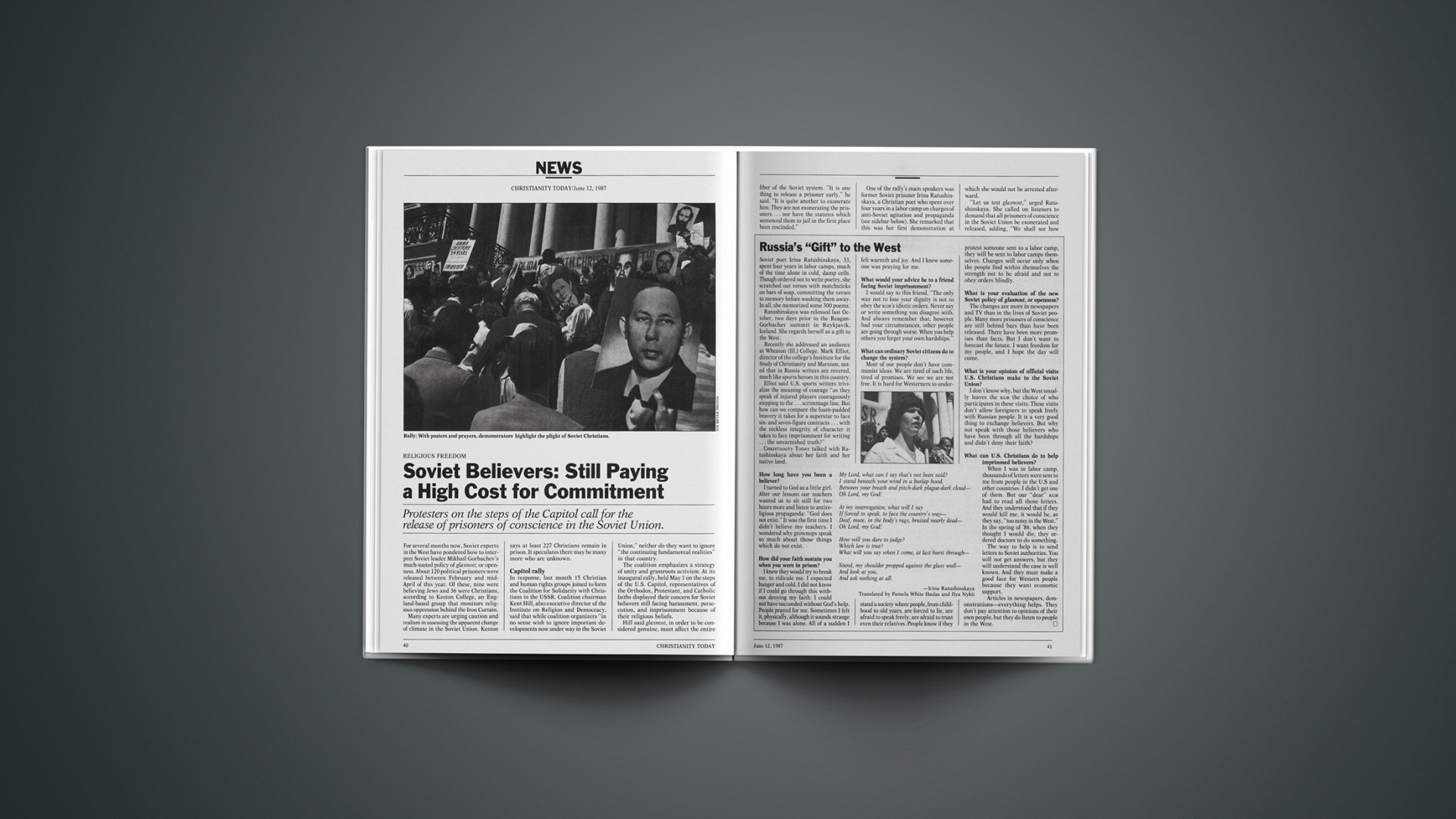

Soviet poet Irina Ratushinskaya, 33, spent four years in labor camps, much of the time alone in cold, damp cells. Though ordered not to write poetry, she scratched out verses with matchsticks on bars of soap, committing the verses to memory before washing them away. In all, she memorized some 300 poems.
Ratushinskaya was released last October, two days prior to the Reagan-Gorbachev summit in Reykjavik, Iceland. She regards herself as a gift to the West.
Recently she addressed an audience at Wheaton (Ill.) College. Mark Elliot, director of the college’s Institute for the Study of Christianity and Marxism, noted that in Russia writers are revered, much like sports heroes in this country.
Elliot said U.S. sports writers trivialize the meaning of courage “as they speak of injured players courageously stepping to the … scrimmage line. But how can we compare the foam-padded bravery it takes for a superstar to face six-and seven-figure contracts … with the reckless integrity of character it takes to face imprisonment for writing … the unvarnished truth?”
CHRISTIANITY TODAY talked with Ratushinskaya about her faith and her native land.
How long have you been a believer?
I turned to God as a little girl. After our lessons our teachers wanted us to sit still for two hours more and listen to antireligious propaganda: “God does not exist.” It was the first time I didn’t believe my teachers. I wondered why grownups speak so much about those things which do not exist.
How did your faith sustain you when you were in prison?
I knew they would try to break me, to ridicule me. I expected hunger and cold. I did not know if I could go through this without denying my faith. I could not have succeeded without God’s help. People prayed for me. Sometimes I felt it, physically, although it sounds strange because I was alone. All of a sudden I felt warmth and joy. And I knew someone was praying for me.
What would your advice be to a friend facing Soviet imprisonment?
I would say to this friend, “The only way not to lose your dignity is not to obey the KGB’s idiotic orders. Never say or write something you disagree with. And always remember that, however bad your circumstances, other people are going through worse. When you help others you forget your own hardships.”
What can ordinary Soviet citizens do to change the system?
Most of our people don’t have communist ideas. We are tired of such life, tired of promises. We see we are not free. It is hard for Westerners to understand a society where people, from childhood to old years, are forced to lie, are afraid to speak freely, are afraid to trust even their relatives. People know if they protest someone sent to a labor camp, they will be sent to labor camps themselves. Changes will occur only when the people find within themselves the strength not to be afraid and not to obey orders blindly.
What is your evaluation of the new Soviet policy of glasnost, or openness?
The changes are more in newspapers and TV than in the lives of Soviet people. Many more prisoners of conscience are still behind bars than have been released. There have been more promises than facts. But I don’t want to forecast the future. I want freedom for my people, and I hope the day will come.
What is your opinion of official visits U.S. Christians make to the Soviet Union?
I don’t know why, but the West usually leaves the KGB the choice of who participates in these visits. These visits don’t allow foreigners to speak freely with Russian people. It is a very good thing to exchange believers. But why not speak with those believers who have been through all the hardships and didn’t deny their faith?
My Lord, what can I say that’s not been said?
I stand beneath your wind in a burlap hood.
Between your breath and pitch-dark plague-dark cloud—
Oh Lord, my God!
At my interrogation, what will I say
If forced to speak, to face the country’s way—
Deaf, mute, in the body’s rags, bruised nearly dead—
Oh Lord, my God!
How will you dare to judge?
Which law is true?
What will you say when I come, at last burst through—
Stand, my shoulder proppedm against the glass wall—
And look at you,
And ask nothing at all.
—Irina Ratushinskaya
Translated by White Hadas and Ilya Nykii







