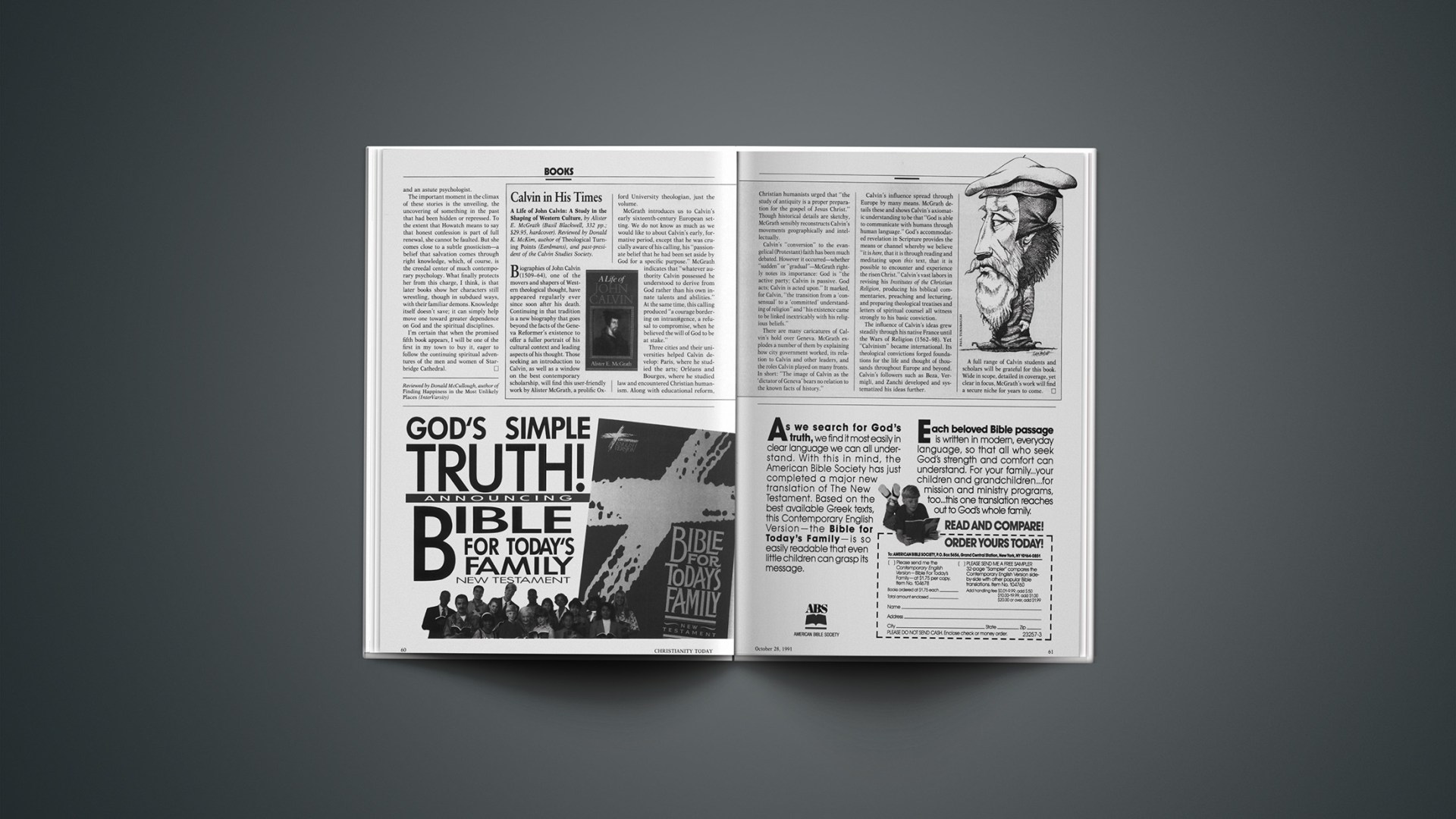

A Life of John Calvin: A Study in the Shaping of Western Culture, by Alister E. McGrath (Basil Blackwell, 332 pp.; $29.95, hardcover). Reviewed by Donald K. McKim, author of Theological Turning Points (Eerdmans), and past-president of the Calvin Studies Society.
Biographies of John Calvin (1509–64), one of the movers and shapers of Western theological thought, have appeared regularly ever since soon after his death. Continuing in that tradition is a new biography that goes beyond the facts of the Geneva Reformer’s existence to offer a fuller portrait of his cultural context and leading aspects of his thought. Those seeking an introduction to Calvin, as well as a window on the best contemporary scholarship, will find this user-friendly work by Alister McGrath, a prolific Oxford University theologian, just the volume.
McGrath introduces us to Calvin’s early sixteenth-century European setting. We do not know as much as we would like to about Calvin’s early, formative period, except that he was crucially aware of his calling, his “passionate belief that he had been set aside by God for a specific purpose.” McGrath indicates that “whatever authority Calvin possessed he understood to derive from God rather than his own innate talents and abilities.” At the same time, this calling produced “a courage bordering on intransigence, a refusal to compromise, when he believed the will of God to be at stake.”
Three cities and their universities helped Calvin develop: Paris, where he studied the arts; Orléans and Bourges, where he studied law and encountered Christian humanism. Along with educational reform, Christian humanists urged that “the study of antiquity is a proper preparation for the gospel of Jesus Christ.” Though historical details are sketchy, McGrath sensibly reconstructs Calvin’s movements geographically and intellectually.
Calvin’s “conversion” to the evangelical (Protestant) faith has been much debated. However it occurred—whether “sudden” or “gradual”—McGrath rightly notes its importance: God is “the active party; Calvin is passive. God acts; Calvin is acted upon.” It marked, for Calvin, “the transition from a ‘consensual’ to a ‘committed’ understanding of religion” and “his existence came to be linked inextricably with his religious beliefs.”
There are many caricatures of Calvin’s hold over Geneva. McGrath explodes a number of them by explaining how city government worked, its relation to Calvin and other leaders, and the roles Calvin played on many fronts. In short: “The image of Calvin as the ‘dictator of Geneva’ bears no relation to the known facts of history.”
Calvin’s influence spread through Europe by many means. McGrath details these and shows Calvin’s axiomatic understanding to be that “God is able to communicate with humans through human language.” God’s accommodated revelation in Scripture provides the means or channel whereby we believe “it is here, that it is through reading and meditating upon this text, that it is possible to encounter and experience the risen Christ.” Calvin’s vast labors in revising his Institutes of the Christian Religion, producing his biblical commentaries, preaching and lecturing, and preparing theological treatises and letters of spiritual counsel all witness strongly to his basic conviction.
The influence of Calvin’s ideas grew steadily through his native France until the Wars of Religion (1562–98). Yet “Calvinism” became international. Its theological convictions forged foundations for the life and thought of thousands throughout Europe and beyond Calvin’s followers such as Beza, Vermigli, and Zanchi developed and systematized his ideas further.
A full range of Calvin students and scholars will be grateful for this book. Wide in scope, detailed in coverage, yet clear in focus, McGrath’s work will find a secure niche for years to come.