
In a remote village in India, people of all ages stream down a dusty road to their weekly meeting place. Most are poor and have little education; they come from homes with no electricity or running water. Yet they gather at the appointed place—to watch religious programming on videocassettes.
The image may seem incongruous, but Indian Christian leaders say a “video revolution” is sweeping their nation. African leaders confirm a similar trend in many parts of their continent.
The same technology and political changes that are reshaping the global village are also creating more opportunities to spread the gospel than ever before, say Christian media groups. But as cultures converge via microchip, many Christian leaders are raising concerns about the impact and appropriateness of new methods of evangelization.
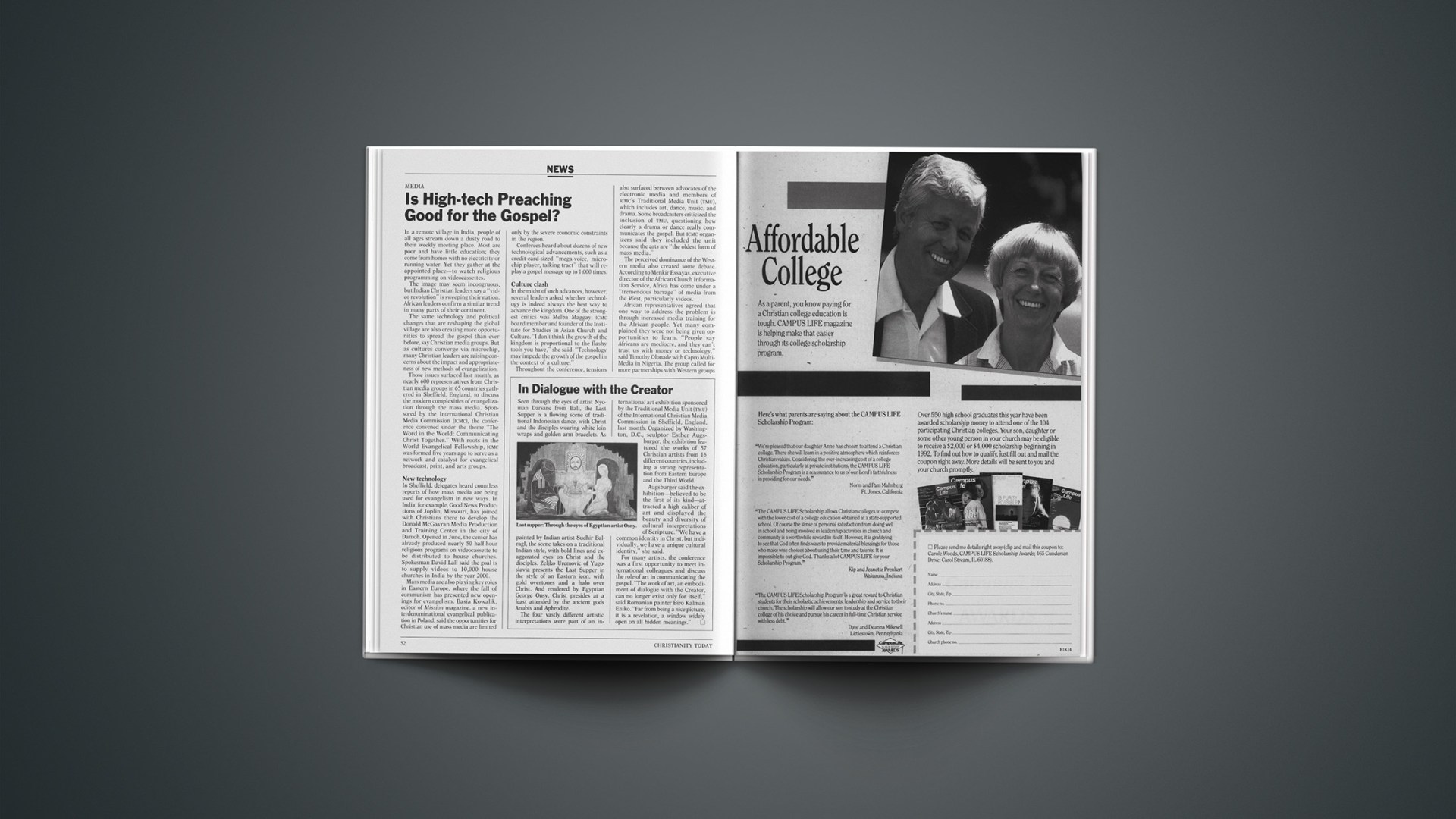
Those issues surfaced last month, as nearly 600 representatives from Christian media groups in 65 countries gathered in Sheffield, England, to discuss the modern complexities of evangelization through the mass media. Sponsored by the International Christian Media Commission (ICMC), the conference convened under the theme “The Word in the World: Communicating Christ Together.” With roots in the World Evangelical Fellowship, ICMC was formed five years ago to serve as a network and catalyst for evangelical broadcast, print, and arts groups.
New Technology
In Sheffield, delegates heard countless reports of how mass media are being used for evangelism in new ways. In India, for example, Good News Productions of Joplin, Missouri, has joined with Christians there to develop the Donald McGavran Media Production and Training Center in the city of Damoh. Opened in June, the center has already produced nearly 50 half-hour religious programs on videocassette to be distributed to house churches. Spokesman David Lall said the goal is to supply videos to 10,000 house churches in India by the year 2000.
Mass media are also playing key roles in Eastern Europe, where the fall of communism has presented new openings for evangelism. Basia Kowalik, editor of Mission magazine, a new interdenominational evangelical publication in Poland, said the opportunities for Christian use of mass media are limited only by the severe economic constraints in the region.
Conferees heard about dozens of new technological advancements, such as a credit-card-sized “mega-voice, microchip player, talking tract” that will replay a gospel message up to 1,000 times.
Culture Clash
In the midst of such advances, however, several leaders asked whether technology is indeed always the best way to advance the kingdom. One of the strongest critics was Melba Maggay, ICMC board member and founder of the Institute for Studies in Asian Church and Culture. “I don’t think the growth of the kingdom is proportional to the flashy tools you have,” she said. “Technology may impede the growth of the gospel in the context of a culture.”
Throughout the conference, tensions also surfaced between advocates of the electronic media and members of ICMC’s Traditional Media Unit (TMU), which includes art, dance, music, and drama. Some broadcasters criticized the inclusion of TMU, questioning how clearly a drama or dance really communicates the gospel. But ICMC organizers said they included the unit because the arts are “the oldest form of mass media.”
The perceived dominance of the Western media also created some debate. According to Menkir Essayas, executive director of the African Church Information Service, Africa has come under a “tremendous barrage” of media from the West, particularly videos.
African representatives agreed that one way to address the problem is through increased media training for the African people. Yet many complained they were not being given opportunities to learn. “People say Africans are mediocre, and they can’t trust us with money or technology,” said Timothy Olonade with Capro Multi-Media in Nigeria. The group called for more partnerships with Western groups where Africans are “copartners, not just assistants.”
At the same time, Western media groups acknowledged the need for cultural sensitivities when working internationally. And though some felt too much criticism was leveled at Americans during the conference, others found value in the comments. Said David Clark, president of the National Religious Broadcasters and an ICMC board member, “It’s good for people to know that not everyone thinks like a Republican American.”
Many delegates believe ICMC stands at a crucial point. The effects of the tensions evident at the conference remain to be seen. ICMC executive director Bill Thatcher said the group’s purpose was to “create a place for the historical evangelical stream of Christian media people to come and discuss issues,” he said. “If we are truly committed to accepting one another, we have to be willing to work through those difficult places.”
By Kim A. Lawton in Sheffield, England.
In Dialogue with the Creator
Seen through the eyes of artist Nyoman Darsane from Bali, the Last Supper is a flowing scene of traditional Indonesian dance, with Christ and the disciples wearing white loin wraps and golden arm bracelets. As painted by Indian artist Sudhir Balragl, the scene takes on a traditional Indian style, with bold lines and exaggerated eyes on Christ and the disciples. Zeljko Uremovic of Yugoslavia presents the Last Supper in the style of an Eastern icon, with gold overtones and a halo over Christ. And rendered by Egyptian George Onsy, Christ presides at a feast attended by the ancient gods Anubis and Aphrodite.
The four vastly different artistic interpretations were part of an international art exhibition sponsored by the Traditional Media Unit (TMU) of the International Christian Media Commission in Sheffield, England, last month. Organized by Washington, D.C., sculptor Esther Augsburger, the exhibition featured the works of 57 Christian artists from 16 different countries, including a strong representation from Eastern Europe and the Third World.
Augsburger said the exhibition—believed to be the first of its kind—attracted a high caliber of art and displayed the beauty and diversity of cultural interpretations of Scripture. “We have a common identity in Christ, but individually, we have a unique cultural identity,” she said.
For many artists, the conference was a first opportunity to meet international colleagues and discuss the role of art in communicating the gospel. “The work of art, an embodiment of dialogue with the Creator, can no longer exist only for itself,” said Romanian painter Biro Kalman Eniko. “Far from being a nice picture, it is a revelation, a window widely open on all hidden meanings.”