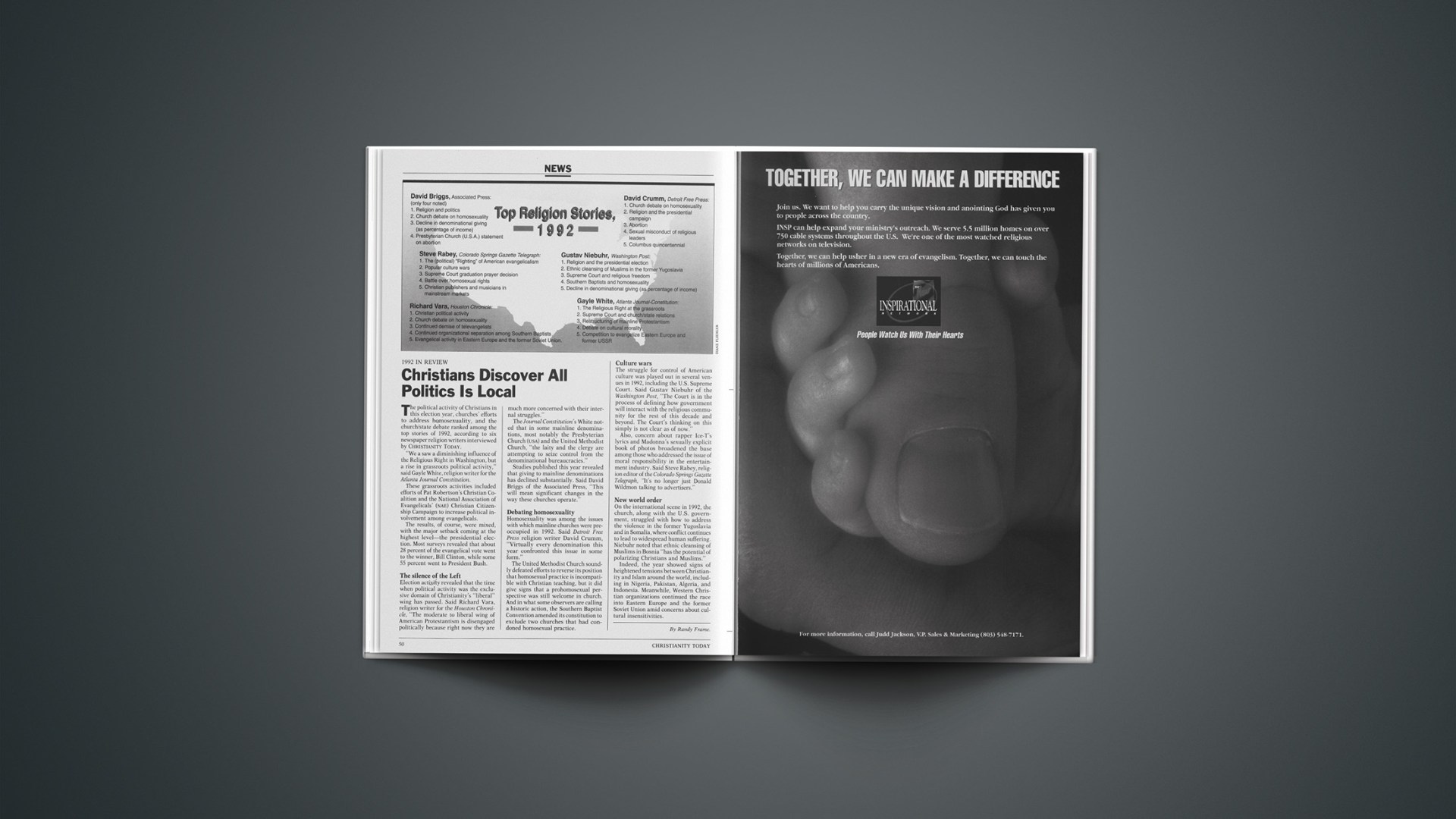

The political activity of Christians in this election year, churches’ efforts to address homosexuality, and the church/state debate ranked among the top stories of 1992, according to six newspaper religion writers interviewed by CHRISTIANITY TODAY.
“We a saw a diminishing influence of the Religious Right in Washington, but a rise in grassroots political activity,” said Gayle White, religion writer for the Atlanta Journal Constitution.
These grassroots activities included efforts of Pat Robertson’s Christian Coalition and the National Association of Evangelicals’ (NAE) Christian Citizenship Campaign to increase political involvement among evangelicals.
The results, of course, were mixed, with the major setback coming at the highest level—the presidential election. Most surveys revealed that about 28 percent of the evangelical vote went to the winner, Bill Clinton, while some 55 percent went to President Bush.
The Silence Of The Left
Election activity revealed that the time when political activity was the exclusive domain of Christianity’s “liberal” wing has passed. Said Richard Vara, religion writer for the Houston Chronicle, “The moderate to liberal wing of American Protestantism is disengaged politically because right now they are much more concerned with their internal struggles.”
The Journal Constitution’s White noted that in some mainline denominations, most notably the Presbyterian Church (USA) and the United Methodist Church, “the laity and the clergy are attempting to seize control from the denominational bureaucracies.”
Studies published this year revealed that giving to mainline denominations has declined substantially. Said David Briggs of the Associated Press, “This will mean significant changes in the way these churches operate.”
Debating Homosexuality
Homosexuality was among the issues with which mainline churches were preoccupied in 1992. Said Detroit Free Press religion writer David Crumm, “Virtually every denomination this year confronted this issue in some form.”
The United Methodist Church soundly defeated efforts to reverse its position that homosexual practice is incompatible with Christian teaching, but it did give signs that a prohomosexual perspective was still welcome in church. And in what some observers are calling a historic action, the Southern Baptist Convention amended its constitution to exclude two churches that had condoned homosexual practice.
Culture Wars
The struggle for control of American culture was played out in several venues in 1992, including the U.S. Supreme Court. Said Gustav Niebuhr of the Washington Post, “The Court is in the process of defining how government will interact with the religious community for the rest of this decade and beyond. The Court’s thinking on this simply is not clear as of now.”
Also, concern about rapper Ice-T’s lyrics and Madonna’s sexually explicit book of photos broadened the base among those who addressed the issue of moral responsibility in the entertainment industry. Said Steve Rabey, religion editor of the Colorado Springs Gazette Telegraph, ‘It’s no longer just Donald Wildmon talking to advertisers.”
New World Order
On the international scene in 1992, the church, along with the U.S. government, struggled with how to address the violence in the former Yugoslavia and in Somalia, where conflict continues to lead to widespread human suffering. Niebuhr noted that ethnic cleansing of Muslims in Bosnia “has the potential of polarizing Christians and Muslims.”
Indeed, the year showed signs of heightened tensions between Christianity and Islam around the world, including in Nigeria, Pakistan, Algeria, and Indonesia. Meanwhile, Western Christian organizations continued the race into Eastern Europe and the former Soviet Union amid concerns about cultural insensitivities.
By Randy Frame.