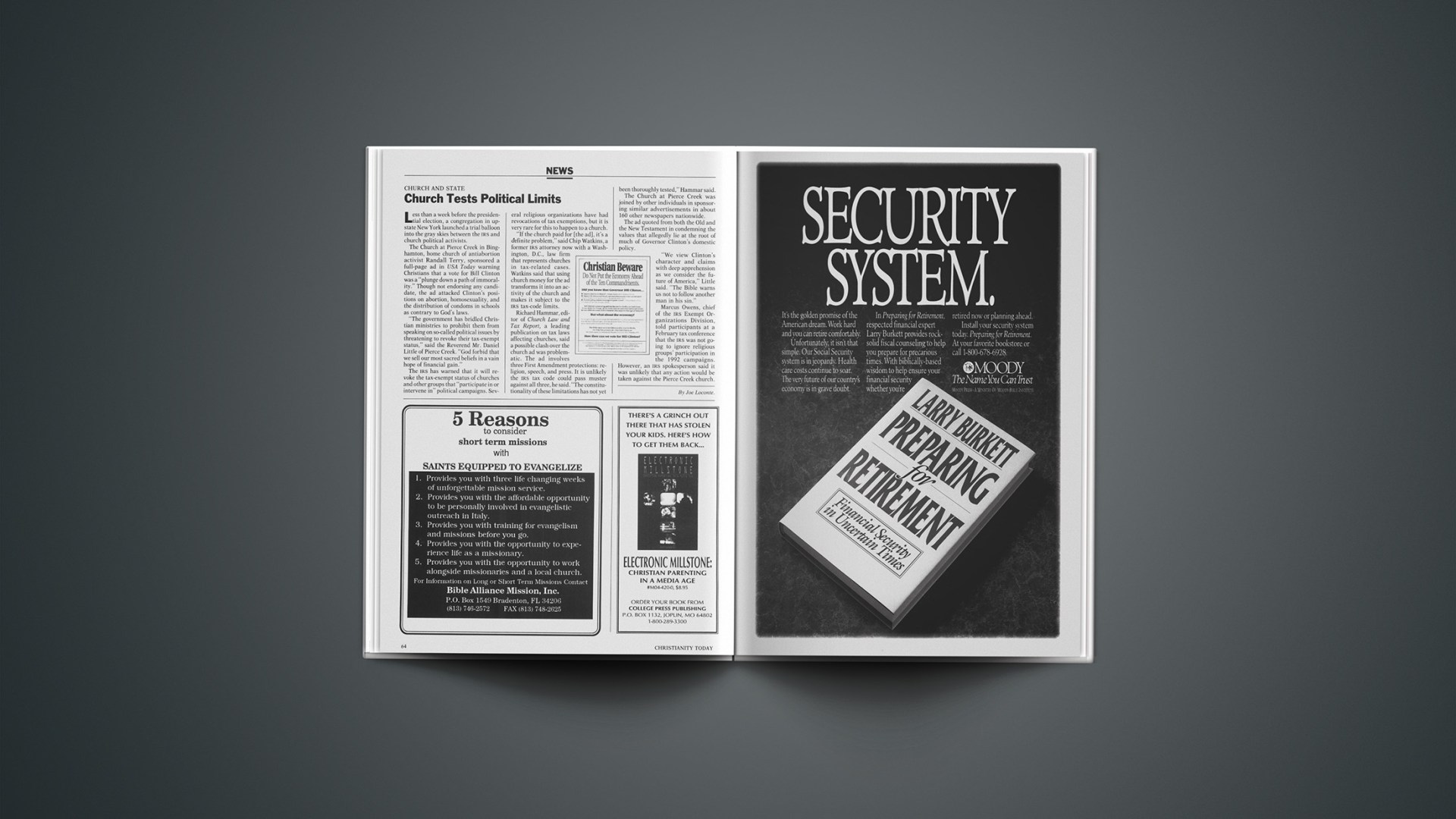

Less than a week before the presidential election, a congregation in upstate New York launched a trial balloon into the gray skies between the IRS and church political activists.
The Church at Pierce Creek in Binghamton, home church of antiabortion activist Randall Terry, sponsored a full-page ad in USA Today warning Christians that a vote for Bill Clinton was a “plunge down a path of immorality.” Though not endorsing any candidate, the ad attacked Clinton’s positions on abortion, homosexuality, and the distribution of condoms in schools as contrary to God’s laws.
“The government has bridled Christian ministries to prohibit them from speaking on so-called political issues by threatening to revoke their tax-exempt status,” said the Reverend Mr. Daniel Little of Pierce Creek. “God forbid that we sell our most sacred beliefs in a vain hope of financial gain.”
The IRS has warned that it will revoke the tax-exempt status of churches and other groups that “participate in or intervene in” political campaigns. Several religious organizations have had revocations of tax exemptions, but it is very rare for this to happen to a church.
“If the church paid for [the ad], it’s a definite problem,” said Chip Watkins, a former IRS attorney now with a Washington, D.C., law firm that represents churches in tax-related cases. Watkins said that using church money for the ad transforms it into an activity of the church and makes it subject to the IRS tax-code limits.
Richard Hammar, editor of Church Law and Tax Report, a leading publication on tax laws affecting churches, said a possible clash over the church ad was problematic. The ad involves three First Amendment protections: religion, speech, and press. It is unlikely the IRS tax code could pass muster against all three, he said. “The constitutionality of these limitations has not yet been thoroughly tested,” Hammar said.
The Church at Pierce Creek was joined by other individuals in sponsoring similar advertisements in about 160 other newspapers nationwide.
The ad quoted from both the Old and the New Testament in condemning the values that allegedly lie at the root of much of Governor Clinton’s domestic policy.
“We view Clinton’s character and claims with deep apprehension as we consider the future of America,” Little said. “The Bible warns us not to follow another man in his sin.”
Marcus Owens, chief of the IRS Exempt Organizations Division, told participants at a February tax conference that the IRS was not going to ignore religious groups’ participation in the 1992 campaigns. However, an IRS spokesperson said it was unlikely that any action would be taken against the Pierce Creek church.
By Joe Loconte.