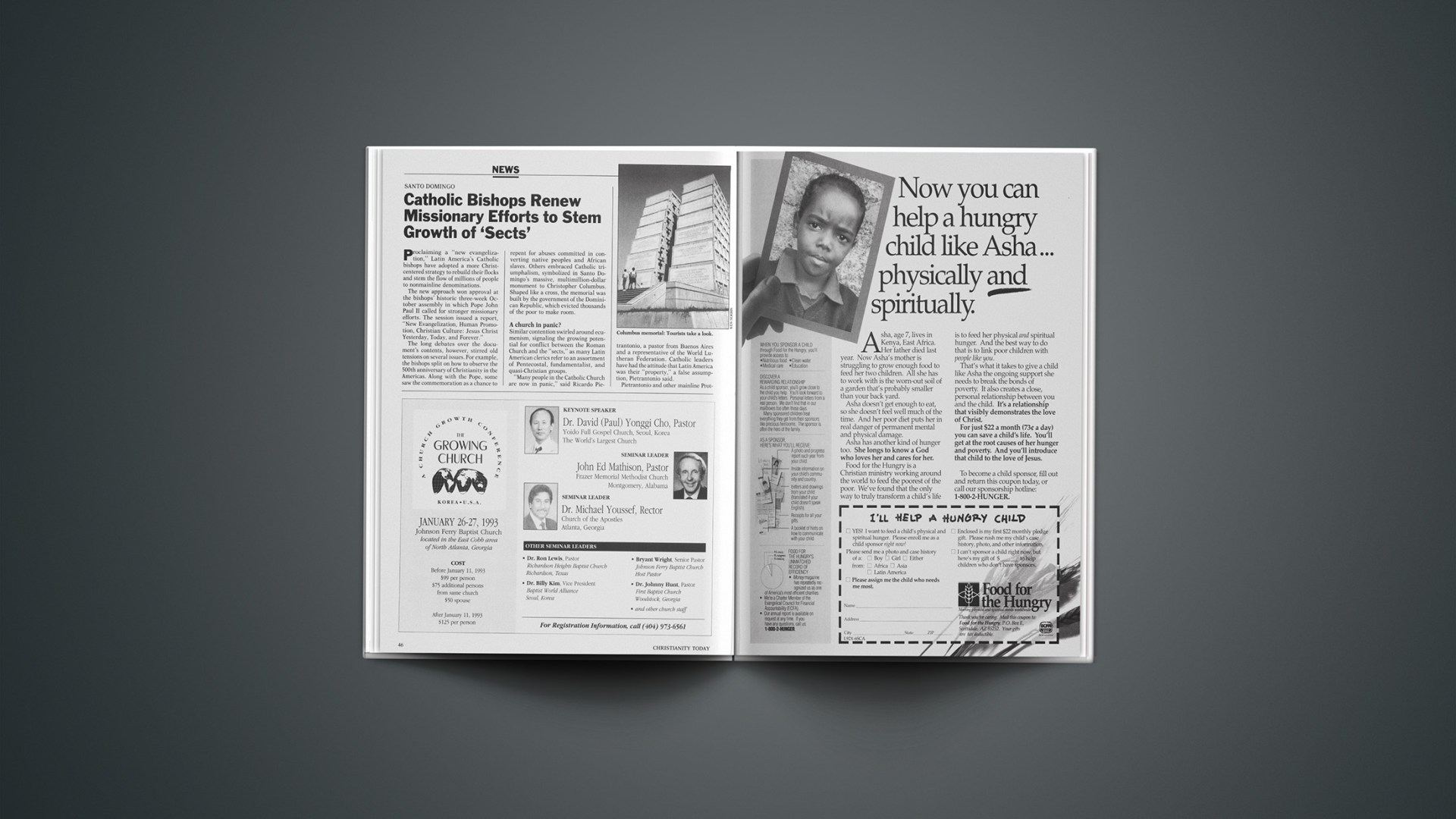

Proclaiming a “new evangelization,” Latin America’s Catholic bishops have adopted a more Christ-centered strategy to rebuild their flocks and stem the flow of millions of people to nonmainline denominations.
The new approach won approval at the bishops’ historic three-week October assembly in which Pope John Paul II called for stronger missionary efforts. The session issued a report, “New Evangelization, Human Promotion, Christian Culture: Jesus Christ Yesterday, Today, and Forever.”
The long debates over the document’s contents, however, stirred old tensions on several issues. For example, the bishops split on how to observe the 500th anniversary of Christianity in the Americas. Along with the Pope, some saw the commemoration as a chance to repent for abuses committed in converting native peoples and African slaves. Others embraced Catholic triumphalism, symbolized in Santo Domingo’s massive, multimillion-dollar monument to Christopher Columbus. Shaped like a cross, the memorial was built by the government of the Dominican Republic, which evicted thousands of the poor to make room.
A Church In Panic?
Similar contention swirled around ecumenism, signaling the growing potential for conflict between the Roman Church and the “sects,” as many Latin American clerics refer to an assortment of Pentecostal, fundamentalist, and quasi-Christian groups.
“Many people in the Catholic Church are now in panic,” said Ricardo Pietrantonio, a pastor from Buenos Aires and a representative of the World Lutheran Federation. Catholic leaders have had the attitude that Latin America was their “property,” a false assumption, Pietrantonio said.
Pietrantonio and other mainline Protestants accepted a Vatican invitation to come to Santo Domingo as observers, but the so-called sects were not invited. The guests, however, became entangled in a series of disputes, which indicated that ecumenism will become more difficult for the church as it tries to match the success of the sects.
In one incident, a leading bishop, pressured by others unhappy with the pastors’ presence, hinted that two Protestant guests should withdraw from a committee set up to draft the final document’s statement on ecumenism, interreligious dialogue, new religious movements, and sects. The departure of the Protestants sparked furor among prelates in favor of dialogue, and the pastors were quickly asked to return. In another episode, hardliners tried to write their own harsher alternative statement on the sects, but protests by ecumenical forces foiled the move. The final document stated that ecumenism was a priority for the church. Yet, it contains sharp words that ecumenical bishops wanted out.
Santo Domingo’s message diverged from previous gatherings in Medellín, Colombia, in 1968 and Puebla, Mexico, in 1979, which emphasized liberation theology and the “preferential option for the poor.” Since the rise of John Paul II, Catholic progressives in Latin America have suffered a series of setbacks under fire from conservative bishops and the Vatican. Times have also changed politically with the emergence of democracy throughout Latin America. With political freedom on the rise, the church is no longer needed as “the voice of the voiceless.” Progressives have also lost ground due to disenchantment with socialism.
“Liberation” Vetoed
The word liberation was left out of the Santo Domingo conclusions, although social issues and the now “evangelical” option for the poor remained a central theme. A number of bishops angrily accused the Vatican of manipulating the meeting to shift the Latin church’s emphasis on the social agenda back to the far more spiritual and universal outlook of the pre-Vatican II era.
The church’s situation in a vastly changed world is increasingly putting evangelization and the sects at the top of the agenda. Meanwhile, in some countries, such as Nicaragua and Mexico, bishops are seeking to resurrect the kind of privileges typical of past church-state alliances. Such relationships would heighten tensions between Catholics and the sects. Mauro Encamación Figueredo, a deacon at a small Pentecostal church in one of Santo Domingo’s poorest neighborhoods, seemed oblivious to the bishops’ assembly, and he said he was resentful of what he sees as the church’s privileged position here.
Liberal bishops, as well as Pietrantonio, played down the discord over ecumenism, but the Lutheran pastor pointed out that many bishops seemed to lack an understanding of Protestant history and the distinctions among denominations. “This world is going to have religious pluralism,” and the solution is to “coexist, not combat,” Pietrantonio said.
By Ken Serbin in Santo Domingo.