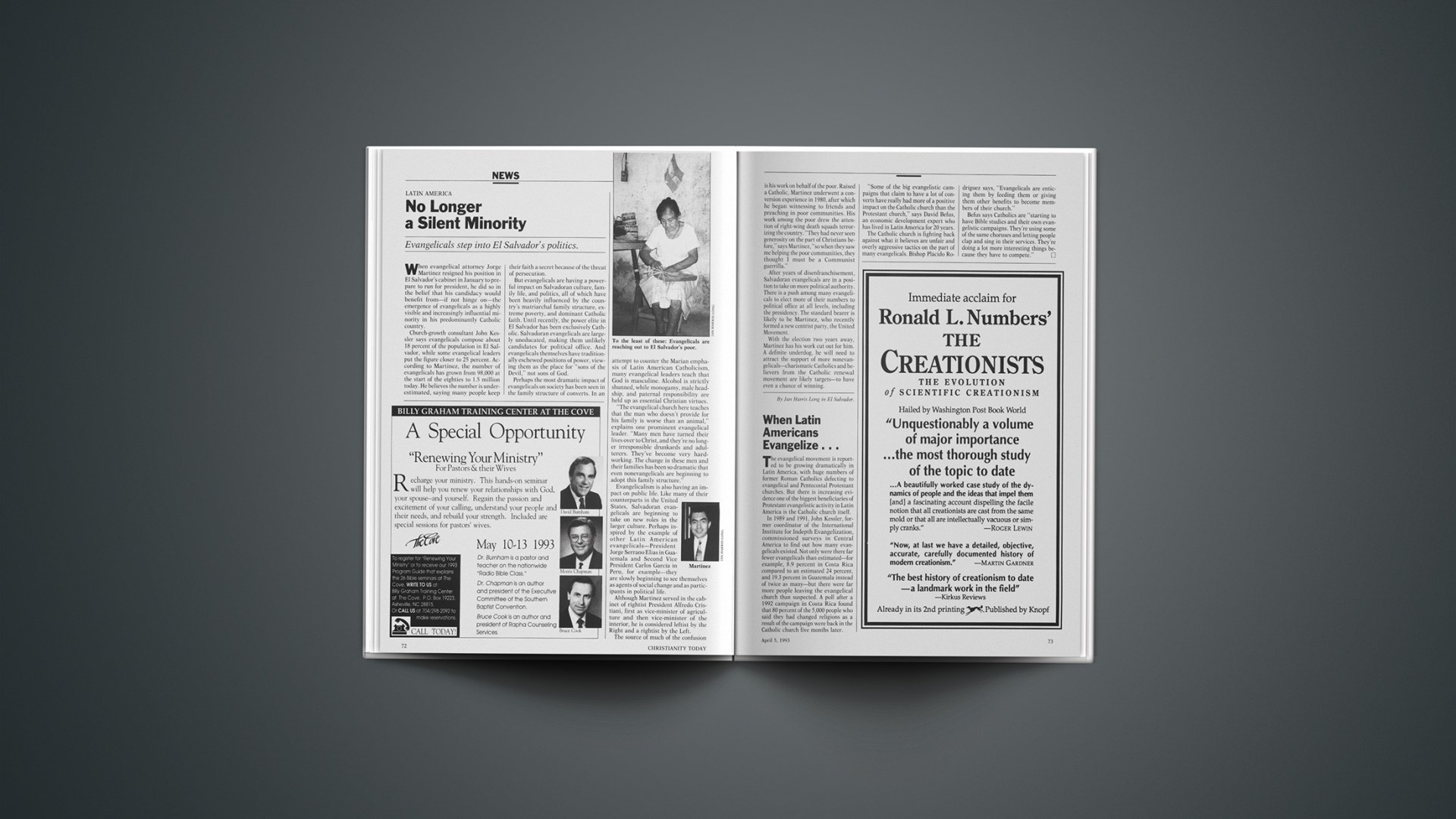

Evangelicals step into El Salvador’s politics.
When evangelical attorney Jorge Martinez resigned his position in El Salvador’s cabinet in January to prepare to run for president, he did so in the belief that his candidacy would benefit from—if not hinge on—the emergence of evangelicals as a highly visible and increasingly influential minority in his predominantly Catholic country.
Church-growth consultant John Kessler says evangelicals compose about 18 percent of the population in El Salvador, while some evangelical leaders put the figure closer to 25 percent. According to Martinez, the number of evangelicals has grown from 98,000 at the start of the eighties to 1.5 million today. He believes the number is underestimated, saying many people keep their faith a secret because of the threat of persecution.
But evangelicals are having a powerful impact on Salvadoran culture, family life, and politics, all of which have been heavily influenced by the country’s matriarchal family structure, extreme poverty, and dominant Catholic faith. Until recently, the power elite in El Salvador has been exclusively Catholic. Salvadoran evangelicals are largely uneducated, making them unlikely candidates for political office. And evangelicals themselves have traditionally eschewed positions of power, viewing them as the place for “sons of the Devil,” not sons of God.
Perhaps the most dramatic impact of evangelicals on society has been seen in the family structure of converts. In an attempt to counter the Marian emphasis of Latin American Catholicism, many evangelical leaders teach that God is masculine. Alcohol is strictly shunned, while monogamy, male headship, and paternal responsibility are held up as essential Christian virtues.
“The evangelical church here teaches that the man who doesn’t provide for his family is worse than an animal,” explains one prominent evangelical leader. “Many men have turned their lives over to Christ, and they’re no longer irresponsible drunkards and adulterers. They’ve become very hard-working. The change in these men and their families has been so dramatic that even nonevangelicals are beginning to adopt this family structure.”
Evangelicalism is also having an impact on public life. Like many of their counterparts in the United States, Salvadoran evangelicals are beginning to take on new roles in the larger culture. Perhaps inspired by the example of other Latin American evangelicals—President Jorge Serrano Elias in Guatemala and Second Vice President Carlos Garcia in Peru, for example—they are slowly beginning to see themselves as agents of social change and as participants in political life.
Although Martinez served in the cabinet of rightist President Alfredo Cristiani, first as vice-minister of agriculture and then vice-minister of the interior, he is considered leftist by the Right and a rightist by the Left.
The source of much of the confusion is his work on behalf of the poor. Raised a Catholic, Martinez underwent a conversion experience in 1980, after which he began witnessing to friends and preaching in poor communities. His work among the poor drew the attention of right-wing death squads terrorizing the country. “They had never seen generosity on the part of Christians before,” says Martinez, “so when they saw me helping the poor communities, they thought I must be a Communist guerrilla.”
After years of disenfranchisement, Salvadoran evangelicals are in a position to take on more political authority. There is a push among many evangelicals to elect more of their numbers to political office at all levels, including the presidency. The standard bearer is likely to be Martinez, who recently formed a new centrist party, the United Movement.
With the election two years away, Martinez has his work cut out for him. A definite underdog, he will need to attract the support of more nonevangelicals—charismatic Catholics and believers from the Catholic renewal movement are likely targets—to have even a chance of winning.
By Jan Harris Long in El Salvador.
When Latin Americans Evangelize …
The evangelical movement is reported to be growing dramatically in Latin America, with huge numbers of former Roman Catholics defecting to evangelical and Pentecostal Protestant churches. But there is increasing evidence one of the biggest beneficiaries of Protestant evangelistic activity in Latin America is the Catholic church itself.
In 1989 and 1991, John Kessler, former coordinator of the International Institute for Indepth Evangelization, commissioned surveys in Central America to find out how many evangelicals existed. Not only were there far fewer evangelicals than estimated—for example, 8.9 percent in Costa Rica compared to an estimated 24 percent, and 19.3 percent in Guatemala instead of twice as many—but there were far more people leaving the evangelical church than suspected. A poll after a 1992 campaign in Costa Rica found that 80 percent of the 5,000 people who said they had changed religions as a result of the campaign were back in the Catholic church five months later.
“Some of the big evangelistic campaigns that claim to have a lot of converts have really had more of a positive impact on the Catholic church than the Protestant church,” says David Befus, an economic development expert who has lived in Latin America for 20 years.
The Catholic church is fighting back against what it believes are unfair and overly aggressive tactics on the part of many evangelicals. Bishop Plácido Rodríguez says, “Evangelicals are enticing them by feeding them or giving them other benefits to become members of their church.”
Befus says Catholics are “starting to have Bible studies and their own evangelistic campaigns. They’re using some of the same choruses and letting people clap and sing in their services. They’re doing a lot more interesting things because they have to compete.”