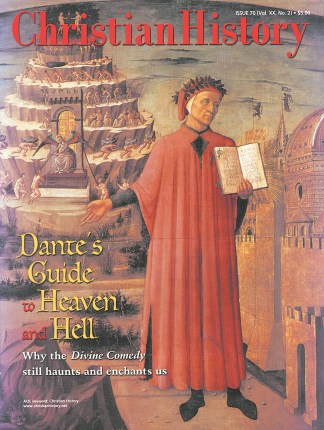
Dante was the first writer to draw an elaborate map of Mount Purgatory, but he did not invent it. The idea of a place between death and heaven, as well as the practice of praying for the dead, dates back to the earliest days of the church.
Though not directly mentioned in the Hebrew canon that became the basis for the Protestant Old Testament, prayers for the departed are encouraged in the Greek Septuagint, on which the Catholic and Orthodox Old Testaments are based. For example, 2 Maccabees states: “It is therefore a holy and wholesome thought to pray for the dead, that they may be loosed from sins.” Other verses cited as proof of purification after death include 2 Samuel 12, 1 Corinthians 3:11-15, and Matthew 12:32.
The latter verse, in which Jesus declares that “anyone who speaks against the Holy Spirit will not be forgiven, either in this age or in the age to come,” struck Augustine. He argued in City of God, “That some sinners are not forgiven either in this world or in the next would not be truly said unless there were other [sinners] who, though not forgiven in this world, are forgiven in the world to come.”
Words of hope and comfort (precursors to the modern “Rest in Peace”) appear on many early Christian monuments, especially in the catacombs. Believers gathered there on death anniversaries to ask mercy for the departed souls. Expansions of this practice, such as granting indulgences for the dead, developed later.
Another aspect of the doctrine of purgatory is that some sins will be punished more severely than others—a concept vividly illustrated in the Divine Comedy. The distinction between major and minor sins and the belief in cleansing after death are found in early Christian texts, notably in the visions of Perpetua, a third-century North African martyr. Greek and Latin church fathers of the second and third centuries (Justin Martyr, Irenaeus, Tertullian, and Origen) refer to these as established doctrines.
Belief in purgatory was widespread throughout the early Latin Middle Ages, but it was not unchallenged. In the fourth century, Acrius taught that prayers for the dead were fruitless—an assertion Epiphanius, bishop of Salamis, rebutted in his “Refutation of All the Heresies.” Some early Greek (Eastern) theologians also dissented from the emerging consensus on purgatory, while others supported it.
Later in the Middle Ages, the Albigensians, Waldensians, and Hussites all rejected purgatory, though for different reasons. So did John Calvin and to a slightly lesser extent Martin Luther. At the same time, though, Latin theologians were systematically developing the doctrine. It was affirmed after discussions between Latin and Greek theologians at the Second Council of Lyons in 1274.
Purgatory was defined at the Council of Trent in 1545-1563: “Whereas the Catholic Church, instructed by the Holy Ghost, has from the Sacred Scriptures and the ancient tradition of the Fathers taught in Councils and very recently in this Ecumenical synod that there is a purgatory, and that the souls therein are helped by the suffrages of the faithful, but principally by the acceptable Sacrifice of the Altar.”
Though intricately described by Dante and others, the Catholic doctrine of purgatory boils down to a short list of essentials. Sin estranges us from God. By virtue of Christ’s paying our eternal penalty on the cross, God forgives us. At that moment the guilt and eternal punishment owed for having betrayed him is removed as far from us as east is from west. But the wound remains—not in God, but in us.
God is pure holiness. No imperfection can enter his sight (Hab. 1:13). The temporal traces left behind by sin must be removed before we can enter God’s presence. In purgatory the fire of God’s love burns away the impurities not already removed by devotion to God before death, readying us for God’s presence.
Purgatory is not a second chance to accept or reject God’s ever-proferred grace. Only those who will eventually reach heaven spend time there. Thus it is not a question of if a soul in purgatory will see God, but when.
Dennis Martin is associate professor of historical theology at Loyola University (IL). Elesha Coffman contributed to this article.
Copyright © 2001 by the author or Christianity Today/Christian History magazine. Click here for reprint information on Christian History.