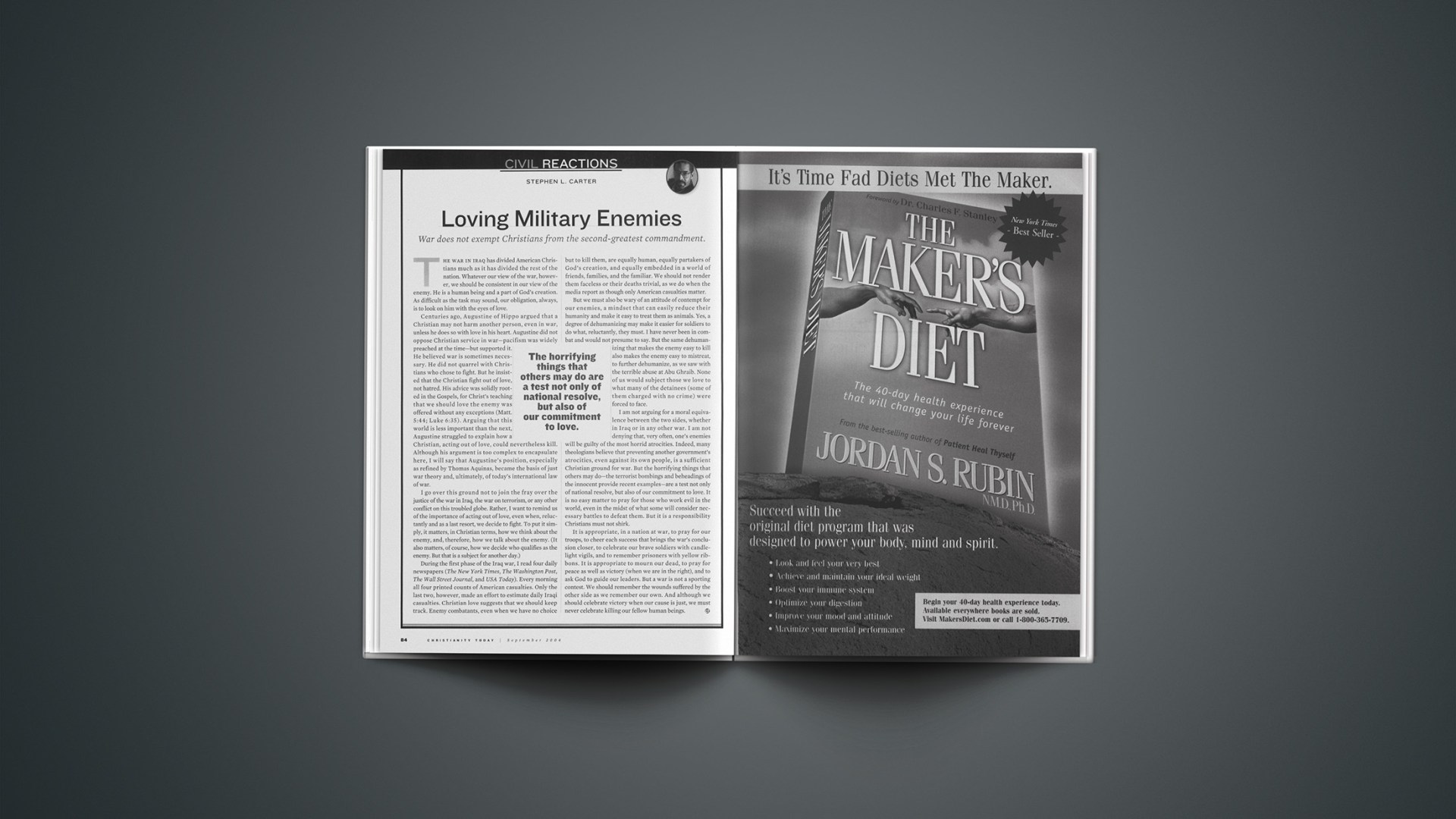

The war in Iraq has divided American Christians much as it has divided the rest of the nation. Whatever our view of the war, however, we should be consistent in our view of the enemy. He is a human being and a part of God’s creation. As difficult as the task may sound, our obligation, always, is to look on him with the eyes of love.
Centuries ago, Augustine of Hippo argued that a Christian may not harm another person, even in war, unless he does so with love in his heart. Augustine did not oppose Christian service in war—pacifism was widely preached at the time—but supported it. He believed war is sometimes necessary. He did not quarrel with Christians who chose to fight. But he insisted that the Christian fight out of love, not hatred. His advice was solidly rooted in the Gospels, for Christ’s teaching that we should love the enemy was offered without any exceptions (Matt. 5:44; Luke 6:35). Arguing that this world is less important than the next, Augustine struggled to explain how a Christian, acting out of love, could nevertheless kill. Although his argument is too complex to encapsulate here, I will say that Augustine’s position, especially as refined by Thomas Aquinas, became the basis of just war theory and, ultimately, of today’s international law of war.
I go over this ground not to join the fray over the justice of the war in Iraq, the war on terrorism, or any other conflict on this troubled globe. Rather, I want to remind us of the importance of acting out of love, even when, reluctantly and as a last resort, we decide to fight. To put it simply, it matters, in Christian terms, how we think about the enemy, and, therefore, how we talk about the enemy. (It also matters, of course, how we decide who qualifies as the enemy. But that is a subject for another day.)
During the first phase of the Iraq war, I read four daily newspapers (The New York Times, The Washington Post, The Wall Street Journal, and USA Today). Every morning all four printed counts of American casualties. Only the last two, however, made an effort to estimate daily Iraqi casualties. Christian love suggests that we should keep track. Enemy combatants, even when we have no choice but to kill them, are equally human, equally partakers of God’s creation, and equally embedded in a world of friends, families, and the familiar. We should not render them faceless or their deaths trivial, as we do when the media report as though only American casualties matter.
But we must also be wary of an attitude of contempt for our enemies, a mindset that can easily reduce their humanity and make it easy to treat them as animals. Yes, a degree of dehumanizing may make it easier for soldiers to do what, reluctantly, they must. I have never been in combat and would not presume to say. But the same dehumanizing that makes the enemy easy to kill also makes the enemy easy to mistreat, to further dehumanize, as we saw with the terrible abuse at Abu Ghraib. None of us would subject those we love to what many of the detainees (some of them charged with no crime) were forced to face.
I am not arguing for a moral equivalence between the two sides, whether in Iraq or in any other war. I am not denying that, very often, one’s enemies will be guilty of the most horrid atrocities. Indeed, many theologians believe that preventing another government’s atrocities, even against its own people, is a sufficient Christian ground for war. But the horrifying things that others may do—the terrorist bombings and beheadings of the innocent provide recent examples—are a test not only of national resolve, but also of our commitment to love. It is no easy matter to pray for those who work evil in the world, even in the midst of what some will consider necessary battles to defeat them. But it is a responsibility Christians must not shirk.
It is appropriate, in a nation at war, to pray for our troops, to cheer each success that brings the war’s conclusion closer, to celebrate our brave soldiers with candlelight vigils, and to remember prisoners with yellow ribbons. It is appropriate to mourn our dead, to pray for peace as well as victory (when we are in the right), and to ask God to guide our leaders. But a war is not a sporting contest. We should remember the wounds suffered by the other side as we remember our own. And although we should celebrate victory when our cause is just, we must never celebrate killing our fellow human beings.
Copyright © 2004 Christianity Today. Click for reprint information.
Related Elsewhere:
More Christianity Today articles on Abu Ghraib and the War in Iraq are available on our Hot Topic pages.
Recent Christianity Today columns by Stephen L. Carter include:
Hope Deferred | Christians are uniquely positioned to further racial equality. (June 29, 2004)
A Politics of Gratitude | Stop whining, count your blessings, and love your global neighbors. (March 08, 2004)
Sports Mobs and Manners | There’s a difference between cheering the home team and being boorish. (Aug. 25, 2003)
Roe vs. Judicial Sense | Forget briefly its immorality—it’s just bad law (July 1, 2003)
Willing to Lose | By voting we place our hope in the next world. (March 4, 2003)
Virtue via Vouchers | The Supreme Court’s recent decision can help prevent more corporate scandals. (Dec. 4, 2002)
Remedial History | The educational establishment seems confused about our spiritual heritage. (July 10, 2002)
Uncle Sam Is Not Your Dad | The separation of church and state protects families too. (March 22, 2002)
A Quiet Compromise | Why a moment of silence is better than school prayer. (Feb. 25, 2002)
Leaving ‘Normal’ Behind | Life before September 11 seemed more secure, but do we really want it back? (Dec. 4, 2001)
Rudeness Has a First Name | Instant informality actually sabotages true friendship. (Nov. 2, 2001)
Why Rules Rule | Debates on the Ten Commandments expose our culture’s ultimate rift. (Sept. 6, 2001)
We Interrupt This Childhood | Parents who raise their children to do right face a barrage of resistance. (July 11, 2001)
And the Word Turned Secular | Christians should count the cost of the state’s affirmation. (May 29, 2001)
Vouching for Parents | Vouchers are not an attack on public schools but a vote of trust in families. (Apr. 2, 2001)
The Courage to Lose | In elections, and in life, there is something more important than winning. (Feb. 6, 2001)