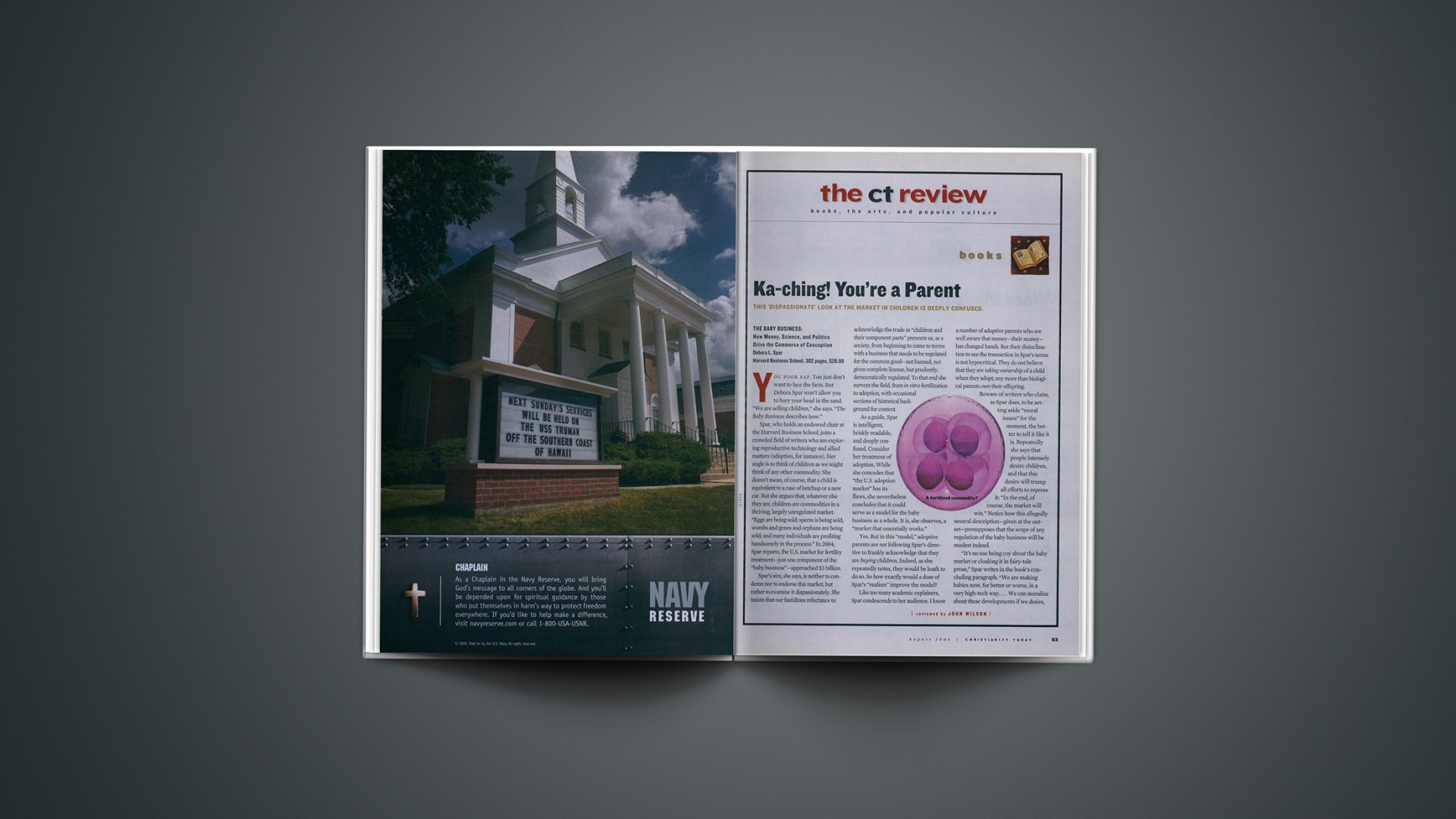

You poor sap. You just don’t want to face the facts. But Debora Spar won’t allow you to bury your head in the sand. “We are selling children,” she says. “The Baby Business describes how.”
 THE BABY BUSINESS:How Money,Science, andPolitics Drivethe Commerceof Conceptionby Debora L. SparHarvard Business School302 pp.; $26.95 |
Spar, who holds an endowed chair at the Harvard Business School, joins a crowded field of writers who are exploring reproductive technology and allied matters (adoption, for instance). Her angle is to think of children as we might think of any other commodity. She doesn’t mean, of course, that a child is equivalent to a case of ketchup or a new car. But she argues that, whatever else they are, children are commodities in a thriving, largely unregulated market: “Eggs are being sold; sperm is being sold; wombs and genes and orphans are being sold; and many individuals are profiting handsomely in the process.” In 2004, Spar reports, the U.S. market for fertility treatment—just one component of the “baby business”—approached $3 billion.
Spar’s aim, she says, is neither to condemn nor to endorse this market, but rather to examine it dispassionately. She insists that our fastidious reluctance to acknowledge the trade in “children and their component parts” prevents us, as a society, from beginning to come to terms with a business that needs to be regulated for the common good—not banned, not given complete license, but prudently, democratically regulated. To that end she surveys the field, from in vitro fertilization to adoption, with occasional sections of historical background for context.
As a guide, Spar is intelligent, briskly readable, and deeply confused. Consider her treatment of adoption. While she concedes that “the U.S. adoption market” has its flaws, she nevertheless concludes that it could serve as a model for the baby business as a whole. It is, she observes, a “market that essentially works.”
Yes. But in this “model,” adoptive parents are not following Spar’s directive to frankly acknowledge that they are buying children. Indeed, as she repeatedly notes, they would be loath to do so. So how exactly would a dose of Spar’s “realism” improve the model?
Like too many academic explainers, Spar condescends to her audience. I know a number of adoptive parents who are well aware that money—their money—has changed hands. But their disinclination to see the transaction in Spar’s terms is not hypocritical. They do not believe that they are taking ownership of a child when they adopt, any more than biological parents own their offspring.
Beware of writers who claim, as Spar does, to be setting aside “moral issues” for the moment, the better to tell it like it is. Repeatedly she says that people intensely desire children, and that this desire will trump all efforts to repress it: “In the end, of course, the market will win.” Notice how this allegedly neutral description—given at the outset—presupposes that the scope of any regulation of the baby business will be modest indeed.
“It’s no use being coy about the baby market or cloaking it in fairy-tale prose,” Spar writes in the book’s concluding paragraph. “We are making babies now, for better or worse, in a very high-tech way. … We can moralize about these developments if we desire, ruing the gods who pushed nature aside. … Or we can plunge into the market that desire has created, imagining how we can shape our children without destroying ourselves.”
But what does “fairy-tale prose” look like? How can we recognize it, so we can plunge fearlessly into the market, no longer encumbered by foolish fancies? When Lee Silver writes in Remaking Eden about the future of genetic engineering—”The final frontier will be the mind and the senses. Alcohol addiction will be eliminated, along with tendencies toward mental disease and antisocial behavior like extreme aggression”—is he indulging in fairy-tale prose, or is he merely giving us a scientist’s clear-headed look ahead at our brave new world?
You decide.
John Wilson is editor of Books & Culture.
Copyright © 2006 Christianity Today. Click for reprint information.
Related Elsewhere:
The Baby Business: How Money, Science, and Politics Drive the Commerce of Conception is available at Amazon.com and other retailers.
An interview with the author, Debora Spar, can be found in the New York Times. Spar’s biography can be found on her Harvard faculty page.
Christianity Today‘s most recent cover story discussed the blessings of many children.