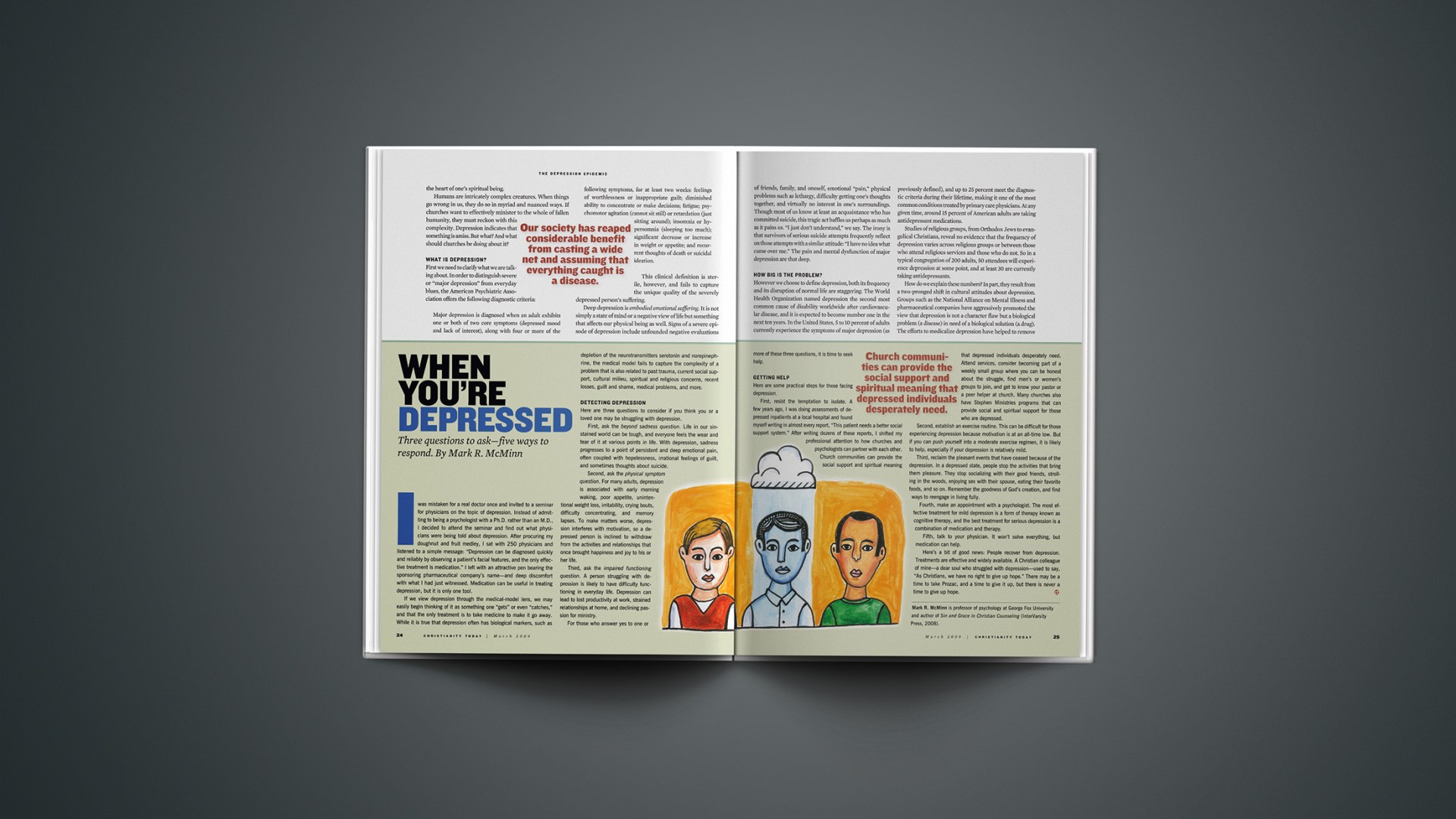

I was mistaken for a real doctor once and invited to a seminar for physicians on the topic of depression. Instead of admitting to being a psychologist with a Ph.D. rather than an M.D., I decided to attend the seminar and find out what physicians were being told about depression. After procuring my doughnut and fruit medley, I sat with 250 physicians and listened to a simple message: “Depression can be diagnosed quickly and reliably by observing a patient’s facial features, and the only effective treatment is medication.” I left with an attractive pen bearing the sponsoring pharmaceutical company’s name—and deep discomfort with what I had just witnessed. Medication can be useful in treating depression, but it is only one tool.
If we view depression through the medical-model lens, we may easily begin thinking of it as something one “gets” or even “catches,” and that the only treatment is to take medicine to make it go away. While it is true that depression often has biological markers, such as depletion of the neurotransmitters serotonin and norepinephrine, the medical model fails to capture the complexity of a problem that is also related to past trauma, current social support, cultural milieu, spiritual and religious concerns, recent losses, guilt and shame, medical problems, and more.
Detecting Depression
Here are three questions to consider if you think you or a loved one may be struggling with depression.
First, ask the beyond sadness question. Life in our sinstained world can be tough, and everyone feels the wear and tear of it at various points in life. With depression, sadness progresses to a point of persistent and deep emotional pain, often coupled with hopelessness, irrational feelings of guilt, and sometimes thoughts about suicide.
Second, ask the physical symptom question. For many adults, depression is associated with early morning waking, poor appetite, unintentional weight loss, irritability, crying bouts, difficulty concentrating, and memory lapses. To make matters worse, depression interferes with motivation, so a depressed person is inclined to withdraw from the activities and relationships that once brought happiness and joy to his or her life.
Third, ask the impaired functioning question. A person struggling with depression is likely to have difficulty functioning in everyday life. Depression can lead to lost productivity at work, strained relationships at home, and declining passion for ministry.
For those who answer yes to one or more of these three questions, it is time to seek help.
Getting Help
Here are some practical steps for those facing depression.
First, resist the temptation to isolate. A few years ago, I was doing assessments of depressed inpatients at a local hospital and found myself writing in almost every report, “This patient needs a better social support system.” After writing dozens of these reports, I shifted my professional attention to how churches and psychologists can partner with each other. Church communities can provide the social support and spiritual meaning that depressed individuals desperately need. Attend services, consider becoming part of a weekly small group where you can be honest about the struggle, find men’s or women’s groups to join, and get to know your pastor or a peer helper at church. Many churches also have Stephen Ministries programs that can provide social and spiritual support for those who are depressed.
Second, establish an exercise routine. This can be difficult for those experiencing depression because motivation is at an all-time low. But if you can push yourself into a moderate exercise regimen, it is likely to help, especially if your depression is relatively mild.
Third, reclaim the pleasant events that have ceased because of the depression. In a depressed state, people stop the activities that bring them pleasure. They stop socializing with their good friends, strolling in the woods, enjoying sex with their spouse, eating their favorite foods, and so on. Remember the goodness of God’s creation, and find ways to reengage in living fully.
Fourth, make an appointment with a psychologist. The most effective treatment for mild depression is a form of therapy known as cognitive therapy, and the best treatment for serious depression is a combination of medication and therapy.
Fifth, talk to your physician. It won’t solve everything, but medication can help.
Here’s a bit of good news: People recover from depression. Treatments are effective and widely available. A Christian colleague of mine—a dear soul who struggled with depression—used to say, “As Christians, we have no right to give up hope.” There may be a time to take Prozac, and a time to give it up, but there is never a time to give up hope.
Mark R. McMinn is professor of psychology at George Fox University and author of Sin and Grace in Christian Counseling (InterVarsity Press, 2008).
Copyright © 2009 Christianity Today. Click for reprint information.
Related Elsewhere:
This article, “Light When All is Dark,” and “My Life with Antidepressants” are part of Christianity Today‘s March cover package on “The Depression Epidemic.”
Previous articles on depression and suicide include:
The Gospel According to Prozac | Can a pill do what the Holy Spirit could not? (August 1, 1995)
To Be Happy in Jesus | Are evangelical Christians really happier than their neighbors? (March 8, 2006)
Good Question: Is Suicide Unforgivable? | Question: What is the biblical hope and comfort we can offer a suicide victim’s family and friends? (July 10, 2000)