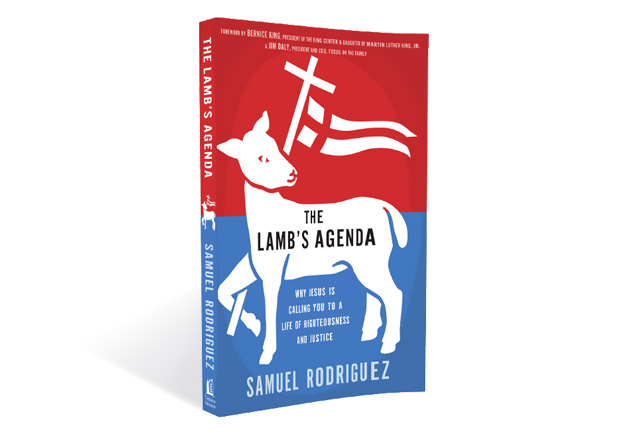
The Lamb's Agenda: Why Jesus Is Calling You to a Life of Righteousness and Justice (Thomas Nelson) is a "strange bedfellows" book—and that's a good thing. The book features two forewords—one by Focus on the Family president Jim Daley and one by Bernice A. King, daughter of Martin Luther King Jr. and doyenne of the King legacy.

The Lamb's Agenda: Why Jesus Is Calling You to a Life of Righteousness and Justice
Thomas Nelson
256 pages
Pastor Rodriguez's goal is to create a movement that would change American society for good through the marriage of evangelism and social justice work—much in the way that evangelicals of an earlier era fought the evils of the gin industry and injustices of the slave trade by bringing a transforming gospel to those trapped by these forces while also working to eliminate these evils from society.
Historically speaking, there is little new in The Lamb's Agenda. John Wesley, Charles Finney, and William Wilberforce's Clapham Sect also married evangelism, moral reform, and social crusades. Rodriguez is certainly not the first to argue that Christians must not be captive to any political party and that we must not let them use us as their "useful idiots." Instead, we must let Jesus' prophetic call to justice and compassion judge both parties and render all ideologies relative.
Just before the 2004 election, Jim Wallis and Sojourners conducted a high-profile campaign to liberate Christian activism from enslavement to political parties. Their ad campaign cum petition headlined "God is not a Republican … or a Democrat" gained 40,000 signatures. Immediately after the election, Wallis attacked the media identification of Christians with the Republican Party in his book God's Politics.
Rodriguez, ever the preacher, reframes Wallis's slogan in zoological terms: "As followers of Christ, we stand committed to advancing not the agenda of the Donkey or the Elephant but only the Agenda of the Lamb." (If you haven't heard Rodriguez preach, you should start with his keynote address at the 2013 National Martin Luther King Jr. Celebration at King's Ebenezer Baptist Church.)
The Lamb takes no cues from the Donkey or the Elephant. He judges both the Tea Party and the Occupy movement. The Lamb's agenda can only be discovered in the combined visions of Dr. Martin Luther King Jr. and the Rev. Billy Graham. The Lamb's agenda is revealed at the intersection of the horizontal and vertical arms of the Cross. Thus Rodriguez says a firm no to the either-or forces that polarize our time and a resounding yes to prophetic biblical witness.
But is he successful in distancing himself from the political powerbrokers and polarizing political wannabes? Rodriguez and his wife Eva have both offered benedictions at Republican conventions. He has been known to associate with theocratic Christians and to speak at their events. People for the American Way lists 19 Rodriguez-related postings on their RightWingWatch.org website. They scratch their heads and wonder how he "has managed to somehow be both a radical Religious Right activist while enjoying a reputation as a moderate who is regularly invited to the White House and to presidential events."
For good or ill, The Lamb's Agenda is unlikely to change the minds of Rodriguez's progressive critics. He takes firm stands on social-conservative litmus issues like abortion and traditional marriage. He also joins the chorus of those who are critical of the Obama administration's mandate that too narrowly exempted organizations that objected to funding contraceptive or abortifacient drugs. Such positions are to be expected from any mainstream evangelical leader, and they don't merit a "radical Religious Right" label.
However, Rodriguez also demonstrates deep suspicion of collaboration with activists from other camps. For example, he recounts events from 2006 when Los Angeles Cardinal Roger Mahony worked with prochoice Catholic labor leaders on the issue of illegal immigration. When prolife activists challenged Mahony's actions, he replied, "This isn't about left or right. This is about justice." Those labor leaders, unfortunately, failed to reciprocate, actively working against a ballot initiative that would have required parental permission for underage girls to obtain an abortion. Rodriguez concludes, "Well-meaning people who collaborate on social issues with enemies of life usually find themselves betrayed." Such words do not encourage bipartisanship in an age of polarization.
Nevertheless, progressives should be glad that Rodriguez expresses no such reservations when it comes to government redressing injustices. They will applaud his leadership on immigration issues, his repeated disapproval of violence and prejudice toward gays and lesbians, and his condemnation of bullying. These are issues that, to paraphrase Mahony, are neither left nor right, but about justice.
Progressives have been divided over the Bush administration's efforts to put faith-based organizations on an equal footing with secular agencies in receiving funding for social ministry. Rodriguez calls it "entirely contrary to the spirit of the Bible for a faith-based group to approach government and beg for funding to accomplish a divine mandate of charity and compassion. … [I]f we accept subsidies from Caesar, we agree to play by Caesar's rules, and his rules are not anything like our rules."
Rodriguez is proudly, unapologetically Hispanic. He calls himself the son of immigrants, and he celebrates what Christian migrants from Latin America can offer to the United States economically, demographically, spiritually, and morally. But Rodriguez never indulges in identity politics. He writes as an unhyphenated American and as a Christian. He sees tremendous potential for national renewal in "the multiethnic church." He does not promote any group of ethnic Americans as a power bloc, but treats all ethnic groups together as the kingdom field in which the twin gospels of righteousness and justice can flourish.
The publisher of Sam Rodriguez's first book, Path of Miracles, packaged it as belonging in the religious self-help genre. Subtitled "The Seven Life-Changing Principles That Lead to Purpose and Fulfillment," its title and his byline were embossed in gold foil. These marketing touches aimed it at prosperity gospel believers. But there was one discordant note on the cover: "Foreword by Jim Wallis." Indeed, the miracles the book spoke of were not geared to wealth and well-being but to living within God's radical purposes.
Nevertheless, Rodriguez framed that book in largely individualistic terms—with a brief tip of the hat to the importance of finding partners. The Lamb's Agenda, on the other hand, is framed in broadly corporate and communal terms. It is about America as a city set on a hill, and it is about the church as an outpost of God's kingdom. It is about bringing a message of righteousness to those who need to hear it and about doing justice for those who have been deprived of it. It is about the divine call placed upon us as the people of God and as Americans.
David Neff is an editorial vice president at Christianity Today.
Related Elsewhere:
Christianity Today senior writer Tim Stafford profiled Samuel Rodriguez in 2006. Read "The Call of Samuel."