







I have a confession: I knew I would like Jen Wilkin’s new book, Women of the Word: How to Study the Bible with Both Our Hearts and Our Minds (Crossway), before I read it. Having become familiar with Wilkin after finding her blog, I was struck by how she proclaims difficult truths without alienating readers. Her teaching—on display as a leader at the Village Church in Flower Mound, Texas—is saturated in scriptural insights and demands serious attention.
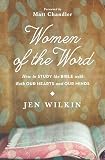
There is an increasing number of Bible resources for women rooted in sound theology, thanks to teachers like Beth Moore and Kay Arthur. Women of the Word goes further in equipping women with the tools to study Scripture rightly.
Wilkin identifies two significant problems among Christian resources for women: They tend to be emotion-driven and human-centered. Too often, women approach Scripture asking not “Who is God?” but “Who am I?” The latter question certainly has its place, but, as Wilkin objects, “Any study of the Bible that seeks to establish our identity without first proclaiming God’s identity will render partial and limited help.”
She warns against a list of mistaken approaches, such as the “Xanax Approach,” which “treats the Bible as if it exists to make us feel better,” and the “Magic 8 Ball Approach,” which demands that “the Bible tell us what to do rather than who to be.”
Wilkin then offers a five-step primer for studying Scripture, which she calls the “Five Ps”: Study with Purpose, Perspective, Patience, Process, and Prayer. The goal is to help women grow in Bible literacy. Although the approach is rigorous, Wilkin is quick to extend grace and understanding to busy women whose season in life may not afford them the time.
The book ends strongly, as Wilkin argues for the value of female teachers, explaining that women in our churches need their example, perspective, and authority. She offers helpful guidance for women who discern a call to teach. As a Bible teacher myself, I would recommend this chapter to any woman who discern a similar call.
Women of the Word is a necessary improvement from many popular resources for Christian women, and it would benefit any woman who desires to know God and study his Word. Beyond the tools within its pages, it will help women discern the quality of the Bible resources they already consume.
My only quibble is with Wilkin’s understanding of the heart. For Wilkin, women’s Bible study materials too often exhibit an overreliance on loving God with one’s heart, which comes at the expense of loving God with one’s mind. Wilkin defines the heart as the seat of one’s emotions and will, and she believes we must place “the mind in charge of the heart,” reasoning that “the heart cannot love what the mind does not know.”
Wilkin makes her case using Scripture, but I am not convinced the Bible presents us with such a dichotomy. When Scripture refers to the “heart,” it often has something broader and more holistic in mind than mere emotions. A stark distinction between the emotions and mind evokes Plato more than Scripture. I would caution, therefore, against an overcorrection that neglects the nuanced, organic relationship between the heart and the mind that the Bible depicts.
That caution aside, Women of the Word is excellent. Wilkin speaks prophetically into the women’s ministry landscape. She is a leader in what I hope will be the next chapter of women’s ministry.
Sharon Hodde Miller writes for Her.meneutics and is a doctoral student at Trinity Evangelical Divinity School. She blogs at SheWorships.com.







