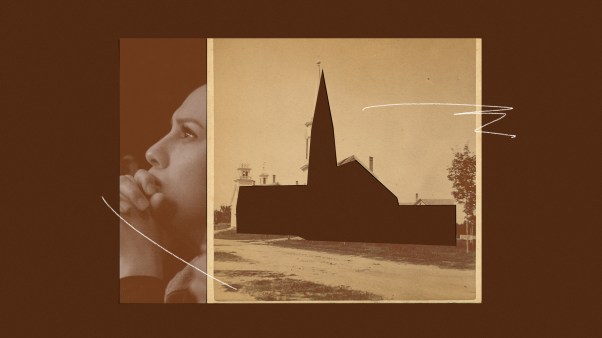
I have seen art deco–style pulpits, boxes with fronts that come to obtuse points: forward, forward, as the engines of history turn, forward with the Lord of hosts and right angles. I have seen others plain and polished, austere and iconoclastic, self-effacing even, as though they would be secretly embarrassed to distract from the speaker. Way up in the north woods, I have seen still others that look as though they have just sprouted out of the ground: narrow trunks of white birch trees lashed with twine into ragged, ribbed stands.
Below the decorative level, each of these pulpits hides its true purpose, which is to bear the weight of the universe upon a slanted shelf. This is where the Bible sits, inches above a Styrofoam cup of water.
From a height of six feet the functionality is apparent, but for earthbound toddlers a normal pulpit rises like a wooden rampart under the distant vault of the sanctuary ceiling. Climbing up the pastor’s side to peer out across empty pews is like ascending a watchtower to survey the site of an approaching battle, the affixed microphone below your gaze an oratory catapult.
I have watched aged hands grip the sides of a pulpit enough times to know that the rampart imagery is not inapt. Consider what must be overcome in the act of preaching. While standing in front of dozens or hundreds you must, by some grace, gather what greased words you can and attempt to string them into sentences and paragraphs. This in the absurd hope of conveying eternal verities to a crowd that often is unimpressed by verities, even the eternal ones.
Wordless opposition is aloft in every zone of your visual field. What can save you? What can shelter you from this falling cloud of bored looks and silent opposition?
When the flesh is weak to the point of threatening collapse, the pulpit stands fast. Grasping those panels enclosing the plane where your Bible sits recollects your homiletic purpose. Against these teeming, impatient masses, the trebuchet is again armed, and the words go back out.
As your confidence grows, perhaps you will find yourself walking in a slow circuit around the pulpit. If the atmosphere in the sanctuary has thickened, if there is a sense of openness, you might not feel the need to interpose the wooden box between you and your listeners. But having stepped into the adjacent clearing, you hear the wind rustle in the carpet strands, and you rotate your wedding band around your ring finger for reassurance.
The crowd may not notice the ways in which the pulpit lends you gravitas, as though you stand in front of the sturdy furniture of God’s own mind, but the benefit is still yours. As a soldier salutes the rank before the officer has earned a salute, so a congregation may attend to the one behind the pulpit, even if his words fall among them haphazardly.
That podium is a bulwark, evoking in its angles and height the church that guards the deposit entrusted to it. More basically, however, the pulpit evokes the logos itself: the foundation for thought, life, and being; a principle of order that bestows itself here; a single, unmoving point in a tilting universe.
This may be part of why I favor the simple pulpit to the ornate: clean lines and darkness bring to mind an Archimedean geometry that is invoked as the Word disseminates into the cosmos. The servant of God extrapolates these living truths from behind his podium, praying for a single bored face to turn. When the words catch and a single congregant nods in sudden assent, the pulpit becomes a fixed outcrop for a hand to grasp in a thundering crush of time against eternity. History rushes and breaks upon this book; centuries of strife and wonder crack into halves over it.
The book still sits; the pulpit still stands. The preacher finds his words, and from the pulpit, those words go out again.
Martyn Wendell Jones lives in Madison, Wisconsin, where he is a technical writer. He writes a weekly column for Christ and Pop Culture, and his work has also appeared in The Common Vision. You can follow him on Twitter @martynwendell.