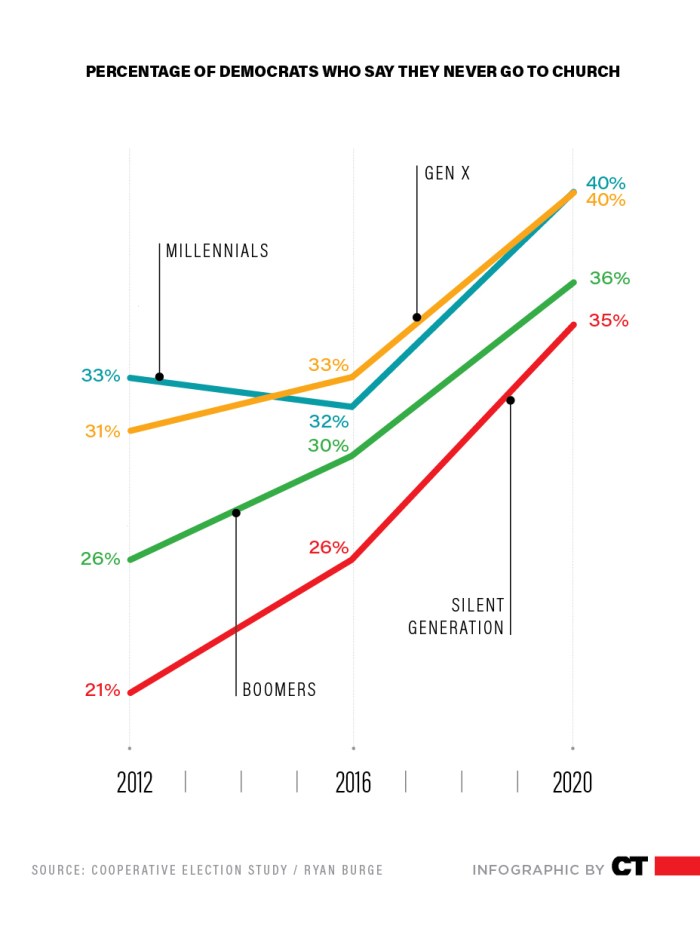
Donald Trump’s presidency accelerated the decline of church attendance in America. While the number of people going to church was already going down steadily, data from Harvard University’s Cooperative Election Study shows an “exogeneous shock” in 2016, according to political scientist Ryan Burge, who specializes in the study of religious data.
“For every action there is a reaction,” Burge told CT. “Donald Trump is the action. His election caused all these ripple effects in American society, and you can see it in the pews.”
Politically moderate and left-leaning evangelicals appear most impacted. A growing number seem to have felt estranged from their congregations in the Trump era. The rate of self-identified Democrats giving up on church in their 20s–50s doubled from the end of Barack Obama’s presidency to the end of Trump’s, according to Burge. And the dramatic change came in 2016. At the same time, more Republicans started identifying as evangelical but not attending any worship services.
The growing consensus of social scientists is that political identities are currently much, much stronger than religious commitments.
 The winds of change are not blowing gently at Regent University in Virginia Beach. In July, the board of trustees named a new president and an interim law-school dean. Some students and alumni say those changes signal a disturbing philosophical shift away from Regent’s conservative moorings. Students are also crying foul over the manner in which the former law-school dean, Herbert Titus, was removed.Student leaders claim Titus’s removal violated the school’s policy on tenure and that it will upset the ratio between students and faculty. For those reasons, some fear the law school will be unable to gain full accreditation with the American Bar Association (ABA). The school currently has provisional ABA accreditation.Regent University policy requires faculty contract renewal unless the faculty member has breached that contract, says student council member Norm Sabin. “[Breach of contract] has not been put forth or even alleged in the situation with Dean Titus.”“The events and the way they were brought about … shed some doubt on whether the tenure system as represented was really there,” Sabin says. “Without tenure we cannot get ABA approval.” Further, he says, replacing Titus with faculty member Paul Morken helps bring the student-to-faculty ratio to a level the ABA considers “unacceptable.”Titus holds a conservative approach to constitutional law that Sabin characterizes as “very much textually oriented.” Some speculate he was removed in an effort to tone down the school’s conservative emphasis. Trustees have not explained their reasons, saying only that before his dismissal Titus was offered a paid sabbatical and a professorship, which he rejected.In an interview with CT, new president Terry Lindvall declined to explain why Titus was removed, indicating that litigation is pending. Lindvall says that Regent is “still very much committed to accreditation,” and administrators are “adjusting” to the upset student-to-faculty ratio. “We’ve got some professors who are teaching more than what’s really healthy, but at the same time it is not endangering the quality of education.”Titus’s removal is not the only personnel change making waves. Several alumni and students believe Lindvall’s appointment is another indication of a philosophical move to the Left.Says Tom Blackstone, Regent alumni association president, “Our primary concern is … to avoid institutional drift and what we call the ‘Duke-Harvard syndrome,’ whereby schools that began with a godly base within generations became secular humanist bastions in the areas of the liberal arts.”Lindvall, a communications professor and film producer, says Regent is going through “growth pains,” and that his first priority is to “bring reconciliation to the whole community.”“Regent has been almost sectarian and provincial in its first 15 years,” says Lindvall. He wants to stress Christian scholarship and women and minority enrollment.By Thomas S. Giles.