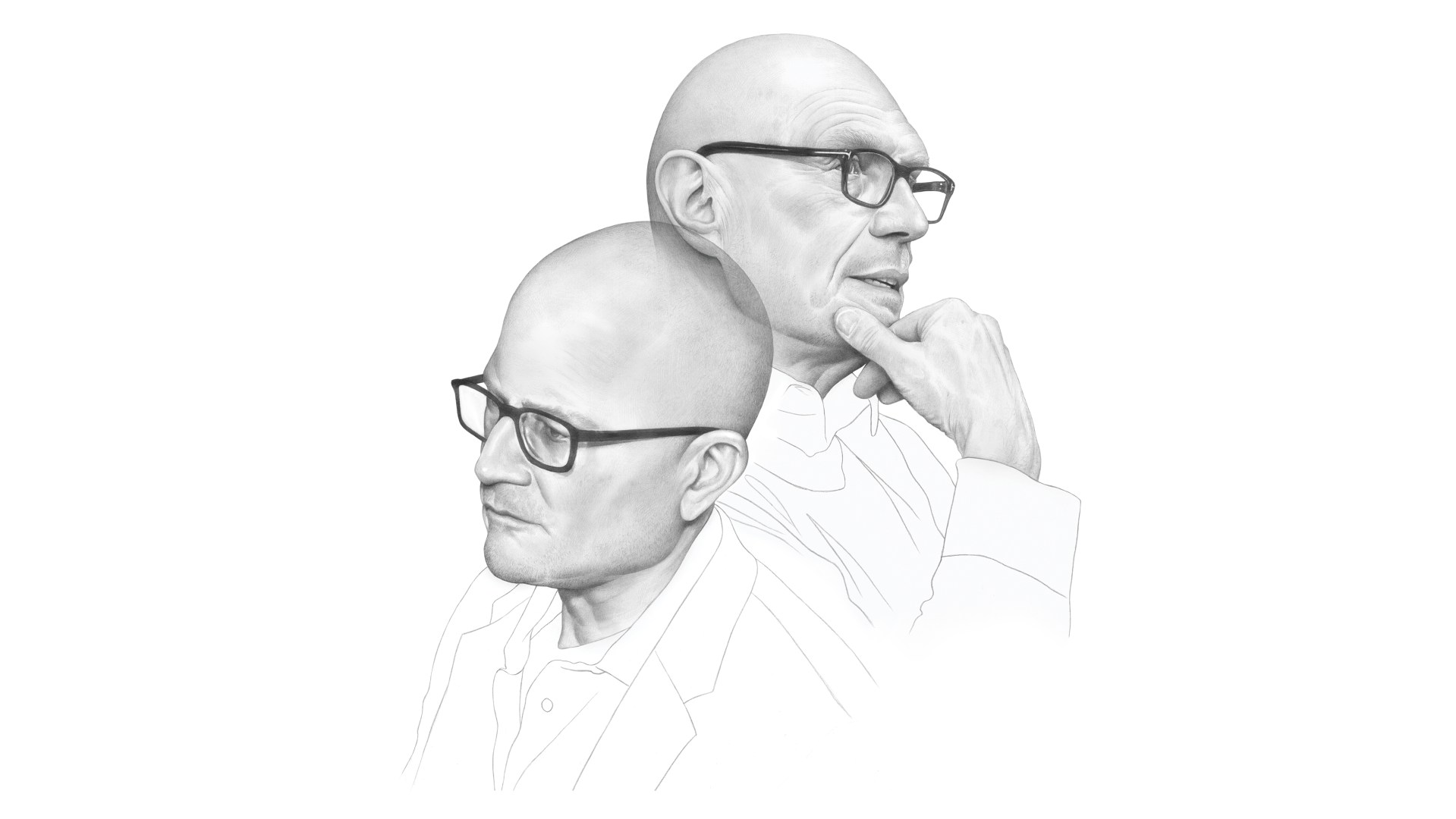

“My office or a big room?” Miroslav Volf asked. His Blundstone boots carried his tall frame to a sputtering coffee machine. Before Volf got the last words out, his friend Christian Wiman said, “Big room.” Wiman was running a few minutes late because a half-marathon in New Haven, Connecticut, had led to road closures. His “Montana” baseball cap was slightly askew. He looked pleased that coffee was underway.
It was a gray Labor Day at Yale University when I met with Volf and Wiman, my former professors. The mild temperatures heralded the end of summer, and campus was mostly quiet aside from some rustlings in the hallway, where students sat around open laptops and sifted through books that bloomed with colorful tabs. We met in an empty seminar room in the building where Volf directs the Yale Center for Faith & Culture.
Volf and Wiman loom large in their respective fields for good reason. They have spent their lives exploring the human experience and articulating something of the complexities of faith—Volf as a theologian and Wiman as a poet.
The former has spent his life asking questions about the furthest reaches of forgiveness and the ways we can live together across great differences. The latter has long wrestled words of faith and doubt across pages. Poetry helped him return to church after a 20-year absence and a diagnosis of incurable blood cancer.
Along the way, these two men have built a friendship by looking squarely at life’s big questions and tackling faith and doubt, suffering and joy, together.
Their writing seems incapable of lingering on the superfluous. No question is too big or unwieldy for Volf and Wiman, no confession of doubt too destabilizing. Rather than lead them toward cynicism or unbelief, their willingness to ask hard questions has drawn them closer to one another and to God.
Recently, the two friends decided to give readers an intimate view of their relationship in their book Glimmerings: Letters on Faith Between a Poet and a Theologian. They expanded on those letters as they sat at a long table in the classroom last September. The conversation centered on each man’s faith, including Wiman’s ongoing battle to keep despair at bay and Volf’s admission that he longs to possess a hunger for God that seems to elude him.
For years, Volf and Wiman have taken walks together, beginning at Yale Divinity School and trekking a regular route along the sidewalks of New Haven. The walks began early in their friendship, and these first conversations tended to focus on what each was reading. Neither had read the other’s works. Their friendship came about when Volf’s wife, Jessica Dwelle, took a class with Wiman. When the two couples got together for dinner a short time later, Volf and Wiman found themselves compelled by the mind of the other. “At some point,” Volf said, “we started talking about prayer and about a desire for God.”
Occasionally, one of them would be out of town or unduly weighed down by a teaching load, or Wiman was sick, and they’d continue their conversations by writing emails to one another.
The emails began in earnest during the fall of 2022. Wiman said these letters “came at a period of great urgency.” He had been diagnosed at age 39 with a rare and incurable form of cancer called Waldenström macroglobulinemia. Twenty years later, as he began his correspondence with Volf, he “really was dying.” He went on to say, “It was a literal godsend to me the way that this exchange happened.”
Cancer’s effects on Wiman’s body come in waves, quieting for a stretch of years then becoming acutely virulent. “I started getting sick in 2022 and had a hard time finishing that semester, but in 2023 it was really bad,” he said. He completed a book called Zero at the Bone: Fifty Entries Against Despair but wasn’t sure he would live to see it published.
He was wrestling at the time with “what it means to love God.” He said, “It seems to me such an abstract question. And in a way I feel like
I know what it means, in the way that I feel like I know when a poem is beginning. It’s about the same sort of feeling. But there’s something very elusive and frustrating about it when you are in a period of suffering.”
“I found it immensely helpful to think about these issues with somebody concrete before me,” Volf said of their email correspondence. Rather than working through an issue alone and “speaking to myself or to a potential reader,” he said, “I had specifically Chris in view, and that just catalyzed something for me.” Their walks on campus and around New Haven laid the foundation on which they later built as they emailed one another. “It was really helpful that I knew [Wiman] well,” Volf said. He spoke of “a certain honoring and appreciation of what’s coming from the other side. And that to me was really wonderful.”
“I don’t know what faith means anymore,” Wiman wrote to Volf in an email that would later appear on the first page of Glimmerings. “I’m
fifty-six years old with a pile of books behind me and an experimental bone marrow transplant ahead of me and I don’t know what faith means.”
That kind of raw honesty marks their published correspondence, from the first entry on February 28, 2023, to the last one written on June 16, 2024. As Wiman struggled with a sense of God’s absence, Volf confessed that he doesn’t reach for God so much as he recognizes God is holding him.
“My sense is that even when Chris and Miroslav experience God differently,” Wiman’s wife, poet Danielle Chapman told me, “they approach theological questions with the same urgency.” She said the friendship with Volf has been “a great gift to Chris, to have a friend who sees but is not put off by his intensities, whose own faith and understanding is sharp enough to engage real suffering and despair without attempting to dispel or dismiss it. This has been all the more true when the questions they’ve asked together have literally been questions of life and death.”
In the midst of his correspondence with Volf, Wiman underwent an experimental treatment in Boston called CAR T-cell therapy, which
saved his life. When we met, he looked well, like the Wiman I remembered from class.
Both Volf and Wiman come from families riddled with tragedy and grief. Each bears the marks of the place from which he came.
Born in Croatia and educated in Germany, Volf came of age in the 1960s, a tumultuous time in former Yugoslavia. His father was a Protestant minister in a predominantly Catholic region who spent time in a labor camp and whose conversion came during a death march he narrowly survived. Volf’s mother lost four children.
“What my mother did early on,” Volf said, “was to talk to us about her experiences of her four children dying, of the grief that she had. She didn’t shield us from that.” He said her openness wasn’t disorienting for him. Rather, “my love for my mother, and for her struggle, and for what has come to be of her just grew. Suffering was in the middle between us.”
Wiman responded, “She sounds like a strong person who could convey her pain without it being completely destructive. I didn’t have that. There wasn’t strength to convey suffering; there was just this blast of suffering.”
Wiman came of age in a trailer in a hard-beaten stretch of West Texas. His family was prone to reoccurring avalanches of addiction and self-destruction. His essays about his early years are threaded with violence and chaos and what he calls his “badly plugged well of unfocused rage.” I asked him once, during a coat-and-tie dinner at which our conversation about drug-addicted and incarcerated family members stood in ragged contrast to the crisp linens on the table, how he’d gotten from there to here. “Sheer desperation,” he told me.
Navigating desperation and despair is a far cry from the sort of acclaim these men have earned in their professions. In addition to founding and directing the Yale Center for Faith & Culture, Volf is a longtime professor of theology at Yale Divinity School. Wiman is an author, editor, translator, and professor of communication arts at Yale Divinity and the university’s Institute of Sacred Music. Volf sat on the hiring committee for Wiman, a detail Wiman hadn’t heard before our talk last year.
Although Volf can be found teaching graduate seminars or giving the Gifford Lectures, he can just as readily hold a conversation onstage with Rainn Wilson at the Aspen Ideas Festival or chat with Maria Shriver on the Today show. His books are among the seminal theological texts of our time.
Edgardo Colón-Emeric, dean of Duke Divinity School, recounts using Volf’s The End of Memory: Remembering Rightly in a Violent World in a seminar on the theology of reconciliation. “One of my students was a Burundian pastor who had been recently tapped by his government to work on a post-genocide national reconciliation project,” Colón-Emeric said. “I was so moved by his story that I gave him my marked-up copy of Volf’s book. He thanked me profusely and told me, ‘This book will save lives.’”
Wiman’s writings have left their own imprint. He received the distinguished Wallace Stegner Fellowship at Stanford University and then spent years at the helm of Poetry magazine. His work can be found in the pages of The New Yorker and in his own books of prose and poetry. He recounts stories of strolls down Chicago sidewalks with the late poet Mary Oliver and the dead bird in her pocket or time spent with his friend and poet laureate the late Donald Hall.Wiman also speaks around the country, discussing the works of French philosopher Simone Weil or 18th-century theologian Jonathan Edwards and offering sermons at Yale’s Marquand Chapel.
His own suffering marks others’ art. Singer-songwriter Sandra McCracken told me, “Chris Wiman’s work haunts me with truth as he wrestles so earnestly with suffering and certainty.” She said reading Wiman’s writing is “disruptive—and all the more effective because it’s so elegant. I am quite sure that Wiman’s poetry has left some of its shimmering residue on my songs for many years now.”
For all of their accolades, what comes through most when Wiman and Volf are in the same room is a deep friendship, one that can handle a bit of intellectual roughhousing. That’s something the two men engage in, though their tussles are not with one another so much as with themselves. There’s a lightness: In Glimmerings, readers can sense their friendship acutely during these disagreements. Volf writes, “I love how disagreeing with you feels like disagreeing with myself, free of any envy and malice.”
During our talk, Volf spoke of the correspondence with Wiman as one “with no upmanship” and said, “It is a kind of release where my own winning was not at stake.” Wiman replied that their communication, even when friction was present, “was a genuine search. We did disagree, but it was a genuine search.”
Wiman has no formal theological training and never spent a day in graduate school, but there is still a piercing clarity of theological insight in his writing. He writes about feeling God’s absence, needing to summon God by focusing his attention on him. Wiman is very much after something. His hunger for God is heard in his voice and seen in his tendency to rub his palm over his closely shorn scalp as he stews on a question.
Volf, confessing that he does not reach for God as much as he recognizes that he’s being held by God, said, “I’m not proud of that.” He continued, “I want to have what Chris has. I want to have the longing.”
Wiman seemed surprised to hear this. “Really?” he asked.
“Yeah, absolutely I do.”
“I want to have what you have,” Wiman replied. They turned toward one another as smiles slowly appeared. “You seem secure in your faith,” Wiman said. “You don’t seem milquetoast or lukewarm. You seem secure. I would like to have that security. I just think of it as a calm—some deeper calm that enables people.”
Perhaps that sense of calm stands out in contrast to Wiman’s own—as he puts it—“impulse to self-destruction, which has been a war throughout my life.” He has found some refuge from the war in poetry, through which he came to Christ—taken by the throat, he has said—in his 40s after falling in love and receiving his cancer diagnosis.
He said concepts like grace, faith, sin, and love can feel impenetrably abstract. “I can only understand these abstractions when they’re rooted in poetry or metaphor that opens them up in some way,” he said. Poetry “locates abstraction,” and then, as he writes in Glimmerings, “all of my instincts tell me I must follow God. I simply know that he is.”
Volf spoke of what he called a “feature of modernity,” particularly pronounced in the United States, in which there is an “expectation that life should be directly within your control, and if it isn’t, then there’s something wrong with the world, or something’s wrong with you.”
“I was raised in the setting in which this expectation could not be had,” Volf said. “The relationship to faith was not a matter of asking how faith can help me be fully in control of my circumstances.” Nor was it a matter of “how faith would actually help shift and change” his circumstances. In the churches of his youth, he said, “we prayed for healing, but the assumption was that the world is such that you are not and will not be in control. And God comes.”
Indeed, God comes, even in suffering. The topic of suffering was peppered throughout the course of our conversation, as it was in Volf and Wiman’s correspondence. In one letter, Volf relayed a provocative question that came out of a class he taught with a colleague. The question was “whether we could imagine letting Jesus raise our kids.” Volf said he initially “balked at the idea viscerally, as if some unspecified but great damage would befall them if committed to [Jesus’] care.”
Volf has three children, and Wiman two. They discussed how, as Wiman put it, Jesus seems to claim people through suffering. Both explored the thought experiment of whether they ultimately could allow their children to suffer and watch it happen if it was the means by which God claimed them. Volf wrote of his young daughter, “Somewhere deep down, I do desire to take Mira’s hand and together with her follow the radical, uncomfortable Christ.”
Many of us carry questions that could fold us under their weight. They can incite a despair that renders us anemic and our places and lives and futures only arid. Or they can incite a despair, like Wiman’s response to me at our fancy dinner, that has the capacity to buoy us and spark newness.
In spite of the suffering that both men have walked through, Volf and Wiman maintain a fierce and visceral hope. Both have a ready laugh that sounds sincere, albeit hard-won.
The glimmerings in the book title is taken from a line by poet Seamus Heaney: “Glimmerings are what the soul’s composed of.” It was Wiman who first proposed that their correspondence become a book. “It was a very strange thing for me to do,” he said. “I’m not looking for more work. It was a weird, sudden thing.” Wiman sent an email to Volf, who responded immediately that he had been “musing on the same idea.” Volf told me, “I felt that there was something really significant going on that could be of broader significance than just for us.”
Many of the book’s early readers seem to agree. Krista Tippett, who has interviewed both Volf and Wiman for her show On Being, told me, “The learning behind these letters is matched by the fierce courage of their words to each other.”
In any of the differences between these friends, the necessity of facing soberly and honestly not just their own suffering but the suffering of Christ is a place of earnest agreement. “He did make those in need terminal points of his love,” Volf wrote in one of his letters. “He fed the hungry, healed the sick, raised the dead.” Volf later continued, “Christ consoles because his experiences with God are so close to our anguish.”
Despite Wiman’s assertion that he doesn’t know what faith means anymore, his life tells another story. Knowing him, reading his writing, and listening to the recent conversation all say something quite different. Wiman may always need to pile sandbags against encroaching despair and self-destructive impulses. Volf may always, at the edges of even the best days, feel moments of what he calls “cosmic motherlessness.” They may be chronic, these symptoms of human finitude and frailty.
But Volf and Wiman seem simultaneously to believe so deeply that Christ is present and hears them that each will take to God the loneliness, absence, and doubt he feels about that very God.
We are less inclined to cry out—for years and decades—to an ether we believe is empty. Part of faith is believing that we will be heard. Volf and Wiman seem to know that, ultimately, they will be.
As our conversation drew to an end, I asked Wiman to read aloud one of my favorite poems of his before we parted. It is titled “I Don’t Want to Be a Spice Store” and is a litany of what he wants and does not want to be. He doesn’t want to carry “handcrafted Marseille soap” or other luxuries.
Half the shops here don’t open till noon
and even the bookstore’s brined in charm.
I want to be the one store that’s open all night
and has nothing but necessities.
Something to get a fire going
and something to put one out.
It is one of my favorite poems because of the final three lines, two dozen words that startle me because of the openness to which they aspire and the possibility of communion for which they leave room—expect, even.
I want to hum just a little with my own emptiness
at 4 a.m. To have little bells above my door.
To have a door.
Neither Wiman nor Volf is a spice store. Their lives and their work have never dealt in trivialities. The necessities they have offered are sometimes comforting, like finding God amid a ravaging illness, and sometimes challenging, like finding ways to forgive those who have injured us and our families most deeply.
They share a sense of urgency in that each has spent his life asking the most pressing questions humans can ask. As they have asked how to repair ruptures—whether across warring ethnic groups, in a family, or within themselves—both have done so with a sense that God sees and holds them, even when they’ve had to strain to believe it.
Like the biblical psalmists of old, Volf and Wiman have taken refuge in the belief that no frantic, middle-of-the-night question, no flash of desperate honesty, is unheard by God. They have also taken refuge in the friendship of one another. Each carries the essentials. Each has a door.
Andrew Hendrixson is an artist and writer who is pursuing a doctoral degree in theology from Duke Divinity School.
This article appeared in the January/February 2026 issue of Christianity Today as "No Question Too Big".
Related