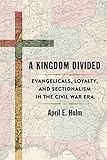
In antebellum and Civil War–era America, churches and denominations along the border between North and South voiced what would have been considered “moderate” opinions on slavery. But as April Holm shows in A Kingdom Divided, neutrality was attractive but never really neutral. It was a political choice like any other. Border-region evangelicals were not proslavery ideologues; neither were they abolitionists. Mostly, they believed churches should focus on “spiritual” matters and avoid weighing in on controversial political debates.
Slavery, however, was an all-encompassing system—the central fact of politics, economics, and culture, especially for white Southerners. As Holm puts it, the idea that the church “had no place promoting equality and freedom, or opposing racism and slavery,” was “neutrality” in theory only. “In practice, it was proslavery.”
Holm, director of the Center for Civil War Research at the University of Mississippi, studies the behavior of churches and denominational organizations in the border area—defined here as Delaware, Maryland, western Virginia, Kentucky, Missouri, and some part of each of their adjoining states. People living in this region initially thought of themselves as being part of “the West.” In the first third of the 19th century, migrants populated the region, thanks to Indian removal as well as forced slave migrations. By the mid-20th century, border residents thought of themselves as peaceful moderates. In practice, however, they were more anti-abolitionist than they were anti-slavery. As one editorialist in Louisville put it in 1846, “ABOLITIONISM IS A SIN.” Interestingly, in this regard, border-region Baptists, Methodists, and Presbyterians mirrored the views of antebellum Catholics. They, too, perceived slavery as perhaps regrettable while treating abolitionism as actively evil.
As various denominations split over slavery in the mid-19th century (the Methodists in 1844, the Baptists in 1845), the treasured but mythical middle ground occupied by these border-state Protestants shifted. “At the local level,” Holm writes, “churches fractured as they struggled to divide property, select ministers, and identify with a region.”
The Civil War changed everything, of course. The federal government demanded loyalty in Union states (and Union-occupied regions, such as Nashville, Tennessee) and enforced it in churches. The feds were not shy about jailing disloyal ministers or shutting down Confederate-sympathizing editorialists. This offended Christians who thought they could remain neutral in thought and deed.
Over time, Holm explains, border-state believers began their “transition from a loyal opposition within the northern denominations to independence to eventual affiliation with the southern denominations.” And after the war, Southern church leaders took up a similar emphasis on “the spirituality of the church” in order to claim that they, unlike Northerners and abolitionists, were not politicized. They were neutral and spiritual, not agents of an overweening federal power. Or so they said.
But the experience of enforced wartime loyalty helped push border evangelicals into the waiting arms of the South. Northern churches increasingly appeared as agents of “overzealous schismatics,” a charge formerly leveled at Southern churches. Southern evangelicals defended and grew their separate denominations; border evangelicals increasingly joined them. Together, they wrote histories of the era in which Northern evangelicals were agents of politicization and apostasy, while white-Southerner evangelicals defended the purity of their churches.
This was balderdash, but it grew into a standard orthodoxy soon enough. The reality, as Holm clarifies, was that “the withdrawal of border evangelicals from northern churches represented continuity with, not a departure from, prewar priorities. . . . Southern denominations offered the closest approximation of a return to the prewar status quo—one that did not threaten white supremacy.” The final result was that border evangelicals eventually affiliated with Southern churches, “which continued to defend slavery even after it had been abolished.”
A Kingdom Divided contains abundant lessons for the present day. Holm devotes a quick paragraph at the end toward drawing them: “This, then, is the problem of neutrality in the face of a moral crisis: Neutrality cannot be neutral.” The proper response, instead, is active resistance.
Paul Harvey is professor of history at the University of Colorado at Colorado Springs. He is the author of Christianity and Race in the American South: A History (University of Chicago Press).
Do you agree? Is this missing something? Share your feedback here.