
Evangelicals unite in the ex-communist country.
The bronze statues of Lenin and Stalin that once graced Tirana’s main square are long gone. But some reminders of Albania’s communist past are harder to remove than others.
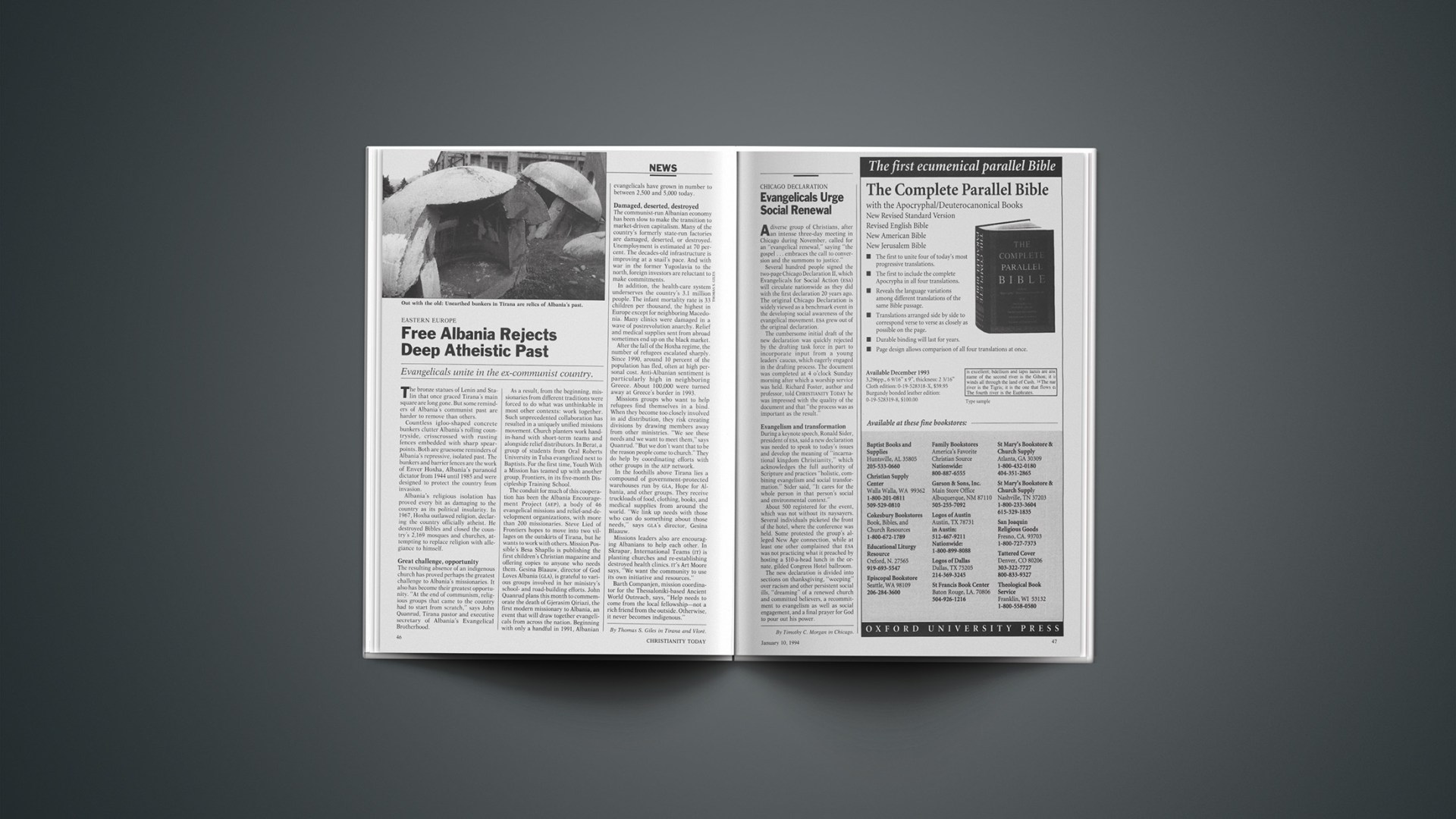
Countless igloo-shaped concrete bunkers clutter Albania’s rolling countryside, crisscrossed with rusting fences embedded with sharp spear-points. Both are gruesome reminders of Albania’s repressive, isolated past. The bunkers and barrier fences are the work of Enver Hoxha, Albania’s paranoid dictator from 1944 until 1985 and were designed to protect the country from invasion.
Albania’s religious isolation has proved every bit as damaging to the country as its political insularity. In 1967, Hoxha outlawed religion, declaring the country officially atheist. He destroyed Bibles and closed the country’s 2,169 mosques and churches, attempting to replace religion with allegiance to himself.
Great challenge, opportunity
The resulting absence of an indigenous church has proved perhaps the greatest challenge to Albania’s missionaries. It also has become their greatest opportunity. “At the end of communism, religious groups that came to the country had to start from scratch,” says John Quanrud, Tirana pastor and executive secretary of Albania’s Evangelical Brotherhood.
As a result, from the beginning, missionaries from different traditions were forced to do what was unthinkable in most other contexts: work together. Such unprecedented collaboration has resulted in a uniquely unified missions movement. Church planters work hand-in-hand with short-term teams and alongside relief distributors. In Berat, a group of students from Oral Roberts University in Tulsa evangelized next to Baptists. For the first time, Youth With a Mission has teamed up with another group, Frontiers, in its five-month Discipleship Training School.
The conduit for much of this cooperation has been the Albania Encouragement Project (AEP), a body of 46 evangelical missions and relief-and-development organizations, with more than 200 missionaries. Steve Lied of Frontiers hopes to move into two villages on the outskirts of Tirana, but he wants to work with others. Mission Possible’s Besa Shapllo is publishing the first children’s Christian magazine and offering copies to anyone who needs them. Gesina Blaauw, director of God Loves Albania (GLA), is grateful to various groups involved in her ministry’s school- and road-building efforts. John Quanrud plans this month to commemorate the death of Gjerasim Qiriazi, the first modern missionary to Albania, an event that will draw together evangelicals from across the nation. Beginning with only a handful in 1991, Albanian evangelicals have grown in number to between 2,500 and 5,000 today.
Damaged, deserted, destroyed
The communist-run Albanian economy has been slow to make the transition to market-driven capitalism. Many of the country’s formerly state-run factories are damaged, deserted, or destroyed. Unemployment is estimated at 70 percent. The decades-old infrastructure is improving at a snail’s pace. And with war in the former Yugoslavia to the north, foreign investors are reluctant to make commitments.
In addition, the health-care system underserves the country’s 3.1 million people. The infant mortality rate is 33 children per thousand, the highest in Europe except for neighboring Macedonia. Many clinics were damaged in a wave of postrevolution anarchy. Relief and medical supplies sent from abroad sometimes end up on the black market.
After the fall of the Hoxha regime, the number of refugees escalated sharply. Since 1990, around 10 percent of the population has fled, often at high personal cost. Anti-Albanian sentiment is particularly high in neighboring Greece. About 100,000 were turned away at Greece’s border in 1993.
Missions groups who want to help refugees find themselves in a bind. When they become too closely involved in aid distribution, they risk creating divisions by drawing members away from other ministries. “We see these needs and we want to meet them,” says Quanrud. “But we don’t want that to be the reason people come to church.” They do help by coordinating efforts with other groups in the AEP network.
In the foothills above Tirana lies a compound of government-protected warehouses run by GLA, Hope for Albania, and other groups. They receive truckloads of food, clothing, books, and medical supplies from around the world. “We link up needs with those who can do something about those needs,” says GLA’s director, Gesina Blaauw.
Missions leaders also are encouraging Albanians to help each other. In Skrapar, International Teams (IT) is planting churches and re-establishing destroyed health clinics. IT’s Art Moore says, “We want the community to use its own initiative and resources.”
Barth Companjen, mission coordinator for the Thessaloniki-based Ancient World Outreach, says, “Help needs to come from the local fellowship—not a rich friend from the outside. Otherwise, it never becomes indigenous.”
By Thomas S. Giles in Tirana and Vlorë.