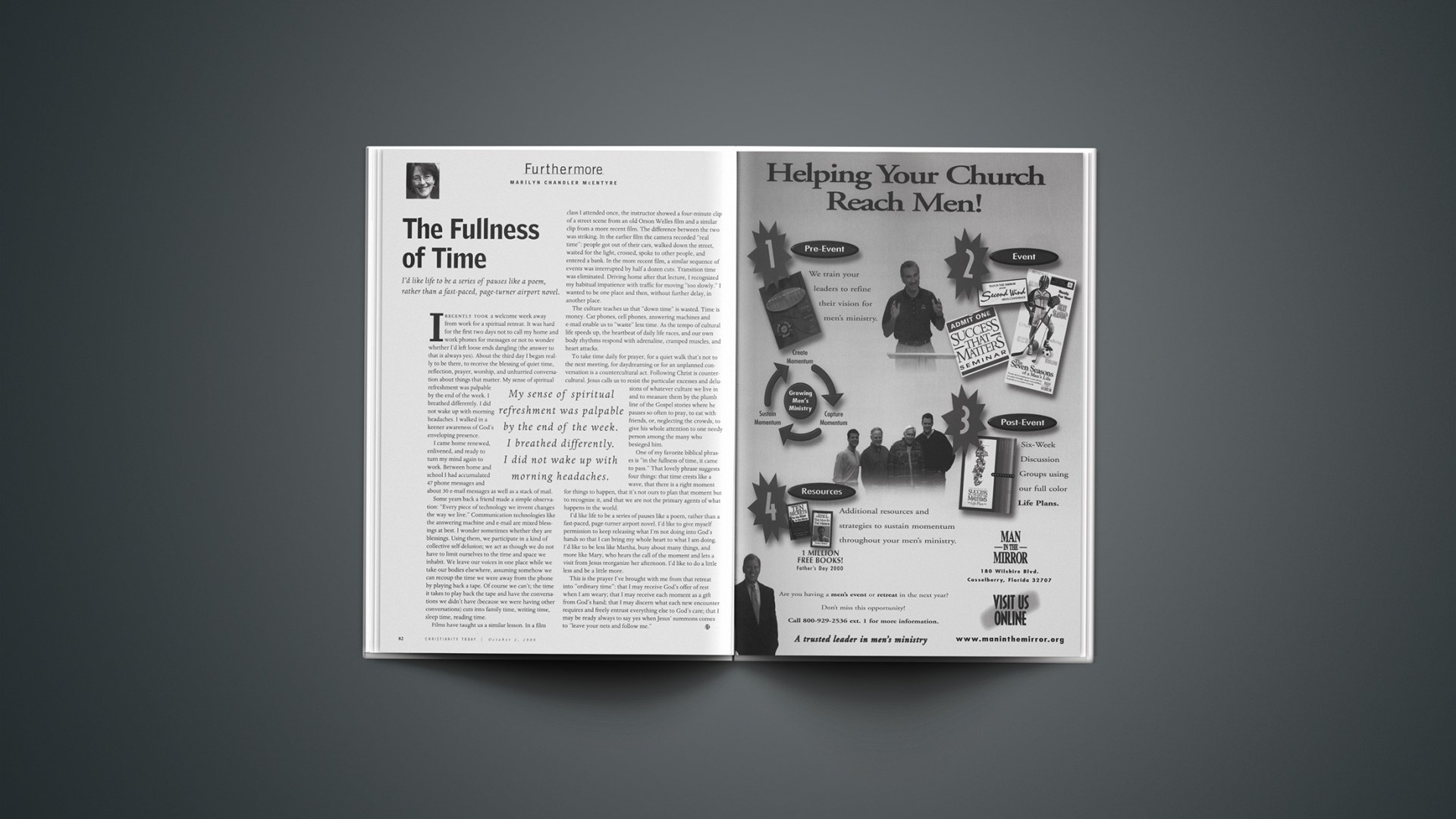

I recently took a welcome week away from work for a spiritual retreat. It was hard for the first two days not to call my home and work phones for messages or not to wonder whether I’d left loose ends dangling (the answer to that is always yes). About the third day I began really to be there, to receive the blessing of quiet time, reflection, prayer, worship, and unhurried conversation about things that matter. My sense of spiritual refreshment was palpable by the end of the week. I breathed differently. I did not wake up with morning headaches. I walked in a keener awareness of God’s enveloping presence.I came home renewed, enlivened, and ready to turn my mind again to work. Between home and school I had accumulated 47 phone messages and about 30 e-mail messages as well as a stack of mail.Some years back a friend made a simple observation: “Every piece of technology we invent changes the way we live.” Communication technologies like the answering machine and e-mail are mixed blessings at best. I wonder sometimes whether they are blessings. Using them, we participate in a kind of collective self-delusion; we act as though we do not have to limit ourselves to the time and space we inhabit. We leave our voices in one place while we take our bodies elsewhere, assuming somehow we can recoup the time we were away from the phone by playing back a tape. Of course we can’t; the time it takes to play back the tape and have the conversations we didn’t have (because we were having other conversations) cuts into family time, writing time, sleep time, reading time.Films have taught us a similar lesson. In a film class I attended once, the instructor showed a four-minute clip of a street scene from an old Orson Welles film and a similar clip from a more recent film. The difference between the two was striking. In the earlier film the camera recorded “real time”: people got out of their cars, walked down the street, waited for the light, crossed, spoke to other people, and entered a bank. In the more recent film, a similar sequence of events was interrupted by half a dozen cuts. Transition time was eliminated. Driving home after that lecture, I recognized my habitual impatience with traffic for moving “too slowly.” I wanted to be one place and then, without further delay, in another place.The culture teaches us that “down time” is wasted. Time is money. Car phones, cell phones, answering machines and e-mail enable us to “waste” less time. As the tempo of cultural life speeds up, the heartbeat of daily life races, and our own body rhythms respond with adrenaline, cramped muscles, and heart attacks.To take time daily for prayer, for a quiet walk that’s not to the next meeting, for daydreaming or for an unplanned conversation is a countercultural act. Following Christ is countercultural. Jesus calls us to resist the particular excesses and delusions of whatever culture we live in and to measure them by the plumb line of the Gospel stories where he pauses so often to pray, to eat with friends, or, neglecting the crowds, to give his whole attention to one needy person among the many who besieged him.One of my favorite biblical phrases is “in the fullness of time, it came to pass.” That lovely phrase suggests four things: that time crests like a wave, that there is a right moment for things to happen, that it’s not ours to plan that moment but to recognize it, and that we are not the primary agents of what happens in the world.I’d like life to be a series of pauses like a poem, rather than a fast-paced, page-turner airport novel. I’d like to give myself permission to keep releasing what I’m not doing into God’s hands so that I can bring my whole heart to what I am doing. I’d like to be less like Martha, busy about many things, and more like Mary, who hears the call of the moment and lets a visit from Jesus reorganize her afternoon. I’d like to do a little less and be a little more.This is the prayer I’ve brought with me from that retreat into “ordinary time”: that I may receive God’s offer of rest when I am weary; that I may receive each moment as a gift from God’s hand; that I may discern what each new encounter requires and freely entrust everything else to God’s care; that I may be ready always to say yes when Jesus’ summons comes to “leave your nets and follow me.”
Related Elsewhere
McEntyre’s credentials are available at the Westmont College site, including a list of all her books and articles. In Quiet Light: Poems on Vermeer’s Women , McEntyre’s latest book, will be available at the end of October.Previous McEntyre columns for CT include ” Silence Is to Dwell In ” and ” ‘I’ve Been Through Things’ .”Other Christianity Today articles on time include:Time Out | The view of time that the round clock suggests is only a polite fiction. In reality, time is running out. (Oct. 25, 1999) Rediscovering the Sabbath | The Sabbath is the most challenging—and necessary—spiritual discipline for contemporary Christians. (Sept. 1, 1997)
Copyright © 2000 Christianity Today. Click for reprint information.