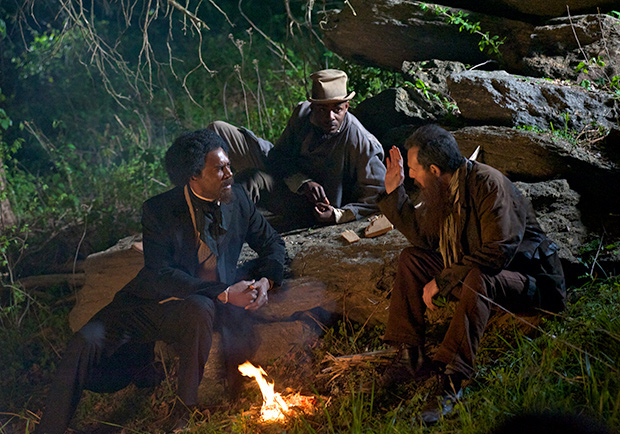
(RNS) As the nation marks the 150th anniversary of the Emancipation Proclamation, PBS premieres "The Abolitionists," a three-part series, today.
Documentarian Rob Rapley, the writer and director of the series, talked with Religion News Service about the role religion played in the lives of the abolitionists.
The interview has been edited for length and clarity.
How would you sum up the role of faith in the work of American abolitionists?
It was a time in which religion played a central role in American life with the Second Great Awakening. Every one of the abolitionists was shaped very much by their faith. In fact, they would have defined themselves first by their faith before any other category.
Many of the abolitionists were driven by the notion that slaveholding was sinful. How did their opponents respond?
One of the most difficult things to comprehend about this story is the degree to which slavery was an accepted part of American life. It was sanctioned in the Bible, certainly all over the place in the Old Testament, so slaveholders used that as justification.
Some abolitionists talked about "moral suasion." How did that affect their arguments against slavery?
They really resorted to this idea of converting people. Since that was a central part of the evangelical movement that was sweeping the country at the time, they thought, "Well why not? If people can be converted to faith then why can they not be converted to anti-slavery?"
How would you describe some of the religious views of abolitionists such as John Brown?
As John Brown saw it, God had a plan for him, that life was predestined and, especially, that you had to make sense of your afflictions. As John Brown's afflictions mounted, he took that as a message from God that he had to take up arms.
You pointed out the role of women abolitionists, such as Angelina Grimke's appeal to Christian women of the South. Was she at all successful?
She said explicitly, "I know that you do not make the laws, but your husbands and brothers and fathers do." She urged them to advocate ending slavery to their kinfolk who were in positions of power. She thought that if the women of the South turned against slavery, it would lead very quickly to the end of slavery, that men would follow suit. That was roundly rejected. The gentle appeal to her kinfolk resulted in a violent backlash.
Despite their differences, Frederick Douglass hailed William Lloyd Garrison for challenging the power of both church and state. What was Garrison's greatest charge against the church?
A lot of the established churches just said, "We don't want any part of this,'' where they had initially hosted anti-slavery meetings. Garrison said, "You are not being faithful to the Word. We are. Therefore, we must come out of the churches." It was actually called come-outerism: come out of the churches, come out of the government, separate ourselves from this unclean society. That was the essence of Garrison's charge. The churches were part of the evil.
What about Douglass? Did he have similar problems with the church?
Douglass had grown up in slavery surrounded by very outspokenly religious slaveholders who were the pillars of the Methodist church in Maryland. So he just felt from the beginning that the established church was just unredeemably corrupt. But he also was a profound, faithful man.
Before he signed the Emancipation Proclamation, President Lincoln had a different view on what to do with the U.S. slave population. What did he suggest to black ministers?
He invited five black ministers to the White House in the summer of 1862 and he basically said, "If it weren't for your people, we wouldn't have this war." He tried to recruit them into an effort to lead colonization. These prominent ministers would lead their people and, with the aid of the government, would take them back to Africa to Liberia or to Haiti. Everyone in the abolitionist movement was absolutely stunned by this. Once he had signed the Emancipation Proclamation, he never mentioned it again.
As the country marks the 150th anniversary of the Emancipation Proclamation, what message do you hope viewers will walk away with after seeing your series?
I think it's really a testament to the power of the individual. These characters were up against overwhelming odds. In hindsight, it seems like the end of slavery was inevitable, but it was in fact about the most unlikely thing in the world. And a very small set of people set this vortex in motion, which eventually swept up the country and changed our history for the better. It really is so easy to lose sight of the fact that if you're dedicated enough and if you have a clear vision of something right and true that you can, in fact, effect change.