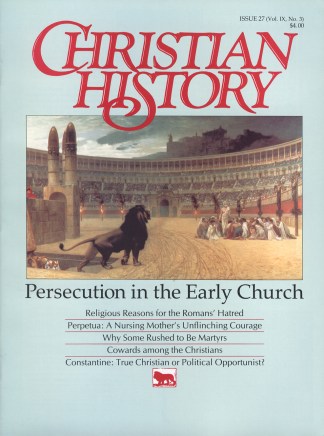
Persecution in the Roman Empire was not, as is widely supposed, a constsant experience for Christians. Rather, it was sporadic, spaced sometimes by long periods of relative tranquility. The first long peace lasted from 211 to 250 (briefly interrupted in 235), and the second from 258 to 303.
Diocletian, the emperor who launched the “Great Persecution,” was a somewhat reluctant persecutor, the main thrust coming from his junior colleague Galerius.
Persecution was not always Empire-wide; more often, particularly in the first two centuries, it was localized.
Inflamed rumors, perhaps based on the early Christians’ observance of the Eucharist and love feasts, accused believers of cannibalism and incest.
Many Christians lapsed (i.e., compromised their faith by complying with imperial directives or cooperating with government authorities) under the threat of persecution. The numbers of those who fell away produced a crisis for the church in the 250s. Eventually the question of whether to readmit the lapsed produced several schisms.
The church allowed flight in order to escape persecution and warned against rushing into a voluntary martyrdom.
The high regard for the martyrs as the heroes of the church and the privileges assigned to them led to the cult of the saints.
One of the leading charges against Christians in the Empire was that they were “atheists,” that is, they did not worship the pagan deities and so did not participate in the social and civic activities that involved homage to them.
The catacombs around Rome were burial places and only infrequently places of hiding during persecution. Their locations were known to the authorities, with whom they were registered.
Persecution often grew out of animosity by the populace rather than from deliberate government policy.
The “Edict of Milan” in 313, so the story usually goes, was an edict issued at Milan by the emperor Constantine that established Christianity as the imperial religion. Actually, this was not an edict but an agreement between Constantine and his imperial counterpart, Licinius, that resulted in rescripts to provincial governors. Though Constantine and Licinius had met in Milan, the “Edict” issued not from Milan but from Nicomedia, near Constantinople. In the agreement, Christianity was not established as the state religion but was recognized as a legally permissible religion among others in the Empire. There had been earlier grants of toleration, as by Gallienus in 261 and Galerius in 311.
The total number of martyrs was not nearly so great as often imagined. Imperial decrees often were directed against church property, the Scriptures, or only the leaders of the church.
Martyrs were thought to go directly to the presence of God without having to wait in an intermediate state for the final judgment.
Perhaps the most severe persecution, the “Great Persecution,” was also the last, beginning in 303 and continuing off and on in places until 324.
It is estimated that more people have been martyred for Christ in the past 50 years than in the church’s first 300 years.
Dr. Everett Ferguson is professor of Bible at Abilene Christian University and author of Backgrounds of Early Christianity (Eerdmans, 1987).
Copyright © 1990 by the author or Christianity Today/Christian History magazine.Click here for reprint information on Christian History.