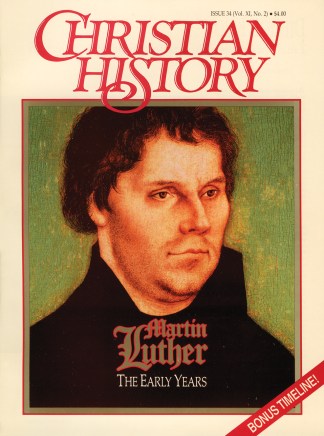
Scholars have given the mature Luther more attention in recent years. The following books help trace Luther’s actions and thoughts from the time he emerged from Wartburg Castle in 1522 until his death in 1546.
• Mark U. Edwards, Jr., Luther and the False Brethren (Stanford, 1975); Luther’s Last Battles: Politics and Polemics, 1531–1546 (Cornell, 1983). Two of the finest books about the later Luther. Interestingly written and based solidly on the sources.
• Martin Brecht, Martin Luther: The Preservation of the Church, 1532- 1546 translated by James L. Schaaf (Fortress,1993). The third and final volume of what will likely become the standard multi-volume biography of Luther in English.
• H. G. Haile, Luther: An Experiment in Biography (Doubleday, 1980; Princeton,1983). A colorful, well-written biography of the mature and aging reformer.
• Paul Althaus, The Theology of Martin Luther and The Ethics of Martin Luther, both translated by Robert C. Schultz (Fortress; 1966, 1972). Althaus systematically covers Luther’s doctrinal and social teachings.
• Heinrich Bornkamm, Luther’s World of Thought, translated by Martin H. Bertram (Concordia, 1958). The book presents Luther’s teachings on a wide variety of issues.
• Walter G. Tillmans, The World and Men around Luther (Augsburg, 1959). Interesting thumbnail sketches of the people, both friends and foes, who interacted with Luther.
• Jaroslav Pelikan, ed., Interpreters of Luther (Fortress, 1968). Eleven essays on how Luther has been interpreted from the sixteenth century through the twentieth century.
Luther’s Grave: Safe beneath the pulpit of the Wittenberg castle church, where he preached.
By Luther
Luther wrote some 60,000 pages, much of it later in life. For the range of those writings, see the largest English collection—Luther’s Works: The American Edition, 55 vols. (Concordia and Fortress, 1955ff.). Helpful short anthologies include Martin Luther: Selections from His Writings, edited by John Dillenberger (Anchor, 1961) and Martin Luther’s Basic Theological Writings, edited by Timothy F. Lull (Augsburg Fortress, 1989). Here are several key writings from the mature Luther.
• Eight Sermons at Wittenberg [Amer. Ed. 51, (67) 70–100]. Luther preached these in 1522 to restore peace and order following Karlstadt’s excesses.
• Seven Penitential Psalms [AE 14, (137) 139–205] and The Four Psalms of Comfort [AE 14, (207) 209–277] express the great reformer’s pastoral concerns.
• The Bondage of the Will [AE 33, (3) 15–295] stands as one of Luther’s most influential writings. He responds to Erasmus and declares that humans are saved not by their own merit or works but solely by the unmerited grace of God.
• Luther wrote three main treatises on the Peasants’ Revolt: Admonition to Peace [AE 46, (3) 17–43], Against the Robbing and Murdering Hordes of Peasants [AE 46 (45) 49Ä55], and An Open Letter on the Harsh Book against the Peasants [AE 46, (57) 63–85].
• In That These Words of Christ “This Is My Body, ” Etc., Still Stand Firm against the Fanatics [AE 37, (3) 13–147], Luther deals with the position of Zwingli, Oecolampadius, Bucer, and others on the Lord’s Supper.
• Two of Luther’s most distinctive commentaries on the Bible are Lectures on Galatians (1535) [AE 26, (1) 3–461; 27, (1) 3–149] and Lectures on Genesis [AK, vols.1–8]. Written during the last ten years of his life, these commentaries contain Luther’s final statements of his theology.
• On the Councils and the Church [AE 41, (3) 9–178] presents what has been called Luther’s “final judgment concerning the medieval church as well as the first broad foundation for a new doctrine of the church.”
Dr. George S. Robbert is professor of historical theology at Concordia Seminary, St. Louis, Missouri.
Copyright © 1993 by the author or Christianity Today/Christian History magazine.Click here for reprint information on Christian History.