In this series

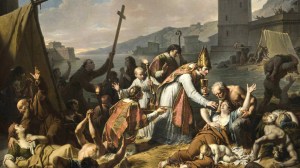
Medieval society was seen as composed of three complementary classes. Wrote one, “Some pray, others fight, and still others work”—referring respectively to clergy, knights, and lay people. “These three groups live together and could not survive apart.”
The medieval Catholic church accepted a wide range of religious tastes and expressions, which in the modern world might find places in different denominations.
Many medieval churches were owned privately by wealthy laymen, monasteries, or bishops. The owner sold or passed on the property as he wished, and its revenues went into his pocket. He appointed the priest, had him ordained, and paid him. Many owners gave the parish to a priest as a “living,” who as “rector,” received all or most of the revenues.
The parish rector collected offerings at mass, on the anniversary of a parishioner’s death, at weddings and funerals, and from penitents at confession. Offerings might be in kind: bread for Communion, wax and candles, eggs at Easter, fowls at Christmas.
During some periods, church offices were bought and sold openly, and church officials lived sumptuously—“loaded with gold and clad in purple,” as one critic put it. Money could buy any kind of dispensation, even for receiving stolen goods. The corruption so angered people, they sometimes ransacked monasteries or killed bishops.
Though priests took a vow of celibacy, many had concubines. The practice was often open and accepted, as long as the priest was faithful to one woman. One chronicler tells about a woman who lived with “a right amorous priest for many years and bore him four sons, three of whom became priests.”
The flickering lights of marsh gas were to many people fairies or goblins; fireflies were the souls of unbaptized dead infants. Many thought sorcerers and ghosts manipulated human lives. Astrology was used to explain things. For example, the University of Paris concluded that the bubonic plague of 1340s-50s was due to the conjunction of Saturn, Jupiter, and Mars.
Since Jews were considered responsible for killing Christ, they were discriminated against. Jews weren’t allowed to sell flour, wine, oil, or clothing to Christians. In some places, Jews (along with Moslems, heretics, and prostitutes) were required to wear in public a circular patch of yellow felt.
People were fascinated with Christ’s suffering. Many used Bonaventure’s advice to better identify with it: “Contemplate the drops of blood, the blows in the face, the persistence of the whip, the crown of thorns, the derision and spitting.…” Some people even whipped themselves until they bled.
People often associated in confraternities, charitable and social groups of 20 to 100 members. Among other things, they donated church windows, adopted hospitals, staged religious plays, and held sports competitions. On feast days, they processed with a statue or portrait of their patron saint. They also marched in the burial procession at a member’s death; if he died insolvent, they supported the widow and children.
Though many people strove to earn God’s forgiveness by good works, others—even those following the most rigorous religious lifestyle, monasticism—knew salvation is entirely by grace. One Carthusian monk wrote that the “inner goal, to forsake the world and follow Christ, cannot be had by one’s own natural powers but is by the free gift of God.”
By the 1200s, virtually all Christians were members of a geographically defined parish, each with its own pastor. In fifteenth-century England, there were about 9,500 parishes with 3 million people, an average of roughly 300 men, women, and children per parish.
Copyright © 1996 by the author or Christianity Today/Christian History magazine. Click here for reprint information on Christian History.