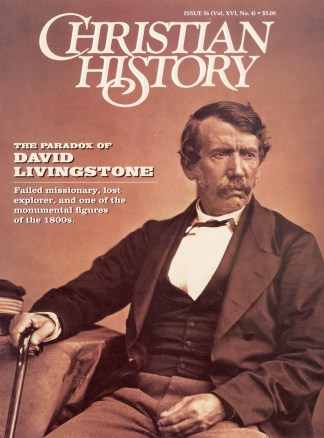
Along with his surgical kit and medicine chest, David Livingstone always carried a microscope and sextant—with which he observed God’s creation with awe and wonder. In his writings, he described his discoveries with a lively sense of imagination.
“The birds of the tropics have been described as generally wanting in power of song,” he said, comparing them to English song birds. The bird chorus “is not so harmonious and sounded always as if the birds were singing in a foreign tongue. … The mokwa reza gives forth a screaming set of notes like our blackbird when disturbed, then concludes with what the natives say is ‘pula, pula’ (rain, rain), but is more like ‘weep, weep, weep.’
“These African birds have not been wanting in song,” he concluded, “they have only lacked poets to sing their praises.”
Wild animals great and small figure prominently in his journals and books: rampaging rhinoceroses and drowsy hippopotamuses, wise ants and savage alligators. But of the hundreds of species he cataloged, he seemed particularly fascinated with three (not including the lion).
TERRIBLE TSETSE. The little fly that attacked oxen, cattle, and horses with such devastating consequences. Livingstone described one infected animal’s brain, saying it looked “as if a quantity of soap-bubbles were scattered over it, or a dishonest, awkward butcher had been trying to make it look fat.”
Elephants appear in two forms in Livingstone’s writings: alive and dead. They shout and trumpet from the riverside at the steamship going by, all very reminiscent of Huckleberry Finn along the Mississippi. Dead, they appear as a commodity of commerce: ivory. One “elephant was rather small, as is common in this hot central region,” he wrote. It yielded only 256 pounds of ivory.
In the savanna land, even worse than the mosquito was the tsetse fly, “a perfect pest,” which Livingstone put on the cover of his first edition of Missionary Travels and Researches in South Africa. The tsetse flies love the smell of oxen, cattle, and horses. They can decimate a herd or caravan in a matter of days, injecting a poison like tiny scorpions.
Anyone who has spent a summer in the north woods will sympathize with his hatred for the tiny mosquito. Livingstone was subject to recurrent bouts of “the fever” or malaria—27 by one historian’s count—which he described in precise medical detail. He was one of the first to make the connection between mosquitoes and malaria (although he blamed the marshy breeding areas, not the insects), and pioneered the use of quinine as a treatment.
Copyright © 1997 by the author or Christianity Today/Christian History magazine. Click here for reprint information on Christian History.