
Biologists love to make things glow in the dark. And why shouldn’t they? Who hasn’t been mesmerized by fireflies winking in and out of the night, the fleeting streak of a shooting star, or the unspooling of a movie in a darkened cinema? A light in the dark is very comforting. But for biologists, making things glow is essential.
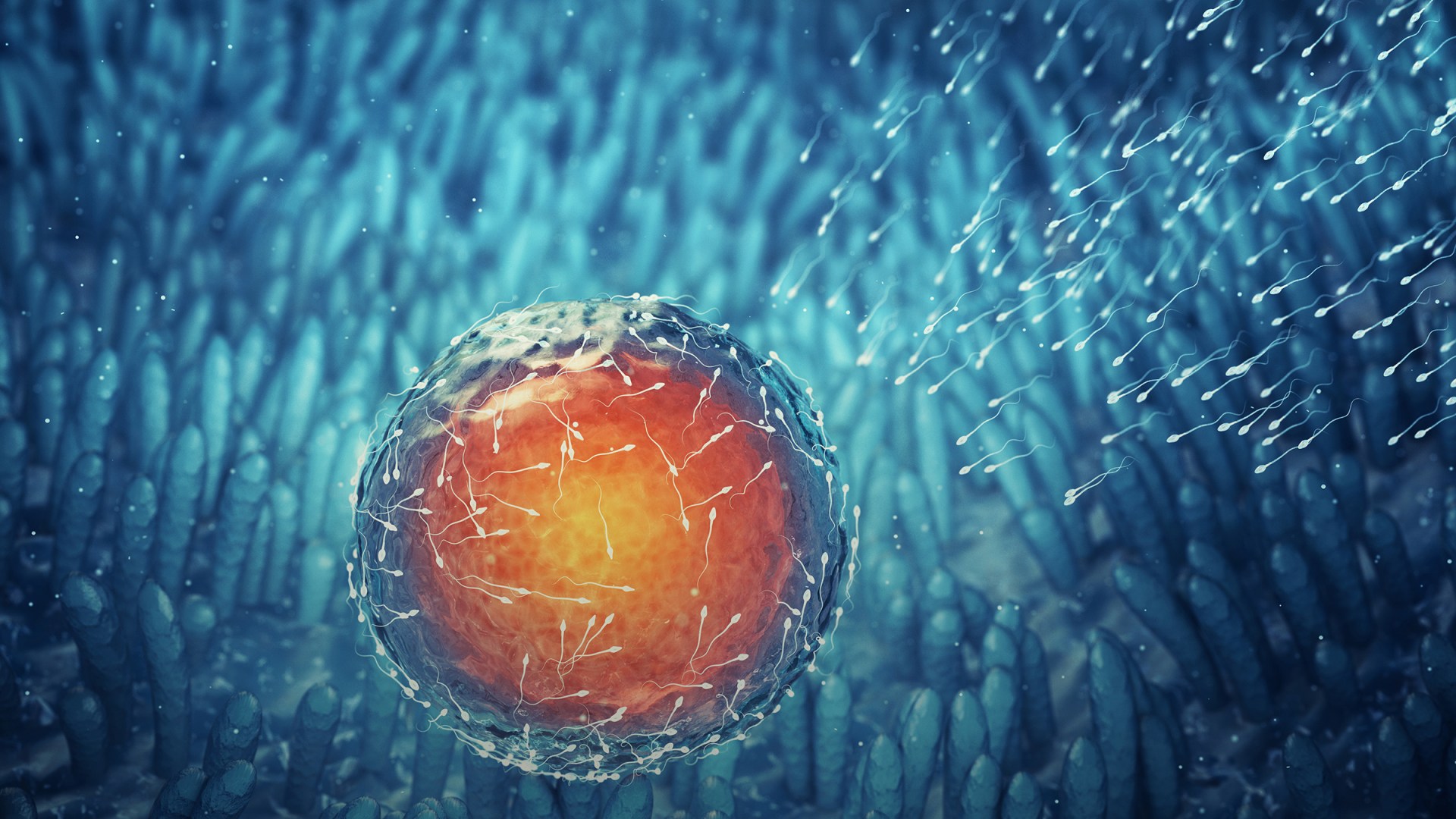
The latest achievement in this area has been widely circulated in a video of a human egg. The video is typically publicized as capturing the “actual” spark of light that occurs at the moment of human conception, but that isn’t really the whole story.
Without help from biologists, the materials of biology—such as the moment of conception—are largely inaccessible to the eye. Historically, microscopes have aided scientists by making individual cells big enough to see. But much of what goes on inside these cells remains too small or doesn’t interact with light in a way we can perceive. Fortunately, biologists have developed a host of clever tricks for making the invisible visible.
Stains and dyes were some of the earliest tools for revealing the unseen. Just about anyone who has been in a molecular biology lab has likely used ethidium bromide for example. It’s a chemical that fits in between the “ladder rung” base pairs of DNA. It also glows in the presence of ultraviolet (UV) light. These two properties make it perfect for detecting the presence of otherwise invisible DNA. Stains are also invaluable diagnostic tools, which help biologists identify different kinds of bacteria and other microscopic pathogens.
More recently, biologists have gotten help from fireflies and jellyfish. Fireflies glow because of a protein named luciferase and a chemical named luciferin. Luciferase transforms luciferin such that it will emit light. Through genetic engineering, all kinds of cells and organisms can be made to produce the luciferase protein at the same time as another protein under investigation. Then all biologists need to do is look for the light to see when and where the cells make luciferase, and by inference the other protein they want to study. The green fluorescent protein of jellyfish can play a similar role without the need to add luciferin; it just requires UV light to glow. Mice, fish, and even a rhesus monkey tastefully named ANDi have been given a little jellyfish glow.
Those are just a few of the tricks biologists employ to make the invisible visible. Sophisticated lab protocols using multiple fluorescing compounds can produce truly stunning pictures. Images of individual cells decorated in the vibrant primary colors of superheroes regularly make the covers of prestigious scientific journals and appear in news reports. Increasingly, scientific papers are supplemented with animated movies of these Technicolor marvels.
Last month’s video of human conception is fascinating and reveals a genuine biological phenomenon, the simultaneous release of large quantities of zinc from all over the egg cell. The coordination involved is impressive, and being able to visualize it in this way is informative and exciting, with implications for understanding human development and infertility. But there’s no actual “fireworks” inside the human body. The light in the video is provided by the researchers via a chemical that fluoresces in the presence of zinc; ordinarily the release of zinc would be invisible.
The development of a human being from a single cell is a remarkable process. We have learned a great deal about the intricate steps involved thanks to the ingenious work of biologists to see the unseeable. A whole host of questions would be unanswerable otherwise. For example, how does a spherical cell that appears completely symmetrical develop into something with clear left-to-right, front-to-back, and head-to-toe axes? Careful labeling reveals the invisible chemical gradients that signal which parts should develop where. Those mice and fish with the green fluorescent protein added show us the patterns of gene expression that further regulate the development process, causing certain cells to become your heart, your brain, your eyes.
Those eyes and that brain enable us to process lots of information visually, which is why rendering the invisible visible is such a powerful technique in science. The exacting work involved is also a reminder that there’s more to reality than meets the eye. In a universe that is 96 percent dark matter and dark energy, on a planet where 80 percent of the habitable volume is a kilometer underwater where sunlight doesn’t penetrate, in an ecosystem that may contain as many as 1 trillion species of which we’ve only seen 0.001 percent, we’d do well to remember that there is more to believing than seeing.
Andy Walsh (@MadroxDupe42) is chief science officer at Health Monitoring Systems, Inc., a public health software company. He earlier wrote about ant routes and exponential growth for The Behemoth.