News

Floods Scatter Christian Communities in Africa

A pastor in Kenya struggles to rebuild a church destroyed by erratic weather.

A resident carries her child through a flooded area in West Nyakach, Kisumu County, on March 22, 2026.

A resident carries her child through a flooded area in West Nyakach, Kisumu County, on March 22, 2026.

Christianity Today May 6, 2026
Brian Ongoro / Contributor / Getty

On March 3, Kenyan Assemblies of God pastor Benjamin Kogo woke up early to open his church, located 100 meters from his house in Emng’wen village on the slopes of Mount Elgon in Trans-Nzoia County, for morning prayers after a night of heavy rain. When he arrived, he found the building had collapsed during the night, the iron roof flat on the ground.

“We thought it was just normal rain,” Kogo said. “We did not know that it will cause such a damage.”

Kogo prayed with a few church members who had gathered, then called other members to inform them about the damage. They canceled the following Sunday service to allow church leaders time to look for an alternative venue. Kogo learned that Kitum Primary School, where another branch of the church often met, had also collapsed and flooded.

That Sunday, more than seven hours away in Nairobi, floods caused by heavy rains swept through the capitol, swamping several churches in the Mukuru area with several feet of water, disrupting Sunday services, and displacing 300 families from nearby homes.

Kenya’s National Police Service blamed flooding for 110 deaths across 30 of the nation’s 47 counties and the displacement of 35,000 people. The spring torrents followed a period of extreme drought in northern Kenya along the Somali border, which put 2 million people at risk of starvation.

Weather pattern changes, faulty early warning systems, and poor disaster response plans and infrastructure have left Kenyans—and other Africans—particularly vulnerable to natural disasters and made recovery slow. Some researchers attributed the record floods to wetter conditions caused by climate change and have reported that the March-to-May rainy season in East Africa has become intense and unpredictable.

Though the number of people worldwide dying from climate-related disasters has fallen, Africans are heavily impacted by these events.

In many cases, public weather forecasts remain inaccurate, leaving Kenyans distrustful of their usefulness. Some Kenyans may prefer to rely on traditional rhythms for planting crops rather than national weather forecasts or not find forecasts in their local language. Some Kenyans, especially from herding communities, prefer the advice and predictions of traditional “rain makers”—Indigenous people who claim to have the power to predict rains and droughts—over meteorologists. Kogo said he had heard predictions of heavy rain and floods on KBC, the national broadcast service, but he never took it seriously.

Failure or distrust of early warning systems leave Kenyans vulnerable. The floods and resulting landslides don’t just damage buildings; they separate communities.

“The floods scattered us,” Kogo said. “We have to walk about two kilometers to a school where we hold our prayers on Sundays.” He’s trying to keep his 80-member congregation together, but right now they can’t meet for weekday prayers—all the school classrooms are occupied.

Severe flooding has slammed other communities in eastern and southern Africa this year. In late January, Mozambique suffered the worst floods seen in decades—with at least 100 people dead and 80,000 homes destroyed. The World Health Organization (WHO) reported that several weeks of intense flooding affected more than 1.3 million people in six southern African nations, including South Africa, Tanzania, and Zimbabwe.

In early March, Ugandan authorities warned of flash floods, landslides, and related disease outbreaks that could occur due to heavy rains in counties along its western border, near Kenya. Days later, a prayer center in Kampala posted a video showed church members sweeping flood waters out of Christ the Rock Church and requesting funds to help rebuild.

In Kenya, pastor Sammy Logiron of the Anglican Church of Kenya in Kitale said his congregation and surrounding churches are rallying around rebuilding Kogo’s church. They schedule fundraisers after Sunday services, inviting wealthy community members such as politicians and businessmen who aren’t members. Attendees drop money or other items into a large basket placed in the center of the church. Then a guest pastor gives a speech and announces his contributions while presenting cash or a check.

“We are donating food, clothes, and money to help,” Logiron told CT. “We are all affected. When your brother is in trouble, you have to give a hand.”

So far, Kogo’s church has received 10,000 Kenyan shillings (about $77 USD)—enough to by wooden poles and nails for a makeshift structure. Kogo is planning another fundraiser in his church to buy plastic chairs for church members to use during services.

Alphonse Kanga, chairman of the National Council of Churches, Nairobi region, said that when floods displace people, churches often provide shelter, food, and blankets. But when church buildings collapse, this can leave a gap for residents in need.

Kanga blamed the disasters on both climate change and the failure of government systems that focus more on politicking and raising taxes instead of environmental stewardship: “If you mismanage the earth, you have destroyed it. You have gone against the will of God.”

Churches have long championed sustainable farming practices and protection of forests from too much mining or logging. Recently, they’ve also asked the Kenyan government to invest in green energy to reduce dependency on fossil fuels.

Some Kenyan church leaders have blamed corruption and land grabs for the deadly floods in the country. During a March 8 press conference in Nairobi, bishop David Munyiri of the Glory Outreach Assembly church said corrupt and influential people have grabbed land meant for water drainage to build their own homes and businesses. He called on the Kenyan government to strengthen its disaster management by recovering public property and rooting out corruption.

According to a 2023 study, corruption in disaster preparedness is an international concern, often causing or worsening natural disasters worldwide. Corruption can lead to sloppy infrastructure, poor zoning enforcement, and misuse of funds intended for disaster relief. Jackson Ole Sapit, archbishop of the Anglican Church of Kenya, called on the government to better enforce laws regulating construction around drainage systems.

The Resilience Action Network Africa (RANA), an advocacy organization that addresses health and climate issues in Africa, recommended the government take control of early alert systems while also encouraging communities to focus on local risk assessment and solutions to better protect their residents.

Churches are taking action to do just that. Pastors in neighboring South Sudan have tried to bring practical solutions to communities affected by flooding. Pastor James Deng, a local evangelist in the Bentiu region, told National Catholic Reporter, “People are not living in their homes, their crops are destroyed, and there is looming starvation.”

Deng said local churches are constructing dikes to safeguard residents whose lives might be endangered by flooding.  

On the slopes of Mount Elgon in Kenya, Kogo and his members now meet in a semipermanent building made of wooden poles and clay. Kogo said they are recycling iron sheets from the collapsed church and hope eventually to buy land on a site with higher terrain for a more permanent church home.

Members of the church are now digging terraces to collect and redirect future rainwaters that rush down from the hills. They are also planting indigenous trees along riverbanks to protect the soil from erosion. Kogo said environmental experts have advised them not to graze their animals near the water sources, because they destroy the soil. Meanwhile, the county government has provided seeds and fertilizer to those whose fields were washed out by the floods.

“It is sad [that we lost the church], but again we thank God that none of our members lost a life,” Kogo said.

Church Life

Faith Is Not a Sprint

President & CEO

A letter from CT’s president & CEO in our May/June issue.

A lone silhouetted figure walks down an empty corridor flanked by two converging rows of tall streetlights against a hazy pink sky.

David Mceachan / Pexels / Edits by CT

I grew up on stories of resilience. I heard my parents’ stories, how they walked miles to get to school each morning up and down the steep hills of Pittsburgh through snow and rain and blistering conditions. They recounted my maternal great-grandmother’s perseverance as she worked to integrate the local school system. They shared stories of the patriotism of my grandfathers who served in World War II and returned home to fight national wars against inequality. These were the legends of my ancestors who pressed through the difficulties for the sake of a better life for themselves and subsequent generations. While they battled larger systemic challenges like Jim Crow and economic barriers on the outside, some stories were as small as overcoming self-doubt on the inside.

The climax of these stories was never a point of pain or oppression, but the deep resolve and transformative resilience that kept them going when others quit. I learned that tenacity is a product of steeled, stubborn, seed-like faith that blossoms over time. These stories were more than personal narratives passed down to my generation. Their inner resolve was a family heritage meant to teach, but it was more than that: Resilience was a central part of our shared Christian faith.

This perseverance is available to every believer. The writer of Hebrews likens the life of faith to a race, reminding us that we are to “run with perseverance the race marked out for us, fixing our eyes on Jesus, the pioneer and perfecter of faith” (12:1–2). With our gaze on God’s glory and our faces focused on the Savior, we can have faith to envision what the world cannot see, so that we may travel farther than others could ever imagine.

This kind of faith is far from a sprint. The tenacity to keep going grows resilience, but never resilience for its own sake. It is only when we fix our eyes on Jesus that we’ll have the resolve to keep placing one foot in front of the other. No matter the cost. No matter the systemic or individual challenges. No matter how often the gates of hell try to overcome the Christian or the church (Matt. 16:18). Jesus has defeated even death! His resurrection testifies that death does not have the final say. In his resurrection power, the order of things has changed. Now that sin and death have lost their sting, restoration and revival might speak words of fortitude and triumph.

The magazine you hold bears witness to this divine reality. Over Christianity Today’s seven decades, our leaders wanted to quit at times. There were seasons of challenge and negative opinion. There were countless days where the solutions to problems were not easy to find. The cultural headwinds were sometimes against them, and yet, through Christ, they survived. So it is for all of us: Our individual and corporate lives testify to God’s faithfulness.

I invite you to reflect on your own stories as you lean into the ones we share in these pages. Remember the resilience of generations past and find hope in the grace that is accessible to all through Jesus. When you do, I believe you’ll find that God is stronger in you than you could ever be on your own.

Nicole Massie Martin is president & CEO of Christianity Today.

Theology

Why I Don’t Debate Atheists

Columnist

We need apologetics, but what we need more is genuine confidence in the Word we carry.

Cartoon illustration of two political candidates sitting knee-to-knee on stools in front of empty podiums, engaged in friendly conversation.
Illustration by James Yates

As a former seminary dean, I’ve interviewed lots of people for jobs teaching Christian apologetics, to equip future pastors and missionaries to defend the faith against unbelief. Almost all of them were brilliant—skilled not only in philosophy and science but also in rhetoric and logic. Many of them were quick on their feet and could demolish any atheist who dared debate them. After a while, though, I noticed something all these interviews had in common. When I would ask, “How did you come to Christ?” not a single one, to my memory, ever pointed to an apologetic argument.

Often these apologists would talk about finding faith the same way I did: growing up in a good church or having parents who shared and demonstrated their faith. One candidate, a towering intellect who had been a graduate student at an Ivy League university, happened to stumble into a tiny congregation to hear a preacher with a fifth-grade-level education talking about what grace means. Another candidate blushed as he told me he became a Christian while watching disgraced televangelist Jimmy Swaggart quote John 3:16.

But these scholars had nothing about which to be embarrassed. I walked away from those stories even more amazed by grace than I would have been had they told me they were convinced by the cosmological argument for the existence of God. And sometimes I wished these apologists who became Christians through seemingly unsophisticated ways would say that more often, more loudly, more publicly. In fact, as the years have gone by, I’m even more convinced that the parts of their lives they mentioned quietly are far more important to defending the faith in the 21st century than the carefully crafted onstage takedown of a professional atheist.

We are well past the heyday of traveling road-show debates, which were at their height when the New Atheists at the end of the last century levied Bertrand Russell–like breadth of knowledge with Oscar Wilde–level wit and sarcasm against the Christians across from them. In other debates, apologists seemed to get bored with talking about, well, God as they moved more and more into political polemics or attention-economy YouTube theatrics.

Today’s apologetics debates are quite different from those of eras past; sometimes both sides seem to doubt that there’s a God and that he raised Jesus from the dead. Some of those most eager to defend the faith want to talk instead about civilization, discussing how socially “useful” Christianity is rather than whether it’s true. Some of them speak definitively about gender pronouns or Islamic jihadism or vaccine mandates, but when asked whether the Resurrection happened, they’ll say, Well, what do you mean by “happened”?

All that seems exhausted now. Yet something is stirring, and I think it could take us where we should have been all along.

In the case of apologetics debaters, the exceptions prove the rule: What makes the best apologists stand out is precisely the ways they are not a mirror image of their interlocutors. Think of the most compelling defenders of actual historic Christianity, even in “Christian versus unbeliever” open debate. William Lane Craig comes to mind, as do John Lennox and many others. Yes, their gifting is in rhetorical firepower and philosophical argumentation, but those traits seem embedded in something else. When these forums seem to burn with life-changing fervor, it is not when the Christians applaud loudly and the skeptics slink away, having been “owned.” It’s not just about their arguments—these apologists could not be replaced by artificially intelligent debate bots. Something else is there.

Most of us, when thinking about apologetics, turn to Acts 17, the account of the apostle Paul at the Areopagus, and rightly so. Paul squared off against the Athenian Stoics and Epicureans, skillfully demonstrating—from their own architecture and poetry and philosophers—that they didn’t have the certainty they pretended to possess. But what we often forget is that Paul, though ready to debate that way, didn’t start there.

What provoked the session at Mars Hill was not what made the gospel intelligible to Athens but what made it strange. He was, Luke records, “preaching Jesus and the resurrection” (Acts 17:18, ESV throughout). Paul went from the Resurrection to disputes over the “unknown God” to right back where he started:

The times of ignorance God overlooked, but now he commands all people everywhere to repent, because he has fixed a day on which he will judge the world in righteousness by a man whom he has appointed; and of this he has given assurance to all by raising him from the dead. (vv. 30–31)

At its best, our emphasis on apologetics has served God’s kingdom well when it is enfolded in a much bigger project of carrying, bearing witness to, and demonstrating the gospel that reconciles people to a God who loves them and forgives their sins. But the debate culture of our time can sometimes impede that end. Christians sometimes think the way to share the gospel is to have a ready answer for every possible objection to belief—from archaeology to quantum theory.

The church needs people who can do all that—and that’s why we ought to thank God for and support the training and participation of physicists and archaeologists and philosophers and, yes, YouTubers and TikTokers who know how to have a virtual cage fight.

But we also need to emphasize that not every individual needs to be equipped to do all that in order to share the gospel and bear witness to the life-changing reality of Jesus Christ. Some are intimidated because they feel inadequate to “always [be] prepared to make a defense to anyone who asks you for a reason for the hope that is in you” (1 Pet. 3:15). But the apostle is not calling for omnicompetent debaters.

The “defense” here is in the context of people who are free from fear of what others can do to them, who seek holiness, who are gentle and respectful, who have good consciences. It’s not primarily about how Christians articulate the hope that is within them but about how they cultivate it.

Apologetics is not about building the household of God; it’s about clearing the brush around it. When someone says, “We can’t trust the Gospels because they were written hundreds of years after Jesus lived,” we should show them why that’s not true. When someone says everything is material, we ought to show them how they don’t really act as though love and courage and music and beauty are just chemical secretions. We might set up a ride to church for a friend who can’t get there or note where the wheelchair ramp is for a neighbor who’s had surgery, but the point is not the ride or the ramp—it’s what happens once that person gets there.

Apologetics is not the mastery of information for the sake of getting people to master Jesus as another, greater piece of information. God is not an algebra equation. Faith is “the evidence of things not seen”(Heb. 11:1, KJV). Evidence may lead people to a moment when, in seeing Jesus, they have faith. But faith is not the endpoint of an accumulation of evidence. Faith is the evidence. People must experience it from the inside to really know it.

The great Mississippian novelist Eudora Welty once explained why she didn’t “crusade” more in her writing. She said in an Atlantic essay, “A plot is a thousand times more unsettling than an argument.” She was right. We need the arguments, but none of them matter if we’ve lost the plot.

We need debaters, yes, and we need experts. But more than that, we face an opportunity when people all around us are exhausted by living like machines. Many of them will keep their guard up and argue confidently, but deep down they wonder, What if there is more than this? What if, behind all this, there really is someone who knows and loves me? Apologetics is a step toward showing people Jesus, but winning arguments alone is not the kingdom of God.

What we need now is genuine confidence. The Word we carry is resilient and can handle whatever the next decade throws at it. That’s not because our opponents are stupid but because the gospel is true.

Russell Moore is editor at large and a columnist at Christianity Today.

Church Life

Evangelicals Debate Sterilization

Vasectomies and tube tying are more common among evangelicals than many realize. Do they have biblical warrant?

Composite image featuring three editorial-style illustrations: an abstract collage of overlapping silhouetted figures; a lone silhouetted person standing at the intersection of multiple converging paths; and a silhouetted family on a hillside at sunset.

Illustrations by Shonagh Rae

In this series

About 15 percent of men in the US between the ages of 45 and 49 have undergone a vasectomy. The Centers for Disease Control and Prevention reports that tubal ligation (tying fallopian tubes) is the most common form of birth control for women in the country. On social media platforms, women are celebrating their hysterectomies with friends. These procedures are not uncommon, including in the church. Yet we don’t talk about them.

Hysterectomies are most commonly used for dangerous or debilitating health problems such as to save life during birth or to treat endometriosis. Often, women are devastated after receiving them even if the procedure saved their lives. But female sterilization especially has a dark history. Historically, governments worldwide have used them to compulsorily sterilize women or to control “undesirable” populations, including certain ethnic groups, immigrants, the mentally ill, or unmarried mothers. Today, hysterectomies are still used in some places to force women to work more efficiently. Meanwhile, others see them positively as “gender-affirming treatment.”

So how should the Christian think about these permanent sterilization procedures? Christianity Today invited three writers to consider “the snip” more thoughtfully. Justin Whitmel Earley shares a personal story about his decision seven years ago and encourages men to care for their families through taking on the burden of contraception. Katelyn Walls Shelton examines why we are uncomfortable with the conversation about sterilization. Finally, Matthew Lee Anderson writes that Protestant arguments for and against vasectomies are not rigorous enough—and that we must think more clearly and carefully here.

As you read, our hope is not that you feel shame, regret, or discomfort. Rather, it is that you thoughtfully consider a cultural movement through the lens of Scripture and a theology of the body so you can carefully counsel church members or consider all sides of a decision before making a (quite literally) life-altering choice.

Kara Bettis Carvalho is the senior features editor at Christianity Today.

Ideas

Men Who Didn’t Get the Message

Editor in Chief

Amid pressure to worship Darwinism, these are three stories of resilient refusal.

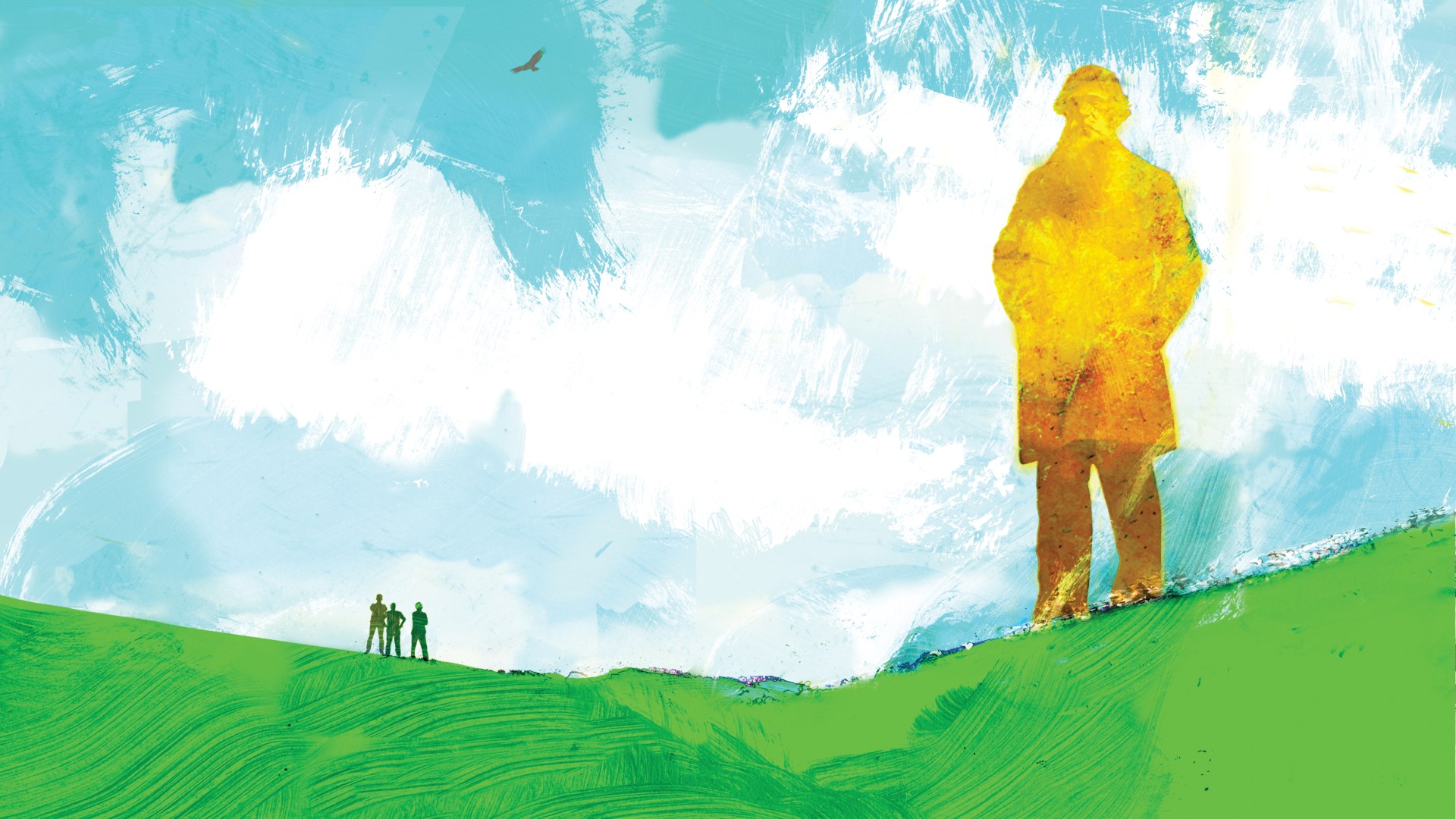
Painterly illustration of three small figures gazing up at a towering golden silhouette of Charles Darwin.
Illustration by Simon Pemberton

They didn’t get the message. They won’t bow down.

About 2,600 years ago, King Nebuchadnezzar erected a 90-foot-tall image of gold on the plains of Babylon. He assembled his empire’s leaders, and a herald announced, “When you hear the sound of the horn, pipe, lyre, trigon, harp, bagpipe, and every kind of music, you are to fall down and worship the golden image.” The alternative: “Be cast into a burning fiery furnace” (Dan. 3:5–6, ESV). 

For decades now in university science classrooms, the furnace hasn’t been fiery, and most of the music has come from marching bands on football fields. But the message to conform to Darwinistic materialism has seemed unstoppable. Rice University chemistry professor James Tour says Darwin devotees preach it to their students, who pass it along to their students in turn. Nobody “wakes up in the morning thinking, I’m going to deceive people today,” he told me. “You grow up with it. The professor acts like he knows it, and you just nod along.” 

Vern Poythress, who celebrated his 80th birthday on March 26, understands the milieu. He was valedictorian of his class at the California Institute of Technology, an experience he says was “invaluable in understanding the ‘This Is How We Do Science’ atmosphere. It’s not just words. It’s a whole community experience—and God never enters into the picture.” 

Encouraged by his parents, Poythress was a math prizewinner, but he said, “I became more and more interested in the Bible and in theology. Midway through grad school, I realized all my spare time was going into Bible and theology. And I stood back and asked the Lord, ‘What does that say? Where is my heart?’ I decided, yeah, I really want to study this. My parents had to adjust.”

Poythress has a PhD in mathematics from Harvard and is the author of 26 books, including Redeeming Mathematics and Redeeming Science. His knowledge is important because “population genetics” is the big push among Darwinists today, now that the search for a “missing link” (or “transitional link”) between apes and humans has faltered—more about that later. The mainstream belief has become that humans have more genetic variation than an original Adam and Eve could have produced.

Poythress told me about one article making that claim. “I looked up the footnotes, and the footnotes were these technical articles on models of population genetics. But I could read them because of my math background. I saw that built into the models were assumptions about the size of population needed, but those were assumptions. It’s all hypothetical. Evangelicals who are not comfortable with the science get intimidated.”

Married for 43 years, Poythress has taught at Westminster Theological Seminary for 50. He talked about the pressure to conform: “I’m grateful to the Lord for my background because it means that I’m not swept away.” 

He also rests in the understanding that God acted supernaturally in creation and resurrection, “first Adam and Second Adam.” Adam and Eve, he notes, could have had normal DNA but sperm and eggs “with extra diversity. Could God do that? Of course he could. Did he do it? We don’t know. But I’m not willing to say I know he didn’t do it.” Much that seems strange could happen “when you’ve got a unique event. And God does what he pleases.” 

And so does Poythress, not on theological essentials but on cultural standards. During our interview, he was in his home office in Glenside, Pennsylvania, but he wore a tie. I asked why. He responded, “Oh, I see. This looks strange to you. Most of the faculty go without ties nowadays, but this is a professional meeting, so I’m going to dress professionally. That’s the way I think. The culture is going every which way, but I’m going to be who I am.”

Another professor who stands by his standards is Tour at Rice University. Tour, 66, has taught chemistry at the leading research university since 1999, with respect from the administration because he’s pulled in millions in grant dollars for his pathbreaking work in nanotechnology and materials science. “I bring in more money to the university than anybody else,” he said. That’s hard to verify externally since Rice does not publicize the data, but the university’s Office of Research, in a glowing article headlined “The Relentless Genius of James Tour,” was 

dazzled by the range of fields Tour touches: cancer therapy, chemical cleanup, sustainable manufacturing, advanced nanotechnologies like computer memories and ultrastrong materials. … Tour doesn’t just publish and move on. He actively pushes his discoveries toward commercialization: More than a dozen startups and partnerships have spun out from his research.

Tour also makes lists like “The World’s Most Influential Scientific Minds” and “The 50 Most Influential Scientists in the World Today.” His career h-index score of 182 (measuring how often people cite a researcher’s work) is like hitting 500 home runs in Major League Baseball—which would mean entry into the Hall of Fame.

And yet Tour gets eye rolls and worse from many other scientists and is not one of the 2,600-plus members of the National Academy of Sciences. Current members would have to vote him in, but Tour has shown that an emperor of mainstream biology—the idea that life emerged purely through natural causes—has no clothes. 

Tour is famous, or infamous, for telling defenders of blind evolution, “Show me the chemistry!” And, he says, they can’t.

Based on his record, Tour knows chemistry as well or better than any other human, so when he says, “I don’t understand the chemical basis behind evolution,” scientists in other fields should listen. “The few people who really know a lot don’t want to talk to people like me because I ask them questions,” he says­—questions that make “their arguments wither.” Those questions include: How do simple organic molecules spontaneously assemble into complex, functional components in the right place and purity? What are the specific chemical reactions that transform one complex biological system into another?

My junior high school teacher in 1964 taught me about the 1952 Miller-Urey experiment that featured a lightning strike forming some amino acids. The theory about the beginning of life is still pretty much stuck on that speculation, which Tour scoffs at. The chemistry of cells, he explains, is so hugely complicated that it could not be the product of chance. He also says the human brain is so massively different from any animal brain that belief in the one-small-change-at-a-time mantra, no matter how many eons are involved, involves a leap of faith greater than rational people should indulge.

Charles Darwin contended in The Descent of Man (1871), his sequel to On the Origin of Species, that humans are descended from an apelike ancestor that lived millions of years ago. Tour differs: “Humans alone have the capacity for art, music, advanced communication, advanced mathematics, and religious practice. I do not understand the mechanisms needed to change body plans or the mechanisms along the descent pathway. Nobody else understands the mechanisms either. Nobody.”

Real science is based on evidence, and Tour says that since the idea of life originating from nonliving matter has no evidentiary support, Darwinism is faith rather than science. Ironically, that makes Tour, who grew up in a Jewish home and became a Christian in graduate school, the scientific agnostic in the classroom. He teaches what is proven scientifically regarding how life and humans emerged so, he says, “I have no problem telling the young we don’t know. I never say God did this. I just say, ‘Science doesn’t know.’”

Tour did gain election to the National Academy of Engineering in 2024 and was not surprised: He remembers years ago going to “a big engineering meeting. They prayed before they ate. It would never happen in the sciences, never, that these people would pray. The engineers have always been more open. I mean, scientists act as if they understand these things, but they really don’t. I’ve sat with them many times. Many of them have said to me they agree with me, but not to use their name.”

Tour does give some scientists an out: They’re not chemists, so they look at the big picture and not the tiny pictures of cells—“You’re not a chemist; you just nod along.” But he sees change coming: “Just today a student walks up to me and says, ‘I don’t understand how life comes about. Do you have some information I can read?’”

Tour does, and you can read his explanations (and his testimony) at JMTour.com. You can also readily access the enormous abuse heaped on him by Googling “James Tour.” How does Tour stay resilient as he faces frequent attacks? He said he’s willing to challenge the scientific community “because Jesus challenged his community.” He then referred to Luke’s quotation of Jesus: “Whoever is ashamed of me and of my words, of him will the Son of Man be ashamed when he comes in his glory” (Luke 9:36, ESV).

Tour also has the benefit of a 43-year marriage to Shireen, who grew up in a Christian home in Pakistan. “I think the criticism hurts her, but she always encourages me,” he said. “She doesn’t complain about it.” Tour does complain, but the wall of his office has a student-drawn depiction of the fruit of the Spirit.

He recited what it proclaims: “love, joy, peace, patience, kindness, goodness, faithfulness, gentleness, self-control.” Tour clearly depends on those and tries to restrain his sarcasm about Darwin advocates, but he still says, “The vast majority of people who are very confident in evolution know nothing about it.”

Daniel’s history of the flaming furnace has three protagonists—Shadrach, Meshach, and Abednego—so I spoke with a third person who has the background to understand these scientific arguments. Hans Madueme, 50, has since 2012 been a theology professor at Covenant College, an unlikely landing point for a person with a medical degree and three years of residency at the prestigious Mayo Clinic. 

That’s particularly true given his heritage: “Both my parents are Nigerian [with] a very traditional way they thought about vocations for their kids. At the top was medicine and then law and engineering and maybe architecture. Anything else was worthless.” Madueme’s dad worked for the United Nations: Madueme, born in Sweden, raised in Austria, and schooled in England, said, “I’ve always been more of an outsider than an insider.”

Madueme entered college at McGill in Montreal and “did all the pagan things that you do.”

During the summer, though, he visited his aunt and her family in Nigeria. “They did family devotions every evening. I had to sit in. It wasn’t anything profound: Read a bit of Scripture, talk about it, maybe sing a song and pray. And for whatever reason, in that context suddenly my eyes were opened.” He returned to McGill and said, “I’m a Christian now.” His friends were shocked “because of all the ways we had hung out, partying and all that.”

Madueme joined the McGill Christian Fellowship. “So now I’m a Christian learning what it is to be a Christian, and I’m a premed student doing a bachelor’s in anatomy.”

He entered medical school at Howard University in Washington, DC, and then completed his internal medicine residency in Rochester, Minnesota. 

“Of course, with his eldest son ‘at the world-renowned Mayo,’” Madueme said, his dad “was the proudest Nigerian you could be.” But during his residency, Madueme was using his stipend to feed a growing theological hunger: “All these theology books arriving from Amazon, and I’d rush home from the hospital to unpack another book.” Soon, he said, 

My dreams are about preaching, about theology. Being a doctor is a great calling and way to serve the Lord, but I felt pulled in other ways. It was a crisis, because you can’t be a Nigerian at the Mayo Clinic and decide you want to do something else; that’s unheard of. I knew this would be very difficult for my parents. I talked to them, and not surprisingly they were saying, “Why don’t you practice medicine for 10 years? If you still want to go to seminary, you could do it then. Don’t make this rash decision, son.”

But Madueme made his own decision, and now he’s a professor, a church elder, and the author of Defending Sin: A Response to the Challenges of Evolution and the Natural Sciences. His training allows him to analyze critically what others merely accept: “I can look at what the experts are saying while asking the uncomfortable theological questions. When I push back on evolutionary biology, that puts me, at least by some reckonings, in an unsavory place, but I’m happy to let the chips fall where they may.” Madueme has no qualms recognizing the arguments supporting evolution, but like Poythress, he remains unpersuaded because the counter-evidence from Christian theology and the biblical foundations on which it rests are stronger. In the end, God is God. 

Did growing up as an outsider and being willing to push back against cultural expectations when necessary prepare Madueme to push back against other pressures? Shadrach, Meshach, and Abednego had the God-given faith to stand for Him and stand up to Nebuchadnezzar, and the experience of their whole lives helped.

My own doctorate is in American studies, not scientific or biblical studies, so I approach both subjects as an amateur. As a journalist, I do notice trends, and it seems that the high point for materialist evolution was the centennial in 1959 of Darwin’s paradigm-shattering work, On the Origin of Species. One year later, the hit movie Inherit the Wind portrayed the evolution debate as a battle of smart versus stupid.

My biology textbooks during the 1960s all showed the “tree of life,” which was Darwin’s prime metaphor in The Descent of Man. I and millions of others learned that our ancestors first moved on all fours then stood up to see over the grass—and then brains became bigger and thumbs became opposable. Brow ridges softened and teeth shrunk. The creatures made tools and mastered fire.

The Beatles in 1967 sang “Lucy in the Sky with Diamonds,” and the 1970s brought fame to some 3-million-year-old bones scattered across the Ethiopian ground. They became part of a put-together four-foot-tall skeleton of Lucy, named after the song. Lucy was a member of Australopithecus, a genus of “hominins,” purported ancestors of humans known as “missing links.” The “I love Lucy” show at many museums is still going. When Tour makes fun of those who see an easy pathway “between the australopithecine brain and modern human brains,” he’s taking aim at exhibits at the American Museum of Natural History and others that show Lucy fossils or models of them.

As late as 2015, Time was still running headlines like “How Lucy the Australopithecus Changed the Way We Understand Human Evolution.”

But even then the bubble was bursting. As Nature articles have acknowledged, much of Lucy’s body (as best we can tell, since only about 40 percent of her bones were found) was “quite ape-like.”

If she did walk upright, it wasn’t much like humans because she also knuckle-walked like today’s chimps and gorillas and spent a lot of time in trees. A 2016 Science Daily headline noted the results of a Johns Hopkins study: “Human ancestor ‘Lucy’ was a tree climber.”

Overall, the idea that Adam and Eve were special creations of God has new resilience, and Tour’s “Show me the chemistry” challenge resonates more than it might have 20 years ago. Unable to answer well, some Darwinians have turned more to “Show me the math”—but the claim that humans and chimps have 99 percent similarity in DNA has given way to estimates of 84 or 85 percent. 

The new analysis, instead of proving Darwin’s “descent of man,” is leading to the descent of percentages. My children 40 or so years ago enjoyed a song lyric “I am not descended of monkeys, / though you may be fooled at first glance.” But the battle over statistics is not child’s play. (Although children enjoy learning that humans and bananas have genes with a 60 percent DNA overlap.)

With the study of bones inconclusive, “population genetics” is the new standby, but Poythress and others have pointed out alternatives to assuming human populations worldwide have so much variety that a human pair in the past 500,000 years could not be responsible for the world’s occupants. 

As an epilogue to Poythress’s story, recent research from many Christian biologists and mathematicians shows that modern human genetic diversity does not preclude our species descending from an initial pair.

So clear were their findings that, in 2018, one of the top initial promoters of this argument against Adam and Eve conceded that even a naturalistic history of the human race could accommodate Adam and Eve giving rise to modern human genetic diversity, provided they lived far enough in the past. 

So if a Caltech valedictorian turned theologian, a Jewish Christian chemist with more than 1,000 publications, and a Swedish Nigerian with a Mayo Clinic seal of approval walked into a bar—no, a meeting of the National Academy of Sciences—what would happen? They could hold their own.

Marvin Olasky is editor in chief at CT.

Books
Review

We Don’t Need Resilience. We Need Resurrection.

As Tish Harrison Warren’s new book explores, springing back to strength after disaster isn’t the picture offered by Scripture.

Colorful illustration of cluttered shelves filled with wilting potted plants, a cracked classical bust, scattered books, a sneaker, a wine glass, and various household items against a black background.
Illustration by Yuki Murayama

Conversations with my husband these days often center on the logistics of family life. We have to sort out what feels like infinite details: We are launching our eldest out of 24-7 life at home to college in the fall (so many scholarship deadlines, decisions, and FAFSA applications); we need to keep track of our second son’s golf calendar; and we sort through school choices for my third son, all while planning the travel for my daughter’s gymnastics meets. We also must decide who is feeding the bunnies, cooking dinner—and could we please just sit in quiet and watch All Creatures Great and Small at the end of a long day? Is that too much to ask?

We long for an escape from the details. A sick day sounds preferable to endless to-do lists, looming questions about the future, and the monotony of a meal calendar. It’s easy to grow numb from the onslaught of decisions and minutiae. Long after our own college graduations and decades into marriage, while we face new challenges with work and ministry, we’re finding that much of the spark of dreaming about the future has settled into the more mellow reality of what is. A settled life is not bad, of course. But for those future-minded idealists among us (me!), it’s tempting to view our lives—including our spiritual lives—as failing if they lack the same spark they once had. We don’t just have weary bodies; we have weary souls. 

As such, those in middle age may be primed for the ancient vice of acedia. Often translated as sloth and referred to as the “noonday demon” by ancient monks, acedia describes something deeper than laziness. And it afflicts more than monkish men who lived over a thousand years ago. Acedia is listlessness, an inner restlessness, what the monk Evagrius described as the day appearing “to be fifty hours long.” It can turn into self-pity, isolation, hating one’s work, numbness, and feeling abandoned by God. When we are deeply settled into the grooves of life—monk or modern—acedia can rear its head so our souls always seek “elsewhere, no matter where it is, to escape the overwhelming tedium of now, until the heart hardens into a stony numbness” as author Laura Fabrycky puts it. In such instances, Netflix seems preferable to prayer. 

What, then, might we do to combat this vice?

I’m putting three books in conversation here—Tish Harrison Warren’s What Grows in Weary Lands, John Eldredge’s Resilient, and Nassim Nicholas Taleb’s Antifragile —as they take up ancient questions that still haunt us today: What practices might fortify against spiritual blahs? What do we do with our longing for things to be good again? Are some of us just determinedly more resilient or robust? How might we grow away from fragility, toward resilience or even antifragility?

Most pressingly, another overarching question echoes in my mind: Is resilience actually what we seek? 

Warren’s latest book, What Grows in Weary Lands: On Christian Resilience, briefly addresses acedia. Though she may not use the word often, she does describe a soul weariness where “God began to seem less like a kind, present friend and more like a corpse on a table that we, like medical examiners, analyzed and debated.” In such desert seasons, God feels far-off, and even with effort and spiritual practices the Christian life seems to have lost its luster. In such times, we may be tempted to fall into a spiritual version of the midlife crisis: frantically grasping after a shiny new idea, faith practice, or congregation that we believe will bring us out of our listlessness.

To counter this, Warren offers a series of monkish postures gleaned from the early Christian desert fathers and mothers on fortitude—what we’re more likely to think of as resilience today. What Grows in Weary Lands is her own story of “reconversion; of coming back to Jesus day to day.” She exhorts her readers toward the wisdom of these early Christians, with such memorable phrases as “Stay in Your Cell” (an injunction to move through desert seasons rather than numb out), “Pledge Your Body to the Walls” (a call to rootedness in Christian community), and “Wait in the Womb” (a call to be formed into future hope). 

Throughout the book, Warren hits our Western cultural pain points, like screen addiction, which is a symptom of our souls’ propensity to run to “frivolous distractions” rather than letting “the silt settle.” She encourages readers to stay put, since resilience happens even through pain or friction in our communities and among local congregations. Resilience, fortitude, and hope are born not from success but “when the dream of what we thought life would be begins to fall apart and die.” She writes that this hope “is found when we are most tempted to despair, when we don’t see a way through, when any ability to hold our lives together through our gifts or strength goes up in flames, and at last, we begin to wait on God for rescue.” 

Warren writes too of the gift of desert seasons: Some things only grow in dry lands. “Cacti can live because they’ve adapted to catch any available moisture out of the air,” she notes. “They take and use every hint of nourishment that comes their way. They waste nothing good.” Her spiritual analogy, then, is that in God’s ecosystem, the spiritual doldrums usher us into the desert, where we can flourish less like fragile perennials and more like cacti. We learn to adapt, to look for God’s goodness, and to accept that the Spirit may kindle life even in our losses and weary seasons.

While much of the ancient wisdom Warren gathers may be new to evangelical readers, it certainly isn’t new to our times or to Christian publishing. From Brother Lawrence to Thomas Merton, Dallas Willard to John Mark Comer, Teresa of Avila to Kathleen Norris, monastic wisdom continues to be repackaged and recommended for our weary, distracted age.

And while some intentional Christian communities still carry echoes of monasticism, our local neighborhoods and congregations more often ascribe to consumer patterns, where we give as long as we’re not inconvenienced and opt in as long as we don’t have better plans. Will these books show us a better way to live, or are they the latest iteration of books as consumer products—nice to read to get a spiritual jolt, but with only short-lived effects in the trajectory of life?

As I read Warren’s latest, even as someone who deeply appreciates her work, I still kept wondering if resilience is actually what we’re after in desert seasons. Etymologically, resilience comes from resilio, meaning to leap back or recoil; the word evokes a stretching and then bouncing back to an original shape. But the life of faith isn’t a Slinky. We need more than bouncing back; indeed, as Warren wrote, we are desperately in need of rescue.

During the coronavirus pandemic years, books with resilient in their titling (like Eldredge’s Resilient) spoke to a hunger for normalcy and growth, but now the word itself feels a bit overdone. It reminds me of the many Christian books using the word liturgy, often in a vague, nondescript way.

How is resilience similar to or different from the words Scripture itself uses to speak of remaining steadfast or growing in a life of faith? How is it different from being faithful or fruitful (Matt. 5–7), abiding in the vine (John 15), or running a race (Heb. 12:1–2; 1 Cor. 9:24–27)? Resilience doesn’t seem to lend itself to this dynamic of rest and activity, feast and fallow, pushing and enduring, reception and action, that Scripture’s own metaphors for growth in hard times evoke. 

After all, resilience isn’t a fruit of the Spirit, nor is it a cardinal virtue (though perhaps it could be seen as a combination of fortitude and prudence). When I’m overwhelmed with details, exhausted by the news cycle, or struggling to trust God’s goodness in suffering, holding on seems like a fine start to faithfulness. But is holding on enough? After all, when I’m spiritually weary, I want more than a return to what was—I want a transformation of what is into what God will make of it. I want resurrection and metamorphosis, even if I can’t see what’s ahead.

Perhaps resilience is more easily imaginable than transformation.  Whereas transformation departs from the past, resilience could be a return to what was. And when we’re in weary seasons, we long for our lives to spring back to something that feels “normal.” Eldredge names this desire in his book Resilient: Restoring Your Weary Soul in These Turbulent Times. Published in 2022, it addresses our collective loss and coping mechanisms through what Eldredge calls the “trauma cycle” of the COVID-19 pandemic, civil unrest, and distrust of institutions and authority. 

Eldredge cautions that as we near the end of the age, followers of Jesus must hold on. We must grow in resilience. “Our longing for life to be good again will be the battleground for our heart,” he writes. “How you shepherd this precious longing, and if you shepherd it at all, will determine your fate in this life and in the life to come.” He spends most of the book exhorting Christians toward attachment to God, walking readers through exercises with special emphasis toward the need for resilience in what he considers to be the last days. 

It makes for a fine book, but I was baffled by a few aspects. While Eldredge mentions humanity’s fragility and resilience, he fails to define either concept adequately. He does mention that resilience is imparted from God, but beyond that, readers are left to form meaning on their own. Might the spiritual practices he references be just as helpful in building gentleness or empathy as they are in building resilience? Resilience seems more about things we lack—our longings and our weariness in the 2020s—than about a certain skill set or spiritual acquisition. 

Longing for the world to be good again is natural, especially in the trials of adulthood. But the word again is a backward glance. Its reference point is the past, our own experiences, rather than forward to the coming hope and justice of Jesus’ wedding supper of the Lamb, where all will be made right. 

More than that, longing for a return to good times past can be distracting and misguided in the life of faith, and it’s not really an image we get from Scripture. Abram was told to leave his home and to follow God before he knew where he was headed. The men who were thrown into Nebuchadnezzar’s fiery furnace weren’t living their best resilient life; they were in fact led toward death, and they knew it. Their response to the king—that “even if” God didn’t save, they wouldn’t bow down to him—seems to indicate they knew the pattern of the life of faith always goes through death and into life (Dan. 3:18). Remarkably, one like a Son of Man joined them in the furnace. 

God may not deliver us as we imagine, but he always is with his people in the fire, taking suffering upon himself—even when we’re chronically slow to notice or even if he seems to be hiding from us in desert seasons. 

In my hunt for how to think about spiritual growth in midlife, I began to wonder if there might be a better goal for Christians than resilience. Antifragile: Things That Gain from Disorder is a 400-plus-page book published in 2012 by a former options trader, statistician, and self-described flâneur, Nassim Nicholas Taleb. It is not an easy book to get through (so many graphs!), and it isn’t written from an explicitly Christian perspective. But his concept of antifragility stuck with me.

According to Taleb, we can call something—a person, a venture, a nation, and so on—“fragile” if it reacts negatively to stress through time, while an antifragile thing instead grows stronger. Champagne flutes are fragile. A rock is robust. But something antifragile, like a muscle, strengthens when under stress. 

Taleb writes that the nature of being human involves “a certain measure of randomness and disorder.” We know this to be true: From our bated breath to see if we’ve won a hand of cards to the exhilaration of finding of a lost laptop after having left it in a cab, or even running on a dirt path, which changes each footfall, our lives are entwined with our finitude, capacity for risk, and struggles against impossible odds. Our modern world often seems to form us into the image of machines, but we humans can’t help but set efficiency aside to hear and tell a good hero story every now and then. We are drawn to the antifragile.

Early in the book, Taleb writes about why he doesn’t see resilience as an answer. It is “timid,” he argues, and it can stifle “the mechanism of growth and evolution.” Civilization didn’t get to where it is because of resilience, he writes, but rather “thanks to the appetite for risks and errors of a certain class of people we need to encourage, protect, and respect.”

Antifragile people and institutions thrive amid change, disorder, and time. More than simply withstanding stress, antifragile things grow. Set aside Taleb’s evolutionary assumptions for the moment: The framework of fragility, robustness, and antifragility may be a helpful distinction beyond simply calling things resilient or not resilient.

If we apply this triad to the spiritual health of a person or community, we might be able to say that someone like Judas Iscariot was fragile. When the reality of the person of Jesus and his kingdom met what Judas imagined the Messiah should be, he took the self-preserving, self-destructive way out. His fragile faith lacked the capacity for change or growth when circumstances, trials, and disorder hit. 

I imagine that the crowds that followed Jesus, especially the curious but uncommitted, were robust. They neither rushed to him for rescue nor tried to trap him like the religious leaders. 

The apostle Paul was antifragile. He wrote to the church at Philippi that he had learned the secret of contentment in both hunger and in plenty, having rooted his identity in Christ and having received encouragement and care from the church (Phil. 4:10–15). We see throughout the Book of Acts and Paul’s letters that he was stoned, shipwrecked, run out of town, and abandoned. His faith seems to have only grown under duress.

There are plenty of reasons for Christians to disagree with Taleb. Much of his theory seems to embrace a cold bootstrapperism of Darwin and the Stoics. But his analysis that people like entrepreneurs (and martyrs) thrive during risk, volatility, and randomness rings true. And those kinds of people help those of us who are more fragile to embrace risk and change.

Yet being antifragile or resilient is not the goal. As Christians, both Eldredge and Warren recognize that the telos of resilience is not resilience for its own sake. “Resilience is not an end unto itself,” Warren writes. “The point of all of our lives is encounter and unity with the living God.” She also points to Paul as one who staked his life on the life, death, and resurrection of Jesus, rather than his circumstances. 

So in the end, I prefer resurrection rather than resilience or antifragility. (I think Warren does, too, whatever her book’s subtitle may be.) Resurrection is more than bouncing back or holding on, more than embracing uncertainty and growing from it. It acknowledges the reality of death and the truth that in God’s kingdom, death is not the end.

Through the Spirit’s power, we must be willing to take up our crosses and follow Jesus through death, knowing that in the new heavens, we will be sated, justice will roll down, and suffering and evil will be no more. We need more than a resilient patience. We need a resurrected faith, where  we see dry seasons, evil, and desolation not as deviations from God’s blessing but as part of the cycle of death and resurrection that happens a million times through the trajectory of a life. 

And more than that, God has always been with his people even when his face has been hidden. The origin of all truthful promise keeping, he will not go back on his word; he will never leave or forsake us. 

I’m realizing that the monotony of middle age is part of this season’s challenge. Focusing on resilience to resist it might sound right, but it may also be a sly way to ignore the death-to-life transformation that faith in Christ requires, thereby making faith too easy or tame. 

The answer certainly isn’t to derail one’s life in despair, however tempting that may be in spasms of acedia. Nor is it to rest in cynicism. Instead, it is to let God lead us in the pattern of Jesus’ life: down, into suffering, always accompanied by him, trusting that in the end, we will rise again to new life. 

Ashley Hales is editorial director for features at Christianity Today.

Church Life

My Church Makes Everyone Take Nursery Shifts. Can I Object?

CT advice columnists also weigh in on a new deliverance ministry and inviting friends to church.

Black-and-white cartoon of an exhausted, wide-eyed parent surrounded by four energetic children scribbling and playing at a craft table on a yellow background.
Illustration by James Yates

Got a question? Email advice@christianitytoday.com to ask CT’s advice columnists. Queries may be edited for brevity and clarity.


Q: My church has a new policy making every member take nursery shifts on a rotating basis. I volunteer other ways and don’t want to do this—but I also think there are bigger objections. Shouldn’t the people taking care of babies be good at it and happy to be there? And shouldn’t the kids get a stable and familiar group of caretakers? Also, we don’t run other volunteer rosters this way. I think these are valid objections, but maybe I’m being selfish. —Irritated in Illinois

Karen Swallow Prior: Involuntary volunteerism—even for church members, who are by definition called to serve the church body—strikes me as more than a little bit off. Thinking beyond this one case, there might be valid reasons a church member is unable to volunteer at all. (Age, infirmity, and illness come immediately to mind.) Will the church make no exceptions or some? Who will monitor this? 

In terms of nursery service specifically, I agree that this opportunity (like some others) is best filled by those fitted with the matching gifts and desires. Of course, nursery service also ministers to parents, not just their children. Since this is the overarching purpose of the church nursery, the congregation might look for alternative solutions that fulfill that primary need. 

More importantly, by making volunteering a requirement, the church undervalues its role in discipling, equipping, and motivating members to desire to serve in ways its congregation needs. A church that is united, cultivates relationships, and models service is more likely to develop members who want to serve where there is a need. 

If that has yet to happen, then a requirement to serve in the nursery may be a short-term solution that will only bring longer-term problems that are a lot more difficult to resolve.

Painted portrait of columnist Karen Swallow PriorIllustration by Jack Richardson

Karen Swallow Prior lives in rural Virginia with her husband, two dogs, and several chickens. Following a decades-long vocation as an English professor, Karen now speaks and writes full-time.


Q: Recently my pastor began a deliverance ministry, practicing it before and after services and in community groups. I believe the Spirit is active and present in our lives but don’t see a biblical foundation for this. I’m concerned that it’s spreading fear and fixation on demonization. It feels like my previously solid church is losing its footing, and I feel lost. How should Christians address sudden theological shifts in church doctrine and practice? —Confused in California

Kevin Antlitz: While I can’t be sure how this particular ministry is being conducted, there is biblical warrant for ministry focused on freeing people from demonic influence or spiritual oppression. This was a big part of Jesus’ earthly ministry, and it seems clear that he expected his Spirit-filled disciples, who observed the way he lived and loved, to continue this kind of work (John 14:12).

I’m showing my theological cards here, and Christian traditions differ on exactly what that continuity should look like. But I think deliverance ministry is absolutely within bounds for churches.

That said, any change in the church can be confusing and painful. If not led well, changes can produce serious conflict and even church splits. Your church leadership bears responsibility for managing this change in healthy ways—by teaching on it and creating space for the congregation to ask questions. Good change often happens slowly and should always be done carefully and transparently. 

Even if you believe your church’s leadership hasn’t managed this well, I encourage you to talk with your pastor. Take a curious posture while sharing your concerns, maintaining peace as far as it depends on you (Rom. 12:18). If all else fails, it may be that the church is no longer a great fit for you. A good pastor will understand that and bless you as you find a new church home.

Painted portrait of columnist Kevin AntlitzJack Richardson

Kevin Antlitz is an Anglican priest at a Pittsburgh church positively overflowing with kids. He and his wife have three young children who they pray will never know a day apart from Jesus.


Illustration of a person sitting at a desk throwing an American football.Illustrations by Ben Hickey

Q: My small group has been wanting to invite unbelieving friends to church but is nervous about first impressions. What if that’s the week the pastor decides to talk about sexuality? Our friends might be open to exploring faith, but I’m worried that starting with a tricky topic like that—where what Christians believe is so out of the ordinary—would put them off entirely and maybe damage our friendship too. —Cautious in California

Kiara John-Charles: First impressions can be nerve-racking. When it comes to church, they can leave us feeling especially vulnerable because our faith and community are so important. Caution about inviting unbelieving friends to church
is understandable. 

However, we must learn to release our fear (2 Tim. 1:7), because we don’t want these concerns to lead to inaction. We can’t control the sermon topic. Instead, we must trust the Holy Spirit to speak to our friends through the sermon, whatever it may be (John 16:13).

That said, while wanting your friends to come to church is a good and godly desire, you could also consider a different way of sharing your faith. Sunday morning doesn’t have to be the first step. You can share the gospel while meeting friends for coffee or invite them to a church small group. Sometimes a more intimate setting can be a comfortable space for people to explore faith for the first time. 

Later on, they may initiate the conversation about attending church—or it may feel less daunting for you to invite them after those other interactions. And if the sermon happens to address a difficult topic, you’ll have already built relational equity, helping them feel comfortable asking you questions about the message. Ultimately, we must remember that while we may plant the seed, God is the one who brings the growth (1 Cor. 3:6–7).

Painted portrait of columnist Kiara John-CharlesIllustration by Jack Richardson

Kiara John-Charles is an LA native with Caribbean roots and a love for travel and food. She works as a pediatric occupational therapist and serves at her local church in Long Beach, California.

Ideas

To Grow Resilient Kids, Don’t Take Away Struggle

Editor in Chief

A Q&A with Tish Harrison Warren on resilience, raising children, and technology.

Cartoon illustration of a kid clinging to a giant thorny vine sprouting from a smartphone, watched by his mother.
Illustration by Kyle Smart

How do parents and teachers build resilience in kids?

All cultures have stories that shape them. Children look to adults to learn resilience. If the story we suggest to children is that your chief identity is as a consumer and your main goal in life is individual happiness or having an Instagrammable life, then anything that seems hard and threatens a sense of bliss is something to be avoided. If that’s the story we tell ourselves, our goal will be to be as comfortable as possible for as long as we can.

Does that search for comfort end up weakening us?

If you never stress your muscles or your bones, they become weaker. If we teach kids that the story of their life is to avoid difficulty, they’ll end up weaker. What brings our life meaning—faith, relationships, generative work, the commitment of celibacy or of marriage and parenting—is difficult. It makes your average Wednesday much harder. Just ask any mother of a kindergartner
in this room.

If we agree that the Christian life does not include cheat codes, how do we get our kids not to cheat when it’s common to do so?

The entire digital experience is aimed at making things as easy as possible in order to addict us to our devices. Corporations keep the barrier to entry low so their products can consume more and more of our attention. We set kids up for being so habituated to instant gratification that we do not give them the muscles to follow a commitment through the long haul. I feel like I’m alarmist when I say this, but I cannot overstate the disaster that is upon us if we lose the ability to sit with difficult, complex ideas and hash them out with people over time and with sustained attention.

In your forthcoming book, you write about Antony, a fourth-century desert monk who nearly died, asking God, “Where were you? Why didn’t you … stop my distresses?” He says God told him, “I was here, Antony, but I waited to watch your struggle.” How do teachers and parents keep from intervening prematurely when they see struggle?

It’s hard to know with an individual kid when to jump in, which is why we need community. The beautiful thing about schools like this is that they’re built to be human-scale.

We’re built to do hard things but not to do them in isolation. We help our kids not by taking away every struggle but by accompanying them as they struggle. When they struggle socially, we can’t just jump in and take over. (As a mother, I know this is hard.) They have to learn to do things on their own. As they struggle, they need roots to help ground them. They need a community. They need to know the name of the trees in their yard or the history of their town. Most especially, they need a church.

Your book explores how Christian resilience is different from the stoic idea that life is suffering and you bear it.

The Christian idea of perseverance and resilience is born of the idea that Jesus will set all things right, that the reason for resilience now is participation in this eternal story of God making the world whole and right. If life is tragic and then we die and that’s the end of the story, why not spend life on a screen? But if what we do today matters because it participates in an eternal reality, then there’s meaning in today—even in the things that feel hard or heavy. Our future hope changes the meaning of the present.

You describe in your new book one example of the way we should guide children toward excellence in art.

My book is not about resilience in children, per se. But I use this example in the book to discuss how all of us—kids and adults alike—learn from those who come before us. Teachers at my kids’ school do not lay out art materials and let students “decide their own path.” They expose them to artists—Georgia O’Keeffe, Henri Matisse, or Pierre-Auguste Renoir—and ask them to copy their work. They seek to teach them what is good and true and beautiful. It’s harder than just following their own impulses, but it teaches them the craft.

It’s not indoctrination; it’s laying before them a feast. Our culture lays before them the high-fructose corn syrup of the mind: addictive, easy distractions. We need to help them develop a palate for what is good, true, and beautiful. A school does this by exposing kids to classics, to beauty, to lasting truth. You learn art better by mimicking those who have gone before us and then, of course, taking those skills and making your own masterpiece—but not until you’re ready.

How do we teach children about the uses and abuses of artificial intelligence?

The conversation about AI, even among Christians, often goes like this: “Will it be something that cures cancer and helps us live better lives, or will it destroy us?” I want to say instead that, even if it doesn’t destroy us, even if it turns out that good can come from AI, we simply do not understand what we are losing in our social world that we deeply need—things in our everyday social interactions that we don’t even notice. I’m talking about intimate conversation but also the chat with the cashier in the grocery line. Those interactions nourish us in ways we don’t fully understand and will not know until they’re gone and there’s a massive mental health crisis.

That brings us back to resilience.

Technology promises us a frictionless world of ease, but there’s something about the goodness of even a broken material reality—even the hard things in our lives—that make us human. When we become disconnected from that, we will lose
our humanity.

Tish Harrison Warren is an award-winning author and Anglican priest. Her most recent book is What Grows in Weary Lands.

Marvin Olasky is editor in chief at Christianity Today.

Ideas

We Need More Than Grit

Staff Editor

A note from our editorial director for features in our May/June issue.

Black-and-white cartoon illustration of a smiling runner jogging through puddles in the rain while holding a striped umbrella against a yellow background.
Illustration by James Yates

Some people are born to run. I am not. I can still recall the feeling of dread during the walk from my junior high school to my class’s off-campus running spot. Inevitably, burning in my lungs followed. But after about eight minutes, I finished the run. I never got a runner’s high or figured out my stride. Growth mindset hadn’t yet entered the pedagogical lexicon, so I found myself trying to “just do better” next time, to will my body to speed up. You might say I bypassed growth in resilience and went straight to determination and grit. But resilience is more than an act of the will. 

In this issue, we bring you the story arc of resilience—from those who failed or overcame, and those whose faith held fast through hardship. Historian Thomas S. Kidd shows us the resilience of missionary Adoniram Judson, who ministered in Burma (now Myanmar), translating the Bible into the country’s language and establishing Baptist churches amid much hardship. 

Stories of resilience aren’t confined to the past. Haleluya Hadero reports about the civic work churches today are doing to revitalize Gary, Indiana, a city once prosperous due to the steel industry. 

Resilience is also never confined to the self; it always requires a community, a place and people in which to be rooted. Marvin Olasky interviews Tish Harrison Warren on her community and on modeling resilience for children. We also review her newest book, alongside two others. 

We seem to go off course when we ruminate and isolate. Bonnie Kristian argues that our incessant focus on gender neglects the real work of being virtuous men and women who are embedded in relationship. And our Roundtable contributors—Justin Whitmel Earley, Katelyn Walls Shelton, and Matthew Lee Anderson—discuss the interconnectedness of Christian virtue and the practices of elective vasectomies and hysterectomies. 

When we read stories of resilience, we want to see the best parts of humanity and know that those are attainable for us. Emily Belz reports from Minnesota’s Twin Cities, where the US government had welcomed Christians from the Karen people group who were fleeing violence in Myanmar. But now immigration officers have gone after them. Local churches have responded with aid and legal help. 

What motivates churchgoers in Minneapolis to risk themselves on behalf of others? What prompts church leaders in Gary to care for their city? What kept Adoniram Judson in Burma when family members died? It is more than simple grit, an act of will before a hard run. As Christians, we know resilience for its own sake rarely motivates. Resilient faith is less about the process, the hardship, or the outcome and more about the object of our faith—Jesus Christ. Jesus models not grit but sacrifice, not rumination but reliance, not grasping but giving his very life.

Belz’s news story on the Karen Christians reminds us of the point of resilience. She records that when she asked one detained Christian if he was mad at God, he replied, “Jesus himself, when he came on earth, he had to go through worse than this. . . .He also commanded us that we have to go through trouble while we live in this world, and we will have peace in the afterlife.” Union with Christ through the power of the Spirit is what motivates our resilience. 

Ashley Hales is editorial director, features at Christianity Today.

History

Pornography Has Always Been a Moral Blight

A look back at evangelical prescience concerning a “moral sickness.”

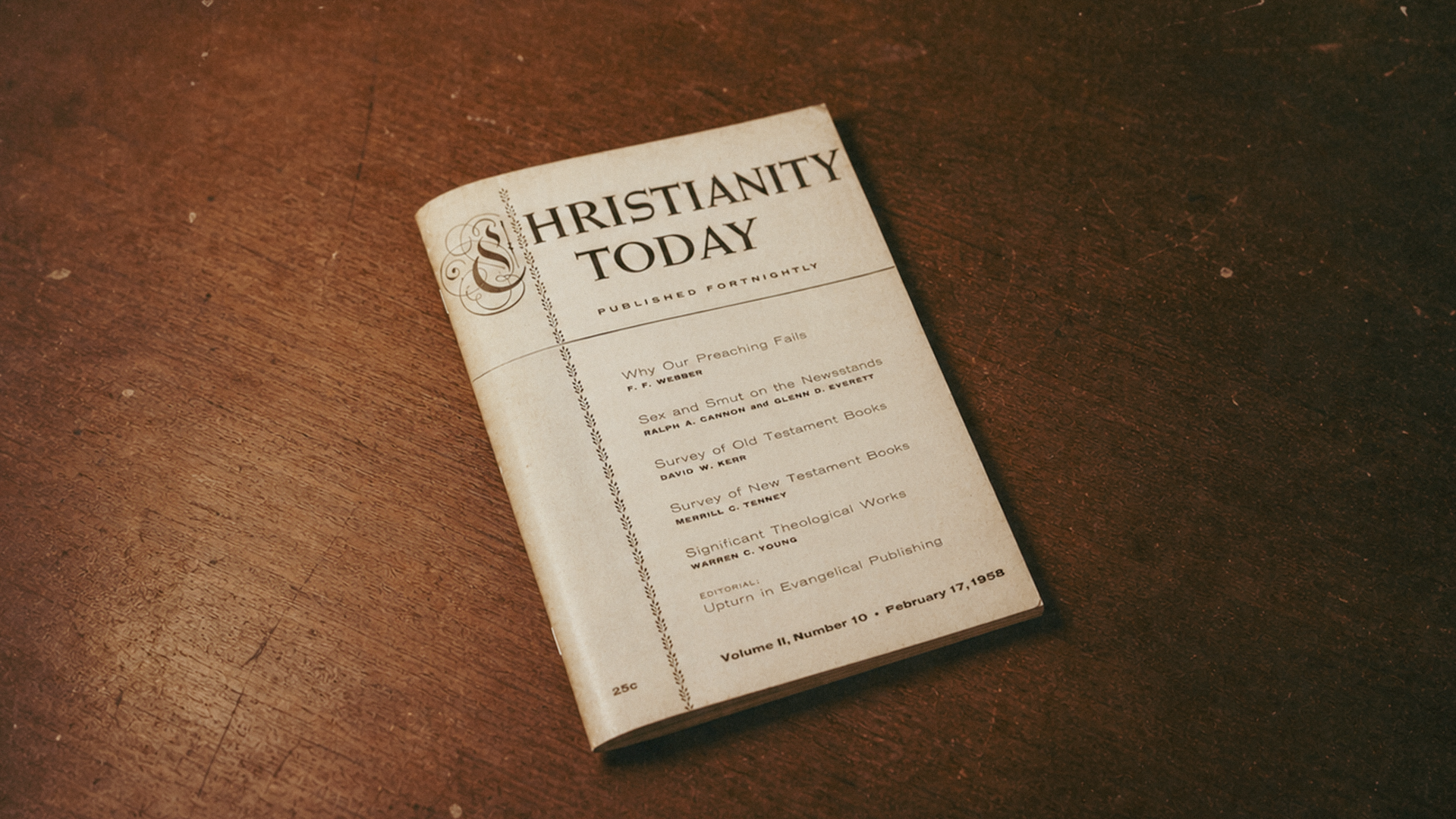
A vintage Christianity Today magazine from February 17, 1958 rests on a worn wooden table.

When Russell Moore late last year reported about “sexbots”—the new wave of high-tech pornography that gives “sad, lonely people artificial intimacy with images and machines pretending to be persons”—he was advancing the warnings that Christianity Today has offered since it began 70 years ago. 

Every Friday since last October we have presented on our website glimpses of how CT from the 1950s to the 1980s covered a variety of issues. We’ve quoted perspectives on abortion, race, politics, wars, rumors of wars, and much besides. I’ll summarize here some early articles on pornography, because over the years some people mocked evangelicals for being culturally behind the times by worrying about such matters—but it now looks as if CT was ahead of the times.

The February 17, 1958, cover story—sensationally headlined “Sex and Smut on the Newsstands”—began, “A virulent moral sickness is attacking American society. Its obvious symptoms may be seen at any newsstand in large cities or small. American society is becoming mentally, morally and emotionally ill with an unrestrained sex mania.”

Some restraints existed then, but CT “watched, appalled, as scores of new titles have made their appearance in the magazine field, many of them violating every standard of decency which has hitherto been recognized in the publishing field.” A CT writer at the time said, “It is high time that our churches awaken to the kind of material being circulated to teen-agers and young adults of both sexes, sold openly at drug stores and newsstands under the guise of sophistication and respectability.”

Exactly one month later, CT ran an investigative “Report on Obscenity: Indiscriminate Sale.” “Two young women learned that the ‘best’ literature in the nation’s capital is readily available to them, even though they are ministers’ daughters,” it said. “On a special research project for Christianity Today, they found easy access to the magazine stocks of three newsstands in downtown Washington.” 

Within three blocks of the White House, they were able to buy “the May issue of Hush-Hush, which features ‘the inside story of the nude model who pinch-hit for Princess Meg,’ ” “the April issue of Ace, which includes the story of ‘a voluptuous wench,’ ” “the spring edition of Sunbathing Review, with more than 85 pictures of nude women and children,” and “the March edition of Night and Day, carrying several advertisements that offer by return mail pictures of women posed to order.” 

On March 12, 1965, CT published “A Time for Moral Indignation,” in which editor in chief Carl F. H. Henry declared, 

“The millions of Christians in America have a special duty,” Henry said. “They know that when anything becomes a national idol, it is because God has first been displaced and his moral law set aside. The final resolution lies with God, who alone can give purity of heart. But until such a time, Christians are summoned to reflect his holy wrath against every unclean thing.”

Every American dedicated to common decency must become morally indignant and let this indignation burn righteously in an articulate protest against an exploitation of sex that is unparalleled in the history of the world. Never before in human civilization has sex been so pervasively prostituted to financial gain, for the technological possibilities were not present until our time.

One month later, CT declared in “Facing the Tide of Obscenity” that “the decline of decency imperils wide reaches of modern culture and life. We are headed for doom unless pervasive immorality is arrested.” The only good news: “America has not sunk to the depravity of the pagan world that existed before revealed religion registered its impact upon society—not yet, happily.”

What to do? 

The rising tide of indignation and concern also signals a moment of methodological danger for all who plot a remedial alternative. We should not rely mainly on programs that promote purity by destroying freedom. Legislative compulsion may provide penalties for infractions and restrain a sick society from iniquity momentarily, but no society will long survive whose citizens lack heart to abstain from evil; apart from the will to decency not even the best laws will keep men from destroying themselves.

CT criticized “the photographic cult of feminine nakedness supported by the magazine traffic in our day” and said, “At his first coming, Jesus Christ drove the money-changers out of the temple; in the final judgment will he not consign publishers and peddlers of sex temptation and their wares to the stenching refuse pits of Gehenna? . . . We are breeding a generation of sex giants with mustard-seed spirits.”

What role should government have? “Civil government will always be needed in a society of sinful and imperfect men. The promotion of just laws is a special responsibility of the people of God. In urging laws to halt the trend toward indecency we are on sure ground insofar as our concern is to protect human rights from the infringements of those who violate them.” But another danger lurked that way: 

If we propose a paternalistic ground for government intervention whenever the license of madmen sets up a clamor for controls, we may be sharpening a two-edged sword of the state by a precedent that someday may threaten the freedom of good men and not simply, as we now propose, the license of bad men.

Commercial pressure might be a better approach:  “Let us ask whether publishers, distributors, and magazine store operators approve these products for their own teen-agers.”

CT editors commented on July 2, 1965, that “now and then we read Playboy—not often, confessedly, but when Hugh Hefner, its editor, occasionally sends a copy hoping Christianity Today will debate his philosophy of sex and give him free promotion.” The editors quipped, “There seems to be only one aspect of grammar that interests Mr. Hefner as an editor—gender, the feminine particularly, so exposed as to suggest a maternal attachment that Mr. Hefner hasn’t yet outgrown.”

The descent since then has been steep. Russell Moore elsewhere summarized a Harper’s article about “ ‘gooning’—a pornography-obsessed subculture among predominantly Gen Z males who spend hours, even days, consuming pornography, often in front of multiple screens in specifically constructed rooms they call ‘gooncaves.’ ” Some gooners are “ ‘pornosexual’ . . .not just uninterested in real-life sex with a real-life person, but … terrified by it.”

Moore’s analysis is in line with the CT tradition, but high tech has brought people lower: 

If we propose a paternalistic ground for government intervention whenever the license of madmen sets up a clamor for controls, we may be sharpening a two-edged sword of the state by a precedent that someday may threaten the freedom of good men and not simply, as we now propose, the license of bad men.

What’s unique here is not lust and shame (as old as Eden’s fig leaves) but the ecosystem that can give us exactly what we think we want—until we are so trapped that we no longer know how to feel want. Sexual sin distorts attachment; this ecosystem dissolves it. Porn industries and their allies don’t make people sexier. They evacuate the capacity for human eros by abstracting pleasure from persons, from story, from place, from love.

Moore is also right in his response: 

The gooners are not some freakish fringe. They are omens of a disembodied age that beckons us all. We can say no to it. We might seem powerless in front of such matters, even willfully ignorant, but the broader body of Christ, transcending time and space, knows the way out: the mystery of Christ (Eph. 5:31–32). 

But escaping this disembodiment will require us to recognize that we face not only our own fallen flesh but also an entire industry of unseen algorithms trained to lead us, step by step, toward this post-human hell.

CT writers in the 1960s saw where we were going. I did not see things as clearly when in the 1980s I taught a media law course at The University of Texas at Austin and told the students about Miller v. California, the 1973 case that opened the doors wide for pornography as a hallmark of individual liberty.

I don’t suspect those Supreme Court justices had imagination, or awareness of the depth of sin, to foresee this enslaved new world. Nor did I, and I gave the students my opinion: I thought it a poor decision, but one that did take into account First Amendment protections.

I look at it differently now. If laws on pornography are to change, many people need to stop associating its omnipresence with freedom of the press. We should instead see it as a right to enslave. I’m suggesting this not as a matter of constitutional law but as a media-philosophy approach: Given enslaving algorithms, my fellow journalists should describe porn not as First Amendment freedom but insidious psychological bondage. 

Any legal action, even if it could get past cultural czars, is probably too late, because the thin fence of the law can’t stop a social avalanche. We need a cultural awakening, which maybe at some earlier point could have come through reserved intellectual persuasion. Now (and I suspect it was always this way) it can come only through Christ changing hearts.

Moore’s conclusion: Christians need to be “seeing clearly and modeling a different story—one that is set at a wedding feast, not in a warehouse of screens.” He writes, “Among the first tasks of the 21st-century church will be to break this spell—to remind ourselves that we are creatures, not machines, and that we are created for love. … We can offer grace and mercy and community through the gospel and, with it, actual life and love. 

“The gates of hell cannot withstand that kind of love. Surely the screens of goonspace can’t either.” 

Marvin Olasky is editor in chief at Christianity Today.

addApple PodcastsDown ArrowDown ArrowDown Arrowarrow_left_altLeft ArrowLeft ArrowRight ArrowRight ArrowRight Arrowarrow_up_altUp ArrowUp ArrowAvailable at Amazoncaret-downCloseCloseellipseEmailEmailExpandExpandExternalExternalFacebookfacebook-squarefolderGiftGiftGooglegoogleGoogle KeephamburgerInstagraminstagram-squareLinkLinklinkedin-squareListenListenListenChristianity TodayCT Creative Studio Logologo_orgMegaphoneMenuMenupausePinterestPlayPlayPocketPodcastprintremoveRSSRSSSaveSavesaveSearchSearchsearchSpotifyStitcherTelegramTable of ContentsTable of Contentstwitter-squareWhatsAppXYouTubeYouTube