News
Wire Story

Southern Baptists Say DOJ Investigation Concludes Without Further Charges

After the federal inquiry didn’t turn up findings around abuse, advocates fear critics will continue to push back against reform.

Christianity Today March 13, 2025
Jae C. Hong / AP

Lawyers for the Southern Baptist Convention said Wednesday that the US Department of Justice has ended an investigation into the denomination’s response to allegations of sexual abuse committed by Southern Baptist pastors and institutional leaders.

That investigation was launched in 2022 after the release of the Guidepost report that demonstrated that SBC executives had mistreated abuse survivors and sought to downplay the effects of abuse in the convention.

“Earlier today, the US Attorney’s Office for the Southern District of New York informed us that the investigation into the Southern Baptist Convention and Executive Committee has officially concluded,” SBC attorneys Gene Besen and Scarlett Nokes told Baptist Press, an official SBC outlet.

Megan Lively, an abuse survivor and activist, said she was disappointed to hear from an FBI agent that the investigation was over. She had hoped, she said, that the investigation would move the SBC to take abuse reforms seriously. “It’s just a mess,” she added.

A spokesman for the US attorney’s office for the Southern District of New York declined to comment.

No abuse charges have been filed as a result of the Guidepost report, though Matt Queen, a former Southwestern Baptist Theological Seminary professor and provost, pleaded guilty last fall to lying to the FBI, and last week was sentenced to six months of house arrest, a year of supervised release and a $2,000 fine.

But aside from Queen’s case, few details of the investigation have been made public. Given that national SBC leaders have no direct control over pastors or churches, it was always unclear what crimes SBC leaders might be charged with.

Leaders from Southwestern Baptist Theological Seminary, where Queen was once a professor as well as provost, said in a statement: “For more than two years, Southwestern fully cooperated with the DOJ throughout the investigation and is pleased that there were no findings of wrongdoing against the institution or current employees. We remain committed to ensuring the safety of all members of the seminary community.”

This is the second time the SBC’s attorneys have announced an end to the DOJ investigation. Last March, those attorneys said that the investigation into the Executive Committee, which oversees the denomination’s day-to-day operations, was over, but later clarified that the investigation into the denomination as a whole continued. 

Southern Baptist leaders have spent more than $2 million on legal fees related to the investigation. Those fees, along with more than $3 million spent defending lawsuits filed by a pair of former SBC leaders named in the Guidepost report, and the cost of the Guidepost investigation itself, have drained the Executive Committee’s reserves and left it unable to pay its legal bills.

On Wednesday, Jeff Iorg, president and CEO of the Executive Committee, gave thanks for the investigation’s end. “We’re grateful that we can close this chapter in our legal proceedings and move forward,” he said.

The SBC’s attempts to manage accusations of sexual abuse have occupied the leadership for more than a decade, and the convention’s governing body, the annual meeting of “messengers” from local churches, has demanded reform, forcing the Executive Committee to commission the Guidepost investigation in a floor vote in 2021.

But critics of the reform efforts point to the cost of the Guidepost investigation to claim that it was a mistake. Abuse advocates worry that those critics will now use the end of the DOJ investigation to derail reforms.

The Guidepost report led Southern Baptists to pass a series of reforms intended to address abuse in churches, including more training and publishing a database of abusive pastors. Those reforms have largely stalled.

While the SBC has distributed training materials and hired a national staffer to help oversee reforms, the database has been tabled for now, with SBC leaders saying last month it is no longer a priority.

Abuse survivors now worry that the end of the investigation and the tabling of the database signal that abuse reforms have run out of steam.

“Everything seems to be falling apart,” said Lively.

Culture

My Walmart Evangelism Wasn’t Working

The Good News didn’t sound so good when I ambushed people in the chip aisle.

Christianity Today March 13, 2025

As college freshmen, my friends and I spent many Friday evenings wandering around Walmarts in southwest Ohio. We paced the tile floors, squinted under fluorescent lights, smelled the bread wafting in from the Subway in the foyer. We strolled up and down the aisles, passing unloaded palettes and abandoned carts. But we weren’t there for groceries. We were there to ask shoppers how we could pray for them.

Our method was simple: Identify a shopper, approach that person slowly, and introduce yourself. Be warm, concise. State your purpose. Hi! My name is Heidie, and this is my friend Leah. We’re Christians, and we were wondering if there was any way we could pray for you today. Then we would smile and wait until the person we were speaking to no longer looked startled.

Many people said no thank you and hurried away, the way one does when cornered by a Girl Scout during cookie season. Some ignored us, continuing to reach for canned goods and check items off their lists. Some responded with open derision, emitting unfriendly grunts or mumbling things like you fundamentalists. But occasionally, a person would say sure, we’d inquire what about, and then we’d start to pray.

Our prayer offer was genuine, though perhaps a sort of front. What we really wanted was to evangelize. We wanted to present the gospel message beginning to end, creation to consummation, and invite people to respond. So we prayed informative prayers. We situated requests inside the story of biblical history, defining terms and quoting Scripture along the way. The social conventions surrounding prayer—namely, that you remain buckled in until someone says amen—made our presentations possible.

This was the evangelistic strategy we’d learned from students earning their master of divinity at our devout Baptist college. The MDiv students took a course titled Introduction to Evangelism, so our campus had a constant supply of pastors-in-training looking to lead outings and confer tips. If all you can do is pray for someone, I heard many MDiv students explain, then pray the gospel. So we did. I prayed the gospel in the produce aisle of a superstore. My friend Zoe opted for the coffee shops in “Hippie Village.” My friend Andrew preferred a nearby mall. My roommate, Alina, visited public universities.
The MDiv students weren’t driving our school’s emphasis on evangelism—more so responding to it. In our daily campus-wide chapel services, speakers regularly preached that all Christians are called to live on mission and that we are in a cosmic battle for souls. My group’s Walmart outreach may have been a caricature of these principles—something I credit to the clumsiness of freshman fervor—but we were working from our chaplains’ exhortations. Tell the story. Name the stakes. Make clear the route to salvation.

Sure, we’d get backlash. But the gospel was offensive to nonbelievers. A “stumbling block,” in Paul’s words (1 Cor. 1:23). Backlash was to be expected. Our job was to “shake the dust off [our] feet” and carry on (Matt. 10:14). One chapel speaker quoted Charles Spurgeon on the subject. “If sinners be damned,” Spurgeon had written, “at least let them leap to hell over our dead bodies.” The speaker enunciated hard on dead bodies. Harrowed amens echoed from our chapel audience.


My Walmart evangelism faded midway through my sophomore year, when most of the MDiv students I knew had finished Introduction to Evangelism and moved on to Biblical Greek. Quiet Friday evenings gave me an opportunity to take stock. I was glad to have an answer when chapel speakers asked the room, How are you responding to the Great Commission? I was grateful, also, for my hardened spiritual calluses, for the dying to self I’d experienced in the face of derision and side-eyes.

My efforts had come from an earnest place. One of the most common encouragements my friends and I would offer each other after a difficult exchange with a shopper was, strangely, a reminder of hell’s reality. Real people were actually facing eternal condemnation. Constantly. A shot at saving someone from that fate was worth rejection.

And yet I still wasn’t satisfied with our approach. People rarely agreed to pray with us, and even those who did hurried away after “amen.” No questions, no conversations. I knew the typical consolation of We just plant the seed, and God will give growth if he wills (1 Cor. 3:6), but I’d started to lose confidence that we were really “planting seeds.” The difficulties we faced seemed prior to “planting,” and prior, even to the “rock of offense” (1 Pet. 2:8, ESV). As I replayed memories of botched approaches in my head, it occurred to me that maybe the gospel hadn’t been what offended our Walmart shoppers; maybe the gall of two strange, Pollyanna-ish teenagers demanding their attention in the chip aisle had.

My reflections were helped along by my upper-level writing courses. Our classes featured loads of discussions about literature’s devotional potential and the duty of the Christian writer, but there wasn’t pressure to sneak sermons into our stories, nor was there any subtext that our writing would be better if we did. Instead, my professors wanted us to approach storytelling with nuance. We discussed books that overtly proclaimed the gospel, like C. S. Lewis’s Narnia series and John Bunyan’s The Pilgrim’s Progress, but we also discussed works that were more subtly—if even detectably—Christian, like Flannery O’Connor’s short stories and T. S. Eliot’s poetry.

Whatever we read, we focused on craft. We were just as concerned with what an author was saying as we were with how the author was saying it. Good writers, my professors emphasized, care about presentation. They connect with their readers. They build rapport. They use humor, tone, narrative, tact, which is why people feel so affected by their words. These were important breakthroughs for me. They taught me a lesson I desperately needed to learn, with applications far beyond the classroom: One could have a great message but deliver it terribly.


I spent the first half of my senior year applying to MFA programs in creative writing, and by the spring, I had been accepted to one at the University of Iowa. UIowa was the kind of place that chapel speakers referred to as “the world.” My university president had recently written an article in which he criticized educational systems teaching “secular humanism, evolutionary theory, and a Godless atheism.” I was headed for one of those.

And with no semblance of an evangelistic strategy, might I add. My Walmart reflections had persuaded me away from the cold-call approach, but they hadn’t squelched my obligation to the Great Commission. I wanted to lead people to the light, to snatch souls out of the fire (Jude v. 23). But it felt upside-down to show up at a university declaring that I had something to teach everyone else. And I didn’t want to reduce my soon-to-be classmates to a sort of faceless evangelistic cause before even meeting them.

Get-to-know-you questions filled my first weeks at Iowa. Classmates asked me, What was your college like? What do you write about? On repeat, I answered: small Baptist college, very devout, Christian art, conversion. I expected my peers to produce the same look of stunned discomfort that my Walmart targets typically had. Instead, they asked more questions.

My answers opened new conversations: about my high-school conversion to Christianity, and my junior year discipleship group, and a 62-foot-tall Jesus statue in Ohio. I wondered if all this talk might count as a kind of evangelism. The rubric in my head told me no. I wasn’t “naming the stakes” or inviting them to bow their heads in informative prayer. But I was providing an account of the Christian life. Of my Christian life. And it was the details they seemed most interested in. The earthiness and humor, for example, of my 14-year-old self googling “serious Jesus colleges Midwest” seemed to give my peers something they could latch onto, some sort of example in which they could locate or revise the things they’d heard about religion.

A bit further into the semester, a classmate asked me why I’d chosen the MFA at Iowa. I explained: As newlyweds, my husband and I decided we both wanted to attend graduate programs. We sat down and made a list of every university in the US that offered both a funded MFA in creative nonfiction and a funded PhD in theoretical physics. We applied until we had no more money to cover application fees. Then we prayed for months. He got accepted into Iowa. I got waitlisted. So we continued to pray and asked everyone we knew to pray, and then a few weeks later, on the national graduate-school deadline, four hours before the midnight cutoff, I got an email letting me know that a spot had opened up for me.

“I’ll give it to you,” my classmate said, half smiling. “That sounds … divine.” 

The moment felt significant: an agnostic glimpsing God. But I didn’t want to push the conversation toward some cosmic ultimatum. Maybe that was my cowardice. Maybe it was something like tact.

I’ve heard all kinds of objections to evangelistic finesse: that God works through broken vessels, that we aren’t to conform to the patterns of the world, that the beauty of the gospel is shared through stumbling lips. I understand the sentiments, and I’m grateful for the ways they encourage Christians who, with Moses, say, “Pardon your servant, Lord. I have never been eloquent” (Ex. 4:10). It’s a prayer we all pray at times.

But I wonder if our familiarity with that prayer has led us to expect bumpy deliveries—or to prefer them, even, misinterpreting a lack of discretion as evangelistic seriousness. It’s easy to cast the plight of a Walmart evangelist in the same light as the apostles’ persecution. It’s harder to admit that confronting strangers with the gospel in the street, a park, or a store might produce an affront that’s more social than theological. Harder to accept that people don’t like being dragged into intimate conversations with strangers. We find ideas more compelling when they’re delivered through the lips of those we know—that is, when there’s a connection, or a relationship, or context.

To be fair, some are hostile toward evangelism regardless of its delivery, even among friends. In one of my first-semester seminars at Iowa, I listened in on a conversation about proselytizing. I didn’t know the word, but I could identify the sour tone in which it was spoken. One classmate called it condescending. Another used the word fanatical. My professor said it was an act of colonialism. People nodded. It wasn’t until someone explicitly said religion that I understood what we were talking about. They weren’t decrying the “stumbling block” (1 Cor. 1:23) of the gospel; they were wholesale decrying the evangelistic act. They were angered by the overt persuasion of it, by the thought that someone might try to convert them.

Two weeks later, the Gideons came to Iowa City. They stood on high-traffic sidewalks and passed out pocket-sized New Testaments. I accepted one as a small act of solidarity, despite having six Bibles at home, and then retreated to a nearby academic building to watch from a window. I winced when students waved the Gideons off, glared, or accepted a pocket New Testament only to throw it in the trashcan at the corner. I watched many New Testaments topple into the trash. I saw the Gideons see it, too.

These were the scenes I held in my head as I worked on my first workshop essay—a personal piece of writing I’d submit to my classmates for feedback. I feared being accused of proselytizing, and I hated that fear, so I mustered the courage I could and wrote about it indirectly. I wrote about the Bible lessons I’d delivered to third graders during my summers working at a Christian camp, and about my time as a public relations writer for my Baptist college’s marketing division, and about my run-in with the Gideons, all situated between my abstract ponderings about religious outreach—about “proselytizing.” It was an unwieldy collage of an essay that I submitted in a panic.

On the day of my workshop, I heard two clear notes from the room. One, the abstract sections were muddled and unnecessary. Two, they loved the moments when I presented religion through personal stories.

One classmate told me the essay “came alive” in the summer-camp scenes. Another said the narrative details made her feel that she was seeing inside Christianity. A third said the personal anecdotes helped her access the essay’s ideas. It wasn’t the reaction I expected, especially with an essay so clearly about religious people sharing their religion. But somehow the narratives created more engagement. A different professor of mine would state it succinctly in a conference with me a couple semesters later: “I’m not interested in talking about Christianity. But I do like your stories.”

Her words called to mind something Paul wrote of his own evangelistic appeal: “To the Jews I became like a Jew, to win the Jews. To those under the law I became like one under the law. … To the weak I became weak, to win the weak. I have become all things to all people so that by all possible means I might save some” (1 Cor. 9:20–22). And perhaps we could add: To the writers I became a writer.

The storyteller and the evangelist alike bring listeners to the brink of a new world. They invite them in, the refrain Come and see on their lips. C. S. Lewis, the gospel allegorist I read in my undergrad literature courses—the writer also responsible for some of the 20th century’s most winsome spiritual essays—described stories, sermonic or not, as windows and doors. That is, access points. Portals. Things people can peer into and step through to “see with other eyes, to imagine with other imaginations, to feel with other hearts.” I can’t think of a better description of what evangelism hopes to accomplish in its hearers.

Of course, this is not a foolproof method; there isn’t one. But I’m convinced evangelists would do well to stash some stories in their pockets, especially for an audience whose greatest need is not airtight doctrinal presentation but a better narrative and a new set of eyes to see it. Again, in Lewis’s words: “One of the things we feel after reading a great work is ‘I have got out.’ Or from another point of view, ‘I have got in.’”

After the workshop, one of my classmates texted me that she was appointing me her “spiritual consultant.” Her words contained some hyperbole, but she wasn’t lying. She began sending her questions my way. How were saints canonized in the Catholic church? How many Marys were in Jesus’ friend group? What did liturgy mean?

Other classmates have joined in, too. Since my first workshop, I’ve been asked, “What are the classes of relics? Why did Saint Nicholas and Arius fight? Why do Christians rub ashes on their foreheads in February? Are songbooks the same as hymnals? Is hell a metaphor? Why do Christians get married so young?” And, ever so nonchalantly—“How does the Incarnation work?”

I love these questions. I love them because they’re meaty, and because they expect answers, and because they bid me to discuss the things of God with seekers and skeptics and friends, which is what I craved and never found in a year’s worth of Walmart aisles.

Heidie Senseman is an MFA candidate in the University of Iowa’s Nonfiction Writing Program. Her essays have previously appeared in Vita Poetica, Dappled Things, Plough, Ekstasis, and other publications.

Ideas

A Closing Door to Persecuted Christians

Trump’s new immigration policies will hurt believers at risk for their faith.

Christianity Today March 13, 2025

It took 18 hours for one Iranian Christian convert to cross the Iranian-Turkish border when she fled her country. “We were in a cold, dark truck with other people,” she later remembered.

Another Iranian convert still can’t talk about the moment she and her family made the border crossing without crying. “I looked at the flag and said, ‘It’s [my] last look at [the Iranian] flag,’” she said, weeping. “It is really difficult.”

And for another, leaving her home in Iran for Türkiye meant entering a country where “we barely receive our basic human rights” as refugees.

Each of these women is an Iranian Christian whom the regime imprisoned because she left Islam, put her faith in Christ, and belonged to an underground house church. After interrogation, each was released with a stern warning to avoid continuing to meet with other Christians. Each woman knew that if she stayed and continued to practice her faith, she could be arrested again, and this time she wouldn’t see the outside of a prison for years.

Meanwhile, in Afghanistan, thousands of Christians fled the country after the Taliban militant government took over in 2021. Many of these believers are converts from Islam and knew that if the new regime discovered their faith, they risked execution.

In North Korea, Christians sometimes make the difficult and dangerous journey to China. Even if they make it across the border, they know that if the Chinese government catches them, they can be repatriated back to North Korea and sentenced to a lifetime in labor camps. Meanwhile, the number of North Koreans the Chinese government has deported has only increased since the COVID-19 pandemic.

These are but a handful of the desperate situations faced by followers of Jesus. For decades, persecuted Christians have left their homes and entered a sort of migration limbo, all the while hoping they could one day end up in a country that would protect their religious convictions. For decades, this country was the United States. But the trajectory of current policies from President Donald Trump’s administration are making it quite likely the US government will send followers of Jesus back to environments where they will be arrested, imprisoned, or even killed.

As American Christians, how might we respond?

The reality ‘back home’

Christians of sincere conviction have varying opinions on how to address immigration. In recent years, numerous parts of the country have struggled to provide housing and services to the thousands of arriving migrants. In fact, in a recent report released by World Relief and Open Doors US (the organization where I’m honored to serve), we “affirmed the need for reforms to improve border security and the asylum process.”

However, since January, Trump’s executive orders have resulted in merely shutting programs down rather than offering any type of meaningful reform. Suspending the refugee resettlement program, ending the asylum process at the southern border, as dysfunctional as it is, and transferring migrants to other countries where they face forced deportation puts thousands of people in dangerous situations. Without initiatives like these, America will be endangering Christian converts from Iran and around the world who fear for their lives and their families’ lives if the US forces them to return.

For instance, last year, Laleh Saati returned to Iran after spending several frustrating years seeking asylum in Malaysia. Authorities arrested her at her father’s home in a suburb of Tehran and imprisoned her in a ward which sits under the jurisdiction of the Ministry of Intelligence, the secretive branch of the Iranian government that has been accused of carrying out assassinations at home and abroad.

Once Saati was in prison, officials interrogated her for roughly three weeks, displaying photographs and videos of her Christian activities and baptism in Malaysia as evidence of her supposed crime. On March 16, 2024, Saati was sentenced to two years in prison for “acting against national security by connecting with Zionist Christian organisations,” a common charge against Christian converts in Iran.  She was just one of the 139 Christians arrested for their faith in 2024 in Iran.

Even after Iranians are released from detention or prison, their situation remains extremely difficult. Many report that the secret police continue to follow them and that their faith poses a challenge to their livelihoods. The Christian who eventually fled Iran in the back of a crowded truck, told Open Doors that after her arrest, the hospital where she worked fired her once after discovering her faith. Other Christians report that schools have expelled their children. Faced with harassment and discrimination, many Christians make the painful decision to leave.

Though most Iranian Christians head first to Türkiye, where they don’t face immediate danger of arrest, they aren’t legally allowed to work or, in some cases, attend school. Türkiye offers no legal pathway for them to make the country their final home. Further, the government can deport them at any point and restricts their movement, meaning they can’t venture beyond a 20- to 30-mile radius of the place where they settle.

No longer a place of refuge?

This pattern happens around the world: Christians flee their homes when it feels as if their only options are apostasy, prison, or relocation. They make the choice to leave their homes and go to other countries, often bordering nations where they hope they can escape the authorities’ notice. These believers live in a sort of legal gray area where they hope they can find permanent homes even as they live at the mercy of the countries where they’ve fled.

From there, they may file for refugee status with the United Nations, waiting (often for years) before they’re told they can resettle. Even then, only 1 percent of those seeking a permanent place to settle ultimately end up in the United States or another nation.

For decades, the United States has been a place where Christians could safely claim asylum or be resettled as refugees. The legal path to finding safe haven is not an easy one—refugees and people claiming asylum must demonstrate they have a “well-founded fear of persecution,” in the words of the US Refugee Act of 1980. Additionally, people who claim asylum can have difficulty finding jobs while they wait for their claims to be approved or denied. Of course, the system isn’t foolproof—some have expressed concern over fake conversions, for instance, though asylum fraud is exceedingly rare in the United States. And that immigration asylum claims that overwhelmed the US system during the Biden administration reveal a status quo that needs reform.

However, American Christians can’t lose sight that real people will be profoundly impacted if the US chooses to forgo careful reform and instead accept the complete suspension of these programs designed to help those in real danger. Currently, with the stoppage of both the asylum process and the refugee resettlement program, Christians no longer have the option of a safe place in the United States.

Are we suffering with them?

As Christians, we can’t let our advocacy for our brothers and sisters in Christ descend to the toxic, polarized dialogue that often characterizes these conversations. Scripture teaches us that when one part of the body suffers, we all suffer with it (1 Cor. 12:26). Instead, our response should recognize that their persecution comes because of their love for and obedience to Jesus—and that our country has the capacity to offer sanctuary and support.   

Those of us in the US must advocate for policies that protect people genuinely facing religious persecution. Again, Christians can disagree on the particulars in good conscience. But our nation was founded in part because of people fleeing religious persecution, and today, over 380 million Christians worldwide face high levels of persecution and discrimination for their faith. While most persecuted believers feel called to remain in their countries (and Open Doors’ primary purpose is to strengthen those who stay), the few who must flee deserve the freedom to follow Jesus safely. We must challenge our elected officials to remember these vulnerable Christians when reforming immigration policies.

I also encourage Christians to get involved with organizations—at local, national and international levels—that help people fleeing religious persecution and help those in the United States who have lost expected help from the government. That may include financial support, but it also includes things like volunteering, local advocacy to shape state and city policies around refugee aid, or work with churches to help asylum seekers and persecuted Christians find hope and purpose in the United States.

Finally, let’s keep praying. In my role at Open Doors US, I always hear a common refrain from our persecuted brothers and sisters: “Pray with us.” Prayer can bring us into solidarity with persecuted Christians, can provide comfort and hope, and, as Scripture shows us, can even change the hearts of those who lead governments like Iran’s that threaten the well-being of God’s followers.

Our responsibilities as followers of Jesus must drive our actions in each of these areas. As American Christians, we must not forget our sisters and brothers who have fled Iran or any other countries because of their faith—and then we need to work to make sure they can have a safer place to go.

Ryan Brown is CEO of Open Doors US, part of the international ministry of Open Doors.

Ideas

South Africa and ‘The Art of the Deal’

Trump makes quick changes, but some consequences are fatal.

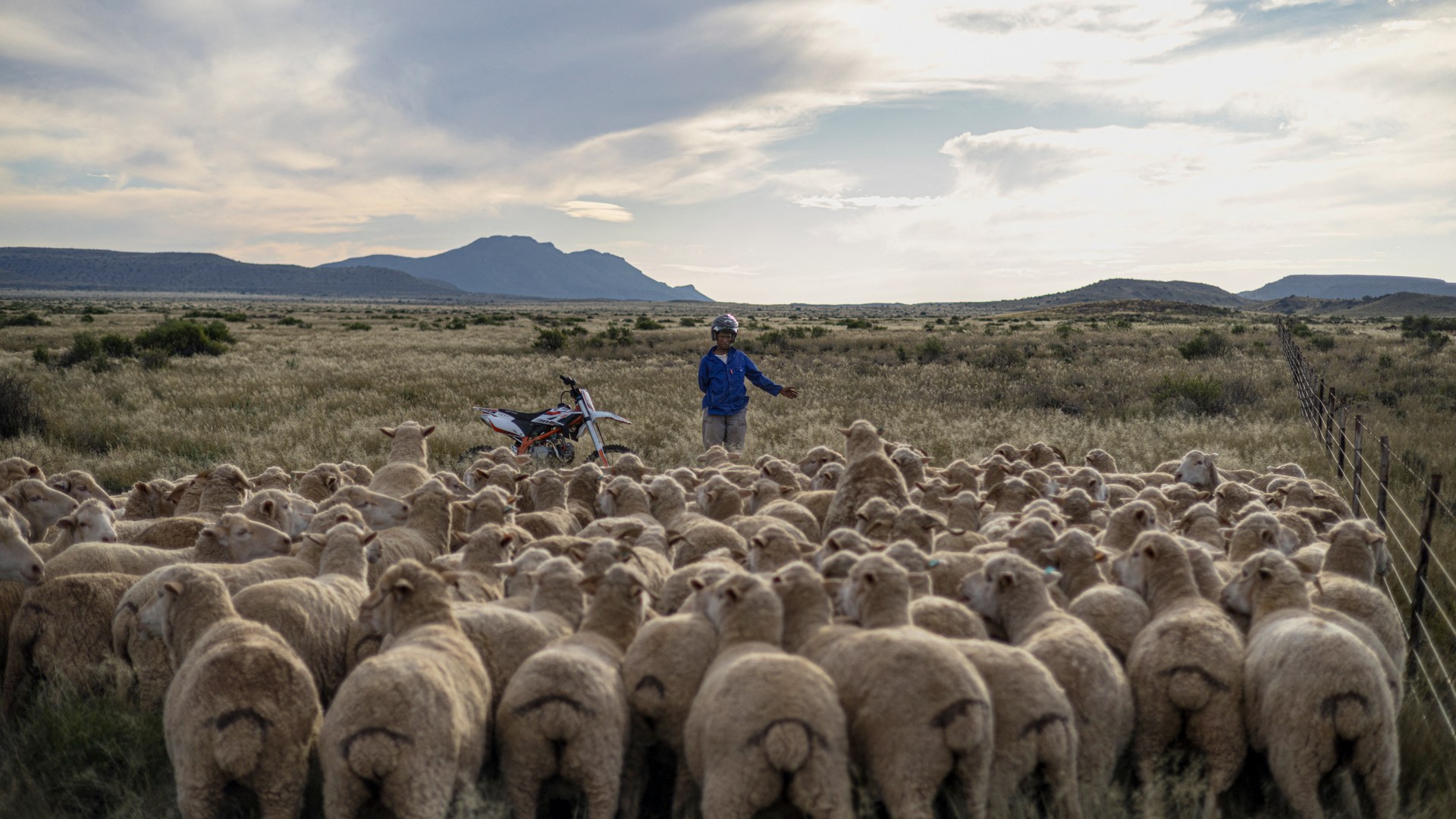
A land owner herding his sheep in South Africa

A shepherd managing his family farm in South Africa.

Christianity Today March 13, 2025
Marco Longari / Getty

This is the last article of a three-part series. See Tuesday’s and Wednesday’s articles.

It’s peculiar to see white South Africans as victims in need of refuge. They make up 7 percent of South Africa’s overall population but own 72 percent of the land, according to a 2017 land audit, while black people comprise 81 percent of the population and own 4 percent of the land. The Trump administration, however, recently put out an executive order that privileges white South Africans.

History underlies those statistics. The Natives Land Act in 1913 restricted black people from buying or renting land in “white South Africa.” Some faced forcible removal from their land. Others lost their land following passage in 1950 of the Group Areas Act, which amplified segregation by saying South Africa’s apartheid government could zone certain areas for use by a single race.

The expropriation of land also hurt the black church. One South African bishop, Josh Malebye, recently told Parliament that depriving black churches of land needed to build multipurpose centers hamstrung their ability to address social ills. Besides, as political analyst Sithembile Mbete told journalist Peter Granitz, “When people say they want land, part of it is also about wanting ancestral belonging and dignity.”

The end of apartheid in 1994 brought a plan to return 30 percent of this land to its previous owners by 2014, but only one-third of that has happened. So South Africa’s Parliament passed the new Expropriation Act, which allows the taking of land only when “the land is not being used and the owner’s main purpose is … to benefit from appreciation of its market value.”

The act does not force landowners away from their properties: It doesn’t reenact the events of 1913 and 1950, this time with “bottom rail on top.” Expropriation goes into effect “where an owner has abandoned the land by failing to exercise control over it.” The underlying ethic is that waiting for the market price to go up while keeping others from obtaining land is unjust. 

Fifteen years ago in Peru, I saw how a similar plan worked. Land uninhabited or unimproved for at least five years could be occupied by the landless poor. Hundreds moved onto one stony hillside at San Juan de Lurigancho. Families put up structures—initially straw or hay, then plywood, then brick or concrete with a stucco finish. City authorities provided electricity and water.

Peru, learning from the work of free-market economist Hernando de Soto, was providing a path for the poor to own land otherwise unused. South Africa could do the same. But the Trump executive order says such a plan is “unjust” and a reason to offer Afrikaners refugee status on explicitly racial grounds.

To punish South Africa for purportedly oppressing its white population, Trump’s executive order says, “The United States shall not provide aid or assistance to South Africa. … [The US] shall, to the maximum extent allowed by law, halt foreign aid or assistance delivered or provided to South Africa, and shall promptly exercise all available authorities and discretion to halt such aid or assistance.”

In some ways, South Africa is the most public whipping boy for what the Trump administration is doing in all of sub-Saharan Africa, which received close to $13 billion in direct US foreign assistance in 2024. The goal of such aid was to save lives, fight poverty and terrorism, and win friends in the one continent where the population is surging. (Also surging in Africa: Christian belief.)

In his recent State of the Union address, though, President Trump attacked aid to Africa. He elicited laughter from some by claiming that America provided “$8 million to promote LGBTQ+ in the African nation of Lesotho, which nobody has ever heard of.” Lesotho is surrounded by South Africa. In the Zulu village of Loskop, not far from Lesotho, 20 years ago I listened to eight boys and girls ages 13 to 18 standing in a circle in a cold, dimly lit room, singing lines from a Ladysmith Black Mambazo song then popular across South Africa: “AIDS killed my father. AIDS killed my mother. AIDS is killing Africa.”

Unless the Trump administration disavows the ordered halt to South African aid, the biggest losers will be many of the 5.5 million South Africans who receive antiretrovirals: Through the President’s Emergency Plan for AIDS Relief (PEPFAR), begun by compassionate conservative President George W. Bush and continued by his successors through two decades, South Africa funded one-sixth of its HIV/AIDS program. Helping those who contracted HIV decades ago is not popular, but an Annals of Internal Medicine analysis last month projected that the Trump decision could result in hundreds of thousands of deaths.

Twenty years ago, 1 in 250 Americans had HIV, compared to 1 of 10 adults in South Africa. Some said the macabre stat would soon be 1 out of 2. Given the number of orphans, it’s no surprise that the World Bank reported high levels of malnutrition, with half of South Africa’s children facing stunted growth. Many children survived by working long hours, sometimes in prostitution.

PEPFAR, though, saved millions of lives. Its shaky future reminds me of what one of the eight teenage singers said 20 years ago, before PEPFAR help arrived in the village of Loskop. Bonga, insisting he could have sex without getting AIDS, claimed that “black people are not the same as white people.” Several years later, a missionary told me Bonga was dead.

Donald Trump’s 1987 bestseller, Trump: The Art of the Deal, includes this memory from when he was in elementary school: “I punched my music teacher because I didn’t think he knew anything about music and I almost got expelled. … Even early on I had a tendency to stand up and make my opinions known in a very forceful way.”

Tony Schwartz, who spent 18 months with Trump in the 1980s to ghostwrite The Art of the Deal, said in 2016 to The New Yorker  that Trump “has the ability to convince himself that whatever he is saying at any given moment is true, or sort of true, or at least ought to be true.” Trump may change his mind regarding South Africa, or he may follow his negotiating practice of punching first and then offering a deal.

Trump’s Truth Social post may be a leading indicator that he will drop his executive order’s racial discrimination. But some dropping of foreign aid will be hard to unwind. The Art of the Deal proudly describe show young Trump didn’t have enough blocks “to build a very tall building.” He asked his brother Robert, two years younger, “if I could borrow some of his, and he said, ‘Okay, but you have to give them back when you’re done.’”

Trump and ghostwriter Schwartz wrote, “I ended up using all of my blocks, and then all of his, and when I was done, I’d created a beautiful building. I liked it so much that I glued the whole thing together. And that was the end of Robert’s blocks.”

News

Gateway Church Founder Robert Morris Indicted on Child Sex Abuse Charges

Less than a year after resigning over allegations dating back to the 1980s, the former megachurch pastor faces a criminal case in Oklahoma.

Robert Morris wears a navy suit and claps on stage.

Robert Morris

Christianity Today March 12, 2025
Alex Brandon / AP

The former pastor of one of the biggest churches in Texas now faces criminal charges over allegations of child sexual abuse that took place in the 1980s.

On Wednesday, a grand jury in Oklahoma indicted Gateway Church founder Robert Morris on five counts of lewd or indecent acts with a child.

He resigned from Gateway last year after an Oklahoma woman publicly recounted how Morris molested her starting when she was 12.

“After almost 43 years, the law has finally caught up with Robert Morris for the horrific crimes he committed against me as a child,” Cindy Clemishire said in a statement to the press on Wednesday.

Last June, Clemishire told the abuse watchdog blog Wartburg Watch that Morris regularly stayed with her family while visiting Tulsa as a young evangelist and that he came into her room and touched her under her clothing. She said the incidents took place dozens of times over four years and included attempting to have intercourse with her as a teen. Morris was in his early 20s and married.

As of Wednesday evening, neither Morris nor his attorney had made a public statement responding to the indictment. Morris previously referred to what happened as “inappropriate sexual behavior with a young lady” and said that “it was confessed and repented of.”

Morris follows a steady string of church leaders who have been the subjects of allegations brought to light through the #MeToo and #ChurchToo movements over the past decade. Such claims have resulted in many prominent pastors being removed from ministry—but few go on to contend with legal repercussions.

The mean age for victims who were abused as minors to disclose their abuse is in their 40s or 50s, so often the opportunity to involve law enforcement has passed. In Clemishire’s case, the statute of limitations is not applicable, according to the state attorney general, because Morris, who was a traveling preacher at the time, never lived in Oklahoma.

The chair of the elder board at Gateway said in a statement to the Dallas Morning News that the church is “grateful for the work of the justice system in holding abusers accountable for their actions” and that the elders “continue to pray for Cindy Clemishire and her family, for the members and staff of Gateway Church and for all those impacted by this terrible situation.”

A four-month-long independent investigation commissioned by the multisite megachurch didn’t uncover additional victims but did result in the termination of church elders who either knew that the “sexual behavior” from Morris’s past involved a minor or who didn’t do enough to question it, according to a church announcement in November 2024.

Morris founded Gateway in 2000, and the church grew in size and influence over the decades, with the rise of popular charismatic musicians like its former worship leader Kari Jobe and Morris’s involvement as a spiritual advisor to President Donald Trump during his previous term.

Morris’s departure—as one of several Dallas-area pastors to step down in scandal last summer—has left his church shaken. The Dallas Morning News reported attendance dropped 40 percent at its main Southlake campus in a matter of months, and the church continues to undergo a moment of reckoning.

The five charges against Morris, 63, carry a total sentence of up to 100 years in prison.

The Oklahoma attorney general said in a statement, “There can be no tolerance for those who sexually prey on children. This case is all the more despicable because the alleged perpetrator was a pastor who exploited his position. The victim in this case has waited far too many years for justice to be done.”

This is a breaking news story and will be updated.

Books
Review

A New Guide to What the Church Has Always Said About Sex

A book for young adults from Louise Perry explores a third way on sexual ethics that rejects gender ideology and cribs from long-standing Christian teaching.

A man's shoes and a woman's high heels
Christianity Today March 12, 2025
Cottonbro, Pexels / Edits by CT

The day of his inauguration, President Donald Trump signed dozens of executive orders, including one that recognized only two sexes, male and female. And he reiterated that “there are only two genders” during his congressional address last week to a standing ovation by Republicans.

If the latter half of the 20th century was defined by the sexual revolution, then the first half of the 21st is defined by gender confusion. Our society is endlessly contesting the definitions of sex and gender, debating how many genders exist, and asking (or refusing to ask), So what is a woman?

Yet cultural revolutions often cause backlash—see Trump’s remarks, Americans’ increasing recognition that gender cannot differ from sex, and the growing impatience with gender ideology among conservatives. Sometimes, those opposing forces eventually settle into a new, stabilized cultural norm, as has arguably happened with same-sex marriage in the US and may be happening with girls’ sports. 

Part of the backlash to gender ideology has come not from Christians or political conservatives but from secular feminists arguing against hookup culture and, simultaneously, for acknowledgment of differences between the sexes. One is Louise Perry, a journalist and self-identified feminist who recognizes the harms the sexual revolution brought, especially to women, and sees disparities in the way sexual “freedom” has been experienced by men and women. 

Her latest book, A New Guide to Sex in the 21st Century, is aimed at young adult readers and is a condensed version of her controversial 2022 volume, The Case Against the Sexual Revolution. The earlier version garnered her attention in evangelical circles for affirming traditional norms

For a book aimed at Gen Z, the only thing more radical than arguing against hookup culture might be arguing for the reality of sex differences. Perry’s New Guide is certainly not abridged in its adult themes; she discusses sexual violence (her experience at a rape crisis center formed her passion on this subject), pornography, and hookup culture in explicit terms. 

But more shocking for many of Perry’s Gen Z readers might be her unashamed case for sex difference: “Once we recognize men and women are different, many other things follow,” she writes. Her reliance on evolutionary psychology is key to the whole book—she marshals evidence that men are more prone than women to commit rape, most women don’t enjoy violent sex, women are less likely to offer casual sex, and reliance on pornography distracts men from real relationships.

Perry attributes the ill effects of the sexual revolution to opposing evolutionary interests between men and women. How, she wonders, can we best promote the well-being of both sexes despite these differing interests? “Somewhere between sexual liberalism and traditionalism, it has to be possible to find another way,” she writes.

She’s a pragmatist in that quest and concludes by offering concrete advice, mostly to women: Avoid men who are sexually aggressive. Don’t get drunk in public. Listen to your moral instincts. Assess whether a man would make a good father before sleeping with him. Consider the stability of monogamous marriage. Despite her desire for some third way, much of Perry’s advice is simply traditional prudence and ethics. In fact, much of it is a diluted version of traditionally Christian guidance. In any case, Perry knows it’s not groundbreaking. 

What’s more novel for younger generations, especially Gen Z women, is her larger message: Recognize the differing interests between men and women and especially the vulnerability of women. Perry’s gender stereotyping isn’t entirely helpful, but it acknowledges the elimination of difference—the reality-rejecting conglomeration of gender ideology—that is increasingly accepted in Western culture.

That acknowledgement for that audience would have been made markedly more radical had Perry embraced the Christianity she has praised and engaged. The church’s teaching on sex difference and chastity will always be radical, and it has new relevance as long-standing cultural norms continue to lose their power to restrain. 

What does it mean to be a woman—or a man? Without biblical guidance, rightful rejection of gender ideology can go awry, landing us with unbiblical extremes of “trad wife” passivity and violent masculinity. Orthodox biblical teaching and real examples of faithful men and women in the church can help younger generations imagine a better way. 

But if we’re honest, evangelicals sometimes struggle to do this well. We can and should celebrate the return of young men to churches, but young women are disappearing from the pews. Superficially gendered responses, like Christian man camps and wine and paint nights, while well intended, are a distraction from real spiritual formation around learning how to be a good brother or sister in the faith or a better father or daughter or husband.

Complementarian churches, which champion differing roles for men and women, too often overemphasize the negatives (Women can’t) rather than publicly embracing and celebrating the unique giftings and callings of each sex. In the worst cases, these congregations have handled sexual abuse poorly, responding in ways that undermine their testimony about God’s good will for men and women.

Churches with an egalitarian point of view, on the other hand, face other risks. They too often minimize the historic, biological, and biblical reality of sex differences. Rushing to insist that women may be called to ministry and other kinds of leadership is sometimes paired with inattention to why we God gave us these particular bodies or why women are more vulnerable to sexual violence. 

For Christians of any conviction, the question is whether we truly understand sex difference. Beyond stereotypes and Perry’s evolutionary psychology, beyond ladies’ crafting nights and men’s campfires, do we have a biblical understanding of how God created us and how we can celebrate and disciple both men and women as members of the body of Christ? 

To compellingly articulate this difference to a world that wants to know what it is to be a man or a woman, we must first understand what Scripture says: that we are all formed in the image of God (Gen. 1:27) and that, in Christ, there is no disparity between the sexes (Gal. 3:28). In his wisdom, God created male and female, both reflecting God’s image in the bodies we inhabit. 

In a world that wants to erase this difference, the church must better understand and confidently articulate the beauty of God’s created order, male and female alike. It is perhaps the most valuable gift we can offer the next generation.

Kara Bettis Carvalho is ideas editor at Christianity Today.

News

Nixed USAID Scholarship Helped Christian Students Escape War

The $45 million diversity-focused program has so far provided 400 Burmese students—including Christian ethnic minorities—a chance to study away from conflict.

Christianity Today March 12, 2025
Illustration by Mallory Rentsch Tlapek / Source Images: Getty

Thae Thae had just left war-stricken Myanmar and was still getting used to life in Thailand last December when tensions arose between her and her family members back home. Emotional distress, along with academic stress and difficulties adapting to a new country, prompted her to seek counseling.

Weeks later, she received an email alerting her that United States authorities had terminated the scholarship program that had allowed her to further her studies at Chiang Mai University.

“The news devastated me,” the 27-year-old said. “My problems came one after another. I couldn’t study and yet felt burned-out and just laid on my bed for a week.”

Thae Thae, a Christian from Chin State, said she had been pursuing master’s degrees in social science and development at Chiang Mai University so that she could help develop her rural hometown in Hakha, the capital of the beleaguered Chin State. Before moving to Chiang Mai last July, she started a library and hosted an English class at her home for children in her community. At the time, access to education had been hobbled by the civil war. [Editor’s note: Since publication, CT has agreed to use her nickname due to concerns for her security upon returning to Myanmar.]

Thae Thae was among 400 recipients of education grants from the Diversity and Inclusion Scholarship Program (DISP) funded by USAID, the US agency overseeing humanitarian aid to foreign countries since the 1960s. The program set aside $45 million in scholarships to students from Myanmar, providing young people refuge and educational opportunities as their country spiraled into civil war after the 2021 military coup. Many students and instructors participating in the Civil Disobedience Movement (CDM) against the military junta refuse to take part in the military-controlled public schools, leaving education options severely limited.

Yet in late January, the Trump administration cut DISP, describing it as wasteful and not aligned with national interests. In a post in X, the Department of Government Efficiency noted it had canceled “$45 million in DEI scholarships in Burma.”

Scholarship holders received vaguely worded emails in the end of January that said USAID “exercised its right to terminate” the program. DISP’s website and Facebook page have since gone offline, and program officials did not respond to CT’s request for comment.

Launched in August 2023, DISP offered Burmese students, particularly those from vulnerable communities, opportunities to study at universities in Thailand, Cambodia, the Philippines, and Indonesia, as well as take online courses from the University of Arizona.

The marginalized populations include ethnic and religious minorities—many of whom are Christian or Muslim in the Buddhist-majority country—as well as women, people with disabilities, people who identify as LGBTQ, and people who are displaced. Currently, the fighting has killed more than 6,000 civilians and internally displaced 3.5 million people.

Thae Thae is among five DISP scholarship holders in her program and is in the second of four semesters. Without the scholarship, she said she would not be able to continue her studies. She noted that the funding freeze has challenged her Christian faith.

“I don’t know what to do,” she said. “God gave me this chance [to study]. And then the chance is gone, just like that. Sometimes I ask him, ‘Why did you let me face such a situation?’”

Hung Ling, another Chin student who received the DISP scholarship, took part in CDM in the early days of the coup but later fled across Myanmar’s border with India in 2022 when he witnessed peers getting rounded up by the junta.

“I stood up against the military because they disrespected our democracy,” the 30-year-old Christian said, referring to the junta’s deposition of the country’s democratically elected government in 2021. “But the persecution got so intense I fled.”

He graduated with a bachelor’s in theology from Mizoram Bible College before applying for the DISP scholarship. With USAID funding, he enrolled in a business administration program in India last year. He said he had hoped to return to his hometown in Chin State after he graduated to work in community development promoting education and business.

“It will be impossible for me to continue pursuing the MBA without the funding,” said Hung Ling, the youngest of eight siblings. “But I know that God is good all the time. The Lord wants me to draw close and trust him throughout this cutting of scholarship funds.”

The US-based nonprofit Institute of Chin Affairs (ICA) is seeking funding on his behalf for the final two years of his MBA program. If they can’t raise the money, Hung Ling plans to remain in India and find work to fund his studies.

Eventually, he hopes to return to Myanmar “when peace is restored,” he said.

Thae Thae said her family has also asked her to stay put in Thailand for now. Her family fears that, like many men and women her age, she would be forced to fight for the military regime if she were to return home. Last year, the junta announced mandatory conscription for men under 35 and women under 27.

Meanwhile, Thae Thae’s classmate, who asked not to be named due to fears for her safety if she returns to Myanmar, said the scholarship was her “lifeline.”

“In Myanmar, we cannot learn safely,” said the 28-year-old from Sagaing, a region in central Myanmar. “Many young people who joined the Civil Disobedience Movement to fight for the future of our country fled when the junta hit back. Many have gotten injured or killed.”

The student noted that the termination of the scholarship program had caught her off guard. She and other affected students have been looking for other funding opportunities, but they are not optimistic.

“We really want to complete our studies. There is just one more year,” she said.

Growing up in a rural, agrarian community, the student, who is Buddhist, attended a monastic college in Mandalay, Myanmar, for her undergraduate degree. She longed to experience the vibrant campus life she had read about in books.

“I was determined to study overseas and have worked so hard for the opportunity,” she said. “My admission to Chiang Mai University has been big for my village in Sagaing.”

Yale academic David Moe, who was born in Chin State, said DISP “filled a vacuum in Myanmar’s education space.”

He noted that studying overseas helps Burmese students “gain a critical perspective,” as students in Myanmar usually aren’t allowed to ask questions or challenge their teachers in the classroom. The loss of the scholarships is a blow to the future generation of Burmese leaders given the country’s current state.

“$45 million is a lot of money for Myanmar,” Moe said. “[The Burmese community] see it as an investment in the country’s democracy.”

Correction: An earlier version of the story misstated the month Thae Thae arrived in Thailand.

Culture

‘Mickey 17’ Laughs at Hope

The new film from Bong Joon-ho smirks at scientific hubris, political corruption, and any attempt to make things better.

Robert Pattinson as Mickey 18 and Mickey 17 in the film, Mickey 17.

Robert Pattinson as Mickey 18 and Mickey 17 in the film, Mickey 17.

Christianity Today March 12, 2025
Courtesy of Warner Bros. Pictures

The famous list of life events in Ecclesiastes 3 assumes an audience ready to supply appropriate situations for each pair. Of course, applying the maxim For everything there is a season proves much easier in some circumstances than in others. Most would place the “time to mourn” (v. 4) squarely amid loss. Surely the “time to mend” (v. 7) follows that playground mishap which tears a favorite jacket.

The “time to uproot” (v. 2), however, shifts according to genus, species, and climate. Marriage counselors know never to prescribe hard and fast rules for the “time to embrace” (v. 5) or “time to be silent” (v. 7). When conflict migrates from the bedroom to the battlefield, the consequences of claiming a “time for war” (v. 8) grow even more dire. One might hope that those who take seriously the call to love their enemies (Matt. 5:44) would seek opportunities to declare a “time for peace” (Ecc. 3:8)—but world events suggest consensus on such matters will remain elusive this side of eternity.

And what of “a time to laugh” (v. 4)?  This may be the slipperiest fish of all. It’s not hard to find someone ready to justify laughter in every one of the situations mentioned by the poet. Joyful laughter that follows the pangs of birth (v. 2)? Check. Laughter in the face of death (v. 2)? Look no further than the Irish wake. And, if my ballroom lessons with my wife are at all typical, laughter most definitely belongs on the dance floor (v. 4).

Harder to stomach are those who chuckle at others’ pain—who gleefully hate (v. 8), kill with a smile (v. 3), and guffaw as others weep (v. 4). Not surprisingly, our increasing willingness to publicly laugh in the face of suffering has infiltrated our storytelling. I suggested that the time for mourning is self-evident, but the stories we tell and sell suggest this isn’t quite right.

I blame it on the bard.

Shakespeare wrote a few “problem” plays, including Measure for Measure and All’s Well That Ends Well—stage dramas that mix silliness with catastrophe, resisting the neat classification of a straight-up tragedy like King Lear or the uproarious comedy of a Much Ado About Nothing. Though such a mishmash confused the playwright’s contemporaries more than it entertained them, these plays have since become critical darlings. Today, many a modern pundit delights in genre mash-ups that require effort to interpret, thematically incongruous puzzles.

Enter the work of South Korean director Bong Joon-ho, whose filmography has won wide acclaim for decades. Five years ago, Parasite became the first film not in the English language to win best picture.

Like others uncomfortable with economic or political systems that place the livelihoods of thousands in the hands of the few, I appreciate Joon-ho’s determination to target abuses of power. He typically opens a tale by positioning working-class citizens against corrupt institutions whose greed and cruelty are painted in large, parodic strokes.

In Snowpiercer (2013), an emotionally detached, flamboyantly dressed elite governs the survivors of an apocalypse with cold malice punctuated by violent cruelty. Maintaining order involves doling out bare subsistence, regularly appropriating children, and maiming any resisters. The Mirando Corporation of Okja (2017) genetically engineers sentient “super pigs” as smart as they are tasty, then ignores the fraternal ties they’ve developed with human caregivers in the name of profit.

The line between villain and hero blurs in other films where Joon-ho’s narrative sleight of hand gambles with his viewer’s sympathies. Instead of setting up virtuous innocents victimized by the system, the writer-director sometimes inserts us into the lives of incompetent criminal layabouts, then demands that we reconsider our initial distaste.

The more realistic the film, the harder this is to do. The inept detectives attempting to track down a serial rapist and killer in Memories of Murder (2003) torture wrongly arrested detainees. A single parent in Mother (2010) burns evidence and kills to protect her guilty child. Parasite (2019) asks us to cheer for a hard-up family that lies, steals, and fatally attacks both working-class and wealthy individuals who get in its way.

Many viewers praise Joon-ho’s tonal complexity as an accurate representation of our absurd existence. Life does not have easy answers. Injustice has no neat solutions.

Though I accept that sin does compromise our ability to see clearly and act rightly, I also believe that our halting efforts matter (James 2:26). I understand the temptation to release responsibility for the world’s problems, but Jesus keeps calling me back to the struggle (Matt. 5:6–16). If my definition of truth extends beyond mere apprehension of what is to encompass a particular vision of what should be, my reaction to suffering should be inflected by concepts like justice and honor (Phil. 4:8).

Inserting comic relief into stories about class struggle, stories that involve assault and murder, can beg a viewer to dismiss real-world injustice as the inevitable product of an absurd existence. It can discourage us from fighting oppression, the product of a broken but ultimately redeemable world. These films ask us to laugh hysterically rather than mourn. Ultimately, they are an attack on hope.

This pessimistic outlook is nowhere clearer than in Mickey 17, which, at a glance, initially resembles another, much earlier Joon-ho film, The Host (2006). In both films, self-absorbed scientists refuse to weigh the likely harm of their actions—in The Host by dumping chemicals into the Han River (a ravenous monster results) and in Mickey 17 by creating a machine that can “reprint” a person from a digitally stored template of mind and body each time they die. The doctors and politicians of The Host treat those who survive contact with the monster as their own personal guinea pigs. So do the doctors and politicians who experiment on each new clone of Mickey Barnes.

The key difference between these intentionally preposterous films lies in where the laughter they provoke takes us. In The Host, the family members who seek to recover a kidnapped young girl from the monster ultimately overcome their status as losers—a label Joon-ho has applied in interviews—by risking their lives in heroic fashion. The sharp laughter which riddled The Host’s first half dissolves into sorrow for the heroes who don’t make it and gratefulness that love holds together the survivors.

There is no time to either mourn or love in Mickey 17. The comedy underpinning Mickey’s many deaths, the romantic partner whose inner life we never discover, and the comical threats over which this new “loser” (as he’s described in the film) continually trips defy any effort to care what happens to him.

To this unrelentingly goofy ride, Joon-ho adds a heavy-handed critique of religion absent from his prior films, a critique that burdens Christians with a host of negative stereotypes. The politician determined to create his own “planet of purity” far from Earth scatters biblical language casually throughout his public orations, confuses the corporation he leads with a church, institutes a moratorium on intimacy during space travel to limit caloric intake, and calls cloning being “born again.”

Laugh, the film tells us, at scientific hubris and political corruption, but also at every attempt to make things better—at efforts to “plant” (Ecc. 3:2), “search” (v. 6), “build” (v. 3), or “heal” (v. 3). Human inquiry and effort cannot forestall a death which apparently retains its horror even after 16 trial runs, so the only thing left is to laugh.

When confronted with suffering, I prefer to weep—and then do my best to love.

Paul Marchbanks is a professor of English at California Polytechnic State University. His YouTube channel is “Digging in the Dirt.”

Ideas

South Africa: Black, White, and ‘Coloured’

A personal reflection on a country deciding between reconciliation and racism.

The South African national flag
Christianity Today March 12, 2025
Cameron Spencer, Getty / Edits by CT

This is part two of a three-part series. Read part one.

South Africa needs men and women who live and embody reconciliation and not racial division. I have seen what reconciliation can do. While researching my book Brothers in War and Peace, my Afrikaner wife, Lianda, and I traveled to Lichtenburg, a rural town in the Afrikaner hinterland of South Africa, to interview political leader Ferdi Hartzenberg. Busts of apartheid prime ministers in his lounge stared down hostilely at us, declaring unequivocally where his political heart was: He was an apartheid (segregation) hard-liner.

At lunchtime, he took us to a restaurant in what was once the home of an Afrikaner hero in their war against the British, General Koos de la Rey. Before we ate, I asked if I could pray. When he gave his assent, I prayed, and this staunch champion of Afrikaner hegemony started to cry when I prayed not only over the food but also for him. It was probably the first time in his life that a person who was not white had prayed for him. It was deeply moving and felt like genuine reconciliation. God was present.

God is present in South Africa, but the country is buckling under criminal activity fueled by poverty and lawlessness. Black Economic Empowerment is a government policy aimed at redressing the injustices brought about by apartheid. Laudable though its intentions are, it has not worked in its implementation. It has largely enriched the new black elite and the politically well-connected while many among the poor have become even poorer.

Youth unemployment stands at more than 45 percent. Last year, 13.2 million South Africans lived in extreme poverty, with a poverty threshold of $2.15 USD daily. People starve to death here. Meanwhile, corruption is widespread, and government emphasis on racial division does not help. A new South African law that protects farms but allows the expropriation of unused property has brought to the fore among Afrikaners the underlying fear of land grabs and the ever-looming threat of Zimbabwe repeated.

I am not white, but I know that white farmers generally love our country passionately and should not be demonized. They should also not demonize others. They are not being driven from their motherland. I have seen beautiful initiatives in various farming communities where white farmers who know farming inside out are assisting black and “coloured” farmers.

One initiative came out of the brain and heart of white farmer Kosie van Zyl, who uses a term familiar to American readers: servant leadership. Van Zyl, in the town of Napier, 105 miles southeast of Cape Town, said, “My wife and I decided a long time ago that we want to build God’s kingdom and not our little kingdom. The only way to do that is to take people with you and build with them, change their circumstances, and together build wealth for all.”

The organization van Zyl founded, Agri Dwala, is a diversified farming operation owned by nonwhite people. Van Zyl started with five farm hands he had known since childhood, and he offered them and others a life-changing break on open land. Today, 14 of the original group are owners, and other land-reform efforts are also helping some among the poor become successful commercial farmers.  

Nevertheless, racial divisions in the country remain immense. Scholarly research indicates that integrated churches are rare. As part one noted, the apartheid system not only divided black and white people but also separated nonwhite people into different groups. Coloured is an invented term to describe the people mainly descended from the Indigenous Khoi while also carrying through racial sexual subjugation and intermarriage with various other races. As one of these people, I reject this term: I am an African.

One of the nuances many Americans do not understand is that black and “coloured” people are often at odds, even among Christians, as a sad history shows. Early in 1994, as South Africa was preparing for its first-ever democratic election and the country was readying itself for a future without the political policy of apartheid, two groups of church leaders, black and “coloured,” met to discuss uniting.

They were from two separate denominations, both created by the white Dutch Reformed Church, which had ignominiously provided the theological justification of apartheid. That denomination created the Dutch Reformed Church in Africa for black Africans in 1859 and the Dutch Reformed Mission Church in South Africa for descendants of the Indigenous Khoi in 1881. 

Then, in April 1994, amid the bonhomie inspired by Nelson Mandela, these church leaders came together to merge their two respective denominations into one Uniting Reformed Church in Southern Africa. This historic event took place 13 days before the election that led to Mandela’s ascendance to the presidency.

One of the “coloured” ministers, Llewellyn MacMaster, said, “We were filled with the spirit of unity in the country.” MacMaster, an erstwhile student activist at the University of the Western Cape, had led a revolt of young people in 1985 and was detained without trial, but he did not deviate from his goal of one day seeing an undivided, nonracial country replacing the apartheid state.

Yet in 2023, almost 20 years after the Uniting Reformed Church in Southern Africa was formed, racism reared up again as black African Christians insisted that one of them should become the church’s leader. They accused MacMaster of being a racist when he objected to a church takeover based on the division between Africans and so-called coloureds. That accusation brought him to tears: “My biggest disillusionment occurred at that general synod of the Uniting Church, when I came to the conclusion—and it’s not nice to have to say it—that in South Africa ethnicity and race even trump the gospel.”

Now, according to the government’s Black Economic Empowerment policy and the Employment Equity Act, black Africans get preferential treatment in all spheres of life. That’s true even in a town like rural Williston, where “coloureds” form more than 80 percent of the population and job opportunities are few. There, black Africans have been brought in and employed at the expense of the local population. Racial tensions are rising, as is deep disenchantment with democracy. 

Some could accuse me of special-interest complaining or lack of sympathy for the poor majority of my fellow African brothers and sisters. Not so. I have dirt-poor relatives. My father was an illiterate dock worker, and my mother packed shelves in a big grocery store. It was not uncommon in a family like ours for children to leave school for low-paying jobs to support the family. I escaped the cycle. The majority of my childhood friends and family did not. Crime, self-destruction, gangsterism, drugs, and a sense of hopelessness are major roadblocks for South Africa’s poor.

President Donald Trump seemingly knows much about what white South Africans have to endure. His ill-informed comments about the terrible things purportedly happening to them led to many jokes and memes on social media, especially in Afrikaner circles. South Africa is a complex country. Rather than the emigration of our valued Afrikaner farmers, what will heal our nation is genuine reconciliation and a recommitment to ending discrimination.

This is what our four Nobel Peace Prize winners—Chief Albert Luthuli, Archbishop Desmond Tutu, Nelson Mandela, and even F. W. de Klerk, South Africa’s last white president, at the end of his life—had dreamed of.

This series concludes on Thursday.

Dennis Cruywagen, author of The Spiritual Mandela, was deputy editor of The Pretoria News.

Books

‘Come as You Are’ Is Not a Slogan for the Church

Stanley Hauerwas meditates on the necessity of the gospel, the politics of the kingdom, and the high demands of sanctification.

A man being baptized with his reflection in the water as a skeleton
Christianity Today March 11, 2025
Illustration by Stephen Procopio

Stanley Hauerwas is perhaps the best-known Christian ethicist in America today and most recently the author of Jesus Changes Everything: A New World Made Possible, newly published by Plough with an introduction from writer Tish Harrison Warren. In advance of the book’s release, he spoke with Plough’s Charles E. Moore about the necessity of the gospel, the politics of the kingdom, and the high demands of sanctification.

This interview has been edited and condensed. Watch part of the conversation here.

In her introduction to your latest book, Jesus Changes Everything, Tish Harrison Warren mentions something many Christians are concerned about: that we live in a post-Christian world. She’s wondering if we actually are living in a pre-Christian world and whether that might not be such a bad place to be. What’s your take on the time in which we live and the opportunities in front of the church?

Well, the mainstream Protestant church is dying. And I don’t think that’s a bad thing. It makes us free. I mean, for some time people argued that the world would go to hell if it were not Christian. That may be the case. But being Christian doesn’t mean you need a Christian America. 

What I think we’re experiencing is the ultimate working out of nihilism, which so often goes with liberalism. Liberalism is the presumption that you should have no story except the story you chose when you had no story.

The gospel is an alternative to that. I mean, let us tell you the story that makes you who you are that you didn’t choose. You learn to make it your own through discipline, but you didn’t choose it. God created the world. You didn’t choose that. We’re now in a position that we may be able to help people rediscover that the gospel is a story they cannot live without. 

The gospel doesn’t need the state either. Many of the critiques of Christian nationalism presuppose a Christian nationalism that is on the progressive side of American politics, because the presumption that you should have no story except the story you chose when you had no story is a presumption that was embedded in many of the progressive views that were backed by Christians of the development in America.

How do you get cooperation between people who share nothing in common other than the story that they have no story? People are dying to have something worth dying for.

You don’t seem too worried about the public square becoming inaccessible to established Christianity, or the loss of religious freedom, or the secularization of our culture, where Christianity is getting increasingly squeezed or pushed aside.

Well, I don’t want to be stupid about it. I mean, as Christians we should be modeling a politics that is otherwise unattainable. So it’s not like I think it would be a bad thing for us to get concerned about appropriate housing for those who have to live in the streets.

There’s no reason that Christians cannot be concerned about secular politics and what the alternatives are. It’s just that it’s not our first priority in terms of what it means to be engaged in the politics of the kingdom.

Something in your book that seems to be quite contrary to one of the central themes stressed in today’s church is your claim that the church is not about being welcoming and affirming and accepting people as they are. That seems to have become a truism today: Come as you are; all are welcome

I don’t want you to accept me as I am; I’ve got too many problems. I want to be challenged to be better than otherwise I would be able to be. And so this idea of Come as you are—there are a lot of people who I don’t think should come as they are. 

I mean, what is baptism? It’s not coming as you are. It’s being drowned in the water of the faith that makes you a different human being than you were before baptism. So Come as you are is a slogan that might be good for self-help groups, but it’s not a slogan that’s good for the church.

In public you explain quite unabashedly that you’re a pacifist, but the reason for this is that, in private, you’re not. 

I don’t like the language of pacifism at all, because it’s so passive. Somehow peace is a much more constructive, positive project. 

But I say that I’m a pacifist in public, using the word that I don’t like, because I hope this creates expectations in the people who hear me. I’ve declared that I’m a pacifist so that they hopefully will keep me honest to what I think I should be. I have no hope of being a pacifist without people helping me be what a pacifist should be. 

So to claim pacifism in public is to create the kind of community I think the church should be: a community that helps us to live as a Christian when it’s not all that easy. And I need that help.

If Jesus changes everything but doesn’t change us, there seems to be quite a contradiction there. You say that to be rich and a disciple of Jesus is to have a problem. 

Well, the Sermon on the Mount clearly sees mammon as a problem. There are many different kinds of problems that mammon produces, but it seems to me the most singular is the presumption that I’m safe. A lot of money and safety so often results in lives of purposelessness. And other than being safe, money is another name for desire. And desires often corrupt. So to have money in a way that assumes it’s mine is always a problem. 

Where did Christians get the idea that I can do what I want with my money? It’s not yours. Think about what God did to Ananias and Sapphira. They got knocked off for being unwilling to share.

You state that Jesus is the Sermon on the Mount. 

To say that Jesus is the Sermon on the Mount is a way of saying that his life is embodied in every command. 

In particular, I think people think that with “Blessed are the poor in spirit,” for example, you’re supposed to try to speculate about what it means to be poor in spirit. Well, each of the Beatitudes are to be determined in terms of how Jesus is portrayed in the Gospels. It is not like you’re supposed to try to be poor in spirit. But by following Christ, you’ll discover that some people are poor in spirit or are the meek and so on. 

What I’m trying to resist is independent speculation about those kinds of descriptions or those kinds of commands in a way that makes them separate from the life of Christ.

It’s so easy to separate the teaching from the teacher and live as though we don’t really need Christ, we just need the teachings. Everything is actually embedded in the person and the story of Christ. His story needs to become our story.

I wish I’d have said that as clearly as you did.

Stanley Hauerwas, a theologian and Christian ethicist, is professor emeritus of theological ethics and of law at Duke University. He is the author or editor of more than 50 books, most recently including Jesus Changes Everything.

Charles E. Moore is a contributing editor and author for Plough, as well as coeditor of the Blumhardt Source Series. His published works include Called to Community and Following the Call.

addApple PodcastsDown ArrowDown ArrowDown Arrowarrow_left_altLeft ArrowLeft ArrowRight ArrowRight ArrowRight Arrowarrow_up_altUp ArrowUp ArrowAvailable at Amazoncaret-downCloseCloseellipseEmailEmailExpandExpandExternalExternalFacebookfacebook-squarefolderGiftGiftGooglegoogleGoogle KeephamburgerInstagraminstagram-squareLinkLinklinkedin-squareListenListenListenChristianity TodayCT Creative Studio Logologo_orgMegaphoneMenuMenupausePinterestPlayPlayPocketPodcastprintremoveRSSRSSSaveSavesaveSearchSearchsearchSpotifyStitcherTelegramTable of ContentsTable of Contentstwitter-squareWhatsAppXYouTubeYouTube