Books
Review

Most of Perpetua’s Life Is a Mystery. Not Her Love for Her Church.

But Sarah Ruden’s new biography of the martyr dismisses her Christian community as misogynist.

The book cover on a blue background.
Christianity Today November 5, 2025
Illustration by Christianity Today / Source Images: Getty, Yale University Press

In the spring semester of anno Domini 2000, I was a first-year college student enrolled in a survey of Roman history. It was there that I first read the Passion of Saints Perpetua and Felicity. Included in the printed packet of course readings were brief comments and discussion questions from the professor, Elizabeth Meyer. Introducing the text, she described it as “stunning.” And to 18-year-old me, it was.

And it still is, on every successive re-reading throughout the quarter century that has elapsed since my first encounter. I’m not alone. In my 15 years of teaching this text nearly every semester in survey classes, I’ve noticed that Perpetua and Felicity is one of the rare assignments that universally grabs students’ attention. Something about it speaks to both professional historians and college freshmen with minimal interest in history, to devout Christians and agnostics, to readers young and old.

To explain why, a brief orientation may be helpful. Two young women, Perpetua and Felicity, were martyred for their faith alongside other Christians in Carthage on March 7, AD 203. Perpetua was a respectable young matron with a nursing toddler. Felicity (or Felicitas, in Latin) was a pregnant slave.

Following her arrest and during her subsequent imprisonment while awaiting execution, Perpetua did something remarkable, a first for a Christian woman: She kept her own prison journal, interspersing real events from her life in these final months with vivid visions. After her death, an unnamed editor added an introduction and a conclusion (narrating the actual martyrdom) and published her journal.

The editor also included the shorter journal of Saturus, also martyred on this occasion—although his account gets lost in the shadow that Perpetua’s more prominent narrative casts over the document. I’ve read Saturus’ account time and again, but I still can’t really say anything about it. It’s remarkably forgettable. Felicity left no writing—as a slave, she was likely illiterate—but the editor mentions her both in the introduction and in the concluding portion that describes the martyrdom itself.

Perpetua’s journal is, by necessity, autobiographical. We get to know her in one place (prison) and time (the last days of her life). But might we be able to broaden the lens and tell her life story more completely?

That is the aim of Sarah Ruden’s new biography Perpetua: The Woman, the Martyr, part of the remarkable Ancient Lives series from Yale University Press. Previous biographies, most notably Barbara Gold’s Perpetua: Athlete of God, have been heavily academic. Ruden aims to introduce Perpetua to thoughtful general readers.

In many ways, Ruden is the obvious candidate for the task. She is a well-known translator of Greek and Roman classics who has also written extensively about early Christianity and has even translated the Gospels. She is also a Quaker—meaning she comes at these texts from the perspective of a believer who has at least some sympathy for a figure like Perpetua. As Ruden notes in her introduction, “Socrates, Perpetua, Dietrich Bonhoeffer—it is fascinating to hear (even if only indirectly) of martyrdom from its practitioners.” Ruden has also written one previous biography—of the Roman poet Vergil—for the Ancient Lives series. She comes to this project well-versed in the difficult art of constructing a life story from mere traces of footprints eroded by time.


There is much to appreciate about the results. Ruden’s writing is characteristically accessible for nonspecialists. She includes her own translation of Perpetua’s reflections at the back of the volume; I would recommend those new to the account begin there. The translation aims to be colloquial, to convey the simplicity and lack of rhetorical artifice from Perpetua herself. Ruden’s analysis of the text’s literary features is undoubtedly the highlight of this book.

It can be tempting to idealize Perpetua’s writing style. At one extreme, she becomes a thoughtful and educated rhetorician simply because she dared write at a time when most women did not. A halo tends to attach itself to “firsts”: in this case, the first Christian woman writer.

At the other extreme, it’s easy to dismiss Perpetua’s prose. Considered objectively, it doesn’t quite pass muster when compared to the words of male Roman orators, like Cicero, or even church fathers, like Tertullian. We could say, “Perpetua was not a properly trained Roman writer, and it shows.” We would not be wrong—yet we would also be missing the point.

In response to both these views, Ruden recommends a parallel between Perpetua’s diary and that of Anne Frank, another writer who was decidedly not a trained professional yet whose journal we continue to find moving today when we approach it on its own terms. “What makes certain women’s writing literature in spite of everything is the superhuman-looking commitment not only to being oneself (any sociopath has that), and not only to becoming more than oneself and part of something much bigger,” reflects Ruden, “but also a commitment to sharing the imperfect and sometimes even shameful process—not always insightfully, not always honestly, but in one’s own unforgettable words.”

Ruden encourages us to read Perpetua’s writing slowly and carefully for what it can tell us about her as a person, a mother, and a Christian. These are good reminders, and the book does well to redeem Perpetua’s writing for modern readers.


Still, anyone approaching this biography with the expectation of finding a true biography—a story of a woman’s life from birth to death, or at least a broader time span than what we get in her journal—is in for a disappointment. In Gold’s earlier book about Perpetua, she was emphatic that we simply do not have enough information to write a true biography of the martyr. Ironically, though, in her reconstructions of Perpetua’s cultural, social, and historical background in Roman Carthage, Gold provided much more of a biography of Perpetua than we get in Ruden’s book, despite the latter’s insistence that this present volume is a biography.

Perpetua, Ruden admits, turned out to be a much harder subject than even Vergil, who was certainly not easy: “In my biography of Vergil, I felt I could speculate about certain turns of events (always identifying the speculation as such) because the evidence of his writings and of his social and historical context is massive, though personal information about him is skimpy. But for Perpetua, most of what we have is truth claims that do not fit together.” “Ironically,” Ruden reflects, “Perpetua’s visions are the most coherent, roundly convincing parts of her narrative.”

For an ancient biography, perhaps this is not a big worry—although, again, modern readers used to reading biographies of more recent figures about whom there is more information might be surprised.

We have no idea where and when precisely Perpetua was born (although Carthage is a major contender, another town nearby is a possibility); we don’t know her father’s precise social position (which means we don’t know Perpetua’s either); we don’t know her racial background (was she native to North Africa, or did she have some other background—e.g., Italian?); we don’t know anything about her husband or what happened to him to leave her alone with the baby at the beginning of her journal (did he die? Did he divorce her? A secret third thing?); we don’t know how she was converted; we’re not entirely sure of the details of her imprisonment, as there are several possible contradictions in her journal; finally, we don’t know for sure where she was martyred (again, Carthage is the most likely, but there are other possibilities).

Welcome to ancient history. The water is fine. It’s just very cloudy all the time.

But the real problem with this book lies in some highly idiosyncratic assumptions that Ruden brings to the text, which she strangely names the Suffering rather than the customary Passion. Deeply uncomfortable with martyrs and martyrdom accounts, Ruden criticizes the Christians who visited and encouraged Perpetua in prison for “making … cannon fodder out of susceptible people.” She repeatedly criticizes the pervasive “misogyny” that she sees as an integral feature of early Christianity—and she connects her discomfort with martyr accounts, like this one, to that devaluing of women. These are Ruden’s assumptions, which she takes as axiomatic and does not bother trying to prove in this book.

Yet the very survival of this text and accounts of other female martyrs puts these assumptions into question. Consider this: In The Missing Thread, a history of women in the ancient world up until early Christianity, historian and classicist Daisy Dunn lists an impressive catalog of ancient female writers. Virtually none of their writings survived. Why?

Perhaps because ancient readers did not respect these works as much as early Christian readers respected the work of Perpetua. The church at Carthage was the intellectual superpower of third-century Christianity. It speaks volumes that leaders in this church supported Perpetua’s writing to the point of saving this document, which would have been easy to destroy. Instead, they edited it after her martyrdom, published it, and made sure it received a reading.

In other words, an integral part of Perpetua’s story that Ruden dismisses outright is the local church, full of such “misogynistic” men as Tertullian. And yet this church was also likely the very audience Perpetua had in mind, first and foremost, when writing her journal.

In history, it is appropriate to take our primary sources’ words at face value unless they give us clear reasons to distrust their testimony. In the case of Perpetua, yes, many mysteries remain. But one thing is clear: She loved her church, and her church loved her. In our age of media obsession with dysfunctional churches, misbehaving leaders, and lukewarm believers, the stories of martyrs still offer a needed reminder of the love we should have for Christ and his bride. Most of us today are not called to die for our faith. But Perpetua’s love for her church still moves modern readers with its deep conviction. 

Nadya Williams is the author of Mothers, Children, and the Body Politic: Ancient Christianity and the Recovery of Human Dignity and the forthcoming Christians Reading Classics: An Introduction to Greco-Roman Classics from Homer to Boethius.

Church Life

How Can I Find a Nondenominational Ministry Job?

CT advice columnists also weigh in on neighborhood witness and awkwardness at church.

Illustration of a man standing in front of a fruit tree with different kinds of fruit
Illustration by Silvia Reginato

Got a question? Email advice@christianitytoday.com to ask CT’s advice columnists. Queries may be edited for brevity and clarity.


Q: In a post on our neighborhood Facebook page, a distraught lesbian woman said all Christians with traditional views of sexuality are bigots and she feels “unsafe” entering these churches when they’re used as polling places. Many people agreed with her. My husband is the pastor of one of those neighborhood churches. How can we be a witness of Christ’s love in our neighborhood while also keeping our orthodox biblical views? —Maligned in Michigan

Karen Swallow Prior: I sense a hint of shame or awkwardness that’s understandable when interacting with someone who may feel anger toward us. We all want to be treated with kindness and respect even amid disagreement on essential matters, and it may be helpful to turn questions like this around: How would we like to be treated by people whose views differ from ours?

After all, those of us in America who hold orthodox views of sexuality are increasingly in the minority, facing greater hostility and alienation from the wider culture. Perhaps we are even approaching the same level of stigma once borne by LGBTQ people. 

In this sense, the early church grew in a context similar to our own. Those first Christians lived in an extremely sexually depraved culture. Yet while the New Testament describes the effects of sexual sin for all (1 Cor. 6:12–20), it prescribes a sexual ethic only for those in the church (5:12). We know that this ethic is good for the flourishing of all. Yet that goodness needs to be displayed in our own lives for others to understand and believe that truth. 

So as Christians, we can model holding strong convictions in a posture of love and care for all our neighbors. On your block, that can be as simple as deliberately being the first to offer a friendly wave.


Painted portrait of columnist Karen Swallow PriorIllustration by Jack Richardson

Karen Swallow Prior lives in rural Virginia with her husband, two dogs, and several chickens. Following a decades-long vocation as an English professor, Karen now speaks and writes full-time.


Q: I’ve spent the past nine years studying theology academically and want to step into full-time ministry. But I come from a nondenominational background and so don’t have the ease of relying on a recognized denomination for a straightforward path into a ministry role. What advice would you give to a soon-to-be new grad seeking opportunities in ministry without the backing of a denomination? —Teachable in Texas

Kevin Antlitz: Whether this step is a disappointment or has always been part of your plan, I am not surprised. Good work can be hard to find, especially in the church and the academy. 

You are right to mention the value of denominations. Denominations are essentially formalized networks of relationships that foster alignment in doctrine, culture, and practice. They narrow the scope of opportunities in the best way and can make it easier to find a position where you can flourish. But it’s still not easy. Finding a good position in a healthy church is more art than science—but here is some advice. 

To begin, use your gifts in your local church right now. Whether this leads to a job or not, it is essential to have a community that confirms your call and is built up by your pastoral ministry. If you’re not currently serving in your local church, that’s the first move.

Next, search for a pastoral residency. These are two- to three-year pastoral positions that offer hands-on training and formation in a local church. Much as teaching hospitals train new doctors, residencies train new pastors. I’m not sure there’s a better way to learn the art of pastoring. 

This too might be easier in a denomination, but the first place I’d look is Made to Flourish (an organization with which I am affiliated). It supports a diverse network of churches that offer residencies. Godspeed!

Painted portrait of columnist Kevin AntlitzJack Richardson

Kevin Antlitz is an Anglican priest at a Pittsburgh church positively overflowing with kids. He and his wife have three young children who they pray will never know a day apart from Jesus.


A man isolated inside a glass domeIllustration by Silvia Reginato

Q: My congregation is small and skews young. Among the handful of folks over 50 are an elder and his wife. She reliably greets and talks to me on Sundays, but he has never engaged with me or, to my knowledge, anyone except his adult children, who also attend. I realize some people struggle with social anxiety, but I find this behavior from a church leader off-putting. Is this worth mentioning to the pastor? —Hesitant in Hawaii

Kiara John-Charles: Being an elder is a significant responsibility within a church (Titus 1:6–9). It comes with high expectations and, often, time-consuming duties. Whatever the details, this is a role to be marked by wise counsel and leadership stemming from a mature relationship with Christ.

However, sometimes we may blur the line between biblical or church-assigned responsibilities and our personal expectations of people in ministry. Is this a failure of leadership or a clash of personalities? As you mentioned, this elder may struggle with social anxiety. Have you tried being the one to initiate a conversation with him?

I also encourage you to reflect on your desire to bring this concern to the pastor. What about the elder’s behavior do you find off-putting, and why do you want to engage with him? Sometimes we construct narratives in our minds that leave us needlessly offended or uncomfortable. While it may feel intimidating, try to start a meaningful conversation with the elder before you consider bringing in the pastor (Matt. 18:15). 

Finding a point of commonality can open the door to connection. Try discussing the sermon or inviting him and his wife out for coffee. You might be pleasantly surprised—this could resolve your concern quite quickly. And in the process, you may also develop an authentic relationship with another leader of your church.

Painted portrait of columnist Kiara John-CharlesIllustration by Jack Richardson

Kiara John-Charles is an LA native with Caribbean roots and a love for travel and food. She works as a pediatric occupational therapist and serves at her local church in Long Beach, California.

Ideas

Charity Begins with Zoning Reforms

Stewarding our neighborhoods is part of Christian hospitality.

An illustration of an urban scene showing people of different ages, individuals with special needs, and a church in the background.
Illustration by Mark Bischel

When my family moved to Michigan over a decade ago, we were looking for something more than a three-bedroom house in our price range. We wanted a place of beauty, refreshment, and welcome for our children and guests. As newcomers to the state, we took the location seriously. Our previous house lost value due to its small-town setting, so we worried about future property values. As an urban geographer, I mapped changes in demographics and housing prices and created bike and bus travel-time maps from work and schools. 

During a frenzied two-day house-hunting trip, we toured 11 houses in city and suburban neighborhoods. We were zeroing in on a 1920s Tudor Revival when our real estate agent caught us off guard: He warned us that our favorite house was right on “the line.” I suspected he was referring to a racial divide. 

Zoning maps that divide cities into districts and ordinances that specify the rules for each district were developed in the early 20th century. At the time, the concern was to give homebuyers and lenders confidence that nuisance industries or towering skyscrapers would not be built next door. But in 1926, after the Supreme Court ruled in The Village of Euclid (Ohio) v. Ambler Realty in favor of restricting apartment buildings and industries to permissible areas, zoning spread widely.

In the first half of the 20th century, housing developers also often attached racial covenants to properties, ensuring segregation, and the Federal Housing Administration encouraged racially homogenous communities. The Fair Housing Act of 1968 banned racial discrimination in housing, but that only led to a greater emphasis on zoning regulations to control neighborhood character and keep out undesirable land uses.

We ended up buying that house. According to New Deal loan-security maps from the 1930s, our current neighborhood sat between the city’s highest-rated and lowest-rated—or redlined—neighborhoods. Families here still feel the effects of those boundaries. Our home sits just inside the Grand Rapids city limits, but only three blocks away is the suburb of East Grand Rapids, where three times as many public high school graduates attend a four-year university than in Grand Rapids. Living here has forced me to pay attention to the visible and invisible dividing lines that shape our places and our Christian calling to be hospitable neighbors.

Today, communities across North America are embroiled in debates over zoning reform. When the Supreme Court upheld Euclid’s zoning laws a century ago, it did so to protect the community’s health, safety, and welfare. But in zoning so much of our urban land for detached, single-family houses, we have forgotten to consider the public welfare. 

Christians value all three of these things and excel in showing hospitality in churches and in private homes. But we can also lead the way in influencing city zoning codes and the housing within them to love our current and future neighbors.

Places form people—both as individuals and as communities. In contrast to the domination of statistics and computerized mapping in his field in the late 20th century, University of Minnesota geography professor Yi-Fu Tuan advocated for attention to the human experience of place. Tuan showed that places are holistic assemblages of material environments, social relations, memories, emotions, and stories. Places powerfully influence our health, our outlooks, our politics, our friend groups, and our well-being. 

For example, while all poor children face many material disadvantages, where children grow up poor also makes a difference. Where we live, especially during childhood, determines our choice of friends, classmates, and role models. Our neighborhood determines whether we have access to good schools, parks, and after-school programs. 

Research shows that growing up in low-income, segregated neighborhoods lacking good schools and two-parent families has a profoundly negative effect later in life, independent of family income or race. According to the Harvard University Opportunity Atlas, 6 percent of white boys who grew up in poor households in my neighborhood were incarcerated as adults, but that rises to 19 percent just a few blocks northwest and drops below 1 percent in the suburbs a few blocks to the east.

Young adults who grew up poor in East Grand Rapids or Cascade Township earn twice as much money on average compared to those who grew up in the same economic circumstances but a few blocks away in my Grand Rapids neighborhood. In the US, life expectancies vary between racial groups by as much as 13 years, but by contrast, the life expectancy gap between the least and most healthy American counties is a whopping 27 years.   

So why doesn’t everyone take advantage of the opportunities found in East Grand Rapids or Cascade? Almost all of the residential areas in these communities are zoned for detached, single-family houses, and prices and property taxes are high. And in contrast with the city of Grand Rapids, with its public housing units as well as houses and apartments built by faith-based nonprofits, East Grand Rapids does not have a single unit of subsidized low-income housing. Cascade has just one building for low-income elderly residents. 

Our homes give us a neighborhood to belong to and neighbors to love. But neighborhoods also give us the challenge of living near others, where spillover effects from our neighbor’s property play a large role in our enjoyment of our house and its market value. For most families, their house is their largest asset. Thus, homeowners have long struggled with how to exert some control over their surroundings to keep their housing investment secure and also ensure good neighbors.

The zoning ordinances that govern neighborhoods act like DNA, dictating what type of buildings, uses, and animals are allowed, along with building height, parking requirements, setbacks from property lines, and more. If you walk around North American cities with a zoning map in hand, you would be amazed at how effectively zoning rules influence the character of neighborhoods. The reason that some streets have tall apartments and others have nothing but single-family houses is all laid out in the zoning code. 

Just a few miles east of my house, in Cascade Township, is the highly sought-after Forest Hills School District. The R-1 zoning rules there specify that lots must be at least 80,000 square feet (1.8 acres), and single-story houses must have a minimum floor area of 1,300 square feet. 

In East Grand Rapids and Cascade—as with most US cities and suburbs—detached single-family zoning districts dominate the map. For example, despite suffering a housing crunch, Seattle has zoned more than 70 percent of its residential land for detached, single-family houses. Typically, the most desirable areas of communities, like those near natural amenities like parks, are designated single-family zones, while areas near noisy highways or commercial areas are zoned for apartments. 

City planners and council members in Minneapolis, for example, now see single-family zoning as a continuation of racially exclusive housing practices and a means for the middle and upper classes to hoard their privileges. Detached single-family houses can be a great place to raise children and show hospitality, but they are not well suited to all households—some don’t need or want the extra space and constant maintenance.

In 2019, my hometown of Minneapolis was celebrated nationwide for its 2040 Plan, which made it the first major US city to eliminate single-family zoning in order to open the most desirable residential areas to everyone, regardless of financial means. The 2040 Plan allows different housing types such as duplexes, small apartments, and small backyard cottages to be built in single-family zones. 

Other cities have followed Minneapolis, but eliminating single-family zoning has hit major roadblocks. Implementation of the Minneapolis 2040 Plan was held up for years by a lawsuit filed by a coalition of environmentalists who demanded greater environmental review and civil rights activists who feared it would trigger a wave of development that would displace low-income communities. 

Our cities and suburbs face similar impasses over attempts to reform zoning. Even if city planners succeed in building low-income housing in affluent areas, allowing broader opportunities for education and accessibility, they are unable to change human hearts. They cannot force well-to-do homeowners to become friends with residents of a nearby affordable housing complex. They cannot make different groups of people live together in harmony. 

Christian love and hospitality are responses to God’s generosity. We are often exceptionally good at showing hospitality in our private homes, but we may not have considered how we and our spaces might be unhospitable on a greater, bureaucratic level. 

The evangelical Christian church has largely flourished in the post-WWII neighborhoods and suburban spaces that are dominated by single-family zoning. The Greek word for hospitality literally means “love of strangers,” yet ironically, hospitality is often only displayed inside residential zones that are inhospitable to families with different needs or fewer resources. Might hospitality also involve reforming zoning codes or constructing places for those with different housing needs or fewer financial resources? 

Believers are called to more than comfort. Loving our neighbors means ensuring they too live in good places. In the Old Testament, land represented economic opportunity and was central to the Jewish ethical system. The distribution of land among the clans, gleaning laws, the Sabbath Year, and Year of Jubilee were all designed to provide relative equality of access to economic opportunity (Lev. 25:8–38). Our Western culture today is not an agrarian society, but land regulations such as zoning laws exert great influence over access to educational and job opportunities. 

The church is one of the last places that brings together people who differ in age, income, social status, and family status. One way to break a “not in my backyard” impasse is to consider the people in your congregation and their housing needs. Is there local housing suited for a newly married couple with student loans, an elderly widow who uses a walker, or a two-parent household with young children? If not, what needs to change? 

Finally, would your local zoning codes allow a Habitat for Humanity house or apartment to be built by your church? In my area, the South Hill campus of Madison Church has taken concrete steps to demonstrate hospitality to new neighbors in this way. The congregation partnered with a faith-based affordable housing provider to build 41 units of affordable housing within their church building, which sits astride another of Grand Rapids’ dividing lines.

Madison Church South Hill now shares a roof and common spaces with its neighbors as well as a weekly community Bible study and monthly community brunch. The first person to be baptized in the new sanctuary was a building resident, a symbol of the bridges that have been built. Building affordable housing in desirable communities has always been an uphill battle, but churches can lead the way in showing hospitality, whether in our houses, churches, neighborhoods, or zoning codes.

Mark D. Bjelland is professor and chairman of the department of geology, geography, and environment at Calvin University and author of several books, including a forthcoming book on Christian place-making.

A portrait of journalist Franco Iacomini, captured in his home city of Curitiba, Brazil.
Testimony

Journalism Was My Religion. Then I Encountered Jesus Christ.

I wanted to be an eyewitness to Brazil’s history. Instead, God made me a witness to his work in the world.

Photography by Gabriela Portilho for Christianity Today

When I was 26, I fell in love with a girl I met in the newsroom. From my desk as a journalist for a daily newspaper in Curitiba, Brazil, I saw her walk in for her job interview. I couldn’t help wondering who she was. When she began working a few steps away from me, I was elated. Her name was Marli.

A short while after, Marli’s best friend started dating a friend of mine. The two often asked Marli and me to come along on their dates, so that’s how we began dating too.

Marli was a Christian, and I was an atheist. By her invitation, I started visiting her Baptist church. I thought the services were boring and wondered why there was so much singing—but it was a small price to pay for a few more hours with my girlfriend.

I had thought evangelicals were narrow-minded people manipulated by greedy pastors on television. I was surprised, then, that the people at church were so nice to me and that the pastors were so clever and wise. But my surprise didn’t lead to much else. Church was purely social for me.

Around the same time, I began working at Veja, a leading Brazilian magazine. Somehow, at an outlet that rarely covered religion, I kept getting assigned to write pieces that involved evangelical Christianity.

First, I was sent to interview a pastor who led a prison ministry. Then I met a group of women who took a two-hour bus trip every week to pray with inmates in a state penitentiary. I covered recovery homes for drug users run by Pentecostal churches and wrote about Christians organizing a samba parade at the annual Carnival.

I couldn’t seem to escape Christians. Even when my reporting trips had nothing to do with religion, believers were there—like when I was at a country fair to write about rodeos and a man approached, introducing himself as a pastor. Each encounter eroded my previously negative perception of evangelicals. I acknowledged that I must have been wrong and left it at that.

Meanwhile, unbeknownst to me, Marli’s whole family was praying for me to meet Jesus.

My father arrived in Brazil in 1953 as a 9-year-old immigrant from Italy. His father, Enea, had made a living producing and selling plaster images of Catholic saints, a tradition in Casabasciana, his mountain village in Tuscany.

So I was raised Catholic, spending much of my childhood enrolled in Catholic schools. But I was never committed to my faith. When I reached my teenage years, I decided to distance myself from the Catholic church and identify as an atheist.

At university, journalism became my equivalent for religion. I was seduced by the idea of becoming an eyewitness to history and that my work could somehow help consolidate Brazil’s young democracy. I started to see everything through the principles of objectivity, impartiality, and truthfulness that are basic to my profession.

So when Marli and my unexpected encounters with Christians began eclipsing my world in 1996, my first instinct was to analyze the church. I separated myself from what was happening around me, as a good journalist should. 

One afternoon, I was driving in Curitiba with Marli when I read a bumper sticker on the car in front of us: “In case of rapture, this vehicle will be out of control.” At first, I didn’t understand it, and Marli laughed at my curiosity. I knew it was some kind of joke—and quickly realized the joke was on me. In that moment, it was as if God said to me, “So you believe in distancing and objectivity? Let me take you for a ride and show you what I’m doing.” 

That same afternoon, Marli brought me to her sister, who shared with me God’s plan of salvation. Jesus Christ, God in the flesh, came to earth out of love for all humankind, died on the cross to redeem us from our sins, and rose again so that those who put their faith in him can have eternal life. Then the two women dropped the big question: What would I do with this information? Would I be willing to give my life to Jesus?

True to my nature, I turned to logic: If there was no God, I would gain nothing by saying I believed in Jesus and I would lose nothing by saying no to him. But if there was a God, my answer would have consequences. Yes meant salvation; no meant condemnation. So reluctantly, I said yes.

“If you declare with your mouth, ‘Jesus is Lord,’ and believe in your heart that God raised him from the dead, you will be saved,” says Romans 10:9–10. “For it is with your heart that you believe and are justified, and it is with your mouth that you profess your faith and are saved.”

For me, saying “I believe” and repeating a prayer that day seemed hardly consequential. It was a calculated response born from a tiny faith, surely smaller than a mustard seed. But from then on, God took my life into his hands.

A few days later, I went away on another reporting trip to write about the growing evangelical population in the Brazilian Amazon.

God had said he would show me what he was doing, and that is exactly what happened. On the banks of the Madeira River, I met missionaries who had left the Netherlands and Norway to work with the riverside people living in villages scattered throughout the Amazon rainforest. 

The missionaries had left their lives behind to do what no one else was doing in a region where even the simplest things—like getting an ID card—could take hours of travel by boat. They ran blood tests to detect diseases like malaria, taught people how to prepare healthy meals and avoid water contamination, and performed eye exams and gave glasses to those who couldn’t get to an optometrist in a faraway city. Above all, they presented the message of Jesus, to whom every life is precious. 

Intimidated by them, I held back from sharing about my recent conversion. I only mentioned attending a few services with Marli, who was now my fiancée. But during one night of conversation, one of the missionaries turned to me and told me that I would also be a missionary someday. I couldn’t tell if he was prophesying or just trying to provoke me. I responded with a nervous laugh.

Shortly after I returned from the Amazon, Marli and I got married. I began going to church more regularly, curious to know more of Jesus and his Word. By 2000, I was finally ready to be baptized.

We were living in São Paulo then, and we joined a small group while in the midst of grieving the tragic murder of a friend. My faith was deepened as I felt how God was with us in our sorrows. I began editing devotional books, which sparked a deeper interest in theology and led me to study at seminary. God guided my family and me to plant a church in metropolitan Curitiba, where I was ordained as a
pastor in 2014. In 2021, we became missionaries in Portugal for 15 months, exactly as the Amazonian missionary had predicted.

Even with these incredible changes in my life, I never stopped being a journalist. My profession depends on exposing truth and exercising freedom, and as a Christian, I am called to share the Good News. God made me an eyewitness to his work in the world and in my own life, and through that, I have learned my true calling: to tell of the truth and freedom I find in my Lord and Savior. 

Marli and I have been married for 28 years now. During those years, I have learned again and again that my life is no longer mine but God’s.

When Jesus invited me to follow him, there at Marli’s sister’s house, he wanted to teach me to love him with all of me.

Theology

All I Want for Christmas Is a Time Machine

Columnist

The transfiguration and the mystery of time and space.

Hands holding a special hourglass.
Illustration by Silvia Reginato

Earlier this year, I asked a friend to be a time traveler for a moment, and she and I ended up in the same place.

The time machine wasn’t literal, of course, only imaginative. It was part of my end-of-the-podcast question for my friend and frequent podcast guest Beth Moore. “If you could be dropped down in any biblical scene … except for the Resurrection,” I asked, “where would you go?”

When she answered, “The Transfiguration,” I immediately yelled, “Me too!” because that’s precisely what I had mentally marked as my own answer.

In that moment on the mountain, Peter, James, and John see Jesus overshadowed with a cloud, incandescent with glory, and hear him addressed by God’s voice. The moment ties together much of the rest of the biblical story: the pillar of fire and cloud that guided Israel through the wilderness, the teaching of Jesus (summoning them to a mountain), the crucifixion of Jesus, the Resurrection, the Ascension, the glory of the New Jerusalem to come—it’s all there.

But the part of the transfiguration account that’s been on my mind the most these days is the appearance of Moses and Elijah.

In his book Lifting the Veil: Imagination and the Kingdom of God, Malcolm Guite references his poem “Transfiguration,” which opens with “For that one moment, ‘in and out of time,’ / On that one mountain where all moments meet.” Guite says the wording was inspired by the presence of Moses and Elijah at the Transfiguration, “both of whom in their own time and place had mountain-top experiences of transfigured illumination, both of whom saw God in some ineffable way.” Guite continues,

I wondered if their appearance in the presence of Christ on this mountain top was not a repetition of that first experience or a re-visiting of this World by these Old Testament figures, who represent between them the Law and the Prophets, but rather that the disciples were witnessing the truth that in the light of heaven, in heaven’s time as it were, those three separate moments: Moses’ on his mountain in his time, Elijah in his, and Christ in this Gospel moment were all one moment! If Moses and Elijah saw the face of God in a mystery then it could be none other than the face of Christ.

In other words, what if Moses and Elijah were not at that moment miraculously transcending space (returning from the beyond) but rather transcending time? What if Peter, James, and John were witnessing the exact moment in which Moses was peering into the glory of God on his mountain and when Elijah was on his? What if the glory that Moses reflected when he returned from the mountain—so painfully brilliant that he had to veil his face—was the glory streaming from the face of a transfigured Christ?

In some prior ages, this idea might have seemed ridiculous. But modern science has shown us that the universe is stranger than we ever knew. In the broad sweep of things, we hardly know anything about how time and space work, but we know enough to realize that Augustine was right when he said that time is not a fixed and linear thing but far more complex. Take a physicist to a high school classroom and watch: Among the first questions will be “What was there before the Big Bang?” The physicist will search for some way to say—in terms a human mind can grasp—that “before” doesn’t make sense in that question.

Now, no one knows exactly how Moses and Elijah were present on that mountain. If Beth Moore and I could time travel there, maybe we would ask. But we would, no doubt, hear the same answer that Simon Peter heard when he asked a question in that moment, not knowing what else to say. We would hear, “This is my beloved Son; listen to him” (Mark 9:7, ESV throughout).

Behind all the speculation is a truth that many of us need to hear. After all, we are time travelers too. In one of the last lines he wrote, singer-songwriter Rich Mullins put it this way:

What I really need to know
Is if You who live in eternity
Hear the prayers of those of us
who live in time
We can’t see what’s ahead
And we cannot get free from what
we’ve left behind

In a letter, C. S. Lewis responded to a spiritually struggling Christian who said prayers were meaningless because God has “known for millions of years exactly what you are about to pray,” as Lewis put it. “That isn’t what it’s like. God is hearing you now, just as simply as a mother hears a child.”

The difference His timelessness makes is that this now (which slips away from you even as you say the word now) is for Him infinite. If you must think of His timelessness at all, don’t think of Him having looked forward to this moment for millions of years: think that to Him you are always praying this prayer.

When a child asks how God can hear prayers from Nashville and Nairobi in the same moment, we don’t think of God as quickly shuttling in space between the two. He is omnipresent—just as present in Nashville and Nairobi as on Neptune. Indeed, he transcends the spatial limits of the cosmos itself (1 Kings 8:27). The same is true for time.

When you look back at some past trauma, you can know more than just that God was with you. He is with you back there. Similarly, you can know more than just that God will be with you in the future that you’re worried about now. He is with you there. As the pillar of fire and cloud protectively hemmed in the Israelites of the Exodus from before and behind (Ex. 14:19–20), God is doing the same for you now.You don’t have to understand it. How could creatures bound to the flow and flux of time ever really do so? You can, though, stand in awe at the Jesus of Nazareth who could say, 2,000 years before Einstein, “Before Abraham was, I am” (John 8:58).

Peter wanted to freeze the moment of transfiguration. He wanted to build monuments there, tabernacles that would tie down and make permanent that flash of glory. But he didn’t understand that that’s not how tabernacles work.

The glory of God followed no predictable rhythm when leading the people through the wilderness. They just knew that when they saw the glory descend on the tent, they would camp, and when it didn’t, they would march onward (Ex. 40:34–38). Like Peter, though, we often want to concretize those moments of God’s felt presence—either through nostalgia for some imagined golden age or with anxiety about some imagined future.

Some who are protective of the church calendar might object that I am discussing the Transfiguration when, in this season of Advent and Christmas, we should focus on the Incarnation. But what Elijah and Moses peered into the radiance to see—what Peter, James, and John witnessed—is indeed all about the Incarnation.

The same John who saw the Transfiguration would later write, “And the Word became flesh and dwelt among us, and we have seen his glory, glory as of the only Son from the Father, full of grace and truth” (John 1:14). Behind all the ordinariness of our lives, behind all the sadnesses and disgraces of our time, “the light shines in the darkness, and the darkness has not overcome it” (v. 5).

Perhaps it’s not just coincidence that so many of our Christmas stories of the past play around with the wonkiness of time. Ebenezer Scrooge of A Christmas Carol is shown both the past and the alternate timelines of his future. George Bailey experiences something similar in It’s a Wonderful Life. We sing “O Little Town of Bethlehem” in the present tense, as if we were observing right now the little village at the time of Christ’s birth, noting, “The hopes and fears of all the years are met in thee tonight.”

Perhaps the rhythms of Advent and Christmas drive us all to a kind of time travel. We look around to see who’s not at the table this year. We see those who were once children playing in the wrapping paper as now the grownups we tried to imagine they would become.

We can’t relive the past. We can’t peer into the future. We can’t even hold on to the present. In the eternal “today” of the God who created and fills and transcends time, we can only know this: God is with us.

Russell Moore is editor at-large and columnist at CT.

News

The Will of God Is a Place

What was lost to war, God reclaimed in welcome. These portraits of Christian refugees tell the story.

A photo of a sky filled with birds.
Photo by Esther Havens

Farming has been in my blood for seven generations. For seven generations I have been rooted to land and place.

Trace our worn family line back as far as you can, and you find we are a people of place-makers who work the earth, grounded in a place by the roots of our plants. We’re as common as dirt. It’s our ground that grounds us.

Walter Brueggemann and others have noted that adam—the Hebrew word for man—shares its root with adamah, the word for ground. We’re not just from the earth. We’re of it. Place isn’t just where we live—it’s part of who we are.

This spring, I sat in a home in Romania that belongs to a young Russian man, Damir, and his wife, Larianna, who’s the daughter of a Ukrainian and a West African. Their children’s paintings dance across the walls, welcoming us. Larianna has just pulled a loaf of apple bread out of the oven. She sets it on a trivet on the corner of her table, beside a stack of plates.

“My father was from Guinea,” she says. “He came to Ukraine to study at university, way back when Ukraine was still part of the Soviet Union, and he fell in love with my mother; she’s Ukrainian.” Larianna cuts generous slices of the steaming bread and plates them before us. “My father’s black and my mother’s white. But because it was the Soviet Union then, it was not allowed for her to get married to an African.”

I listen—seated beside a Russian man in Romania and eating his Ukrainian wife’s apple bread—and taste the words that Jesus spoke: “I was a stranger and you welcomed me” (Matt. 25:35, throughout).

“As we were fleeing Ukraine,” Damir says before pausing to take another bite, “a Romanian border guard saw my Russian passport and asked a lot of questions: ‘Where are you going?’ ”

I wonder: Where do you go when the very dust from which you’ve come quakes beneath incoming tanks and exploding bombs? When the roof meant to shelter your children becomes a target on some war-monster’s radar screen?

“No one leaves home unless / home is the mouth of a shark,” wrote Somali British poet Warsan Shire. Where do you go when the soil on which you were birthed won’t give you the right paperwork and the fury of hades breaks loose?

I know where we as farmers go in spring, generation upon generation. We go out to the fields. We till the earth. And we plant seeds that break open deep down in the earth, seeds to unfurl and grow roots and reach for the sun.

For Brueggemann, the land was a potent symbol of life and fertility for the ancient people of Israel. What happens to a plant that’s pulled out by its roots?

Refugees living in Romania.Photo by Esther Havens
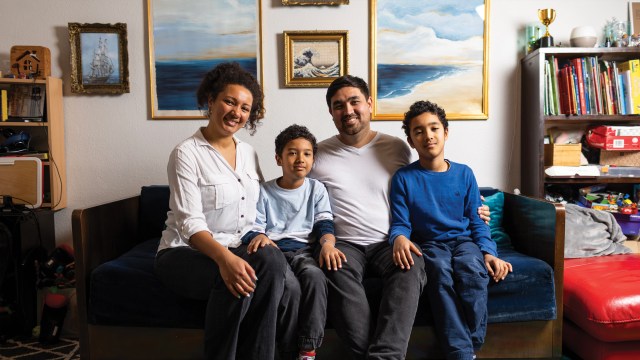
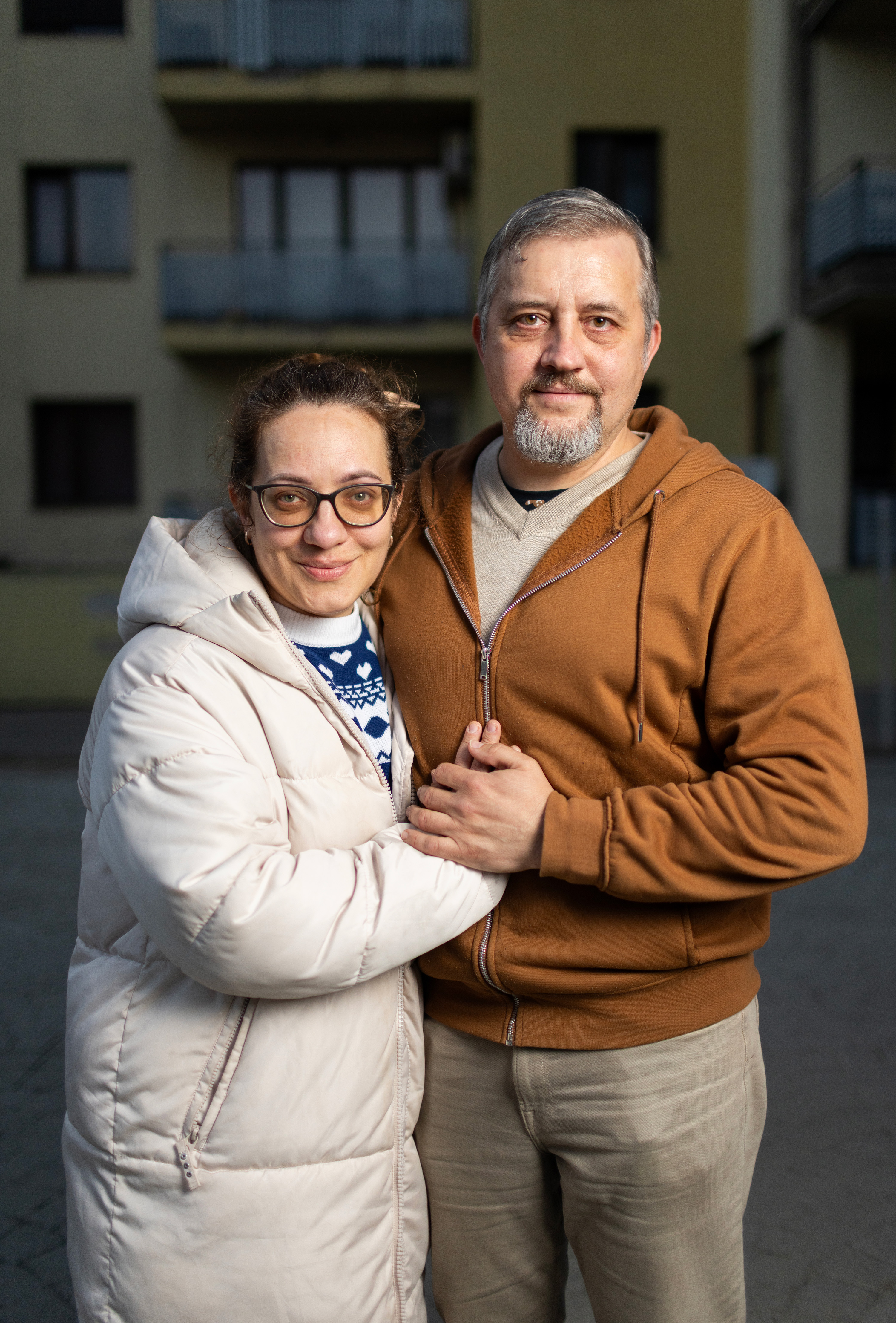
Damir Nurgaleev and Larianna Nurgaleeva sit with their children in the living room of their current home in Romania.

It’s mid-morning, also in early spring, just before the wheat grows green in our fields, when I meet Viktor, his wife, Iryna, and their teenage son—a Ukrainian family—who gave up their place in Moldova to help those fleeing their homeland in the days
right after the Russian invasion.

“​​We were missionaries, serving in Moldova,” Viktor says. “But because my wife speaks both Ukrainian and Romanian, when the war started we went to the Ukrainian-Romanian border to help with coordinating, to help Ukrainians meet with Romanians to find safe places. We didn’t expect to actually leave Moldova, or to end up in Romania, but God opened the door for us. We gave up our place in Moldova. There was a need.”

 I look across the table into his wife’s eyes. She had a safe place of her own—far from sirens, falling bombs, the trauma of war. Why give that up just to help others searching for a safe place to breathe and exist on this planet?

“At first, we stayed with about 20 other Ukrainians in a Romanian horse barn. They didn’t know how to speak Romanian or what to do or where to go for help. We help them find their way …” Viktor’s voice trails off.

“Eventually we had to manage the bills. Electricity, utilities, rent, everything … though we had our own place back in Moldova.” Iryna speaks slowly, emotion welling. “It is very hard. Every month, we have almost nothing left.

“We could go back. But we believe God puts us in a place. And we see that … there is a need for us to be here. Yeah, it’s not easy. But …” She brushes back tears.

I nod, feeling the ache and sacrifice of her words, the testament and witness of their lives. They are dying to self because others are dying to live. 
“The will of God—that is the place for us,” Victor says softly. “His will is where we live.”

What if the will of God is a place we choose to inhabit too? “God, people, and place cannot be separated,” John Inge wrote in A Christian Theology of Place. The places we live aren’t merely geographical but are relational too. What if we eschewed comfort to be the comfort of Christ? I’ve seen this too as one farmer in a long line of farmers: “Unless a grain of wheat falls into the earth and dies, it remains alone; but if it dies, it bears much fruit” (John 12:24).

In the summer of 2017, I walked down roads in Iraq, the land of the Tigris and Euphrates rivers, where the world’s first known farmers grew the earliest strains of wheat. Every year, as they have for hundreds of years, these floodplains deposited nutrient-rich, alluvial soil, creating some of the most fertile dirt in the ancient world.

I walked with Joseph, a 23-year-old Iraqi man, through the rubble left by ISIS where his hometown once stood. On the morning of his 22nd birthday, he woke to his mother singing as she prepared a feast for his birthday dinner. Before she set the plates out, ISIS invaded. I stopped in the middle of the war-wrecked street and quietly asked Joseph, a young man who’d once gone to church every Sunday, how he feels about God.

Joseph’s eyes didn’t leave mine. “I don’t … feel anything about God. I don’t … believe. I used to, before all of this.” He waved his hand like he could brush away the misery that surrounded him. “But now I think, There is no God. There is no God who cares about us.

Then Joseph leaned in, inches from my face, and asked me a question that cut me right to the quick. “Am I wrong?”

I could feel his pain burning in my chest. When love is mostly self-seeking, do people mostly miss seeing the face of God?

Is God only more clearly seen in the world when we seek out and speak out and sacrifice for the interests of others in the world? Is this what it looks like to place myself in the generations of God’s will?

photos of ukranian christian missionaries now living in Romania.Photo by Esther Havens
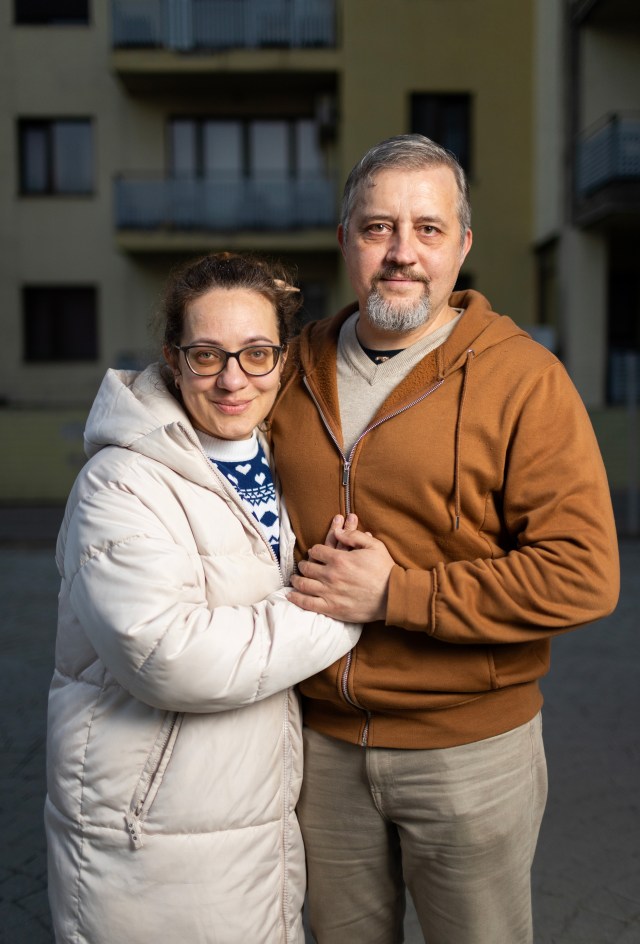
Viktor Ihnatiev and his wife, Iryna Ihnatieva, are Ukrainian missionaries now living in Romania.

“Somebody always wants more” is what Kamila, a young Ukrainian woman who fled with her family to Romania last spring, tells me before we walk across a city square, a flock of pigeons taking flight. “More power, more money, more control, more, more, more. But most people, they just want a normal life. Peaceful. But we end up going through all the difficulties, experience all the horrible things—because someone wants more.”

I see in Kamila’s young eyes what I saw in Joseph’s that day in Iraq.

But Joseph had stepped closer and I’d felt his wild, hurting breath on my face as he spoke. “The world doesn’t consider me even human,” he said. “You can get on a plane and fly back to your nice little island of safe. But me—I’m left in this place to exist as nonhuman—and there’s no one, no United Nations, no united people, no united front—no one who cares how I exist, where I exist, or even if I exist.”

Is the church still a place of fertile soil? A place where every believer becomes a seed—rooted in Christ, dying to self, and producing a harvest that sustains the fleeing travelers who crave the smallest place
of peace?

My father, my father’s father, and his father before him all taught the next generation an important truth: Farmers can have faith that the soil under our feet is fertile with abundance, even enough to share.

“I’m Russian,” Damir says with his Russian passport in one hand and sweet apple bread in the other. “But I’m not only a Russian citizen; I’m also a Ukrainian refugee. I have Ukrainian kids. I have a Ukrainian wife. And I’m living here in Romania, serving in ministry, helping Ukrainian refugees grow closer to God.” He tastes the last of his bread.

“And honestly,” Damir speaks softly, leaning in, “my citizenship is not Russian, not Ukrainian, not Romanian. My citizenship is heaven.
I have heaven.”

I finish the last of my apple bread too. And taste conviction. What does it profit a person to hold citizenship in the best of lands yet care little about the plight of image bearers of God in other lands—and so end up profaning your own citizenship in heaven?

Doesn’t the way we respond to those in need of a safe place reveal what kind of place our souls truly are? Do we desecrate a place when we dehumanize a person?  

Photo of Ukrainian refugee living in Romania.Photo by Esther Havens
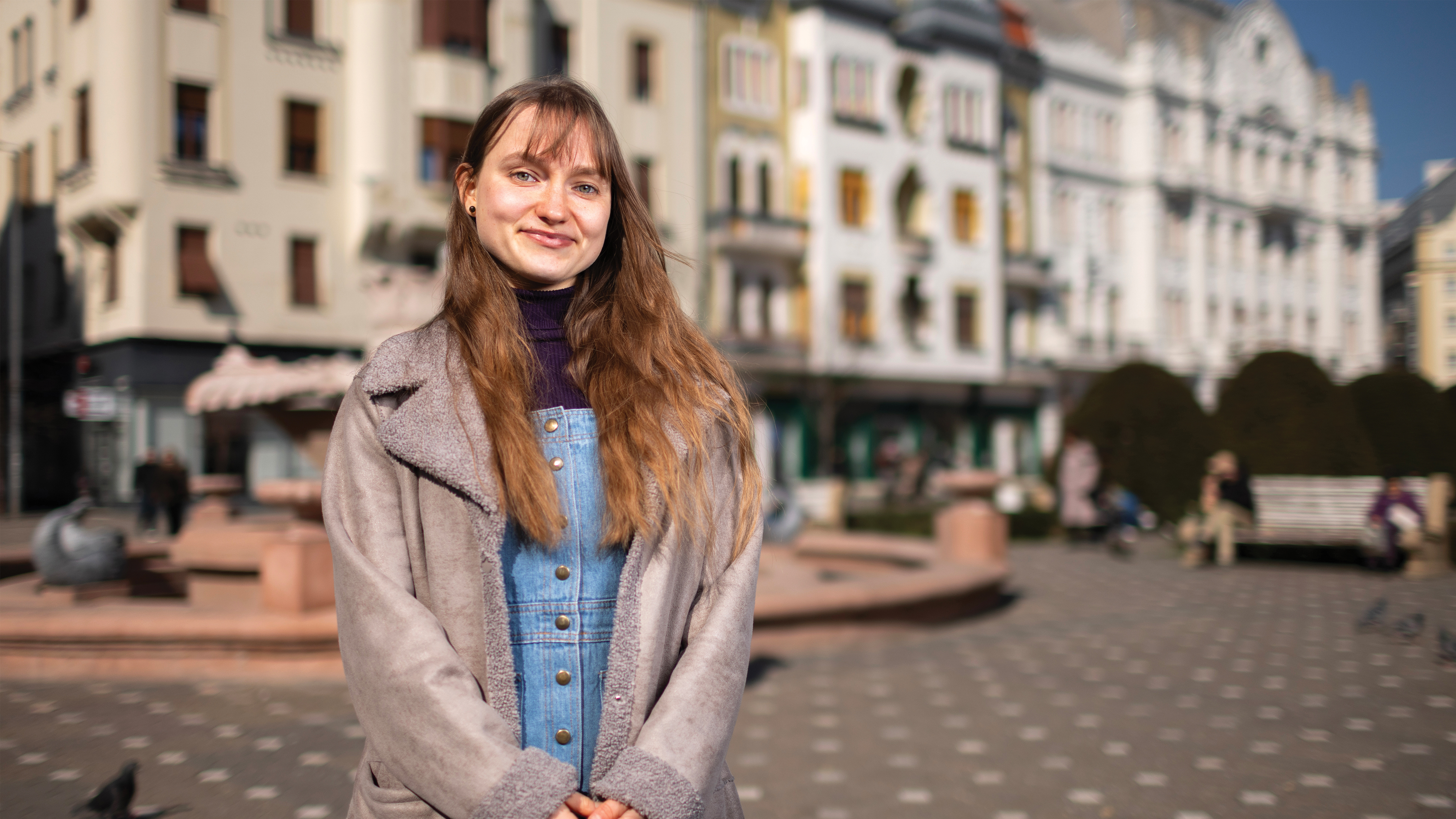
Kamila Polianska, a Ukrainian refugee living in Romania

This is the reality before each of us: The passport every single person carries is the image of God, which means every person comes from a place that warrants dignity. Then immigration is more than a mere political debate—it’s ultimately about a person’s dignity.

Jesus, too, migrated—from heaven’s heights to the human race.

Jesus, too, fled with family, from an unsafe place to Egypt.

Jesus, too, knew what it was to be uprooted and suffer injustice.

And it’s Jesus, too—the refugee—who is seen in the face of every refugee.

Larianna reaches across the table, offering another slice of her warm apple bread.

“Everybody wants to have a stable life. A lovely pillow, a lovely everything. But for your soul to grow? Your faith to grow? You sometimes need to lose something.” Larianna leans forward and repeats herself, to make sure I understand: “To grow your belief, you may need to lose something.

Live all of your life in one house and never lose anything? It’s hard to grow your faith. Because you always have your stable life.”

Her voice is soft, but something hard in me is breaking open.

“But if you lose things … if you lose everything … your faith grows and God becomes everything.” Larianna nods, her eyes holding mine. “It doesn’t matter if you’re with food, without food, with roof, without roof. What matters is that you have heaven, that you have God. This is the only way to happiness.”

Have I forgotten that, in the upside-down kingdom of God, you have to experience loss to grow?

This year, like the last, the wheat grew tall across our farm—this place of dirt and sky and sheep and seed that I call home. Each ripe head bowed humbly down. After the harvest, I walked the dirt fields, knelt down, and gathered into my open palm a seed or two that had fallen to the earth.

To be human is to come from humus, from the earth, from the land. And to belong to Christ is to be all at once a sojourner, a safe place, and a surrendered seed in a strange soil that breaks open and lets go. To grow and harvest abundantly more.

This is what my father told me. It’s what we tell our children, the next generation of farmers in this place, on this land: When you plant a kernel of wheat in the ground, its first growth is always downward, not upward, the seed sending out an embryonic root, called a radicle, pressing lower into the soil.

Growth always begins in this radical downward mobility—this place of letting go, going lower into the wide expanse of the upside-down kingdom of God.

Ann Voskamp is a New York Times best-selling author and farmer based in Canada. Her most recent book is Loved to Life.

Esther Havens is a humanitarian photographer and storyteller based in Dallas.

Books
Review

The Urban Church’s Junior Partners

A Chicago pastor encourages inner-city churches to see their youth as potential leaders.

An illustration showing the silhouette of a basketball hoop against a sky filled with flying birds.
Illustration by Raven Jiang

As a kid, I thought I was just curious—like any other kid. But the grown-ups called it being nosy. More often than I can recount, I would hear the words “Go sit down somewhere and stop talking while grown folks are talking. This is grown folks’ business.” They had important things to discuss and decide, and I was in the way.

In Don’t Despise Our Youth: Renewing Hope for Urban Youth Ministry, David A. Washington, a pastor in Chicago’s South Side, addresses inner-city churches like his own. These churches, he argues, have neglected to invest in youth ministry and failed to engage young people as potential leaders and disciple makers.

Such neglect communicates that church ministry is “grown folks’ business,” to the detriment of reaching, discipling, and deploying youth as urban missionaries. Washington spells out some of the consequences: Urban churches will reach fewer outsiders for Christ, their own youth will struggle to belong, and their youth ministers will feel undervalued, causing some to leave ministry for good.

Because of these factors, Washington argues, the urban church in America is at a crisis point. As he notes, inner-city youth often grow up in communities beset by violence, poverty, drug abuse, and gang warfare. Traditional youth-ministry resources are not contextualized for the challenges of urban life, leaving youth leaders with few resources to help them navigate the needs, challenges, and opportunities of gospel ministry there.

One striking feature of Don’t Despise Our Youth is how Washington’s own life bears out its message. His story testifies to the dramatic difference youth ministry can make in even the most challenging contexts. Clearly, Washington’s philosophy of ministry flows from direct experience, not idle musings drawn up in a bookshelf-lined study.

That philosophy draws special inspiration from the ministry of Salem Baptist Church of Chicago, which helped rescue him from a downward spiral into teenage violence. At age 17, Washington was a gang leader plotting a retaliatory hit on a rival group. On his way to help execute the attack, he encountered Harvey Carey, Salem’s youth pastor at the time. The pastor introduced himself and asked Washington for his name, which he reluctantly gave. Three months later, Carey saw him again on the street and called his name, displaying the kind of intentionality, consistency, and love necessary for faithful youth ministry.

These encounters set the stage for God to draw Washington to Christ through Salem’s ministry. “I was greatly valued,” he recalls, “by a pastor who focused not on what I had become in the world but on what I had the potential to become in the kingdom of God.”

In urban ministry, one often encounters hardened people entangled in seemingly hopeless situations. The landscape can call to mind the valley of dry bones God showed to Ezekiel (37:1–14). Yet Washington’s journey confirms that God can make dead things alive. He can bind up people and places crushed by unrighteousness and injustice.

One of Washington’s central arguments is that vibrant ministry to young people involves “youth doing ministry” rather than merely adults ministering to youth. For some, this distinction might seem like semantics, but the difference is significant. Rather than seeing a church’s youth as passive recipients of ministry formation, Washington hopes they will contribute to the church’s life and mission, even at a tender age.

As Washington argues, simply having a youth ministry doesn’t guarantee that a church is effectively raising youth to spiritual maturity and thereby multiplying disciple makers. On top of that, youth ministries often grow overly isolated from adult congregations and senior pastors. In such situations, teenagers can struggle to find meaningful places in a church’s life and ministry.

To help turn the tide, Washington calls urban churches to a focused ministry of the Word, in which habits of evangelism and discipleship transform young people into active participants in the church’s mission. Even while they are still being discipled, he argues, they can join in the work of “soul fishing.”

Washington writes, “Until we understand the power available through the lives of mature and discipled teenagers in our churches, we will continue to miss out on incredible opportunities to do greater works for God.” For pastors like me, this means remembering to equip our youth as we consider our broader responsibility to equip the saints for the work of ministry (Eph. 4:12). It means valuing them as vital participants in the work of building up the church to maturity in Christ as well as calling other youth from darkness to light.

Building this kind of ministry involves finding and retaining youth pastors whose gifts, calling, and passions are aligned and who intend to stick around for the long haul. The youth-ministry grind can be difficult to sustain. When leaders receive inadequate investment and support from their churches, they can feel tempted to quit or to seek positions higher up the leadership ladder. While Washington calls youth ministers to deep commitment, he also encourages partnership efforts by parents and other church members as well as consistent, public support from senior pastors.

This is all worthy counsel. Still, I believe the book could have done more to emphasize the church’s role in caring for the souls of youth pastors themselves. Seeking lost teenagers in hard places exposes the soul to mountains of grief, as anyone involved in urban ministry knows well. You might lose a kid to gun violence or the criminal justice system. You might witness once-faithful kids succumbing to neighborhood pressure.

These are painful experiences. One way the church can keep youth pastors from wearing down is making sure they can access resources, such as counseling, that help them persevere through tears.

This oversight notwithstanding, Don’t Despise Our Youth meets a critical need for the urban church. It provides inspiration, powerful testimony, and helpful suggestions for inner-city churches looking to tailor their youth ministries to inner-city realities.

Washington deserves credit for treating youth ministry as something more than grown folks’ business. In fact, grown folks’ business isn’t complete without training young folks to be about their Father’s business, for the good of our cities and the glory of his name.

Brian Key is pastor for discipleship at Imago Dei Church in Raleigh, North Carolina.

Books
Review

A Ukrainian Seminary’s Resilience

Russian troops destroyed its buildings but not its mission.

An illustration showing an empty chair set before an open field.
Illustration by Raven Jiang

During my time as a college history professor, I taught a required course on Western civilization. Like many faculty peers, I tried different ways to motivate business and premed majors to take it seriously.

One common method was beginning the semester with C. S. Lewis’s classic essay “Learning in War-Time.” This essay (also the subject of Mark Meynell’s January/February article “War Changes Everything—And Nothing”) eloquently advocates maintaining a commitment to the life of the mind amid adverse circumstances. Professors often stretch the “wartime” metaphor to fit any stressful situation—a global pandemic, political turmoil, or a losing football season.

But what is learning like when the war isn’t metaphorical? In Serving God Under Siege: How War Transformed a Ukrainian Community, Valentyn Syniy details his experiences in leading a Christian academic institution in literal wartime conditions.

My own current work conditions, as the director of a Christian learning community on a public university campus, are admittedly far less challenging. But Syniy’s account offers worthy insights for anyone engaged in the work of higher education.

Syniy is the president of Tavriski Christian Institute (TCI), an evangelical seminary in the southern Ukrainian city of Kherson, near the Crimean Peninsula. In 1996, several pastors there desired to create a regional Bible college for ministers. They reached out to Glen Elliott, a missionary from the United States. Several Christian colleges in the US became involved, resulting in the creation of TCI. The school purchased land along the Dnieper River and began constructing buildings in 2003. Two years later, Syniy signed on as rector.

Yet Russia’s 2022 invasion upended life for TCI’s students, teachers, and staff. As the Russian army attacked and occupied Kherson, Syniy and his family fled the city, along with many TCI students and staff. They traveled over 500 miles to a safer location in the western Ukrainian city of Ivano-Frankivsk.

Interestingly, however, TCI’s history plays only a minor role in the narrative. In fact, readers learn about the school’s founding only toward the end.

Instead, Syniy focuses on how the TCI community pursued other forms of Christian service. They coordinated the evacuation of refugees from Kherson and Kyiv, Ukraine’s capital. They started a coffee shop ministry to local youth patterned after a similar effort in Kherson. Syniy raised humanitarian funds from Dutch and US sources for communities impacted by the war.

Meanwhile, Syniy and his students worked to maintain some semblance of normal life. In the book, he describes celebrating his daughter’s wedding, speaking at a pastor’s retreat, and going on long walks with his dog Sherri.

Yet certain aspects of prewar life did not survive the Russian invasion. One casualty, it seems, was any sense of unity between Russian and Ukrainian Christians.

TCI had received its accreditation from the Euro-Asia Accrediting Association (EAAA), which included many Russian and former Soviet institutions. In March 2022, Ukrainian seminaries held a conference called The Russia-Ukraine War: Evangelical Voices, an appeal to help resist Russian aggression. Presenters, including Syniy, decried notions of “Russian Order” used to justify the war, and they called on Russian Christians to join them in condemning it.

Three months later, the EAAA organized a Zoom conference that included seminary leaders from Asia, Moldova, Ukraine, and Russia. Syniy attended while sitting at a military checkpoint on his way back to Kherson to evacuate refugees. In the book, he recalls his rising anger as a Russian seminarian pleaded for Christian unity and expressed skepticism about reports of Ukrainian suffering:

Here he was, sitting in a warm, cozy study with books behind him, drinking coffee from his porcelain cup, while hundreds of people around me had no clean drinking water.

The inability of Russian Christians to condemn their country’s actions led Ukrainian seminaries to withdraw from the organization. “We found ourselves in two different worlds,” Syniy writes. “We had no choice but to separate.”

The war’s polarizing effects also seem to hamper Syniy’s own ability to rise above geopolitical divides and see Russians as individuals. His narrative refers to Russians as “unrighteous people,” and he concludes it by condemning “the ruthless and bloodthirsty empire that is trying to steal home from every Ukrainian.”

More than anything, Syniy’s story captures the difficulty of education in wartime. Distraction and danger interfere, of course, with pondering lofty ideas. But more fundamentally, they interfere with the practical matter of congregating in a single space.

In August 2022, still exiled from its campus in Kherson, TCI tried starting a new academic year. The school rented a facility in Ivano-Frankivsk, a former hostel for students from India. Makeshift classrooms emerged from bare, white-walled spaces, and a small room on the second floor of a nearby church became the library.

Despite such meager facilities, TCI enrolled several dozen students in a pastor’s licensing program, and another 80 students took classes online. Meanwhile, Ukrainian forces made progress in and around Kherson. Syniy received sad news, however, on the eve of the fall semester in Ivano-Frankivsk: Russian troops had looted the Kherson campus and destroyed three of its buildings.

In November, Syniy and his wife were visiting US churches when he learned that Ukrainian forces had liberated Kherson. Yet two weeks later, his joy over the city’s rescue turned to sorrow when he visited the now-devastated TCI campus. He writes,

I remembered how we had dreamed of having a library built, how carefully we had selected books to fill it, and now everything of value to us was burned inside, scattered around, or taken away by the occupiers.

Syniy cut his tour short, fearing Russian snipers. As he recalls, “I had never felt such a dense and overhanging silence over an empty campus.”

Serving God Under Siege is an engaging window into a community of Christians upended by circumstances beyond their control. Written early in a war that still rages, the story has no certain outcome.

Perhaps TCI will rebuild and flourish in the future. But in the meantime, the school is committed to adapting as best it can amid the hardships of war. “We must fulfill our mission regardless of where we live or what resources we have,” Syniy concludes. “But I’ll tell you honestly, without infrastructure it is a much tougher challenge!”

Rick Ostrander is executive director of the Michigan Christian Study Center in Ann Arbor, Michigan. He is the author of Academically Speaking: Lessons from a Life in Christian Higher Education.

Books
Review

The Rise and Fall of the ‘Evangelical Vatican’

Why Colorado Springs no longer shapes evangelicalism as it once did.

An illustration showing a shattered window with a bird flying free in the distance.”
Illustration by Raven Jiang

Colorado Springs, Colorado, was the center of American evangelicalism in the second half of the 20th century. Ministries relocated to a place whose government and chamber of commerce welcomed them. Megachurches built huge worship centers. Parachurch workers evangelized Air Force Academy cadets with the support of their officers. The confluence of economic, military, and spiritual power turned a small city just east of the Rockies from the “little Wheaton of the West” into an “evangelical Vatican.”

Or into Jesus Springs, as William J. Schultz puts it in his new book, subtitled “Evangelical Capitalism and the Fate of an American City.” Schultz, a historian at the University of Chicago Divinity School, has written a nuanced portrait of evangelical ministries and political aspirations after World War II. In the book, he argues that the “early Cold War was the pivotal moment in the emergence of modern American evangelicalism,” using the trajectory of Colorado Springs as a case study.

Any scholar who writes about evangelicalism faces a definitional challenge. How does one describe a diffuse group of people who don’t always call themselves evangelical? Is theology at the heart of this movement? Or is it some blend, in Schultz’s words, of “white supremacy, conservative politics, and consumer capitalism”?

Schultz smartly cuts through these debates. “Neo-evangelicals” such as Billy Graham, he writes, “sought to Christianize the United States by converting as many people as possible and by securing recognition of Christianity as the dominant force in American culture.” Evangelicals who headquartered their ministries in Colorado Springs—figures like Young Life’s Jim Rayburn, Dawson Trotman of the Navigators, and perhaps most prominently, James Dobson of Focus on the Family—didn’t perceive any conflict between the work of saving souls and efforts at “Christianizing” the nation.

To Schultz’s credit, though, he underscores the centrality of evangelism rather than the nationalistic ends. Trotman and Rayburn, like Billy Graham, were first and foremost evangelists who sought to share Jesus Christ with as many people as possible. Young Life’s goal, as Schultz frames it, was presenting the gospel in “the most attractive and winsome way possible.” It and other parachurch ministries cultivated star athletes, sorority leaders, and soldiers, hoping such high-profile figures would in turn bring others to Christ. Trotman, clad in a leather jacket, rode motorcycles through the streets of 1950s Colorado Springs.

Stodgier Protestants pointed out that Jesus didn’t recruit the cool kids; nevertheless, conservative Protestants still bankrolled these and similar ministries with their promises to save the next generation of Americans. And so Colorado Springs became their base of operations. Young Life acquired Star Ranch, just south of the city, and the Navigators purchased Glen Eyrie, a Tudor-style mansion built by a railroad magnate.

Scores of other ministries followed, in part because the city’s business leaders rolled out a welcome mat. As Schultz notes, the chamber of commerce “plied evangelical organizations with promises of cheap land and cheap labor.” He profiles Alice Worrell, hired by city boosters in 1984 to recruit businesses. Worrell was the devout daughter of missionaries, and she knew what evangelical ministries wanted. “Most people I talk to are trying to escape liberalism,” she explained. By this, Schultz elaborates, she meant not just a political bent but also “a whole host of social ills, most of them associated with big cities.”

Worrell enlisted leaders of Young Life and the Navigators in a successful campaign to bring the Christian and Missionary Alliance denominational headquarters to Colorado Springs. But the city’s biggest evangelical triumph was convincing Focus on the Family to relocate from Southern California. The arrival of Focus and the rising profile of Ted Haggard, pastor of New Life Church, cemented the city’s evangelical reputation.

Not all the evangelical newcomers took the same gospel-centered, largely apolitical approach as Rayburn and Trotman. Robert LeFevre, a staunch libertarian and believer in the prosperity gospel, founded the Freedom School, which had a close association with the right-wing John Birch Society and at least tolerated segregation. One local pastor, David Skipworth, criticized a public school course on mythology as satanic paganism. The city’s leading evangelical lights didn’t want to disrupt warm relations with civic and business leaders and accordingly kept extremists like LeFevre and Skipworth at arm’s length.

By the early 1990s, an era of relative moral consensus was fraying, both locally and nationally. Campaigns for gay rights had stoked evangelical anxiety across the country, and several Colorado municipalities passed ordinances banning discrimination against individuals based on sexual orientation. Colorado Springs evangelicals were prominent among the conservative activists who mobilized a successful campaign to overturn such laws through a state constitutional amendment. Its 1992 passage emboldened evangelicals across the country who hoped to replicate the effort.

Success, however, came at a steep cost. “Many people,” Schultz observes, “blamed Colorado Springs and its evangelical population for imposing its morality on the rest of the state.” Some progressive denunciations were unfair, but evangelicals did themselves no favors by occasionally portraying their opponents as evil and satanic. The city’s business leaders fretted about the negative publicity. The consensus that had brought together evangelicals, civic leaders, and the US military shattered. In 1999, the aptly named incumbent mayor, Mary Lou Makepeace, a moderate on gay rights, defeated a challenger backed by conservatives.

The close relationship between the Air Force Academy and evangelical Christianity also came under fire. The chapel had incorporated separate spaces for Catholic and Jewish cadets, but Protestant Christianity, and evangelicalism in particular, achieved something akin to an unofficial establishment at the academy.

The city’s megachurches and parachurch ministries took every opportunity to evangelize and disciple cadets. The academy’s leadership did its part as well. General Johnny Weida, commandant of cadets, encouraged cadets to participate in the National Day of Prayer and in evangelism. Football coach Fisher DeBerry hung a banner in the team’s locker room that declared, “I am a member of Team Jesus Christ.”

By the early 2000s, the cozy relationship between evangelical Christianity and the Air Force Academy generated complaints and congressional investigations. There was plenty of evidence that nonevangelical cadets chafed at institutional support for evangelical religiosity. Evangelicals countered that their opponents sought to limit their free exercise of religion. The conflict symbolized the crumbling of a once durable consensus.

Another symbol of Colorado Springs’ evangelicalism collapsed in 2006. New Life Church’s Haggard had distinguished himself as one of the country’s most prominent and winsome young evangelical leaders. He was far more reticent about political activism than many of his Colorado Springs counterparts, but he lent strong support to a 2006 state constitutional amendment defining marriage as between one man and one woman. At the same time, however, he had been having sex with a male escort, who also helped him acquire crystal meth. Two days after Colorado voters overwhelmingly approved the proposed amendment, Haggard resigned his position at New Life.

In closing, Schultz uses the historical trajectory of Colorado Springs to illuminate how evangelicalism has changed from the 1950s to today. Men like Jim Rayburn, Dawson Trotman, and Billy Graham, he writes, “worked in an era when they could feel, with some justification, that they were speaking to a Christian population who simply needed to be recalled to their evangelical heritage.” They were confident that they could achieve this goal through “persuasion rather than force.”

But that consensus, says Schultz, is long gone. As he describes it, “We now live in an era of democratic backsliding, cultural progressivism, and widespread secularization.” In response, he finds, newer generations of evangelicals have become more strident, more authoritarian, and more wedded to the Republican Party. There are still many evangelical ministries in Colorado Springs, but some have moved elsewhere in search of cheaper land and new beginnings.

As Schultz comments, “The parachurch ministries that made Colorado Springs into ‘Jesus Springs’ are certainly not irrelevant to American evangelicalism,” and they “retain the loyalty of many Christians.” But the cultural ground has shifted underneath their feet. According to the Pew Research Center, Americans now hold negative views of evangelical Christians in higher percentages than of any other religious group.

Over time, Schultz concludes, this new era will “produce its own version of evangelicalism,” although the outcome “remains to be seen.” Hopefully, however, we won’t be too eager to discard the legacy of Rayburn, Trotman, and Graham. Like many of today’s evangelical leaders, they faced criticism for alleged theological shallowness, unabashed patriotism, and forays into politics. But they undoubtedly succeeded at making evangelical Christianity attractive to large numbers of Americans. Stridency might win attention and notoriety, but winsomeness isn’t the worst starting point for winning people to Christ.

John G. Turner is professor of religious studies and history at George Mason University. His latest book is Joseph Smith: The Rise and Fall of an American Prophet.

Culture

The Anteroom of Christmas

Advent makes room for us so we can make room for Christ.

A special table beautifully set for dinner.
Illustration by Silvia Reginato

The centuries of yearning behind the fulfillment of our Lord’s appearance have myriad small incarnations in the hearts of his people. We’re all waiting on something. Waiting for God to fix a problem. Waiting for him to give us the longing of our hearts. Waiting to see him face to face. It’s tempting to let the season underscore what we still don’t have, even though another year has rolled around. But how much richer it is, I am learning, to embrace the stark solemnity of the great universal waiting for the Messiah and to find a parable of it in my own desires.

The expectancy of Advent throws a reflected light over the waiting days of our lives. “All my desire is before thee,” we whisper (Ps. 38:9, KJV). Both behind and before us, a multitude sends up an echo that has not been silenced since God first taught people to hope in his coming to the human race—and to each of us in the intimacy of our need.

Christmas is a joyous season, but it can also be a difficult one. If we’re honest, many of us embark upon the holidays with conflicting emotions: We are grateful and we are begrudging; we have much to anticipate and we have much to do. We ought to be excited, we tell ourselves, rejoicing in our coming King. But, in reality, we are exhausted, spent with the effort of managing life in an increasingly complex world. The very thought of squeezing all of that extra cooking, cleaning, shopping, wrapping, decorating, and socializing into our already crowded lives makes some of us want to hyperventilate.

Conversely, some of you may long for the bustle of a family or a community to care for, while others still might be grieving, navigating a shadowland against which the fanfare of the holidays stands out like an insult to your loss. Loneliness, deferred hopes, disappointment, bereavement—Christmas, for all its imagined or remembered joys, can only make things worse.

If you fall into any of these categories—and I imagine that each of us can identify with at least one of them from time to time—I have very good news: Advent is the place for you. Advent is where the “now” of God’s active and present love for us meets the “not yet” of our unfulfilled longings, and it is specifically set apart for the wounded and the waiting, the weary and the jaded. Historically, this has been a season of soul-searching devotion, a “little Lent” to prepare our hearts for the astonishing gift of God-with-us. But it is also a time to reverently affirm that all is not as it should be or indeed as it will be.

The story does not end with the Incarnation or even the Resurrection. All creation yearns toward the second coming of Jesus.

Beyond the bright sadness of Advent beams the fulfilled promise of Christmas and the future hope of perfect joy. And while Christmas is a feast in both the sacred and the temporal sense, Advent can be something of a fast, helping us identify excesses and nonessentials in our lives. The gift of this season is space, not to fill but to receive. There is permission here, in this anteroom of Christmas, to choose presence over productivity and quality over quantity. We may have myriad burdens and responsibilities, but Advent clears our heads, inviting us to work—and to live—from a place of sufficiency and peace. Advent makes room for us so that we, in turn, can make room for Christ.

And so, my prayer for you amid all the much ado of this season is that you would find a resting place in God’s unconditional love. May you have the freedom to celebrate a truth that transcends your circumstances and the courage to set aside any trappings that do not serve your relationships. May you keep Christmas in a way that embodies what you believe. Above all, may you lift your heads with the freshened hope that has comforted Christians for centuries: Even so, come, Lord Jesus.

Lanier Ivester is the author of Glad & Golden Hours: A Companion for Advent & Christmastide. She maintains a small farm with her husband.


While it’s lovely to plan and prepare special meals this time of year, keep in mind that some of the most memorable hospitality can also be the most spontaneous. With a few quick recipes in your arsenal and ingredients in your pantry, an unexpected visitor will feel like a cherished guest. Which is, after all, what hospitality is all about.

Cardamom Hot Chocolate

Cardamom pods can be found at Indian grocery stores or purchased online from bulk spice dealers. If you can’t find the dried pods, you can substitute up to 1 teaspoon of ground cardamom, whisking it well into the milk as it simmers. This chocolate is very rich, which is why I serve it in small “demitasse” (literally, “half cup”) teacups.

Serves 6

12 dried cardamom pods
4 cups milk
5 ounces bittersweet chocolate, chopped
4 ounces semisweet chocolate, chopped
1 cup heavy cream
2 tablespoons packed brown sugar,
plus more to taste
2 teaspoons Madagascar bourbon vanilla

Crush the cardamom pods with the butt of a knife and combine with the milk in a medium-sized saucepan. Heat cardamom and milk over low heat and simmer, without boiling, for 10 minutes. Add chocolate, heavy cream, and brown sugar, whisking until the chocolate has completely melted and the mixture is hot. Remove from heat and lift out the cardamom pods with a slotted spoon. Add more sugar to taste, if needed, and stir in vanilla. Serve immediately.

Tapenade Crostini

Tapenade is a briny Provençal spread traditionally made of olives, capers, olive oil, and lemon juice. For this recipe, a good-quality jarred version combined with goat cheese and fresh thyme creates an effortless two-bite appetizer. The crostini toasts can be made up to one week ahead and stored at room temperature in a sealable plastic bag.

Serves 12

1–2 baguettes (8–10 ounces total) sliced ¼ inch thick (48 slices)
¾ cup olive oil
Kosher salt and freshly ground black pepper
¾ cup jarred green- or black-olive spread
3 tablespoons fresh thyme leaves,
plus tips for garnish (or 1 teaspoon dried thyme)
5 tablespoons finely chopped walnuts
¼ cup dried currants
1 small log goat cheese (4–5 ounces), softened

Preheat the oven to 350 degrees. Arrange the baguette slices on two large, parchment-lined rimmed baking sheets. Using a pastry brush, brush both sides of each slice with oil and season with salt and pepper. Bake until golden, 15–20 minutes, rotating the pans halfway through. Allow to cool on baking sheets. In a small bowl, combine the olive spread, thyme leaves, walnuts, and currants. Spread 1–2 tablespoons of goat cheese onto each crostini and top with 1–2 teaspoons olive mixture. Garnish with thyme tips (or sprinkle lightly with additional dried thyme) and serve immediately.


Essay and recipes adapted from Glad & Golden Hours: A Companion for Advent & Christmastide (Rabbit Room Press, 2024); and from The Glad & Golden Hours Kitchen Companion (Rabbit Room Press, 2025).

Apple PodcastsDown ArrowDown ArrowDown Arrowarrow_left_altLeft ArrowLeft ArrowRight ArrowRight ArrowRight Arrowarrow_up_altUp ArrowUp ArrowAvailable at Amazoncaret-downCloseCloseEmailEmailExpandExpandExternalExternalFacebookfacebook-squareGiftGiftGooglegoogleGoogle KeephamburgerInstagraminstagram-squareLinkLinklinkedin-squareListenListenListenChristianity TodayCT Creative Studio Logologo_orgMegaphoneMenuMenupausePinterestPlayPlayPocketPodcastRSSRSSSaveSaveSaveSearchSearchsearchSpotifyStitcherTelegramTable of ContentsTable of Contentstwitter-squareWhatsAppXYouTubeYouTube