News

DC Churches to Trump: Stay Out of Our Parking Lots

Ministers protest presence of federal officers scaring people away from houses of worship.

Immigration and Customs Enforcement (ICE) agents in newly designed vehicles in Washington DC.

Immigration and Customs Enforcement (ICE) vehicles in Washington DC.

Christianity Today August 29, 2025
Andrew Leyden / Stringer / Getty

Black and mainline Protestant clergy in Washington, DC, are demanding that immigration officials stop using their church parking lots.

“We want to remind those federal entities that the property of houses of worship is private and therefore should not be used without expressed permission from those worshipping entities,” the coalition wrote in a public letter signed by nearly two dozen religious and community leaders, including some who work with interfaith and social justice organizations.

Immigration arrests have spiked under President Donald Trump, who has made deportations and large-scale roundups a cornerstone of his second term. Shortly after he was inaugurated, Trump reversed a decades-long policy that prevented officials from carrying out enforcement in churches and other religious institutions. Christian and Jewish groups challenged the new policy in court, arguing it has led to more surveillance. But in April, a federal judge sided with the administration.   

In their letter, the DC ministers say that if Immigration and Customs Enforcement (ICE) officers or other federal officials park on their property, it can make it look as if they support the Trump administration’s move to police the city as well as the “disappearance of our neighbors, family members, and friends.”

Patricia Fears, the pastor of Fellowship Baptist Church, a predominantly Black congregation in the northwest quadrant of Washington, told CT she has heard from roughly ten Black and Latino churches that said they’ve seen either ICE vehicles or unknown cars, some of which carried masked men, in their parking lots. ICE did not comment for this story.

Fears, who organized the letter with an interfaith organization, said officers weren’t arresting congregants but using the church lots to stage operations and detain people nearby. The presence of federal officers limits ministry. Some people, including undocumented immigrants, are staying away from the churches, she said.

“It really causes people not to come to a place where they should and could have peace,” Fears told CT. Over the weekend, she said, she was asked to go and pray privately with people whose loved ones were arrested, including some who went to work and never came back. 

Graylan Hagler, who organized the letter with Fears and serves as a senior adviser to the progressive interfaith organization Fellowship of Reconciliation USA, said in an email that he began hearing reports from local clergy after Trump announced earlier this month that he would put National Guard troops in the district.

The ministers who signed the letter are also calling on other houses of worship not to allow federal law enforcement to use their property “for any means as long as Home-Rule,” which has given DC limited self-governance for decades, “is not respected.”

The Trump administration has argued a federal takeover of the city police department is necessary to quell high crime rates in DC. But critics, including many Democrats, note the district’s violent crime rate is at its lowest level in decades and have accused Trump of using racial tropes about urban crime to justify the takeover. Partisan bickering over DC’s crime data continued this week while the White House also released an executive order that would expand the National Guard’s role in law enforcement across the country.


Culture

Comics and Capes Can Be Christian Formation

Superhero stories like Superman and Fantastic Four depict a moral clarity that’s helpful for our kids.

Collage of a cartoon superhero breaking out of a TV screen on a blue background.
Christianity Today August 29, 2025
Illustration by Abigail Erickson / Source Images: Getty

When our girls were moving through secondary school, my wife and I began taking weekly strolls about the neighborhood, loading this midweek hour with conversations about scheduling, money, and parenting challenges.

We thought this to be pretty good child-rearing practice; routine talks increased the chances we were handling our kids in a similar, or at least complementary, fashion. For us, training up children in “the way they should go” (Prov. 22:6) included making observations about goals, friendships, and behavior, then responding with prayerful deliberation. One consistent challenge: reaching consensus about which TV shows, books, and movies were appropriate at each developmental stage.

During this period, we met another couple who was certain that godly parenting necessitated drastic measures to prevent cultural contagion. Within a year, they moved from the Central Coast of California to rural Idaho with the express purpose of erecting walls around their children’s minds. They believed public schools and popular media pushed too many dangerous ideas to risk further delay. Instead of wrestling with endless questions about the spiritual impact of new books and shows, they opted to step out of the ring altogether.

Was a cloistered life what my own family should have been pursuing if we took seriously the admonition to “set your minds on things above, not on earthly things” (Col. 3:2), to think about what is honorable, just, and pure (Phil. 4:8)?

My wife and I decided that the discernment necessary to “see the distinction between the righteous and the wicked, between those who serve God and those who do not” (Mal. 3:18) required encountering a wide array of fictional situations. Scriptural narrative provided a foundation for our kids, and both faith-informed and secular tales built upon that foundation by elaborating the consequences of embracing or ignoring Christian teaching. As a family, we read aloud, reserved time to watch shows and films together, and engaged in dinnertime exegesis.

Some choices were easy. Mister Rogers winsomely illustrated the power of loving those marginalized by disability or race, VeggieTales songs on a loop taught lessons about selflessness, and conflict-driven episodes of Little House on the Prairie dramatized situations in which virtues could transform the villainous. Our own love of 19th-century classics meant our daughters heard Jane Austen’s Emma while working on handstands in the garage, and I read Charles Dickens’s Hard Times and Charlotte Brontë’s Jane Eyre en route to distant gymnastics meets and vacation destinations. These novels, together with titles like Little Women and Anne of Green Gables, provided opportunities to discuss both healthy and destructive responses to fear, loneliness, and loss.

Other choices proved more difficult.

I discovered superhero comics in late elementary school and collected Marvel and DC titles well into adulthood, and I wanted to share my passion with the girls while they had time to immerse themselves. But aware that superheroes often resolve disagreements with violence, my wife was wary. How might Wonder Woman’s use of force influence a daughter faced with a recalcitrant sister? We started withholding superhero cartoons for a week when one of our kids pushed or pinched her sibling soon enough after watching a show to suggest a connection.

Were we playing with fire? Did knocking adversaries into little pieces in the Lego Batman video game, watching animated Teen Titans pummel their adversaries, and reading colored panels in which the Uncanny X-Men killed hostile extraterrestrials foster aggression in our girls? Were there any benefits to exploring this type of story? Why not confine our kids to tales with grounded, relatable characters in everyday situations, and history with its verifiable truths?

The Christian authors of The Fellowship of the Ring, The Lion, the Witch, and the Wardrobe, and A Wrinkle in Time each contend that fantasy provides valuable opportunities for readers young and old, opportunities to deepen understanding of a God whose unfathomable love and ineffable nature transcend logic’s efforts to measure and categorize. Though none of the three wrote or celebrated comic books, their central claims about fantasy apply well to the thematically complex superhero myths that have evolved over the last century.

Like the fairy tales J. R. R. Tolkien classes as a type of mythopoeia, tales about caped heroes open us to divine possibility. Fictional superhumans prime the imagination to apprehend an omnipotence that bends and breaks the physical laws that fantasy regularly suspends. In a poem written to a doubting C. S. Lewis in 1931, J. R. R. Tolkien affirms that “God made” and “Evil is,” truths he claims sub-creators (writers) validate whenever they “[sow] the seeds of dragons” or describe stars as “living silver that sudden burst / to flame like flowers.” As Tolkien writes elsewhere, by ensuring that recovery and consolation follow great suffering, fantasy also anticipates the truly joyous ending the Gospels promise.

Lewis stopped tiptoeing around his love of fantasy once he realized imagination could extend logic’s finite vision of reality. In fact, he stepped into fantasy’s current at the same time he plunged into the saving depths of belief. Removing mythopoeia from children’s lives, he later observed in “On Three Ways of Writing for Children,” removes an opportunity to counter fear with hope. Beside the “terrible figures” in such tales, fantasy sets up the “immemorial comforters and protectors, the radiant ones.”

Madeleine L’Engle rounds out this trio of writers confident that fantasy provides an effective springboard for an “assurance of things hoped for” though unseen (Heb. 11:1, ESV). In the autobiographical Walking on Water, she holds that fiction of all kinds opens us to possibilities we might otherwise ignore, like our potential to “respond more courageously and openly” to whatever challenges we face. Fantasy fiction offers to take us still further, she attests, drawing away from the secular world’s “dirty devices” and moving toward a vaster reality “interested not in limited laboratory proofs but in truth.”

L’Engle and her fellows recognize that scientific empiricism, useful for identifying material likelihoods, cannot validate truths that elude quantification. The same limit applies to stories that toe a scientific line. The historical novel and realistic film demand that we consider the plausibility of their representation, forcing us to dismiss or apply their conclusions—with crucial emotional consequences for ourselves. If we decide that a particular tale is authentic but far removed from our daily lives, we may experience a painful sympathy—as when watching soldiers caught in a hail of bullets at Normandy—but emerge relieved by the distance that time and space provide.

Superhero films aren’t limited by “laboratory proofs” or concerns about applicability. Instead, they nurture virtue conceptually in children. The incredible situations of these movies discourage practical deliberations while encouraging flights of inspiring fancy. Like a seedling removed to a greenhouse to stimulate growth far from the stressors of hostile bugs and extreme weather, a virtue cultivated in the safely imaginary can grow to ample size before returning to its native environment.

Most superheroes, breathing the rarified air of ideals uncomplicated by political pragmatism, model this inattention to the conventions that slow and complicate virtuous action in the real world. Batman does not ask Commissioner Gordon to vet his strategy for taking down Carmine Falcone before Batman tackles the mob boss in his lair. Captain Marvel does not run her plan of action by Congress before stopping an alien invasion. Both possess a simple, uncomplicated desire to save as many lives as quickly as possible.

In James Gunn’s recent Superman, reporter Lois Lane questions why our hero intervened to stop a land war on the far side of the globe without first conferring with either the US president or the secretary of defense. A delayed response, he observes, would have cost lives: “People were going to die!” Instead of allowing himself to grow numb to statistics about disasters, he considers the opportunity to prevent hundreds of deaths a mandate and acts.

The superheroes my imagination soared with as a kid shared this moral clarity. Superman’s willingness to confront villains grew my own notion of courage well before I had to face bullies in the locker room or defend a minority position in a fraught department meeting. The telepath Professor X, capable of reading and controlling others’ minds, usually entered another’s mind only when invited or when doing so would prevent tragedy. This exercise of patience, gentleness, and self-control (Gal. 5:22–23) provided the nascent professor in me with important lessons about the influence a teacher can wield.

Spider-Man’s mantra, “With great power comes great responsibility,” distills the ethos of many a superhero whose selflessness proves as extraordinary as their special abilities. As a teenager, I absorbed the absurd beauty of loving one’s enemies (Matt. 5:44) the more readily because the X-Men, mutants with unsettling powers, repeatedly put themselves in danger to save the very bigots persecuting them. In Marvel Studios’ recent films, the Hulk saves the general determined to capture and weaponize him, Captain America rescues Bucky Barnes even as the brainwashed friend tries to kill him, and Shang-Chi spares the father who considers his own son’s life disposable.

In Jake Schreier’s Thunderbolts, the morose Yelena Belova sets aside deep bitterness and grief to help a man whose own private darkness threatens to destroy her along with the rest of the world. That she lost her youth to training as an assassin, a calamity few of us can begin to comprehend, does not make risking her life to help someone threatening her the less inspiring. Belova’s transformation invites viewers of all ages to consider whether fixation on their own troubles may sabotage a capacity to give and receive love.

And though the most saintly sacrifice of a life (let alone a fictional one) can only distantly echo Christ’s salvific act on the cross, superheroes who give their lives help seed the imagination to embrace the incomprehensible. In The Fantastic Four: First Steps, Matt Shakman conveys this principle of loving sacrifice in possibly the most optimistic, family-friendly superhero film ever made. (Yes, even more uplifting than The Incredibles.)

Shakman floods his ’60s-era, alternative Earth with a joie de vivre that somehow avoids becoming saccharine. Bright lighting and a cool color palette join good-natured humor and a surprising forthrightness absent from more cynical superhero movies. When the team fails to solve a problem endangering the planet, they admit their failure to an expectant crowd that cheered their return only moments earlier. Instead of prevaricating, Reed Richards unhesitatingly shares details sure to turn the world against them. They admit declining to sacrifice one of their own in a utilitarian exchange that would have saved the entire planet.

As it turns out, however, a blood sacrifice is necessary, and three different characters step willingly toward the altar. This, I think, is one of the most valuable gifts superhero tales can grant to children trained by an anxious society to think first about their own well-being: the greatest form of love involves giving life itself for another (John 15:13).

Will kids learn from such stories that physical force can destroy as well as protect? Most definitely, and we can pray they never have to deliver or receive violence themselves. Even if our kids never face such situations, having imagined the beauty of sacrifice will prepare them to renounce their lives in other ways and to appreciate more fully the one surrender that saves them.

Paul Marchbanks is a professor of English at California Polytechnic State University. His YouTube channel is “Digging in the Dirt.”

News

The Hard Life of a Kenyan Christian Teacher at a Muslim School

Sween Ambeyi can’t be seen reading the Bible, but she doesn’t want to be unemployed.

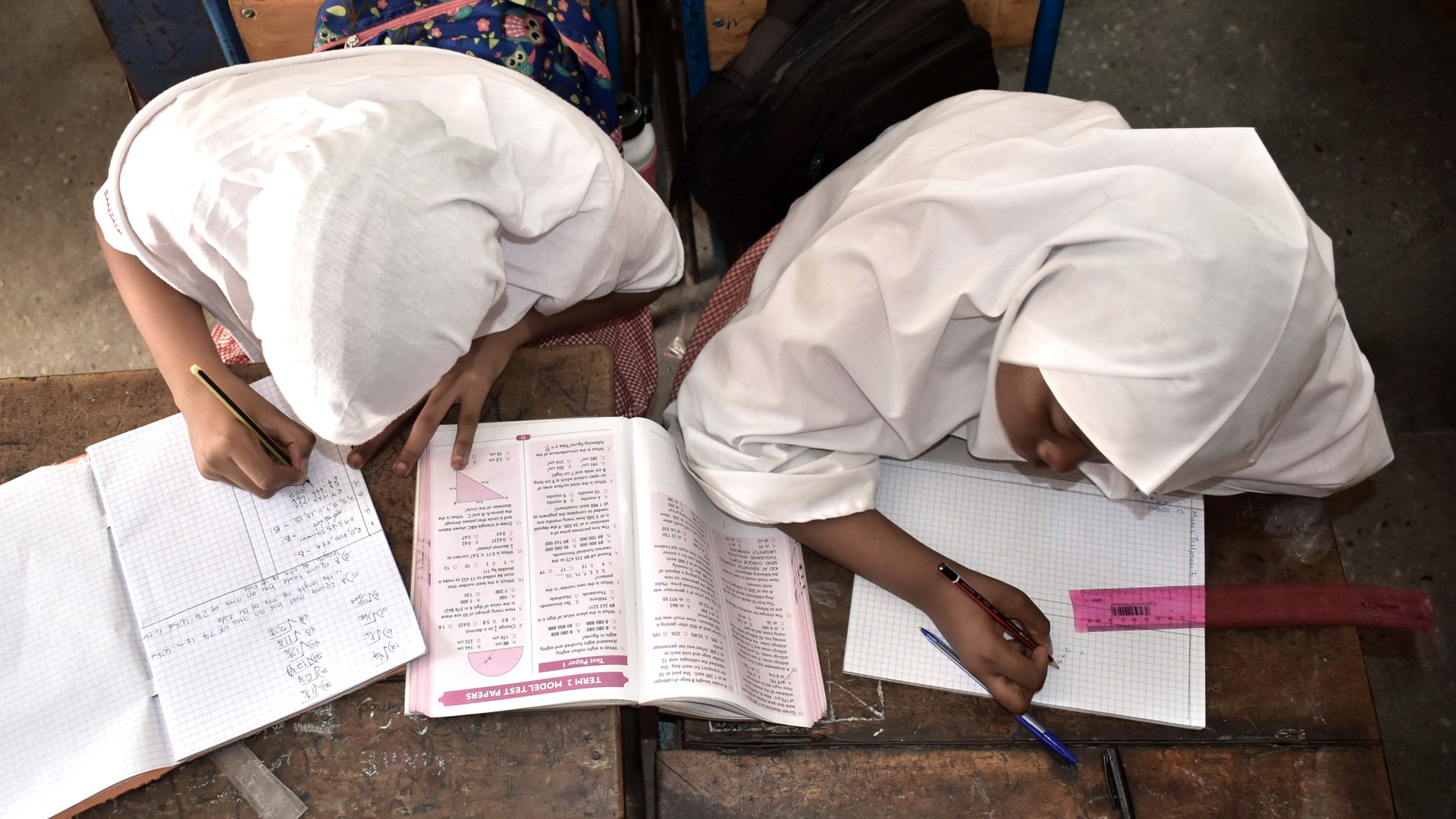
Muslim pupils studying at the Ganjoni Primary School in Mombasa, Kenya.

Muslim pupils studying at the Ganjoni Primary School in Mombasa, Kenya.

Christianity Today August 29, 2025
Andrew Kasuku / Contributor / Getty

At Bil el Burbur Primary School in Wajir County, Kenya, 35-year-old Sween Ambeyi sits on the bare ground in the hot sun and points to a small blackboard hanging on the acacia tree behind her. The 16 Muslim seventh graders—6 girls and 10 boys—sit separately. Though a hijab covers her, Ambeyi is a Christian, as are four out of five Kenyans, according to the 2019 census.

Although Kenya guarantees freedom of religion, Ambeyi cannot worship openly in Wajir due to community pressure. Muslim community leaders force her to wear a hijab. “It is either you obey or be sacked,” Ambeyi said. “When you cover your face like them, they will regard you as one of their daughters. Otherwise, they will beat you up for wearing skirts and other dresses.”

She also has to hide her Bible reading. “I can open my phone and read the Bible, then pray silently,” she told CT. “That’s the only option.”

She also faces bullying and harassment. Community leaders do not allow Ambeyi or other non-Muslims to touch a Quran. Female students and fellow teachers mock her for not having experienced female genital mutilation, a common practice in the area.

Ambeyi said she can’t punish or argue with male students. “Even if a male student is in the wrong, you have to keep quiet, because they will rush home and come with their mothers.” In this culture, mothers fiercely protect their sons. Ambeyi added that the mothers start conflicts with the teachers.

But for Ambeyi, quitting is not an option. Ambeyi said unemployment would be worse, and going back to college to start another career would take years.

When she graduated as a teacher in 2019, Ambeyi worried she wouldn’t find work. She took a friend’s suggestion to search for a job in the majority-Muslim counties of northeastern Kenya. Schools there struggle to hire teachers due to instability caused by the terrorist group Al-Shabaab. (The group killed five people in April 2025 and has targeted teachers in the past.) That’s how she ended up in Wajir a year later.

“You see, life rotates around finance,” Ambeyi said.

Ambeyi first took a temporary position at Machesa Primary School for a monthly salary of 10,000 Kenyan shillings ($77 USD) and started applying for permanent public school jobs. She hoped to gain enough experience at Machesa to qualify for a job with a steady salary and opportunities for promotion. Four years later, the government posted her at the better-paying (about 34,000 shillings or $264 USD) but even-more-remote Bil el Burbur, a school with 300 students and only 4 teachers . Until she can qualify for transfer closer to her home in Western Kenya, Ambeyi has to blend in with the Islamic community in Wajir.

Kenya’s teachers face a high unemployment rate, a factor that pressures Christian teachers like Ambeyi to work in schools hostile to their faith. Around half of qualified Kenyan teachers are unemployed despite severe understaffing at many schools, especially near the Somalian border. Many teachers avoid Muslim-majority counties due to threats from terrorists, which increases competition for more-desired positions. Julius Ogamba, Kenya’s education cabinet secretary, blamed the unemployment crisis partly on uneven teacher distribution across counties. Inadequate salaries, slow government hiring processes, and a mismatch between popular high school teacher specialties  (like humanities) and in-demand subjects (like science) may worsen unemployment and burnout.

Media outlets have blamed bureaucracy and corruption for teachers’ underemployment. Politicians allegedly circumvent the Teachers Service Commission (TSC) and give appointment letters to their relatives or sell them to the highest bidders.

Despite having completed college degrees and one-year internships, new teachers must seek temporary positions or private-school jobs before qualifying for permanent roles in public schools. But even then, their spots aren’t guaranteed. The TSC stirred controversy in 2024 for failing to guarantee probationary teachers permanent positions, forcing them to reapply for their jobs.

Some teachers say their peers resort to bribing TSC officials to get a position. For those who don’t offer bribes, such as Ambeyi, financial need can drive them to take jobs from equally desperate schools.

Ambeyi hopes to get a transfer to a school in a majority-Christian area, but Burton Wanjala—a teacher who has worked in a Muslim-majority area for five years—said getting a transfer is not that easy. Wanjala tried and failed several times. He explained that head teachers can only approve transfers under one of three conditions: medical reasons, replacement, or security reasons. A doctor must recommend a medical transfer. Replacement requires swapping positions with a willing teacher from another school. Security reasons require a clear threat, such as when the killing of nonlocal teachers by Al-Shabaab led to a mass exodus of teachers in 2014 or when the government withdrew all nonlocal teachers in 2020.

Wanjala said head teachers who allow transfers rarely receive replacements due to the shortage of teachers in the region, so they may not want to approve these switches. But, Wanjala said, “you can bribe bosses at the Teachers Service Commission, and you will receive a transfer letter directly without passing through the head teacher.”

The TSC requires newly employed teachers to work at their assigned schools for a minimum of five years before seeking a transfer. Ambeyi has served for less than two. She said she knows of teachers who have managed to get transfers approved before the five-year mark. But as a Christian, Ambeyi won’t pay a bribe or fake an illness. As she waits, Ambeyi prays Al-Shabaab won’t attack her.

“I know one day God will open a door for me and get a transfer to my home area,” she said. “As for now, I have to continue complying to these conditions, as long as I don’t fall in trouble with the Somali Muslim community.”

Books
Review

Faith Crises Feel Urgent. But They Shouldn’t Be Rushed.

While our spiritual wilderness seasons have no definite timeline, God has all the time in the world.

A man walking with an umbrella in the wilderness into a storm.
Christianity Today August 29, 2025
Illustration by Mallory Rentsch Tlapek / Source Images: WikiMedia Commons, Unsplash

There are multiple parallels between being married and being a person of faith. One we seldom talk about is that both relationships bring us face-to-face with disappointment.

Though marital disappointments look and feel different from those we experience with God, the church, or fellow believers, they share the same common denominator: expectations.

All of us carry expectations for each other, specifically for the people we’re closest to. Expectations are not bad. In fact, some of the expectations we hold for our spouses are essential to the success of our marriages, and we typically agree on them long before exchanging rings. Faithfulness, honesty, and fidelity belong in this category.

However, we also tend to carry subjective, unspoken hopes for our partners that rarely get discussed in premarital classes. These might involve division of household labor, the caliber of family vacations, and whose career will get put on hold to care for children.

Some expectations are heavily influenced by our families of origin. (Said by my husband early in our marriage: “My mom always made turkey and lasagna for Thanksgiving dinner.”) Others flow from our personality types. (Said by me early in our marriage: “Can we please find a working definition for punctuality and cleanliness?”) Though navigating disappointment feels unpleasant, it can helpfully pinpoint any unrealistic expectations and guide us toward negotiating ones that are based on who we actually married.

We cannot enter into marriage unencumbered by expectations—and we cannot embark on our spiritual journeys without expecting God and fellow believers to show up in certain ways. Religious expectations come from many sources, such as sermons, conference speakers, and books. I don’t think it’s possible to read Scripture without making assumptions about the life of faith, including the assumptions that our physical needs will be provided for (Matt. 7:9), that God will protect us from harm (Prov. 4:12), and that physical healing will follow confession and prayer (James 5:16).

Even to faithful followers, such biblically based promises can fuel confusion or anger when, say, a layoff comes days after buying a house or cancer ravages a child. Just as how we process marital disappointment affects the quality and longevity of our marriage, how we process spiritual disappointment affects the course of our relationship with God.

Based on the current buzz about deconstruction and deconversion, abandoning the faith seems to be a growing trend. But disappointment doesn’t have to lead us away from God. (Nor is disappointment the only reason folks deconvert.) Catherine McNiel and Jason Hague’s new book, Mid-Faith Crisis: Finding a Path Through Doubt, Disillusionment, and Dead Ends, offers a welcome alternative. 

Similar to other well-known books that focus on spiritual journeys (see M. Scott Peck’s The Road Less Traveled and Brian McLaren’s Finding Faith), the authors base their work on the premise that faith has “predictable stages that include disorientation and disintegration.” Mid-Faith Crisis gives names to these stages as Inherited Faith, Confident Faith, Mid-Faith, and Conscious Faith, plotting them along a chronological line from childhood to adulthood. (Readers like me, who came to faith later in life, may feel that the authors’ first stage doesn’t necessarily align with their lived experience.)

What precipitates the shift from Confident Faith to Mid-Faith? McNiel and Hague use the bulk of their book to consider this question. As they argue, the journey toward a conscious, mature faith will route most of us through a spiritual wilderness that feels unpleasant, disorienting, and at times frightening. The authors name seven possible catalysts for these wilderness periods, grouping them under a single heading: “The Crisis.”

Mid-Faith Crisis does not rush through these catalysts; it gives each one its own chapter. They include doubt, toxic churches, abusive or morally corrupt leaders, unanswered prayer, long-term suffering, the crumbling of our theological constructs, and a loss of emotional connection to God. One of the book’s strengths lies in how the authors lead readers through the various wildernesses.

Doubt kicks off their list for good reason. It is a common—perhaps the most common—catalyst for a crisis of faith. Doubts emerge for many reasons, including an insufficient or faulty understanding about who God is and the cognitive dissonance we feel when our beliefs and our realities no longer align. For instance, many of us have tried but failed to make sense of how an all-knowing, all-loving, all-powerful God does not stop the horrible evil that happens all around us. Questioning his character or backing away from our beliefs may seem like the best solution because it eases that inner tension.

But the reality is, we will never be able to fully know God or resolve all our questions because the glass we look through will always be opaque. We are finite beings, and no amount of Windex will provide us with an unobstructed view of an infinite, holy God. McNiel and Hague encourage us to accept that mystery and unanswered questions are not antithetical to following Jesus. Rather than assuming doubt is “the beginning of the end” of our faith, they reframe it as an essential component of that faith, because it forces us to wrestle with our beliefs and recommit to the trajectory of our journey. They write, “Since there is no path named Certainty, we choose the one named Faith.”

Each of the chapters covering a particular cause of mid-faith crisis is thoughtful and robust. At least for me, however, chapter 6 (“When Our Prayers Fell Silent”) reads as the strongest and most resonant. I imagine that most followers of Jesus have diligently, faithfully prayed for a specific (godly) outcome, only to have their hopes and expectations crushed. Even Jesus faced this reality when he pleaded for the cup of suffering to pass him and yet died by crucifixion.

Hague opens up about repeatedly petitioning God to give his autistic son, Jack, the ability to speak. He vulnerably recounts his pain and how he finally came to realize that “prayer can become all about how persuasive we can be at getting God to do what we want.” Indeed. His honesty, as well as the not-yet-answered prayer, gives Hague’s conclusion real heft: “It’s worth spending time with God, worth practicing how to live in God’s presence, even though we can’t control what God does, even though we know God won’t make all our dreams come true or remove all our pain.” In other words, it’s worth figuring out how we might learn to love God in the darkness. The authors offer numerous handholds for this.

Throughout the book, the writers differentiate humans’ bad behavior from the reality of a good and faithful God, which helps reorient readers from confusion and misplaced expectations back to the Cross. One of the most salient questions McNeil and Hague ask is “How can we be formed such that the searing pain of the world carries us to the suffering Jesus—rather than pull us, like the tides, further and further away from the God who is close to the brokenhearted, the hope and comfort we long for?”

Because they write as fellow sojourners who name and validate the pain and confusion that often accompanies a life of faith, they establish themselves as trustworthy guides. Their gentle, pastoral approach gives readers permission to feel and grieve the losses connected to their crises. (I unexpectedly found tears running down my face several times.)

Hague and McNeil bring the book to a close by referring to Jesus as the Good Shepherd who leads us out of the darkness into verdant pastures and spaces of rest. While readily acknowledging that “we will at times feel lost,” they assure us that “we are never, ever alone.” They say, “How long will we stay here in our mid-faith crisis? There’s no way to be sure. … And there is no rush. The shepherd has all the time in the world.” Because we often feel impatient when a crisis hits, we need to remember that faith is a lifelong journey—not a sprint.

None of us can predict what kind of hardship and loss we may encounter in the years ahead or foresee how such seasons will affect our faith. Mid-Faith Crisis presents a compelling argument for holding onto Jesus during those long, dark days and exchanging doubt, disillusionment, and disappointment for a deeper, more trustworthy faith.

Dorothy Littell Greco is the author of Marriage in the Middle: Embracing Midlife Surprises, Challenges, and Joys and the forthcoming For the Love of Women: Uprooting and Healing Misogyny in America. You can find more of her work on Substack or on her website.

Ideas

Work Makes Love Visible

Living in intentional Christian community with the Bruderhof taught me to honor God and neighbor through my mundane tasks—even on a barren farm.

A tractor in a sunny field.
Christianity Today August 28, 2025
Joe Deutscher / Unsplash

Growing up as one of ten kids in a farming family, I understood from a young age that work is an inescapable part of life.

Before breakfast, beds were to be made, pets and barn animals to be fed and watered, horse and cow stalls to be mucked out. There were never-ending baskets of laundry to deal with, floors to sweep, toilets to clean. And dishes to wash—an eternal mountain of dishes.

But it was only as an adult that I learned that work could also be an expression of love and worship.

The quest for a lived expression of the holistic relationship of work, faith, and practical realities is age old. It sits at the heart of the biblical narrative. It has driven generations of seekers to pursue the question “What is the life God wants for his people?”

One answer to this question comes from the Bruderhof community in which I grew up.

In the aftermath of World War I, a small group of German friends headed by philosopher and theologian Eberhard Arnold and his wife, Emmy, decided to attempt a life of shared faith in the Anabaptist tradition. Inspired by the Book of Acts’ accounts of the early church, whose members shared everything with each other (4:32), the Arnolds and their friends set up a voluntary household in the rural village of Sannerz, which became the first Bruderhof community.

Members warmly welcomed visitors, as we still do. But those expecting a spiritual retreat were in for a reality check when Arnold proffered a pitchfork and a place alongside him as he turned compost. As he put it:

Work must be indivisible from prayer, prayer indivisible from work. Our work is thus a form of worship, since our faith and daily life are inseparable, forming a single whole. Even the most mundane task, if done as for Christ in a spirit of love and dedication, can be consecrated to God as an act of prayer. To pray in words but not in deeds is hypocrisy.

Looking back, my childhood and adolescence at the Woodcrest Bruderhof community in upstate New York, one of 23 such communities now around the world, embodied this belief in work as prayer, prayer as work. Perhaps that is why, long before he and I started dating, I noticed Chris at the sink.

Chris had grown up in another Bruderhof community and moved to Woodcrest to attend a local university, where I was also a student. He would be there after our community’s evening meal finished, up to his elbows in trays and suds, laughing, talking, scouring.

He was studying English literature and journalism and could pen thoughtful poems and persuasive essays—but he wasn’t afraid to scrub pots, generally staying to the last. And he did what I hated most: cleaned out that sieve with all the bits at the bottom of the sink. Impressive.

Both Chris and I had recently taken church membership vows and were excited to be embarking on a lifetime of following Christ with fellow believers. We especially loved that in the Bruderhof, everyone was valued and celebrated for who they were, not what their careers were.

But as we prayerfully began a relationship, I worried from time to time that our work backgrounds might pose a possible hindrance. My family was decidedly blue-collar. His was not.

Before Christmas that year, my dad casually asked me one evening, “I know your young man is focused on his studies, but can he work with his hands?”

I passed this on to Chris during one of our pre-class walks by the river, where we loved to spot “our bird,” an elegant great blue heron. “Hmm,” was all he said in response.

On Christmas morning, underneath the tree, I found my present from Chris: a handcrafted maple and mahogany vase, the neck shaped like a wading heron. It was filled with golden blooms. “Work is love made visible,” the poet Kahlil Gibran famously asserted. And I knew Chris had proved him right.

Until then, I had had no idea that Chris was capable of this kind of craftsmanship. He later told me he’d grown up learning woodworking from his father, a pastor. My dad gave Chris’s vase a careful once-over with silent approval. We were a farming family and well versed in the 4-H pillars: head, heart, hands, health. Apparently, in their own way, Chris’s family was too.

During the remainder of our two-year courtship and throughout the early years of our marriage, Chris and I found the concept of work as a form of worship straightforward. He wrote and edited for the Bruderhof’s publishing house, while I taught in our primary school. We loved our work. We welcomed first one son, then a second, and poured ourselves into parenthood while continuing to find opportunities to serve within our community and neighborhood.

Then in November 2002, Chris and I accepted an invitation from our church to move to Australia to join a new Bruderhof community called Danthonia. We arrived in rural New South Wales to find a few brothers and sisters who lived in sheds and simple cottages on acres of barren land. There wasn’t much else, except work—lots of it.

At first, we thought farming would provide much-needed income and add value to the region. But by the time we arrived, the land was exhausted from two years of drought and 80-plus years of overgrazing.

As we labored to restore the land, our community started a hand-carved sign company. The first years were full of setbacks and surprises and hardly any sales.

Chris, when not working on administrative tasks, became skilled with chisels and helped carve sign letters, and when I wasn’t teaching school, I lent a hand with sales and sign painting. Bit by bit, the business grew.

At the same time, alongside other Danthonia members, we renovated sheds into homes, grew vegetables, built an abattoir, planted orchards, raised our children, and adapted to scorching droughts and torrential rains.

Work, worship, service, love. We poured ourselves into the land, community, and home, with mountains of toil before us, continents away from what we had known. Our life seemed to lack boundaries, the labor nonstop. Work as worship lost its idealized luster. Was this what God wanted for us?

It was around this time I came across the Hebrew word avodah—and our challenging life in Australia began to take on new meaning.

The Hebrew Torah uses avodah to describe the brutal toil of the Israelite slaves (avadim) in Egypt. It’s also the word for the hard labor of the Levite priests who offered sacrifices to God in the tabernacle and, later, the temple: stoking large fires, slaughtering animals, lifting heavy grain sacks. Today, Jews still speak of their daily prayers as avodah shebalev, “the work/worship that is in the heart.”

Rabbi Jonathan Sacks explains that, whereas English translations use words like “ceremony” or “service” for avodah to describe Passover commemorations (see Exodus 12), “hard work” would be a more accurate rendering:

The same word is used to describe slavery and freedom, bondage and liberation, Egypt and exodus. … Nothing has changed. There we were avadim, here we are avadim. There we had to work for a master, here we have to work for a Master. There it was hard, here it is hard. All that has changed is the master’s identity. There it was Pharaoh. Here it is God. But we remain avadim.

In the New Testament, perhaps the apostle Paul had something similar in mind when he styled himself “a slave of Christ Jesus” (Rom. 1:1, CEB)—not only as a statement of allegiance but also as an acknowledgement of the rigorous labor that true discipleship demands.

The ultimate example of avodah is Jesus himself, who challenges us to deny ourselves, take up our crosses, and follow him (Matt. 16:24). On the night he knew he would be betrayed, Jesus taught his disciples a profound lesson, performing a slave’s task by washing their feet. He reminded them—and us—that if the Master himself is willing to serve his servants, how much more ought they to care for one another (John 13:12–17).

In those early years in Australia, our work was rigorous, physically demanding in an intense climate with minimal infrastructure. Yet as I meditated on the meaning of avodah, I was propelled by the liberating thrill of undertaking kingdom work: engaging my heart, mind, and body to build something beautiful for God in a strange land.

Chris and I would walk home late after a day of work and an evening of worship, look up at the closeness of the stars, and realize the closeness of the relationships we were forming with our new brothers and sisters, our numerous guests, our neighbors, and each other.

I’m happy to say that those years of intense building up are in the rearview mirror now. Rhythms of rest, of course, are the underpinning to sustainable work habits. Our work life now has boundaries, our land is flourishing, and our business is established. We work hard and rest well.

I do not wish those early years in Australia back, but their lessons remain. We became a people of work as worship made visible. Each day held concrete opportunities to show love and forgiveness to others, to engage in a discipleship of heart and hand. Each day still does.

Chris and I have now lived at Danthonia for nearly 25 years. Not all Christians feel called to live in intentional communities like ours, but the call to work as worship is universal. It is what has inspired churches in our area to cook and serve a weekly meal for those who need food and fellowship. It is what has motivated an 86-year-old friend to raise funds for hundreds of village water tanks in Myanmar.

Avodah finds expression in myriad ways, and it is no doubt spurring the body of Christ to works of mercy both near at hand and in the world at large.

Naturally, in any shared life of work, family, committee, or church, we have the capacity to hurt one another. But in performing the undesirable tasks of service, we also have the capacity to honor Christ in the people whom we live with and love, whom we have hurt and who have hurt us.

In this way, a tradition of work becomes the fulfillment of love.

Some people clean toilets or teeth, sharpen knives or minds, craft wood or words. In all of our lives, and wherever we find ourselves, we can choose to turn the most menial work into acts of love as profound as washing another’s feet: brewed tea, swept floors, cooked meals, folded laundry, clean dishes. Avodah.

I still notice Chris at the community dish sink. I notice when he cleans out the shower drain with the same meticulous nature that he applies to wordsmithery. I notice the heron vase, which has flown with us across oceans and to several continents and still regularly graces our table.

All these remind me that when heart and hands work in harmony, motivated by love, there is the potential for something beautiful to be born: an act of worship.

Norann Voll lives at the Danthonia Bruderhof in rural Australia with her husband, Chris. They have three sons. She writes about discipleship, motherhood, and feeding people. Find her on Instagram, X, and Substack.

Culture

12 Bible Verses and 3,000 Pushups

At the Christian summer camp Deerfoot, young men are transformed by wilderness and “trail talk” relationships.

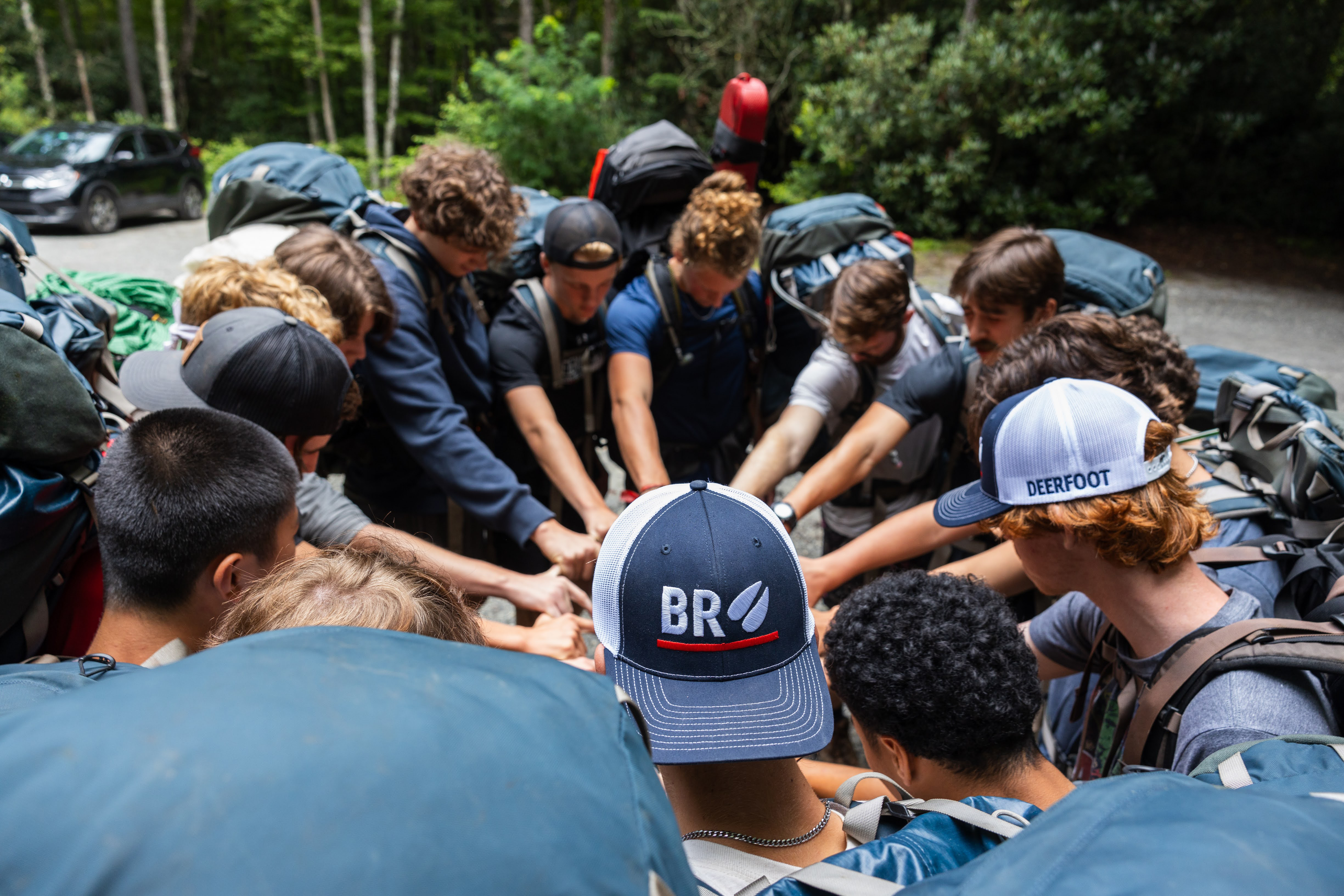
Campers stand on the pier at the Christian summer camp, Deerfoot.

Campers stand on the pier at the Christian summer camp, Deerfoot.

Christianity Today August 28, 2025
Photo Courtesy of Ron Mackey

As a kid, Amit Merchant never felt that he had a close group of Christian friends. Shy and unassuming, he didn’t fit in with his youth group peers.

But when Merchant was 11, his parents announced they would be sending him to a summer program in the wilderness of upstate New York, a two-week Christian boys’ camp called Deerfoot Lodge. Merchant had never heard of the camp before, but he gamely agreed to go—a decision that would reverberate in his life for years to come.

During that first summer at Deerfoot, Merchant felt seen and heard by fellow campers and staff, connected to a community of Christian boys. He and another camper, Ben, became friends and began emailing back and forth as soon as camp ended.

In the decade since, Merchant has kept returning to Deerfoot: first as a camper, then as a counselor in training, then as a staff member, and now as the assistant camp director. Ben has remained a close friend; the two worked on staff together, and Merchant attended his wedding.

What keeps drawing Merchant back to Deerfoot is the chance to connect with other Christian men in a way that feels authentic, uninterrupted, and gospel centered. In the tech-free wilderness, Jesus feels present, and relationships feel more honest.

“It’s one thing to sit in a coffee shop and ask a friend to tell me what’s on his heart,” Merchant said. “It’s another thing when you’re trudging through the woods and you’re caked with mud and the bugs are biting. It strips away so much of the false pretense and identity that we try to present.”

Many others echo Merchant’s story. Since its founding in 1930, Deerfoot Lodge has left a lasting impact on generations of Christian men and inspires loyalty among its attendees. Dads who grew up going to Deerfoot now send their sons to camp, and college students who attended as kids now work as staff to mentor younger campers. Those I spoke with—whether fourth-generation “Deerfooters” or young boys who had only recently become enamored—described the camp with fervor and a kind of reverence, the way young men talk of their fraternity brothers or soldiers describe their military platoons. What was it about this camp that inspired such awe?

My desire for an answer to that question was, in part, a personal one. I grew up attending different Christian summer camps. But for years, friends have been telling me about their experiences at this particular place on Whitaker Lake. Access to Deerfoot’s Adirondack location is somewhat limited to the public, and every year about 80 percent of the camp’s attendance is made up of returning campers. (Deerfoot recently opened a second location in the Blue Ridge Mountains of North Carolina, in part to try to address the long waitlist.)

My interest in Deerfoot also has to do with what’s happening outside its forested boundaries. The camp’s ongoing success comes amid a crisis for young men in America, in which many feel “unmoored and undervalued.” Boys typically lag behind girls in education outcomes, with worse GPAs and less likelihood of graduating high school. More women than men attend college, and about 28 percent of boys ages 3 to 17 have a mental, emotional, behavioral, or developmental problem, compared with 23 percent of girls. A recent Gallup poll that used data from 2023 and 2024 found that 25 percent of US men aged 15 to 34 reported feeling lonely, compared to 18 percent of young women.

What is plaguing so many young men across the country, and what might be the antidote to this malaise? Perhaps this small camp nestled in the Adirondack mountains—held in such esteem by so many boys and men—would have answers.

Camp DeerfootPhotography by Evan France
Campgrounds at Deerfoot.

As you’re driving along New York State Route 30, it’s easy to miss the narrow road that leads to Deerfoot. Except for a small sign, there’s little to indicate that a camp is tucked away in this stretch of the woods. On a recent day in July, I maneuvered my Toyota Corolla down the dirt road that snaked through the woods and led to the camp, where Ron Mackey, Deerfoot’s executive director, was waiting for me.

Dressed in khakis, a light blue T-shirt, and Saucony athletic shoes, Mackey had the briskness of an administrator but the warmth of a pastor. He led me to a clearing where the main camp buildings emerged, several cabins framed in a semicircle around a large field sloping down to the lake. Adirondack maples, beeches, and ash trees ringed the clearing. Some boys were setting up tents to dry after a long hike; others splashed in the lake or surrounded a snapping turtle that had wandered onto the grounds.

Noticeably, no campers were on their phones. There’s no cell service on the campgrounds, and devices are stored in the camp office at the start of each session. “It’s fully present,” Mackey told me while we strolled the grounds. “We live eye to eye here, fully engaged in the thing at hand. We’re not divided and distracted by other things. Life is slower here.”

Mackey and the other Deerfoot staff have tried to preserve the rustic way of life that was first established at the camp’s founding early in the 20th century. In 1930, Alfred Kunz, a New Jerseyan who served as executive director for the Pocket Testament League, decided he wanted to set up a wilderness camp for young men. His goal was to impart “sane, constructive religious teaching of a solidly biblical nature” and to help boys “bridge the gap from boyhood to manhood successfully, and as well develop a rugged, well-balanced manly character.”

With $500 and a couple dozen boys from his church, Kunz set up a camping spot near the Kunjamuk River. Campers originally had to hike eight miles just to reach this spot. But the camp flourished, and eventually Kunz needed to expand, so he purchased a square mile of property near Whitaker Lake. Relying on volunteer labor and a 1922 Buick roadster, he cleared the area and set up the camp.

Not much has changed since those days. Campers still sing many of the same hymns before breakfast. There is no running water in the camper cabins, and there are gas lanterns instead of electric lights.

Like any all-male community, Deerfoot has its own idiosyncratic lingo and rituals. Boss is the most universally used phrase, a kind of all-purpose affirmation: there are “boss” prayers, “boss” hikes, “boss” meals. Beak is the opposite, signifying anything negative. An outhouse is called a “gudge,” staff members are called “chiefs,” and phones are “contraband.” Mornings begin with a salute and the firing of a blank from a cannon. Many campers and counselors participate in a shared practice called “3,000-12,” in which the goal is to memorize 12 verses and perform 3,000 pushups over the course of two weeks. At any given moment at Deerfoot, you may see a boy suddenly drop to the ground and crank out a set.

Campers at Deerfoot’s Adirondack location are divided into three age groups: woodsmen are 9 to 12 years old, pioneers are 13 to 14, and islanders are 15 to 17. Most of their time at camp consists of learning various skills, including archery, swimming, crafts, and wilderness survival. Every age group also participates in an overnight outdoor excursion, ranging from canoe trips to hikes in the High Peaks.

The goal is to forge relational bonds through experiences that are exacting and uncomfortable. Benjamin Thomas, a 15-year-old camper who has attended Deerfoot in Blue Ridge for three summers, recalls hiking a steep mountain trail during a downpour. Drenched in rain and sweat, he felt miserable. But one of his fellow campers, a boy named Ransom, started belting out a hymn, and soon the whole group was singing.

“I felt the presence of the Lord that day,” said Thomas. “It felt like we were invincible. It felt like he was right there with his hand on me, comforting me.”

Campers pray at Deerfoot.Photography by Evan France
Campers huddle up for prayer at Deerfoot.

Deerfoot is built on the idea that transformation for men happens through relationships and that in-depth relationships between men often require shared experiences. Some at Deerfoot call this “trail talk”—the organic conversations that arise from hiking together or canoeing down a river.

“Intimacy among men needs to come from some shared activity,” said Jack Kubinec, a former staff member and camper. “I’ve seen in my own life [that] trying to be friends with guys in the real world, especially in a Christian context, it can be kind of like, ‘Hey, let’s sit around and have coffee,’ and it always feels awkward and never quite clicks.”

Every session, Deerfoot staff present the gospel to the campers. But the mission of Deerfoot—to build godly men through wilderness camping—happens not through flashy sermons or altar calls but through everyday interactions between staff and campers. It’s a “decentralized mentorship ministry,” as Craig Boronow, the Adirondack camp director, puts it.

“Every need of man is met by technology: We can work remote. We can have ‘friends’ remote. We can have entertainment. We can have sex remote,” said Dan Osborn, one of Deerfoot’s staff members. “All those things are remote. There’s a lot of isolation that occurs.”

Deerfoot does the opposite. It puts men in close proximity with each other: running ten miles back to camp after a week in the High Peaks or playing a camp-wide “naval battle” game, in which campers toss “bombs” made from clusters of leaves at each other. 

“We get pegged as an adventure camp because we do adventures. But as uncompelling as this sounds, we’re really a relationship camp,” Mackey said. “We do relationships. Real ones. And that’s life-changing. And it’s also what so many boys and men are starving for at all ages.”

This model necessitates that Mackey and other camp leaders place an enormous amount of faith in their college-age staff counselors, the ones entrusted with exemplifying the way of Jesus. There’s a five-to-one ratio of campers to counselors. Every summer begins with three weeks of paid staff training. Deerfoot also has a summer-long counselor-in-training program for 17- and 18-year-olds called the Guide Program.

“If I were the counselor, I’m like a dad figure or maybe a grandfather figure to them,” Mackey said. “And they expect me to say certain adult things about God and Jesus. That’s what the grownups do. When it’s a really cool college guy and he’s celebrating Jesus, that makes an impact.”

Former staff member Kubinec remembers that when he was growing up, he never connected with the Christians at his evangelical megachurch, who didn’t share his interest in sports. “It felt like you couldn’t be a cool, funny guy and also love Jesus,” he said. When he first attended Deerfoot, he was surprised to see older counselors who were “six feet tall and ripped” but were also faithful followers of Jesus who served others. One of his defining memories was when a counselor sat patiently with him day after day, helping him learn how to dive—an encounter that gave him a glimpse of what it means to put others’ interests first.

“At times it’s hard to know what your masculinity is for,” he said. “When you’re growing up in school, masculinity is primarily talked about in terms of what you shouldn’t do. Deerfoot is a place that channels masculinity in a very healthy way, where it says that you don’t need to subdue your strength or your desire to yell or run around or do all these things that boys should do, but you should use that to serve others.”

Deerfoot, like many other Christian camps, can provide a “mountaintop experience” for campers, where the high of feeling close to Jesus quickly wears off once the summer is over. Mackey remembers a staff member telling him, “Jesus only works for me at Deerfoot. When I’m here, I hear it. I feel it. I want it. But when I go home, it’s a desert. It’s like he’s not there. It’s almost like a mirage.”

Since that conversation, Mackey has tried to conquer what he calls the “50-week problem.” How do you enable Deerfooters to sustain what they’ve learned and encountered even after they leave camp? He’s keen to emphasize that Deerfoot should never be a replacement for becoming involved in a local church.

“We’re not pretending to be a church,” he said. “We are constantly calling men to be engaged in their church. I hope every men’s ministry is a better ministry if they have Deerfooters in it.”

Deerfoot recently hired Osborn, a mission engagement director, to create programming for campers and alumni after the summer season wraps up. This year, Deerfoot will be launching a set of regional fellowships, in which local alumni will meet twice a year to do outdoor excursions together. The camp is also planning to set up a mentorship program where younger alumni can sign up to receive regular guidance from older Deerfooters.

Some alumni have already begun regularly connecting with each other. Douglas Goetz, 72, attended Deerfoot as a camper from 1961 to 1968 and was part of the first cohort of counselors in training. Now, he leads a weekly Zoom meeting on Monday nights for some other alumni, all of whom are over 60 and live across the US. The group of a dozen men spends time catching up—discussing the latest softball game or hike—before sharing prayer requests and discussing a devotional.

“By these Zoom meetings, we have remained brothers in Christ,” Goetz said.


My last night at Deerfoot concluded with a tradition that happens every camp session. Staff constructed a massive 15-foot bonfire on a grassy field near the lake, and all the campers gathered in front of it. As a plume of smoke rose into the sky and night gradually descended, each of the campers had the chance to throw a log into the fire and share one meaningful thing from their session.

One of the boys, dressed in a blue sweatshirt and flannel sweatpants, sidled up to the fire and tossed in a log. “I’m grateful for all the new friends I’ve made and how close Deerfoot has brought me to Jesus,” he said.

“I realized how big God is and how small I am,” another boy said.

“I really felt the Lord’s presence with me. I never want this to leave. I always want this to stay with me,” said another.

After many boys had shared, the entire group stood in an enormous circle. Placing their arms around each other, they began to sway and sing. Wood hissed and crackled. Sparks sprang from the flames and danced in the inky black sky.

Sons of Deerfoot, strong and true,
We will pledge ourselves anew,
And as we part to go our separate ways,
May the memories of these happy days
Keep us faithful unto him
Till we meet again.

Later that evening, I drove out from camp and into the night until the forest enveloped the sounds of laughter and song.

Christopher Kuo is a writer based in New York City. His work has been published in The New York Times, The Los Angeles Times, Duke Magazine, and elsewhere. 

News

‘I Couldn’t Turn My Back on Them’

A Nigerian pastor fights the sale of child brides.

A Nigerian girl, age 12, who is going to be married to a 20-year-old farmer.

A Nigerian girl, age 12, who is engaged to be married.

Christianity Today August 28, 2025
Edits by CT / Source Images: The Washington Post, Getty

Thirty years ago, pastor Richards Akonam invited an 11-year-old girl, Esther, to join him for morning prayer in a village he visited in southeastern Nigeria. One of the participants warned him, “She’s somebody’s wife.” Akonam, learning Esther was married to an 86-year-old man who was opposed to Christianity, recalled villagers telling him “not to even ask questions.” 

But he did ask questions at his church in the south Nigerian state of Cross River. Over the years, he encountered other victims, such as Grace, whose father sold her to a 36-year-old man for 30,000 naira (around $220 USD then) when she was 3.

“He sold her to settle his debts,” Akonam said.

The practice of “money marriage” is an ancient custom among Becheve communities in Obanliku, Cross River. According to Akonam, tax evaders used to pledge their young girls, including the unborn, to avoid jail. The victims are called “money women” or “money wives.” Relatives sell them for as low as 18,000 naira ($12 USD)—often paid in installments or through gifts like bottles of Coca-Cola or wine.

Despite efforts to stop child marriages in Nigeria, around 1 in 6 girls are married before the age of 15. In 2024 UNICEF estimated that the country had over 24 million child brides—the third highest of any country.

While the 2003 federal Child Rights Act prohibits marriage of anyone below 18 years old, child marriages persist, even for those under 15 persist. “The law is not being enforced,” Izuchukwu Nwagbara, a lawyer based in Lagos, Nigeria, told CT. “The Nigerian police is not an efficient law enforcement agency that would enforce the child’s rights law of the different states.”

A subsection of Nigeria’s Constitution addressing citizenship also provides a loophole for child marriage, saying any woman “who is married shall be deemed to be of full age.”

According to Nwagbara, many communities define childhood as ending before age 18 so do not have cultural inhibitions against much earlier marriages. “The only reprieve we have is that long years of education have more or less banished the thought of child marriage,” he said. National prevalence of child marriages has dropped from 44 percent to 30 percent.

The economic crisis in Nigeria also worsened the situation. In 2022, the country’s National Bureau of Statistics reported 40 percent of Nigeria’s 216 million population was living below the poverty line. The husband of a “money wife” wields control over the family indebted to him—if she dies childless, her family must provide another. “This replacement money-wife system puts other children at risk,” Akonam said.

This system also contributes to a form of sex trafficking. Akonam explained that the system acts as an “insurance policy” for older men who make an income from their young wives sleeping with other men in exchange for money or gifts: “Whatever [payment] she gets, she brings back. Even if she gets pregnant, it is part of the game.”

Save the Children International estimates over 22,000 girls die yearly from pregnancy and childbirth linked to child marriage. Nearly half these deaths occur in West and Central Africa. According to one study, “money marriage” increases risks of psychological, physical, and sexual abuse of the girls.

“[Some of the husbands] have the idea that if your wife misbehaves, you can flog her,” said Ignatius Ubetu, a pastor in the northern Kano State who struggles to convince families to see girls’ worth. He lamented that some parents believe girls consume resources, bringing no value to their families until they are married off.

Ubetu pushes back on this belief through Oak Prestigious School, founded in 2015, which teaches holistic development to 200 students, mostly girls. “I want them to know that the girls are as valuable as the boys,” Ubetu told CT.

Mistreatment of child brides has amplified calls for legal and cultural reforms. But some leaders are resisting change to the status quo.

In May 2024, Abdulmalik Sarkin Daji, speaker of the Niger State House of Assembly, revealed plans for a mass wedding ceremony of 100 girls in Niger State. He claimed the girls and young women were orphans who had lost their parents to deadly kidnapping gangs in northern Nigeria, and he committed to providing their bride prices. Critics worried some girls might be underaged or forced to participate for financial reasons. An online petition demanding an end to the proposed marriages gathered over 15,000 signatures.

Uju Kennedy-Ohanenye, then Nigeria’s women affairs minister, filed a court order to stop the mass wedding, saying it violated the Child Rights Act. Niger State Imams’ Forum—an association of Islamic clerics—threatened legal action against Kennedy-Ohanenye, who then backed down, saying, “I did not intend to stop the marriage but to ensure the girls are of marriageable age and were not being forced into it.”

“The former minister could not save the girls,” Lois Auta, a legislative advocate in Abuja, Nigeria’s capital city, told CT. “I think you’re just wasting your time trying to stop a practice which they don’t see as an evil.”

But Akonam, now 55, sees stopping child marriage as a calling: “I couldn’t turn my back on them.”

Soon after encountering child bride Esther, Akonam started fighting against the practice, first by creating awareness through church discipleship. To his surprise, he met challenges even there. Some women opposed him, and men left the church in droves. His community outreaches were more dangerous. He escaped lynching several times, once fleeing a mob of around 45 people, mostly men, after helping Grace escape when she was 13. In 2013, he founded RichGrace Foundation with his wife to rescue girls fleeing these often-abusive marriages.  

Since then, RichGrace Foundation has helped more than 200 girls leave abusive early marriages and get an education. Sometimes, the foundation pays back the debts owed to the girls’ “husbands.” Others just escape. He told me Grace is in her second year in university.

Church Life

Bible Colleges Close, but Their Legacies Live On

Contributor

As the graduate of a defunct school, I know what isn’t lost.

A college building fading away.
Christianity Today August 28, 2025
Illustration by Elizabeth Kaye / Source Images: WikiMedia Commons


I love back-to-school season. I love the sense of new possibilities, the reconnections after summer break, and the joy of learning. But this year, as students unpack their boxes in their new dorm rooms, meet their roommates, and navigate campus to find their new classes at Biola University, other campuses will sit empty.

In New York, The King’s College and Nyack College (most recently called Alliance University) have folded, along with Nebraska Christian College, Lincoln Christian University, Judson College, Trinity International University, and Iowa Wesleyan University in the Midwest; Concordia University in Portland, Oregon; and frankly too many more to list. All these were once bustling with activity. Now they are closed.

Alumni grieve the end of something that held great memories. Students whose education was cut short figure out new pathways. And faculty and staff look for work. For half a dozen years now, an undercurrent of grief and anxiety have plagued academic conferences as colleagues meet and tentatively ask, “Do you still have a job? How’s enrollment?”

A couple weeks ago, my husband and I drove through the campus that used to be the home of Multnomah Bible College in Portland (it became Multnomah University in 2008). It’s now for sale. As one of its beloved presidents said repeatedly, “If it’s Bible you want, then you want Multnomah.” And for almost a hundred years, students came to Multnomah because Bible is exactly what they wanted.

When we arrived as students in 1994 and ’95, my plan was to become a Bible translator. Multnomah offered Greek and Hebrew, plus a major in missions, so it seemed like an ideal place for me. My husband had no intention of graduating. He just thought a year of Bible would do him good. But one semester led to another, and he eventually gained a bachelor’s degree and lost his bachelor status when he married me.

We graduated in 1999 and 2000, at the height of Multnomah’s glory years. Our student body was small by some standards, but between 500 and 600 students called our campus home, and we became a tight-knit community. Classes were full, the dorms were bursting with life, and we moved from one theological conversation to the next all day long. We spent quality time with professors not only in the classroom but also across the lunch table in the cafeteria, in their offices, and in their homes. Two professors traveled all the way to Colorado for our wedding.

Our classmates graduated and went on to become pastors and missionaries, parents and teachers. Some of them became police officers or counselors. Others started businesses. All of us had been transformed. Together we had attended chapel three times a week, invested in 52 credit hours of Bible and theology, planned worship nights, participated in student ministries, and prayed together in the dorms. We’d sip lattes or eat bagels with cream cheese together and talk about how we could change the world.

I think I expected the campus to look more rundown than it is. As we turned off Interstate 205 onto Glisan Street, a woman with a clean cardboard sign asked for help buying cat food. Across the bridge, two unhoused neighbors helped each other put up a tent on the side of the road. Two blocks further, Central Bible Church, where Multnomah used to hold chapels, is boarded up, fenced off, and decked with graffiti. Houses in the neighborhood look tired, with peeling paint, sagging porches, and knee-high weeds. But the campus itself is well-maintained.

What’s missing is the students.

In 2024, the school became “the Multnomah campus” of Jessup University in Sacramento, but that iteration, too, was unsuccessful, and the undergraduates took their last semester of classes in spring 2025. After professors vacated their offices, a fellow alum found the dumpsters full of old yearbooks and award plaques and posted the photos online. The school simply could not make ends meet. Christian families stopped insisting that their kids get a Christian education. Christian young people stopped imagining themselves serving in ministry. Christian donors found other causes to support.

Some would say that Multnomah lost its way theologically or that it lost its vision for theological education, trying to become something it was not. But many of the professors who turned in their keys this year are the same professors who trained me in the late ’90s. They are still faithfully following Jesus.

Certainly, some ideas changed over time. When I was a student in 1996, the academic dean told me that a woman would never teach Bible at Multnomah. But before I finished seminary in 2011, a woman was doing just that. To me that change was a harbinger of hope—a sign that maybe I too could fulfill my dream of giving back to the campus that had given me so much.

After all, it was at Multnomah that I discovered a love for teaching to pair with my lifelong love of the Bible. It was Multnomah professors who nurtured me as a scholar, training me to read carefully and communicate well. It was Multnomah professors who offered me opportunities to work as a teaching assistant and to teach under their supervision. During their office hours I wrestled with a calling to teach and with how to square that with Scripture. In those glorious years I discovered what I was born to do, and I’ve spent the past three decades trying to steward that calling faithfully.

I returned to Multnomah briefly in 2015 as an adjunct professor while I finished my PhD. By then the campus had an entirely different vibe, but I relished the opportunity to design courses (Bible courses!) that could reach a new generation of students. On average, these students knew less about the Bible when they started than we had. More of them commuted. More of them came to play sports. John Mitchell’s tagline, “If it’s Bible you want…,” resonated with some of them, but not all.

I don’t think we can blame the demise of Multnomah on a single thing—too many new majors, loss of a vision, too much emphasis on sports, theological drift. Institutions of higher education all across the nation are struggling. The “demographic cliff” forecast by sociologists for many years now is finally here, and it’s affecting state schools as well as private institutions. Fewer children means fewer potential college students, and the competition for those who remain is fierce.

Jessup University in Sacramento tried to rescue Multnomah through a strategic partnership. But that acquisition saddled Jessup with more debt, as well as property in an aging neighborhood in Portland. After closing the undergraduate programs in Oregon, the university moved Multnomah Seminary fully online. Will this iteration work? It’s hard to say. Christian higher education feels like a game of “Who will be the last school standing?”

I’m not an expert on the history of the Bible college movement, but I’ve been a direct participant and beneficiary of it. Before I came to Biola University in 2021, I taught at Prairie College in Three Hills, Alberta, Canada, and I briefly taught at Multnomah.

Biola was founded as the Bible Institute of Los Angeles (BIOLA) back in 1908 in the thick of the Bible college movement, preceded by Nyack in New York (1882), Moody in Chicago (1886), and Tyndale University in Toronto (1894). They all preceded Prairie Bible Institute (1922), Briercrest Bible Institute (1935), and Multnomah (1936). Each of these schools has had to reinvent itself over the years to survive. The needs and opportunities of each generation fluctuate.

In its glory years, Prairie College had over a thousand students. The massive Prairie Tabernacle offered a beacon of light to the prairies, hosting revival meetings, concerts, and conventions. The tabernacle was torn down many years ago, and other aging buildings on campus have been dismantled since then, but this month the school cut the ribbon on a beautiful new dorm. Prairie is over a hundred years old but going strong in its mission to train students to meet the greatest needs of the world.

Much further south, Biola has such a large incoming freshman class in 2025 that many of its dorm rooms had to be converted into triples. Our seminary has its largest enrollment ever. Thanks to a generous gift from Lynsi Snyder-Ellingson, the CEO of In-N-Out Burger, we’re in the midst of a massive building project—a 45,000-square-foot building to house the Snyder School of Cinema and Media Arts. Almost every student who comes to Biola to study film receives a Bible minor as well, taking 30 credits of Bible and theology alongside students from other disciplines.

Today I met with a student who was wrestling with whether he had made the right decision to be a Bible major. Ultimately he doesn’t plan to be a pastor. So why Bible? I shared with him the story of my husband, who double-majored in Bible and worship ministry but has spent most of his career in finance, mission administration, and now information technology.

On paper, it may not look as if majoring in Bible made any sense, but none of that learning has gone to waste. It’s made him a better deacon, a better neighbor, a better husband, and a better dad. His bachelor’s degree has provided the ticket to a variety of jobs, and the formation he experienced has made him the kind of employee folks are eager to hire.  As Wendell Berry wrote, “The thing being made in a university is humanity.”

Another of our classmates from Multnomah spent a few years in pastoral ministry and then started a heating, ventilating, and air-conditioning business. The Lord has blessed his business, which now employs a dozen people and brings in over a million dollars a year. He and his wife have generously supported Christian ministry through the years. Their goal has been to give as much of the profits away as possible for God’s kingdom purposes. His integrity, leadership, and good work are the fruit of what Multnomah planted in him.

Each generation has to wrestle anew with what God has revealed to us in the Bible about who he is, who we are, and why we’re here. Ethical questions are not going away. A life of discipleship requires competence in reading Scripture, a sense of the scope of church history, and a clear vision for human vocation. Bible colleges are still the best place I know to get that.

I’ve grieved this year over the loss of my alma mater. I’m disappointed that some of the school’s legacy ended up in the dumpster. But as I drove through campus, I felt strangely encouraged. The ministry of Multnomah continues unabated through all of us who were formed there. My colleague, Ken Berding, whose office is down the hall from mine at Biola, trained at Multnomah too. Ironically, after serving as a missionary, he began his teaching career at Nyack College in New York (now also closed). Together we’re training the next generation of Bible majors here at Biola.

I know graduates who are serving in refugee ministry; who have pioneered Bible translation work; who are pastoring, teaching backyard Bible clubs, and leading worship. Some are teachers or counselors. Multnomah’s legacy lives on in many evangelical churches in the Pacific Northwest, where its graduates are pastors and Sunday school teachers, youth leaders, and office managers. Some are professors and authors. Some are principals. One leads an apologetics ministry. Two of our classmates started the BibleProject, a ministry that is catalyzing Bible engagement for a whole generation.

Multnomah will live on as long as its graduates are carrying out its mission wherever we find ourselves. As I head back to the classroom this fall, I’m convinced that things are not what they seem. Multnomah’s legacy is alive and well.

Carmen Joy Imes is associate professor of Old Testament at Biola University and author of Bearing God’s NameBeing God’s Image, and a forthcoming book, Becoming God’s Family: Why the Church Still Matters.

Theology

Advice for Donald Trump on Getting into Heaven

Columnist

Bad news: You can’t get there by earning your way. Good news: We have a Father who loves and will receive you.

Donald Trump in front of a cloudy sky
Christianity Today August 27, 2025
Illustration by Christianity Today / Source Images: Getty

This piece was adapted from Russell Moore’s newsletter. Subscribe here.

Dear Mr. President,

A reporter asked you not long ago about ending Russia’s war on Ukraine.

“I want to end it,” you said. “I want to try and get to heaven if possible. I’m hearing I’m not doing well. I am really at the bottom of the totem pole. But if I can get to heaven, this will be one of the reasons.” Your campaign political action committee then followed up with an appeal to your supporters to help you get into heaven by giving money.

Regardless of motive, the question you raise is a valid one. So here’s some advice from a nasty man who’s had the same obstacles you have in reaching heaven.

Let me start by confessing that—as much as I warn Christians about the politicization of religion and the religionification of politics—I am tempted to turn this into a critique of your character and your policies (especially in regard to vulnerable people). But that would further your problem. The Bible has a lot to say about how “rulers” govern, and you will indeed be judged, like everyone else, for how you used your power.

Your comment evidences that you think you can get right with God through a policy win (Eph. 2:8–9). But Jesus never let people stagnate in their confusion. And this note to you would be different if you were arguing (as some of your supporters do) that your wrong actions don’t affect what it means to be Christian. You’re right; what you do does matter for heaven—just not in the way you’re framing it here.

So let me start with Jesus and finish with Jesus. This is by no means everything—just the start of a conversation, if you want to have it.

You’re aware of the life of Jesus of Nazareth, of his teaching, his healing, his casting out of demons. You’re also aware that he claimed certain things about himself—that the story of Israel found in the Scriptures had found its ultimate goal in him and that he was one with the God revealed in those Scriptures. He is the eternal Word of God come among us in the flesh (John 1:1–14). He announced that, in him, the kingdom of God had arrived in person (Luke 17:20–21) and that those who follow him will be with him in the new creation to come, the home he is preparing for them (John 14:1–6).

You’re aware that he was crucified, and I know from your talk about Easter that you are aware that he was raised from the dead and went back to the mysterious spiritual places from which he came, and that one day he will return for those who are waiting for him. The Resurrection wasn’t just a happy ending to a sad story—and it certainly wasn’t a “comeback,” the way you might compare it to your own story.

In the resurrection of Jesus, God started the new creation he promised through Isaiah and Jeremiah and Amos. And he kept the promises he made to Abraham and Moses and David. Jesus voluntarily entered into all the judgment and curses the Bible warned about for the sake of the world, all the way to the cross itself, bearing the weight and curse of sin that was not his own (2 Cor. 5:21).

Humanity wants to go its own way, and has from the start of our story (Isa. 53:6). The only human being who has ever listened wholeheartedly to the voice of God, who has pioneered the way back to the presence of God, is his Son, Jesus.

When the Bible says from God, “I’m going to judge everybody who sins,” that is a list that includes every one of us except Jesus. And when the Bible says, “Those who are in communion with me, and not captive to sin and cursed with death, can enter my presence,” that narrows the list down to nobody except Jesus (Rom. 6:23).

What Jesus’ followers—who saw him alive—claimed is that everyone whose life is joined to him can find life, can stand in the presence of God, can be reconciled to him. Such people will find that there is no fear for them on Judgment Day because, in Christ, they’ve already been through judgment (Rom. 8:1). These people will find that, regardless of all the bad things they’ve done and thought and said, they are forgiven through the blood shed by Jesus (1 John 1:7).

How does one do that? Jesus said we can’t do it on our own—even if we were to negotiate a peace deal with Russia or even if we were to negotiate a permanent peace deal with the whole world.

In fact, Jesus used the imagery of one universal experience over which we cannot claim to have earned or achieved anything: being born (John 3:3). Jesus and his apostles said that all of us want to be employees or entrepreneurs, to earn our standing before God. If you think about it, that feels like power, doesn’t it? You hire people and fire them all the time. You exchange with them some money and a little bit of your power for their work for you.

But when it comes to God, that way leads to slavery and death. That’s because it keeps us on the old path of exalting ourselves. You’re not the only one who wants your name on every building or your face on every banner. In a certain sense, we all do.

There’s some bad news here for you. Jesus said that it is very difficult for those who are wealthy or powerful to enter his kingdom (Mark 10:25). He said that to follow him means we lose our lives in order to find them again in his life. That means counting a cost. Some rich and powerful people loved their stuff and their fame too much. Some didn’t realize that what they thought was “winning” was really just a vapor of nothing, until it was too late.

But there’s good news too. It’s hard for me to say it, because I resent a lot of what you’ve done and the way you’ve insisted on inserting yourself into every family, church, friendship, and conversation—the way you’ve upended my own life. I’d kind of like to see you get your comeuppance. And that means I would kind of grumble if I saw you next to me in worship in glory.

That part of me is of the Devil. Jesus reminds me that he was gladly willing to receive repentant people who defrauded others (Luke 19:9–10), who committed probably insurrectionist violence (23:43), and who were morally promiscuous (Matt. 21:31).

For me to have anything but gladness, should you ever find Jesus, would be a denial of all for which Jesus has forgiven me. In fact, it would mean a denial of the Good News I’ve received, because it would seem to be saying that I somehow deserve to be in God’s presence more than you. That’s just not true, and I know it. My sin separates me just as far from God as your sin does you.

And I have to fight just as much the urge to want to earn my way into God’s favor. You and I would both agree (for different reasons) that you are “one of a kind” in a lot of ways. But in this one, you are just like everyone else.

To actually enter heaven, you have to give up that mindset of earning your way there. You have to recognize your own need for something you can’t win or achieve or earn. You have to consider Donald Trump to be the wrong path for you. In fact, you have to consider Donald Trump to be dead.

If you confess that brokenness and need, though, you will find forgiveness. If you believe that God has raised Jesus from the dead and that he is the Lord you wish to follow, you will find that you have a place in Christ, which means his life is your life. He is in heaven—and if you’re part of him, you will be there too (Col. 3:1–3).

But following Christ means heaven is very different from what you seem to think it means now. You probably think of a kind of eternal Mar-a-Lago, maybe with less gold, where everyone says “Sir” to you and tells you how tired they are of winning. Heaven is quite different. By the time you get there, should you decide to go this Way, you will find that you want something completely different.

You will see God in such a way that you will be changed into an entirely different form of life (Matt. 5:8). None of the stuff you think is important now will be. Lots of stuff you dismiss now will turn out to really matter. You might also be surprised to find that an impoverished Salvadoran maid in one of your hotels right now will then be ruling and reigning, more famous than you (James 2:1–8). You will find that Jesus was hidden in the lives of people who would never get White House invitations (Matt. 25:31–46).

I suppose I am trying to, in your mind, Make Heaven Great Again.

Will that mean changes for you now? Oh yes. You will see that cruelty, revenge, and glitz are the wrong way (Gal. 5:22–23). You will find that the Spirit will point you in another direction (Luke 3:10–14). You’ll fail and stumble, to be sure, but the centrality of self will be at war with the Spirit of Jesus, and ultimately the Spirit will win.

Again, there’s a lot more to say. Repent of your sin. Believe in Jesus: crucified, bearing your sins, and resurrected for you. In your heart, believe in Jesus as Lord, and with your mouth, say it—not to win over any constituency or to gain approval but because, in your heart, you believe it (Rom. 10:9–10). Seek him—maybe even start by saying, “I want to look for you but I don’t know where to find you,” and you will find him (Isa. 52:6; Matt. 7:7–8).

But first things first. Put aside any way of earning your way out of the lowest place on “the totem pole” in order to get right with God. You can’t do it—in a trillion lifetimes.

To see the way to heaven, stop thinking of yourself as a president or a billionaire, if only for a moment. Think of yourself as a little child—weak and dependent—and in need of a Father who is not impressed with you but who loves you and who will receive you (Matt. 18:3).

You can’t get to heaven with the art of the deal.

Russell Moore is the editor in chief at Christianity Today and leads its Public Theology Project.

Apple PodcastsDown ArrowDown ArrowDown Arrowarrow_left_altLeft ArrowLeft ArrowRight ArrowRight ArrowRight Arrowarrow_up_altUp ArrowUp ArrowAvailable at Amazoncaret-downCloseCloseEmailEmailExpandExpandExternalExternalFacebookfacebook-squareGiftGiftGooglegoogleGoogle KeephamburgerInstagraminstagram-squareLinkLinklinkedin-squareListenListenListenChristianity TodayCT Creative Studio Logologo_orgMegaphoneMenuMenupausePinterestPlayPlayPocketPodcastRSSRSSSaveSaveSaveSearchSearchsearchSpotifyStitcherTelegramTable of ContentsTable of Contentstwitter-squareWhatsAppXYouTubeYouTube