Books
Review

Marilynne Robinson Reads Genesis Without Anxiety

Unperturbed by debates over the book’s relationship to modern thought, she helps us appreciate its marriage of literary structure and theological claims.

Christianity Today May 8, 2024
Illustration by Christianity Today / Source Images: Getty, Wikimedia Commons

In her latest book, Reading Genesis, Marilynne Robinson insists that modern readers have largely misunderstood the literary and theological significance of the Bible.

Reading Genesis

Reading Genesis

Farrar, Straus and Giroux

352 pages

Among the most salient causes of this misunderstanding, she argues, is our tendency to read ancient texts through modern categories—history, myth, fiction, nonfiction—that do not map neatly onto ancient literature. The result is a never-ending and mostly unnecessary debate between those who approach Genesis as a catalog of events and those who read it as mythic pastiche, pieced together from various ancient sources.

We get a feel for Robinson’s impatience with this debate in her characterization of the factions warring over Noah’s flood: “One side in the controversy is rebuilding the ark to demonstrate its seaworthiness, or tramping up Ararat looking for its wreckage. The other sees the story as cribbed and fraudulent.” Both sides, Robinson concludes, are led astray by the same impulse to judge the veracity of Genesis on the basis of how closely it conforms to historical events.

In fact, as she argues at the outset, “the Bible is a work of theology, not simply a primary text upon which theology is based.” The implication for modern readers of Genesis is that when we focus primarily on the historicity of the Flood account, for example, we tend to ignore the arrangement of Genesis as a work of literature designed to grapple with theological questions.

Arranged with artistry

This is not to say that Robinson doubts whether all the events represented in Genesis took place or that she fails to consider its compositional history. The goal of Genesis, in her estimation, is not to offer a play-by-play of primeval events but to give a theological account of who God is, who we are, and how we should live together in light of that theology. In Robinson’s estimation, then, the book’s literary structure is of utmost importance to its interpretation.

By literary, I do not mean that she treats the Bible as somehow comparable to a novel or any other contemporary form of literature. I mean that she is interested in the composition and final form of the biblical text, in the way it has been arranged with artistry to communicate theological truths about God, humans, and the world.

This literary approach makes sense given Robinson’s status as a modern master of the novel and the essay. Her novels have earned numerous honors, including a Pulitzer Prize and a National Book Critics Circle Award. Her erudite essays on subjects ranging from theology and science to politics and history have made her a stalwart contributor to some of the nation’s most storied periodicals, religious and otherwise. Literary structure is her craft, and she is deeply attuned to how the arrangement of Genesis asks us to read it in certain ways to the exclusion of others.

While Robinson’s emphasis on literary craft might seem to place her in the camp of those who regard Genesis as merely human in its authorship, she harbors no compunction about the fact that Genesis is, at least in part, a more-than-human text.

The accounts we find in the Bible “are really far too tough-minded to be the products of ordinary this-worldly calculation,” she points out. “I am content to believe,” she notes, “that certain early Hebrews, under the influence of Moses and still pondering the faithfulness of God that they saw in the liberation from bondage, were inspired with a true insight into His nature.”

For Robinson, the fact that the Scriptures are shaped by both divine and human hands presents no contradiction. As she observes, “the Bible itself indicates no anxiety about association with human minds, words, lives, and passions.” This lack of anxiety—palpable in her prose—is among the most important dispositions of Robinson’s reading that Christians might seek to emulate. She is not apologetic about the things that many modern readers find threatening to the Bible’s relevance, reliability, and authority.

Perhaps the most potent of these perceived threats is scholarly inquiry into the provenance and composition of Genesis.

Whether engaging the Documentary Hypothesis (the theory that the first five books of the Hebrew Bible are stitched together from disparate traditions) or comparisons between Genesis and other ancient Near Eastern texts, Robinson maintains that Genesis is a unique and ingenious literary creation composed by humans, inspired by God, and designed to convey the truth about God and his world. Far from being fearful of comparisons with other ancient texts, Robinson contends that Genesis is most obviously unique at these points of contact.

Robinson argues that resonances between Genesis and ancient Near Eastern stories such as the Babylonian Epic of Gilgamesh or Enuma Elish constitute the best proofs of the Bible’s—and its God’s—exceptional nature. This claim is central to her reading and repeated throughout the book: “The Genesis stories, rather than adopting or appropriating them, instead engage the literatures to which they are often compared, accepting an image or a term but transforming its meaning within a shared language of thought.”

Comparing Genesis with other ancient creation accounts, she maintains that “the biblical way of telling the story of Creation differs from ambient narratives precisely at the points of their likeness.” Contrasting Noah’s flood with Gilgamesh’s, she insists that “these two stories differ crucially at their points of similarity.”

Again and again, Robinson demonstrates how theological insights into God’s character are clearest at these points of comparison. The Babylonian notion that humans exist to make offerings to Marduk, for instance, makes the Hebrew God so radically unique. As Robinson states, God is distinct “in His having not a use” for human beings, “but instead a mysterious, benign intention for them.”

Unlike the Babylonian gods, who are revealed to be numerous, capricious, and needy, Genesis gives us a God who is one, purposeful, and infinitely gracious. This graciousness, in Robinson’s reading, turns out to be central to the theology of Genesis. The book’s literary structure brings us back to it repeatedly, from God’s forgiveness of Cain to the second chance extended to humans after the Flood to the many redemptions of Abraham and his descendants.

Along the way, God’s image-bearers pick up on this divine predilection for compassion and learn to forgive one another. Esau absolves his brother Jacob. Joseph pardons his brothers. Genesis shows that God’s graciousness to us and our need to be gracious to one another cannot be overstated. It establishes mercy as foundational to Israel’s way of life as the people come up out of Egypt and build their own society.

The God of Abraham, Isaac, and Jacob, it turns out, is not like any of the other ancient gods at all—which means that those who would follow him will be set apart from the rest of the world as well.

Robinson’s reading of the ancestral history that begins with Abraham in Genesis 12 and ends with the death of Joseph in Genesis 50 traces the purposes of this God in the lives of Abraham’s descendants and, notably, in the lives of those not descended from the first patriarch. The book’s theological emphasis on mercy and forgiveness thus extends to all people. God calls to himself a chosen people, but he also rescues Hagar and Ishmael and works through Melchizedek, Abimelech, and others who come from outside the line of Abraham.

God is repeatedly shown to be the God of all people, and Robinson’s focus on the literary arrangement of Genesis reveals that God has had a plan for all people from the beginning.

Purposeful answers

The great strength of Robinson’s literary approach to the Bible is that it focuses our attention on how a book like Genesis invites us into lifelong reflection on the nature of God and his plans for us. It may seem, occasionally, that Robinson sidesteps concerns raised by biblical scholars, but her approach fits the design of the text, which was careful and purposeful in answering the questions of ancient readers.

Modern Christians will benefit from spending a few hours with a book that does not treat the Bible as a “primitive attempt to explain things that reason and science would in the course of time make a true and sufficient account of.” And we might especially learn something from Robinson’s characterization of Genesis as an attempt to give a true account of God’s people in light of their convictions about who God is.

Unlike many histories that seek to romanticize and vilify their subjects, Genesis offers unsparing portrayals of some of its most celebrated heroes and generous portrayals of some of its most dastardly villains. It suggests that we might be better prepared to know God if we take seriously the psalmist’s plea for God to search our own hearts and to see ourselves as he sees us. Genesis, in this respect, is truly incomparable.

Matthew Mullins is associate professor of English at Oklahoma Baptist University. He is the author Enjoying the Bible: Literary Approaches to Loving the Scriptures and Postmodernism in Pieces: Materializing the Social in U.S. Fiction.
News

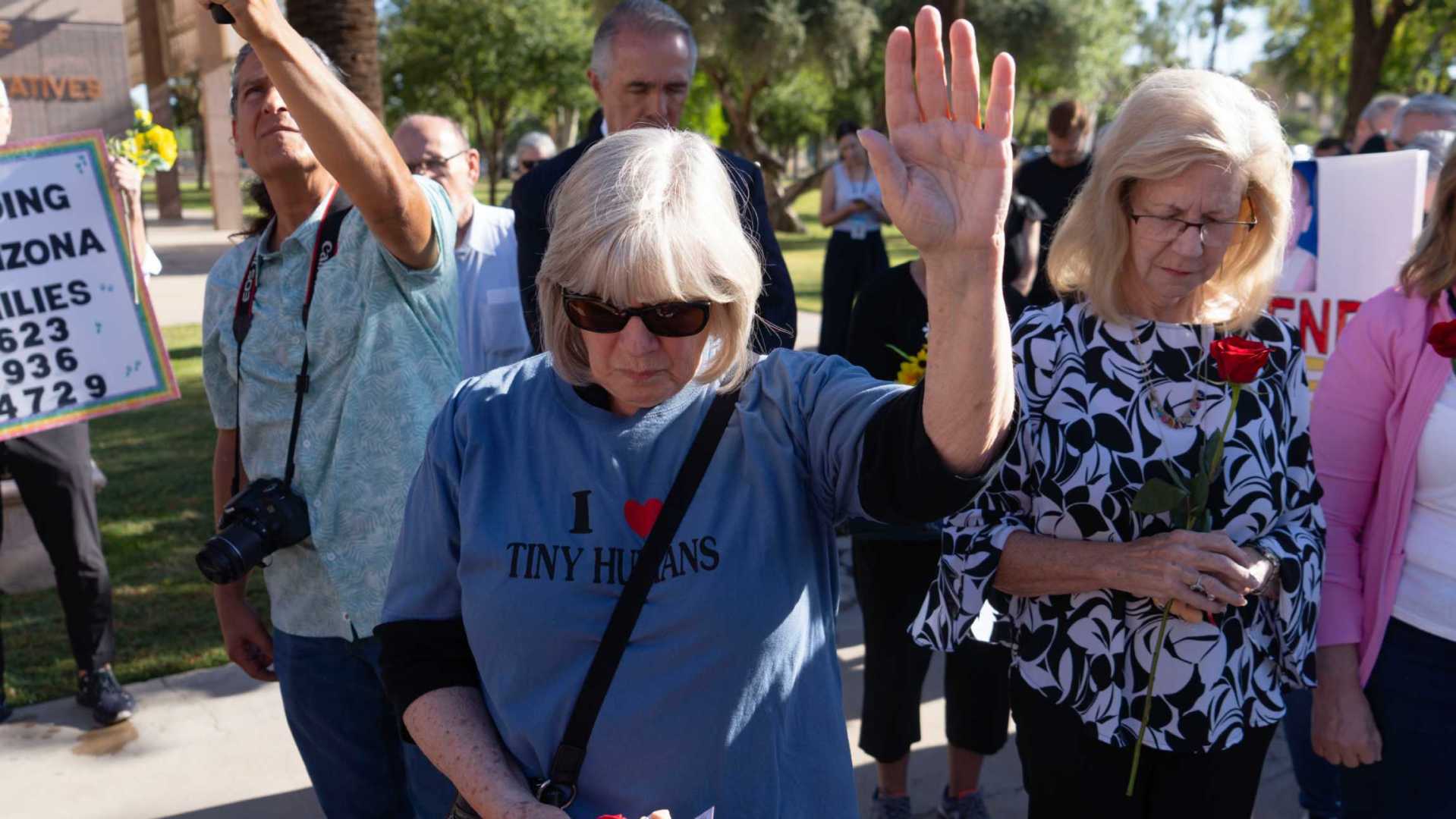
Arizona Pro-Life Groups Pray Against Abortion Ballot Measure

A dozen states could vote on the issue come November.

Christianity Today May 8, 2024
Photo by Rebecca Noble/Getty Images

Rosie Villegas-Smith was spending a Saturday handing out flyers with volunteers from Voces Unidas, a pro-life nonprofit, when she noticed a group gathering signatures.

The woman who approached her never mentioned the word abortion, only referring to women’s rights, but she quickly realized what they were campaigning for: a ballot measure on expanding abortion access in Arizona in the November elections.

The southwestern state is one of up to a dozen across the country that will vote on abortion later this year, part of the continued reshaping of the legal landscape following the reversal of Roe v. Wade.

Arizona’s measure would enshrine the right to an abortion in the state’s constitution, overriding its current 15-week ban and allowing the procedure at any point in a pregnancy if a health care provider determines it is necessary to protect either the life or the physical and mental health of the mother.

The state has been in a back-and-forth over abortion policies for weeks, with pro-life groups ramping up efforts to reach out to women who may be considering abortions and to voters who may consider supporting expanding abortion access.

Last month, Arizona’s top court ruled that an 1864 law prohibiting abortion could go into effect as a result of the reversal of Roe v. Wade. The controversial ruling came under fire nationally; even former president Donald Trump and other high-profile Republicans suggested it went too far. Vice President Kamala Harris slammed the law as putting women in a “state of chaos and cruelty caused by Donald Trump.”

A legislative repeal narrowly passed the state Senate 16–14 after two Republicans crossed the aisle to side with Democrats. One of the GOP lawmakers who voted for the repeal, Sen. Shawnna Bolick, said that repealing the strict 1864 law, and leaving a more moderate abortion bill in place, may dampen efforts by abortion rights groups to put more expansive abortion measures on the ballot. “I am here to protect more babies,” she said.

Gov. Katie Hobbs signed the repeal last week, which is slated to take effect 90 days after the legislative session ends this summer. There are legal efforts underway by the abortion rights groups asking the state supreme court to block the 1864 law from going into effect in the interim.

A 2022 state law allows abortion until 15 weeks of pregnancy in Arizona, with an exception beyond that point if necessary to save the mother’s life. The 1864 law prohibited abortion at any stage in a pregnancy, with an exception for the life of the mother.

“It’s imperative for pro-life citizens in Arizona to educate themselves and their neighbors about this extreme constitutional amendment,” March for Life president Jeanne Mancini told CT. The measure, she said, would “open the floodgates to painful abortion up until birth, ending precious, innocent life and stripping women of the health and safety protections they need and deserve.”

Arizona for Abortion Access, which is campaigning in support of the new measure to solidify abortion protections in the state constitution, says it has met the signature threshold to get the ballot. It’s now up to the secretary of state to verify the signatures.

“They’re not even happy with [15 weeks],” Villegas-Smith said. Pro-life groups like hers are addressing the implications of the proposed amendment and appealing to voters to protect life.

Villegas-Smith, who is originally from Mexico, became interested in pro-life advocacy as a result of watching friends suffer in the physical and emotional aftermath of their abortions. Her group also seeks to reach out to minorities.

The largest group of women receiving abortions in the state are Hispanic—in 2021, 43.8 percent according to the Arizona Department of Health Services—and Voces Unidas seeks to reach minority women with information as well as through support groups, baby showers, and in some cases, safe housing.

“We know that it’s very important to give a message for hope, that the baby is a gift from God, and so we organize baby showers for them and give them a basket and a cake and a full celebration,” Villegas-Smith said, “especially for women who don’t have family support.”

The nonprofit is not explicitly religious, but Villegas-Smith said they often work with religious groups, and that many of the volunteers and employees identify as Christian or Catholic. Voces Unidas makes a practice of “praying for life,” praying outside of abortion centers and at the capital before the vote over repealing the 1864 law.

Abortion policies may be on the ballot in nearly a dozen states come November. In addition to Arizona, there are ballot measures in Florida and Maryland. Other states, such as Arkansas, Colorado, Missouri, Montana, Nebraska, Nevada, and South Dakota, are either in the signature-gathering process or have submitted signatures and are waiting for approval. New York’s ballot measure is facing blowback in the courts, making the fate of the effort uncertain.

Since the Dobbs v. Jackson Women’s Health Organization decision reversing Roe, voters in a handful of states, including California, Michigan, Ohio, and Vermont, chose to protect and in some cases expand abortion access via ballot measures. Other states, like Kentucky and Kansas, voted down measures that would have restricted abortion.

“It’s kind of a wake-up call to us, to I think Arizonans and Americans, that a 15-week abortion law is not enough,” said Kelsey Pritchard, state public affairs director for Susan B. Anthony Pro-Life America. The group has a field team in Arizona canvassing ahead of the election.

“They’re on the ground not only making the pro-lifers aware of what’s at stake here, but people kind of in the middle as well. Because when you’re talking about health and safety, it’s not just a Republican pro-life thing. That’s something even pro-choice people care about,” Pritchard said. “That’s really something for all Arizonians to care about.”

News

Died: Ferdie Cabiling, Philippines’ ‘Running Pastor’

One of the founding leaders of Victory megachurch, he never stopped running to share the gospel.

Christianity Today May 8, 2024
Facebook/Victory Ortigas / Edits by CT

Ferdinand “Ferdie” Cabiling, a bishop at one of the Philippines’ largest megachurches who ran across the Philippines to raise money for disadvantaged students, died April 1, the day after Easter. He was 58 years old.

Dubbed “the Running Pastor,” the moniker describes not only Cabiling’s epic race but how he lived his life and served as an evangelist. For 38 years, he was a vocational minister of Victory Christian Fellowship of the Philippines, which has nearly 150 locations in the country. The branch he led, Victory Metro Manila, averaged more than 75,000 people each Sunday. [Note: The author is a member of Victory Church and was a part of the late pastor's small group in 2014.]

In the past two years, his focus was on teaching evangelism to Victory leaders. Every time he received a teaching invitation, his answer was always yes, said his assistant, Faye Bonifacio.

“He was a maximizer,” Bonifacio said, noting that Cabiling developed a habit of taking short naps while parked at a gas station between long drives. “Because he liked to drive, he did a lot in a day.”

Hours before his death, Cabiling had visited a church member at a hospital an hour away from his hometown of Cuyapo before parking his car at a gas station, likely for a break before heading to his next destination. It was there that an attendant found his lifeless body and rushed him to the hospital he had just visited. Cabiling had died of a heart attack.

“He was a serious man of passion, action, and conviction,” wrote Steve Murrell, the founding pastor of Victory, the flagship church for the charismatic-leaning Every Nation Churches and Ministries, which has churches and campus ministries in 82 countries, in an Instagram post. “For 40 years, he was a part of every major decision made by Victory leaders.”

Born on September 8, 1965, Cabiling lived in the rice-producing Central Luzon. His father was a farmer and his mother was a school teacher. One of six siblings, Cabiling grew up a “nominal” Seventh-day Adventist due to the influence of his mother’s faith, according to his autobiography, Run: Endure the Pain, Keep the Faith, Finish Your Race. After graduating from a Catholic high school, he moved 100 miles south to Manila to attend Adamson University, where his close relatives provided for his tuition and allowance. The plan was for him to become a civil engineer, work abroad, and support his parents.

Yet those plans changed during his sophomore year in 1984, a year marked by civil unrest against the first Marcos presidency, when he attended an evangelistic crusade by the US-based Maranatha Campus Ministries led by Rice Broocks. That night, Broocks highlighted John 3, noting that unless a person is born again, they cannot enter the kingdom of God. “If you died tonight, where would you spend eternity?” Broocks asked the students.

“I felt like I was standing in front of a torrent of truth as he preached the gospel of Jesus Christ with unreserved passion and conviction,” Cabiling recalled in his book. He decided to give his life to Christ during that meeting.

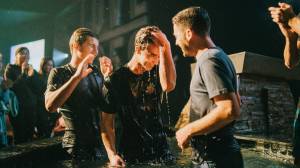
Afterward, one of the American missionaries invited him to be baptized at a pool in the hotel near where they were staying. Cabiling agreed, and the Americans lent shorts too big for him. He remembers “holding on for dear life to my shorts, lest I lose them in the waters of baptism.”

Days after, he was introduced to Murrell, who taught new believers biblical foundations. When the short-term mission trip that had brought them to the Philippines ended, Murrell and his wife had decided to stay behind. Together with Cabiling and other college-aged new believers, they started a church in 1984, initially called Maranatha Christian Fellowship. In 1991, they changed their name to Victory Christian Fellowship to emphasize Christ’s victory over death.

Arnie Suson, one of the early Victory members who later became one of the church’s pastors, said Cabiling was always assigned to do the altar call. Murrell would preach, and then the engineering student would be called to deliver a short gospel presentation. “There was an evangelist inside of him,” said Murrell.

After receiving his engineering degree, Cabiling decided to become a pastor at Victory. In 1991, he married another early Victory member, Judy Pena, who became a campus minister. Together, they helped establish new branches of Victory church.

“When we were starting, Ferdie was a diamond in the rough,” wrote Jun Escosar, a missiologist and Victory’s first paid staff member. “But you could see the steady growth and the passion to learn—not out of selfish ambition or to seek a name for himself.” Victory’s former leadership pastor, Neil Perion, said it took years for the church to convince Cabiling to be ordained a bishop at Victory, as he hated titles.

Victory grew quickly as the church focused on reaching Filipino students on the campus, with small group discipleship a crucial component in their outreach strategy. These young Christians would invite other students, their siblings, and parents, adding to the church’s numbers until thousands were gathering each Sunday in churches around the country.

Rico Ricafort met Cabiling as a sophomore in college. “You may have a lot of guides but not many fathers,” Ricafort said during a memorial service for Cabiling.

Ricafort later became a Victory pastor and, together with Cabiling and several student leaders, founded the campus ministry Youth on Fire in 1994, which spread to many colleges and universities across the Philippines. The late pastor was also instrumental in sharing the gospel to Ricafort’s parents and siblings.

Ria Llanto-Martin, a former campus minister who also met Cabiling when she was in college, described him as a “relational disciple-maker.” She remembers him spending a lot of time with the students, obliging their requests to preach the gospel in their classes and being there for them during times of need.

“I was in my 20s when my dad passed away,” said Llanto-Martin. “He was one of the first people to be in the hospital with us in the ICU. And then he prayed for my dad.”

In 2015, Cabiling, who was an avid ultramarathon runner, decided to run 1,350 miles across all three major islands in the Philippine archipelago to raise around $36,000 for Real LIFE Foundation, an organization he chaired that helps disadvantaged students. He aimed to run 31 miles a day for 44 days in celebration of his 50th birthday. Judy attributed his new obsession to a midlife crisis.

At 2 a.m. on September 5, 2015, Cabiling started his run in the town of Maasim at the southernmost tip of Mindanao. He ran through dangerous areas on the island, including what is now known as Davao de Oro, where insurgents have an active presence. He ran even as his left ankle and foot began to swell to the point that he “could feel bursts of extreme pain with every step.” He said that on the ninth day, “I couldn’t force myself to get up and continue.”

“Nonetheless, I never entertained the thought of quitting,” he wrote in his book. Cabiling’s solo race drew national headlines, as only six others had made the journey. When he arrived in Manila, a little past the halfway point, two prominent Philippine broadcast journalists joined him as he covered the stretch of the historic Roxas Boulevard along Manila Bay. He became known as Philippines’ “Running Pastor.”

On October 26, 2015, he completed the last leg of his race in Aparri, a town on the northernmost edge of Luzon island. In total, he exceeded his goal and raised $55,000, providing scholarships for more than 200 students.

That single-minded focus could sometimes affect interpersonal relationships. Murrell described Cabiling as having “humble boldness,” emphasizing that most who knew him have experienced that boldness “where he would say things we all wanted to say but we were afraid to say them. He’s legendary for speaking the truth in love to very powerful people that aren’t used to hearing correction.“

Several Victory leaders noted the late evangelist could be intense. Ricafort said that unlike those who correct others using the sandwich principle—sandwiching critiques with positive affirmations—his mentor served it “all pure meat.”

Serving the growing church and the campus ministry and equipping pastors and leaders on evangelism took up much of Cabiling’s time. He would preach at two events in two different provinces on the same day while still making time to minister over the phone and even virtually.

Judy said that, at times, she and her husband would have “loving fellowship” (translation: conflicts) over his jam-packed schedule. “He always had to do everything within one day,” she said.

Now, looking back, she sees why: “God allotted only 58 years for him to live, so he didn’t waste any time.”

Cabiling is survived by Judy, his wife of 33 years; a daughter and a son; and two grandchildren.

News

Online Witch Doctors Lure South African Christians

Churches are combating syncretism among millennials and Gen Z amid a rise of social media healers who call on ancestral spirits.

Gogo Kamo, a sangoma in Kempton Park, South Africa, uses bones, herbs, and the Bible to interpret a reading with an online client.

Gogo Kamo, a sangoma in Kempton Park, South Africa, uses bones, herbs, and the Bible to interpret a reading with an online client.

Christianity Today May 8, 2024
Guillem Sartorio / AFP via Getty Images

Millions of Black South Africans seek guidance from sangomas, traditional healers or so-called witch doctors who use their spiritual gifts to connect with ancestors, prescribe herbs to heal illnesses, and throw dry bones to predict the future.

It’s a centuries-old tradition that has continued in the majority-Christian country and has adapted for the internet age: A new breed of influencer sangomas are positioning themselves on social media as digital-entrepreneurial-spiritual seers.

Church leaders across several major denominations in South Africa have long decried the practice as involving “evil, devilish, and unclean spirits.” But as the online sagomas draw in a mass audience of millennial Christians—a generation eager to “decolonize” their lives and reconnect to indigenous African roots—church leaders have new concerns around syncretism as well as internet scams.

Condemnation of sangomas and African ancestral worship is the strongest cog uniting European-legacy churches like Anglicans, Baptists, and Catholics as well as African-initiated churches like the Zion Christian Church (ZCC), said Tendai Muchatuta, a cleric with All Nations Church in Johannesburg.

Both kinds of churches say the practice, despite its popularity, is not compatible with Christianity.

The ZCC is the largest African-initiated church in Southern Africa, with about 12 million churchgoers, including some 9 million in South Africa. Bauleni Moloi, a ZCC pastor in Johannesburg, called sangomas “dubious agents of darkness out to sway Christians from the true focus on the gospel of the cross.”

But younger Christians are more likely to disagree. Many millennial and Gen Z South Africans embrace burning incense, joining initiation ceremonies for sagomas (called ukuthwasa), donning ancestral bangles, and reciting ancestral idioms, all with Bible in hand.

As an Africanist awakening sweeps young Black South Africans, many have been calling for the decolonization of their society and institutions, including Christianity.

“They are Christian, they are under 30 years of age, they make the majority of South Africa’s population demographics. They are unlike their parents who grew up under a strict dogma of obeying Lutheran, Catholic, or Presbyterian missionaries,” said one online sangoma, who goes by the handle luthandolove00.

Another sangoma, Gogo Khanyakude, offers online “dream interpretation” and “crossover meditation” for a millennial clientele. “I grew up in a Christian home,” Khanyakude said, “and there’s no conflict in mixing my Christian faith with the sangoma calling work.”

Many online sangomas say they and fellow healers grew up serving in church, singing in the choir, or leading Sunday Bible school, but they couldn’t resist the pull of ancestral calling, which they say they experienced through dreams, possession, or illness that couldn’t be prayed away by their pastors.

Some churches in the area don’t see sangoma rituals as a contradiction to the gospel. Shembe Church in South Africa—the oldest denomination blending ancestor worship and Christianity in the country—welcomes the use of sangomas and attending their initiation ceremonies.

“African spiritualism is a noble way to tame the relentless influence of European Christianism in South Africa,” said bishop Bulawayo Dhoro of Shembe Church. “We don’t see a contradiction but a wonderful blend of two faiths to make them one. In fact, a dozen of our pastors are sangomas too.”

Other Christians see a much greater risk to adding other sources of healing and guidance beyond Christ and his Word. Christian sangomas will damage the integrity of the Christian faith in South Africa if they are tolerated in mainstream churches, said pastor Ezikiel Mamokethe, a retired Presbyterian cleric.

https://www.instagram.com/p/C17NH4VIOM-/

Actor Thabiso Mokhethi quit being a sangoma to pursue ministry and now advises that those who say they can do both are deceived.

“When it comes to God, he has no equal. He cannot share his glory,” he said on the Street Talk podcast earlier this year. “People are lost. … As long as you are submitting to the ancestorial world, you are out of the kingdom of God.

In April, actress Brenda Ngxoli also announced that she “left sangomahood for motherhood and Christianity.”

Some dodgy sangomas in South Africa use voice apps to create fake online sessions where cloned “voices of ancestors” are relayed to gullible clients on WhatsApp or Facebook.

Syndicates of these fake sangomas have fleeced unsuspecting victims of millions of dollars using a combination of hallucinogenic drugs, romance scams, and promises of spiritual encounters with departed ancestors, the South Africa Police Service warned recently.

“They are swaying many souls from the gospel of truth,” said Mamokethe. “Churches must have the courage to excommunicate believers who dabble as sangomas. It’s a scam.”

According to the pastor, “only gullible churches would welcome Christian sangomas.”

News

SBC Membership Falls to 47-Year Low, But Church Involvement Is Up

Amid the continued declines, Southern Baptists are celebrating back-to-back years of growth in worship attendance and baptism.

Christianity Today May 7, 2024
Kevin Gonzalez / Unsplash

Despite years of record-setting declines shrinking the Southern Baptist Convention (SBC) to its lowest membership in nearly half a century, Southern Baptists have begun to see some signs of life within their 46,906 churches.

Worship attendance, small group attendance, and baptisms were up last year in the SBC’s annual statistical report, released Tuesday, while membership fell below 13 million.

2023 marks 17 straight years of decline for the country’s biggest Protestant denomination. It’s down 3.3 million from its peak, with the steepest drops coming during the pandemic. The SBC lost 1.3 million members between 2020 and 2022 alone.
Beyond COVID-19 disruptions, Southern Baptists have recently confronted some contentious issues within their convention, responding to sexual abuse and clamping down on female preachers, which have led some congregations to leave the SBC (including prominent megachurch Saddleback Church).

But statistics indicate that church departures aren’t a significant driver of membership decline; the SBC was down 292 churches last year, just 0.63 percent of its total.

In 2023, membership fell by 241,000, its smallest decrease since 2018. Yet attendance at SBC churches increased 6.5 percent, reaching above 4 million a week for the first time since the pandemic.

Attendance at small groups and Bible studies ticked up 4 percent to 2.4 million.

With fewer Americans than ever attending church and religious disaffiliation on the rise, leaders see even small increases in engagement and discipleship as worth celebrating.

It’s the first time in over a decade that SBC worship attendance has grown two years in a row, though it still lags behind pre-pandemic numbers. Back in 2019, SBC churches saw over 5 million show up each Sunday.

“Outreach and discipleship are difficult today. They require time and commitment when our culture offers numerous distractions and alternatives. The pandemic was discouraging as fewer people engaged in these activities,” said Scott McConnell, executive director of Lifeway Research, which releases the annual report.

“But as people have re-engaged and new people are participating, there is much to celebrate in Southern Baptist churches today while we invite more to join.”

Baptisms, the key metric for Southern Baptists, also grew for the second year in a row.

“God has been stirring the waters, and an upswing in baptisms has solidly begun,” wrote SBC president Bart Barber, a pastor in Texas.

“Not only have we experienced a second year of increased baptisms, but we have also witnessed a year-over-year gain—25.94 percent more baptisms than in 2022—that leaves no room for doubt about what God is doing among our churches.”

Kevin Ezell, president of the North American Mission Board, said the baptism trend is widespread across regions. Out of 41 state conventions, 35 reported more baptisms in 2023 than 2022.

“Pastors are the difference makers here,” he said in a statement. “Despite all the distractions and challenges out there, they are keeping the focus on evangelism and encouraging new believers to follow up with baptism.”

The report’s release falls about a month before the SBC’s annual meeting, which gathers over 10,000 messengers in Indianapolis in June. They are slated to address new mechanisms for overseeing abuse reform and reporting as well as clarifications to cooperation agreements and guidance around women in ministry.

The SBC’s current membership of 12,982,090 is the lowest since 1976. The membership size peaked at 16.3 million in 2006.

One bright spot, leaders say, is the generosity of members and churches, who spent nearly $800 million on missions last year, up 9 percent.

“We are sharing the gospel with more people, gathering for worship and Bible study in increasing numbers, giving billions to support churches serving communities across our country, and sending millions to support mission enterprises around the world,” said Jeff Iorg, the SBC Executive Committee president-elect.

“Southern Baptists are not a perfect people,” he added. “But we are a movement making a positive difference in our world, and our most recent statistical report underscores this reality and motivates us to press forward.”

Books
Excerpt

Duke Ellington Read His Bible in the Bath

An excerpt from Larry Tye’s The Jazzmen: How Duke Ellington, Louis Armstrong, and Count Basie Transformed America.

Christianity Today May 7, 2024
Illustration by Elizabeth Kaye / Source Images: Getty, Lightstock

“Does Jazz Put the Sin in Syncopation?” asked a 1921 Ladies Home Journal article. Whimsical wordplay aside, the question would become a serious one for mid-century America, as parsons and priests blamed jazz for soaring juvenile crime rates, drugs, and extramarital sex. A 1960 poll found that, among Black preachers, just 1 in 5 wanted to let jazz or blues into their services. Decades before, a religion editor at the Pittsburgh Courier had denounced Louis Armstrong’s “sacrilegious desecration of Spirituals.” Duke Ellington’s music was “considered worldly,” counseled the Rev. John D. Bussey, explaining why the local 1966 Baptist Ministers Conference had unanimously passed his resolution opposing a performance.

The Jazzmen: How Duke Ellington, Louis Armstrong, and Count Basie Transformed America

But whatever commandments they were breaking—and there were plenty, from slighting the Sabbath to serial adultery—Duke, Louis, and king of swing Count Basie all seemed to take the Christian faith they’d been raised in seriously. And that faith found its way into their music.

For Louis Armstrong, the connection was there from the very beginning, when he learned to sing in his mother’s Sanctified church. “The ‘whole ‘Congregation would be “Wailing—‘Singing like ‘mad and ‘sound so ‘beautiful,” he wrote with his characteristic expressive, idiosyncratic punctuation. “I’d have myself a ‘Ball in ‘Church, especially when those ‘Sisters ‘would get ‘So ‘Carried away while ‘Rev’ would be ‘right in the ‘Middle of his ‘Sermon. ‘Man those ‘Church ‘Sisters would ‘begin ‘Shouting ‘So—until their ‘petticoats would ‘fall off. … My heart went into every hymn I sang,” he added. “I am still a great believer and I go to church whenever I get the chance.”

With Saturday night performances that stretched into Sundays, that wasn’t often. But nearly half a century later, Armstrong released an album the church sisters would have loved, Louis and the Good Book, with gassed-up versions of spirituals including “Go Down Moses” and “Nobody Knows the Trouble I’ve Seen.” He recorded “When the Saints,” the anthem of the Big Easy, more than 100 times.

Count Basie was raised in the Black church too. Two of his uncles were ministers; his father was a founder and pillar of Pilgrim Baptist Church in Red Bank, New Jersey. In oral histories and writings, fellow musicians and friends use the word spiritual to describe what Basie brought to the band. Sideman Harry “Sweets” Edison compared their group to church organists and singers who inspire congregants to “get up to shout.” Basie was a spiritual presence offstage too. “Prior to eating, he would do this elaborate silent prayer,” recalls tenor saxophonist Eric Schneider. If the food came before he was finished, “it was understood that we should go ahead and eat.”

Duke Ellington was perhaps the most pious of the three maestros. Growing up, he attended two services each Sunday: African Methodist Episcopal Zion with his father, Baptist with his mother. As a young man, he consulted the Bible twice a day, sometimes taking the book into the bathtub and reading until the water got cold. Though he shunned most jewelry, he wore a gold crucifix around his neck and carried a St. Christopher medal in his hip pocket. His Christmas card bore a simple message in gold lettering: LOVE GOD.

In the last ten years of his life, Ellington devoted himself to a series of sacred concerts, performances that brought together jazz and classical music, spirituals, gospel, and the blues. Suddenly, he was getting more invitations to play in churches than in dance halls. Synagogues too. “These are things people don’t know about him,” said singer-songwriter Herb Jeffries. “He had a great ministry. It was hidden in his music. … He was practicing his ministry moving about here and there, making people happy!” When a reporter asked how he, “as a religious man,” could “play in dark, dingy places where depravity and drunkenness reign,” Ellington whispered, “Isn’t that exactly what Christ did—went into the places where people were, bringing light into darkness?”

He also pushed back against preachers who accused him of defiling their churches with his concerts. “Some people ask me what prompted me to write the music for the sacred concerts. I have done so not as a matter of career, but in response to a growing understanding of my own vocation,” Ellington wrote in his memoir. “I think of myself as a messenger boy, one who tries to bring messages to people, not people who have never heard of God, but those who were more or less raised with the guidance of the church.” The sacred concerts, this most accomplished of composers and bandleaders added, were “the most important thing I have ever done.” They were important to audiences too. Take the girl who approached Ellington after one performance, telling him, “You know, Duke, you made me put my cross back on!”

Sacrilegious, then, isn’t the word to describe these jazzmen. Yes, their faith was unorthodox, and imperfect. But it also was warmly ecumenical and personally sustaining. You can hear it not just in their Christmas tunes but in all of their jazz, music rooted in the gospels and Negro spirituals they grew up with. Their abiding belief in God, all three maestros made clear, is what emboldened and empowered them to write the soundtrack to the Civil Rights revolution, to shape the soul of America.

According to his son Mercer, Duke Ellington “was quite taken with the story of the ‘Juggler of Notre Dame.’” It’s a parable that applies to Armstrong and Basie too. “The man was a great juggler, who would sneak into the church and juggle before the altar. As the story goes, the priests found out about it and kicked him out. God intervened and told the priests to leave him alone. The man was celebrating His presence, by using the gifts that He gave him.”

Larry Tye is a former medical reporter at The Boston Globe, and now runs a Boston-based fellowship program for health journalists. The Jazzmen is his ninth book.

From the book THE JAZZMEN by Larry Tye. Copyright 2024 by Larry Tye. Reprinted by permission of HarperCollins Publishers.

Theology

Yes, Paul Really Taught Mutual Submission

Why Wayne Grudem’s interpretation of Ephesians 5:21 is untenable.

Christianity Today May 7, 2024
WikiMedia Commons / Edits by CT

In Ephesians 5:21, Paul instructs Christians to “submit to one another.” These words have traditionally been understood to require mutual submission, even among family members. The reformer John Calvin, for example, acknowledged that the notion of a father submitting to his child or a husband submitting to his wife might seem “strange at first glance,” but he never questioned that such submission is indeed what Paul prescribes.

In more recent years, however, this reading of Ephesians 5:21 has been called into question—ironically, in the name of theological conservatism. Many evangelical scholars now assert that the submission in this verse is not mutual submission (everyone submits to everyone) but one-directional submission to those in authority (some submit to others). The most outspoken proponent of this view is Wayne Grudem, a prominent theologian who helped establish the Council on Biblical Manhood and Womanhood.

Grudem, who recently announced his retirement from teaching, has argued for more than three decades that Ephesians 5:21 could be paraphrased as follows: “Those who are under authority should be subject to others among you who have authority over them.” On Grudem’s reading, this verse requires a wife to submit to her husband, but it does not in any sense require a husband to submit to his wife.

In defense of this interpretation, Grudem appeals to the meaning of hypotassō, the Greek verb translated “to submit” or “to be subject.” Grudem claims that this verb “always means to be subject to someone else’s authority, in all Greek literature, Christian and non-Christian.”

“In every example we can find,” Grudem contends, “when person A is said to ‘be subject to’ person B, person B has a unique authority which person A does not have. In other words, hypotassō always implies a one-directional submission to someone in authority.”

The problem with this argument is that the claims about hypotassō are simply not true. Consider the following eight ancient passages containing the verb hypotassō. Each decisively refutes Grudem’s claim that hypotassō “always implies one-direction submission to someone in authority.” In several, hypotassō is used to describe submission that is explicitly mutual, not one-directional. And in all eight passages, hypotassō is used to describe submission to people who are not in positions of authority. (All translations are my own. An extended discussion of these and other relevant texts will appear in my forthcoming article in the Lexington Theological Quarterly.)

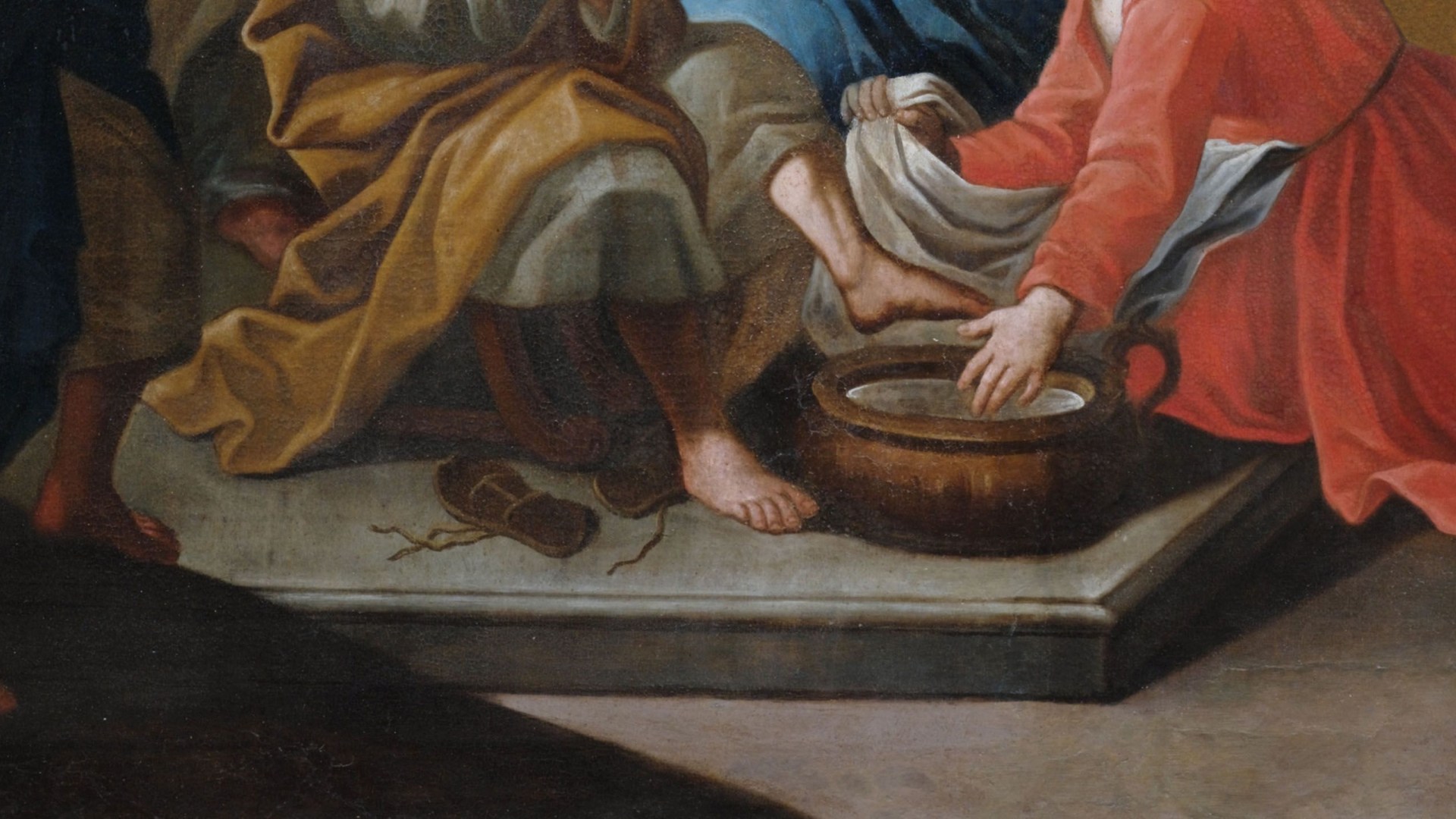
  1. The seventh-century monk Antiochus of Palestine gives the following advice to the one seeking humility: “Let him submit to his neighbor, and let him be a slave to him, remembering the Lord, who did not disdain to wash the feet of his disciples” (Pandectes 70.75–77).
  2. The fourth-century bishop Gregory of Nyssa explains that every member of a monastic community should consider himself “a slave of Christ who has been purchased for the common need of the brothers” and should thus “submit to all” (De instituto Christiano 8.1:67.13–68.12).
  3. In a personal letter, the fourth-century bishop Basil of Caesarea speaks of one “who in accordance with love submits to his neighbor” (Letters 65.1.10–11).
  4. In a treatise regulating life in a monastic community, Basil cites Paul’s exhortation in 1 Corinthians 10:24: “Let no one seek his own good, but the good of the other.” Basil thus concludes that it is necessary “to submit either to God according to his commandment or to others because of his commandment” (Patrologia Graeca 31:1081.30–38).
  5. In a treatise attributed to Basil, the author describes members of a monastic community as both “slaves of one another” and “masters of one another.” This “slavery to one another” is not brought about by coercion, but is rather done willingly, with “love submitting the free to one another” (Patrologia Graeca 31:1384.7–14).
  6. In a sermon addressing sexual promiscuity, the fourth-century archbishop John Chrysostom states that “the bridegroom and the bride” who have not had prior experience with other sexual partners “will submit to one another” in marriage (Patrologia Graeca 62:426.33–35).
  7. In an exhortation to mutual submission, Chrysostom considers how one should treat a fellow Christian who has no intention of reciprocating: “But he does not intend to submit to you? Nevertheless, you submit; not merely obey, but submit. Entertain this feeling towards all, as if all were your masters” (Patrologia Graeca 62:134.56–59).
  8. In a treatise attributed to the fourth-century monk Macarius of Egypt, the author exhorts members of a monastic community to remain “in this good and edifying slavery” and to render “all submission to each one.” The author envisions “all the brothers submitting to one another with all joy,” and exhorts them “as imitators of Christ” to embrace “submission and pleasant slavery for the refreshment of one another” (Great Letter 257.22–261.1).

Grudem’s interpretation of Ephesians 5:21 is thus founded upon a misunderstanding of the Greek verb hypotassō. As illustrated by the passages cited above, this verb is not only used to describe submission to people in positions of authority; it is also used to describe submission to neighbors, to brothers, and to wives.

Moreover, using Thesaurus Linguae Graecae—a massive digital library containing essentially all of the extant Greek literature from the ancient world—I have examined every citation and allusion to Ephesians 5:21 prior to A.D. 500. I find no evidence that the Greek-speaking church was even aware of the some-to-others interpretation defended by Grudem. Paul’s words in Ephesians 5:21 are uniformly understood by the ancient Christians to require submission to everyone in the community, regardless of rank, and are thus routinely associated with passages such as Mark 10:44 (“be a slave of all”) and Galatians 5:13 (“be slaves to one another”).

For example, immediately after quoting Ephesiasn 5:21, Chrysostom gives the following exhortation to mutual submission: “Let there be an interchange of slavery and submission. For thus there will be no slavery. Let not one sit down in the rank of free, and the other in the rank of slave; rather it is better that both masters and slaves be slaves to one another” (Patrologia Graeca 62:134.28–32).

Notice that in expounding Ephesians 5:21, Chrysostom uses the language of Galatians 5:13: “be slaves to one another.” While these two verses are routinely associated in the Greek patristic literature, Paul’s English readers often miss the connection. English Bibles typically render Galatians 5:13 as “serve one another,” but Paul’s language is stronger than this translation suggests. The Greek noun for “slave” is doulos, and the verb used in Galatians 5:13 is the cognate douleuō, which means “to be a slave.”

The verbs douleuō and hypotassō are thus quite similar and are sometimes used together as near synonyms. Consider the following four passages in which the verb hypotassō is paired with the verb douleuō.

  1. The second-century Roman author Plutarch cites Plato’s advice not “to submit and be a slave” to passion (Moralia 1002E).
  2. The Roman philosopher Epictetus, a younger contemporary of Paul, excoriates the one who fails to attain the Stoic ideal: “You are a slave, you are a subject” (Discourses4.4.33).
  3. The Shepherd of Hermas, a second-century Christian text, describes what will happen “if you are a slave to the good desire and submit to it” (45.5).
  4. In the first of the eight passages cited above, Antiochus writes, “Let him submit to his neighbor, and let him be a slave to him.”

In his arguments against mutual submission, Grudem has overlooked the similarity between these two verbs. He correctly observes that hypotassō implies a hierarchy in which one person is ordered below another person. Since two people cannot simultaneously be beneath each other, Grudem and other critics of mutual submission dismiss the concept as self-contradictory.

However, these scholars fail to observe that the verb douleuō in Galatians 5:13 also implies a hierarchy in which one person is ordered below another person. Nevertheless, as all commentators acknowledge, Paul is obviously using the verb douleuō in Galatians 5:13 to describe action that is mutual, not one-directional. Thus, while Paul’s language of mutual submission in Ephesians 5:21 is indeed (deliberately) self-contradictory, it is no more self-contradictory than his language of mutual slavery in Galatians 5:13.

The ancient church uniformly understood Ephesians 5:21 to require mutual submission, and the modern rejection of this interpretation among some evangelicals is rooted in spurious claims about the Greek verb hypotassō. Jesus took “the form of a slave” (Phil. 2:7), and all who follow him, both male and female, are called to embrace submission too.

Murray Vasser is assistant professor of New Testament at Wesley Biblical Seminary. This article summarizes academic research that was presented at the 2023 meeting of the Society of Biblical Literature and is forthcoming in Lexington Theological Quarterly.

Church Life

The Key to Fighting Sex Trafficking? Showing Up.

Indonesia’s Compassion First isn’t knocking down doors, but caring for victims and tutoring at-risk youth living in cemeteries.

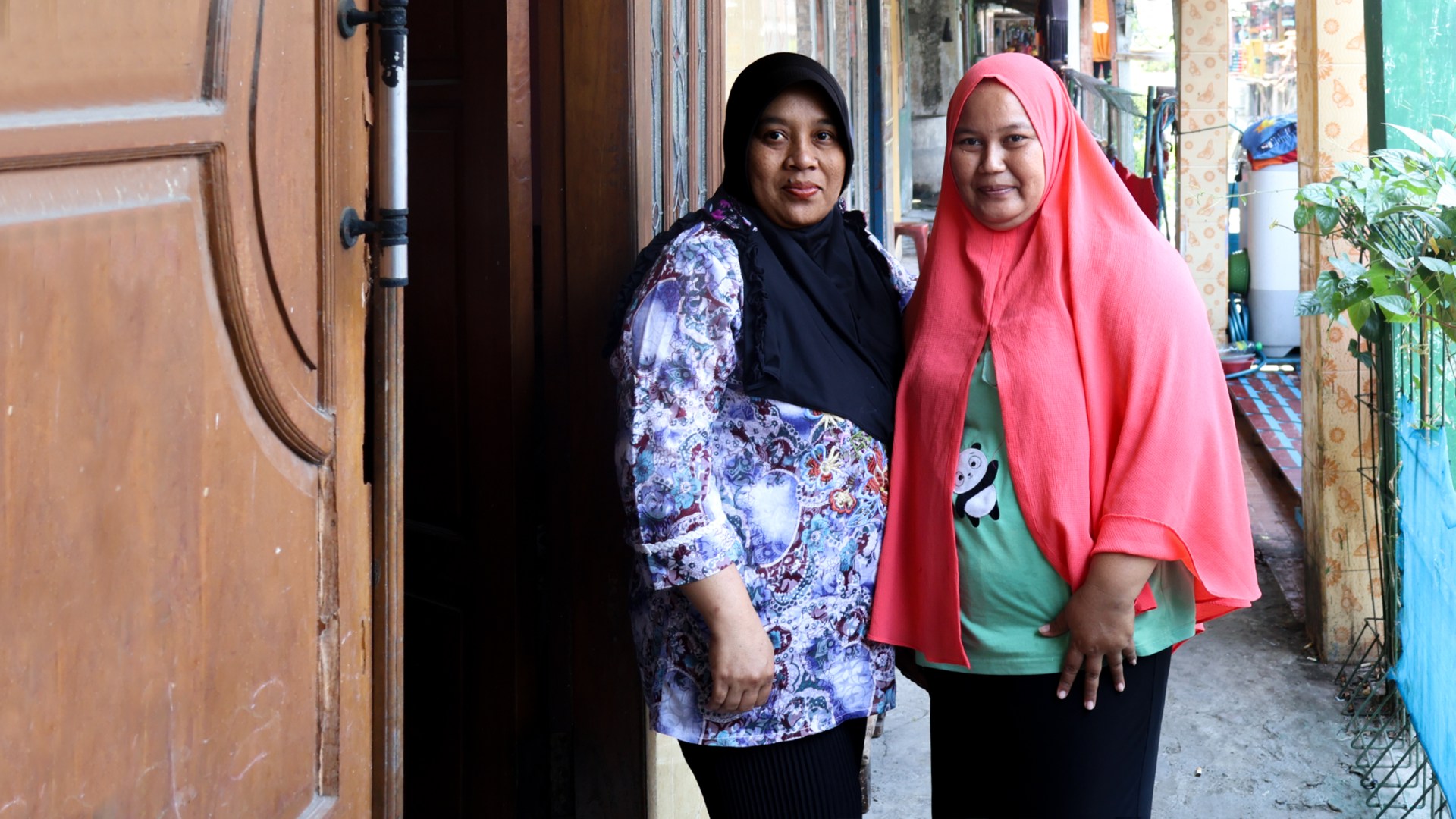
Mala (left) and Susi (right), who take classes from Compassion First.

Mala (left) and Susi (right), who take classes from Compassion First.

Christianity Today May 7, 2024
Photography by Angela Lu Fulton

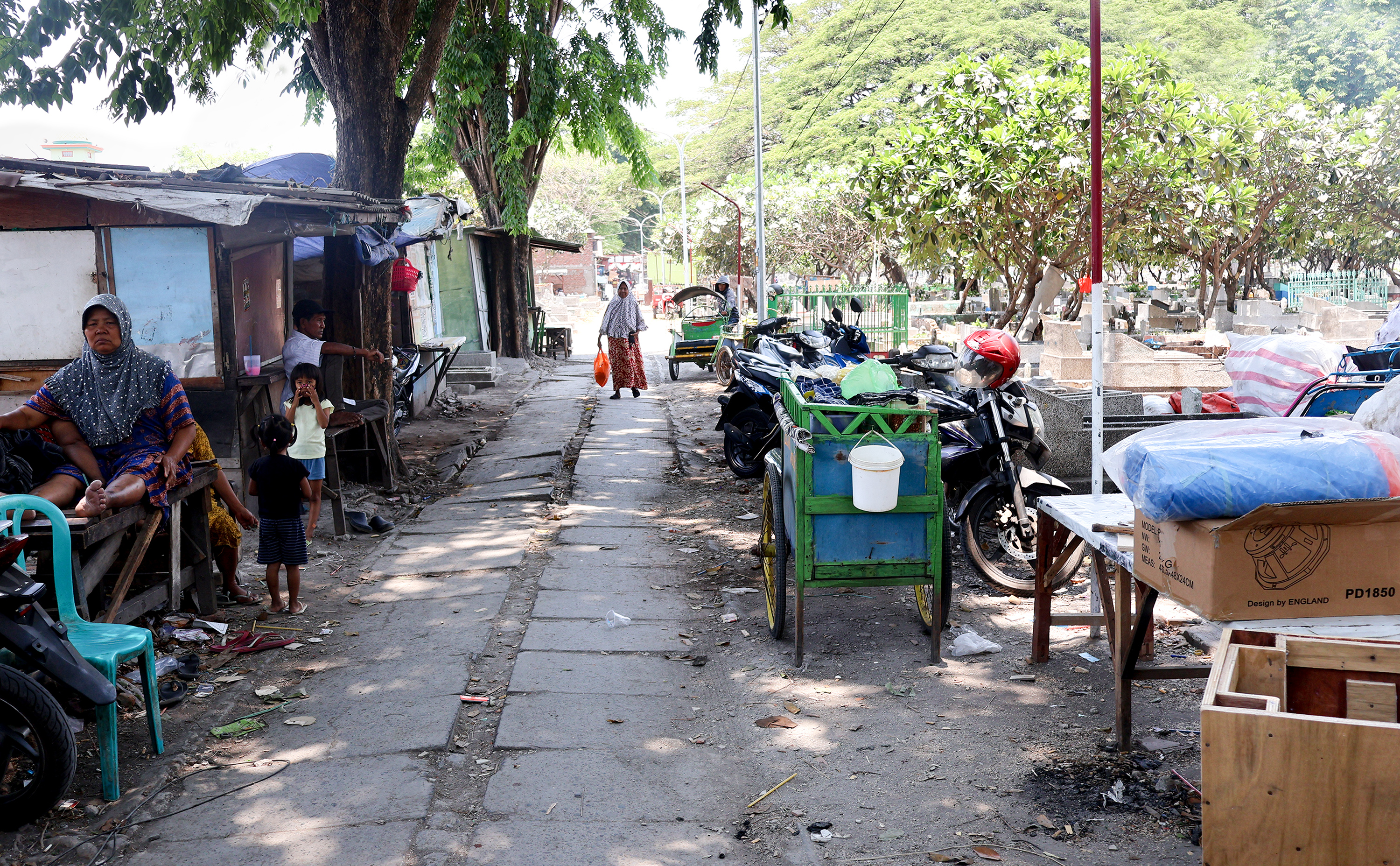
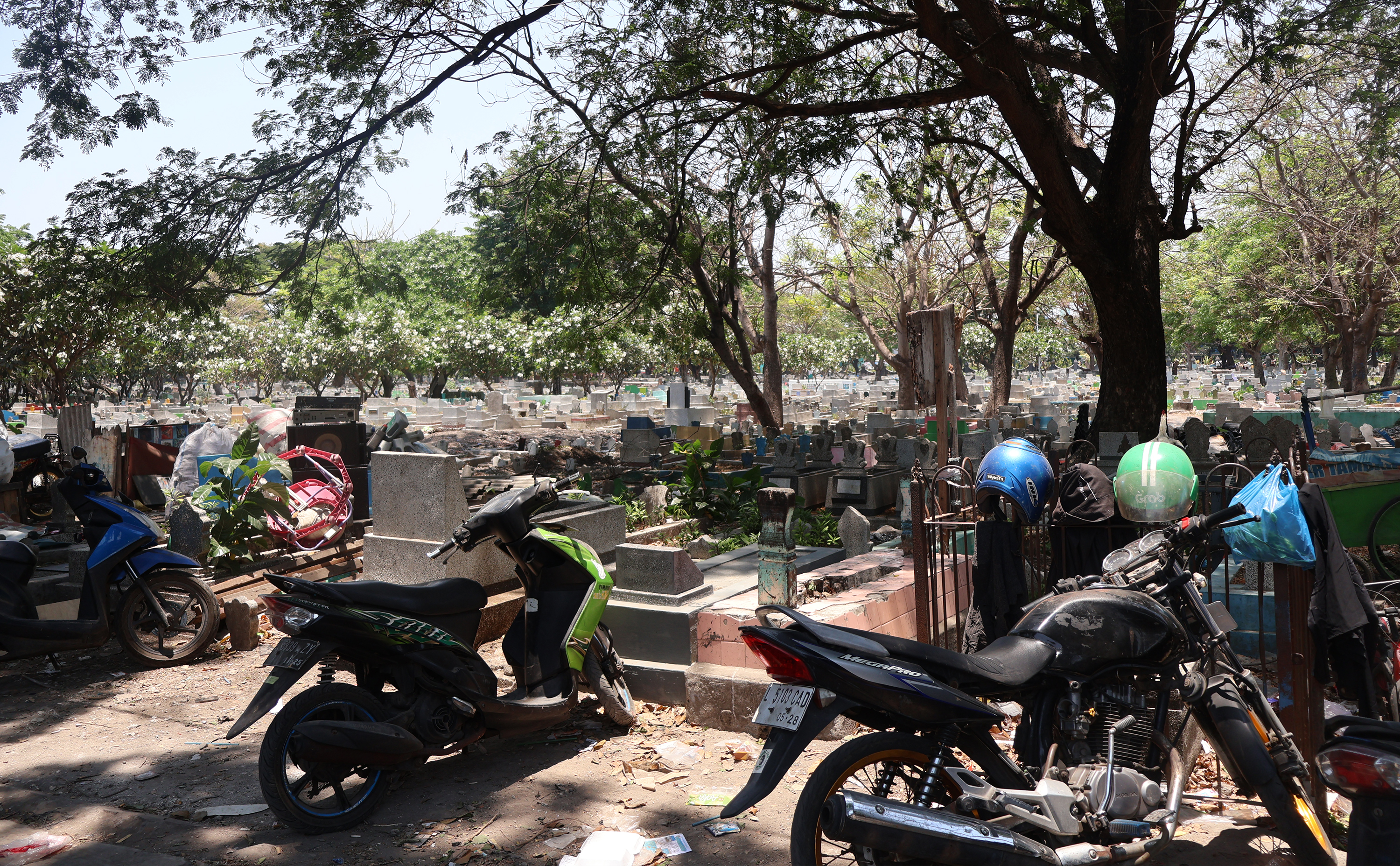
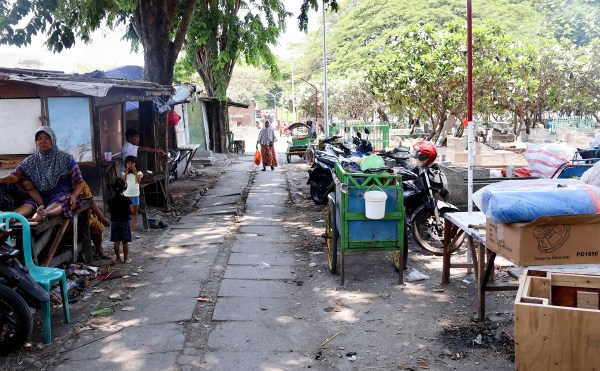
Inside a cemetery in West Java, a woman rests on a mattress laid on top of a gravestone beneath the oak trees. The graveyard is home not only to the dead but to the living poor, who have nowhere else to go.

Residents of the Rose Cemetery community collect garbage, drive pedicabs, or clean graves by day. In the northern section of the cemetery, about 200 families live in brick and tin buildings lining a ditch filled with trash and milky sewage water. At night, many women resort to prostitution to provide for their families. Their daughters are often sold—or kidnapped—into the sex trade. (CT changed the names of the cemeteries and only used the first names of its residents for security reasons.)

Compassion First (CF) offered tutoring, parenting classes, and cooking classes for the community on a blue covered porch in the cemetery complex. Recently they moved to a new community center nearby. CF focuses on fighting sex trafficking in Indonesia, and here at the cemetery, that means community development among families vulnerable to exploitation.

Susi and Mala, two mothers who have lived in the community their whole lives, noted that neighbors rarely knew one another in the past. CF arrived during the COVID-19 pandemic—initially to provide food for the community and scholarships to the children. Since then, the neighborhood has become much more close-knit and better resourced. For young girls, this could make the difference between whether they are trafficked or not.

Susi learned from the cooking class how to make seblak (a spicy dish made of wet crackers and meat or seafood, smothered in sambal chili paste) and now sells it to supplement her income. Mala learned about the five love languages in the parenting class and this helped her relate to her children and husband. “I learned that kids are like durians,” she said. “Spiky on the outside and soft inside.”

Mala said that since CF started its program, all the moms have started small businesses.

“Usually a group comes for a while [then leaves], but YKYU comes here continually,” Mala said. (YKYU is the Indonesian name for CF.) “They really care for us, both the kids and the moms.”

Staying in a community “continually” is what makes Compassion First effective in Indonesia and unique among international anti–sex trafficking efforts there. Beyond the two community development programs in West Java cemeteries, the Oregon-based organization operates two shelters for girls rescued from sex trafficking and a transitional home.

They also work with law enforcement to help return trafficked girls to their homes, partner with other groups to monitor ferry terminals for traffickers, and arrange trainings for police, churches, and local communities on how to spot trafficking.

The work is slow and challenging, and opposition from mafia-linked traffickers and corrupt police had prompted CF leaders to consider giving up. But, amid their weariness, they say they’ve seen God bring the right people and the right resources at the right time.

“We talk about our work … in terms of everyday aftercare, everyday advocacy,” said Traci Espeseth, Compassion First’s director of development. “And it really comes back to just being faithful in showing up day in and day out and saying yes to God’s invitation.”

Photography by Angela Lu Fulton
A cemetery in West Java where the poor have made their homes.Photography by Angela Lu Fulton
A cemetery in West Java where the poor have made their homes.

Providing resources to victims of child sex trafficking

An estimated 70,000–80,000 Indonesian children are victims of sexual exploitation, according to the US State Department’s 2021 Trafficking in Persons (TIP) report on Indonesia. Because the archipelago is expansive, girls are frequently transferred between the 6,000 inhabited islands, making it difficult to track them down and bring them home.

Sex traffickers often use debt or false offers of employment to trap girls—especially those from poor families—into sex work. Tourist spots like the island of Bali are destinations for foreign and local child sex tourism.

In 2022, the TIP report ranked Indonesia as Tier 2, meaning that while the government hasn’t reached the minimum standards for eliminating trafficking, it is making a concerted effort.

The government has come a long way since CF founder and CEO Mike Mercer first started to work in Indonesia in 2010. Before that, Mercer worked on post–Hurricane Katrina relief through his Foursquare church in Beaverton, Oregon. After learning about sex trafficking in Southeast Asia, he sought to work in an underserved country. His contacts told him that Indonesia had a great need, as other NGOs have tried and failed due to the difficulty of the work.

While other anti–sex trafficking groups congregated in Thailand and Cambodia, he headed to Indonesia, where his denomination had 13,000 churches. He knew that to succeed, he’d need local partners.

In 2010, CF opened a shelter for child victims of sex trafficking in the Christian-majority province of North Sulawesi. Due to the poverty in the province and the fact that women from the region are light-skinned (which is viewed as attractive in Indonesia), it has the second-highest number of women trafficked in Indonesia.

CF built connections with law enforcement in the city, especially the head of the investigative unit for women and children. “We were hand in glove from the beginning because we were aligned,” Mercer said. “I think that was the provision of God.”

Police were eager for CF to build a shelter as they had recently busted a sex trafficking ring and sent the girls back to their homes in North Sulawesi. Yet because the families and communities weren’t ready to receive them—some came from unsafe homes and many were stigmatized for their past—they struggled to reintegrate into society, and all the girls were re-trafficked.

The police were demoralized. So when CF contacted them about providing aftercare for rescued girls, local law enforcement were eager to help.

CF’s growing pains

With funds donated from the US, CF hired Indonesian staff, trained them with the help of veteran sex trafficking groups like Transitions Global, and started housing girls. But it wasn’t nearly enough.

“At first, we had to make it up as we went,” said Winda Winowatan, president of CF Indonesia. A North Sulawesi native, Winowatan worked in the church before joining the organization. She noted that while they had models from other parts of the world, locally, “we had no one to learn from.”

Ervillia Valentina, one of the first house moms at Sarah’s House in North Sulawesi, experienced many of those challenges firsthand. She lived 24/7 at the shelter with another house mom and two security guards. Even on her days off, Ervillia slept at the shelter. Together, they cared for four girls.

One night, all four ran away. “They were terrified because they were going through their legal cases,” where they needed to testify against their traffickers, Ervillia said. These attempts at prosecution would upset traffickers, who are closely tied to the mafia. Ervillia remembers mafia members revving their motorbikes outside the shelter to intimidate them. At times, the girls and the CF team needed to spend the night at a hotel.

When a girl ran away, case managers checked in with their parents, friends, and social media to find out where they’d gone. Then they brought them back and discussed whether the shelter was the right place for them. The first time, all four girls decided to return to the shelter.

One time after a girl ran away and Ervillia found her, the girl grabbed a knife from the kitchen and threatened to kill Ervillia. From then on, CF decided that house moms should not stay at the shelter 24 hours a day but live outside and trade shifts with others.

Valerie Bellamy, CF’s director of operations, said that although the girls choose to enter the shelter, most have tried to run away. Every time, CF will go find them again: “There comes a point when she realizes that she’s worth going after.”

Photography by Angela Lu Fulton
In the cemetery complex, Compassion First held classes on the blue covered porch.Photography by Angela Lu Fulton
In the cemetery complex, Compassion First held classes on the blue covered porch.

Miraculous interventions

At times, the dangers have been grave. Mercer noted that one of their first court cases in 2011 took place in a rural city, and CF faced opposition not only from the mafia but from the corrupt police force. During the trial, one girl testified and named seven government officials whom she had been sold to. Several were sitting in the courtroom.

“It’s [times like this] where everybody on our team should have just … gone home, everybody should have quit,” Mercer said. “One of the ways we know the hand of God is with us is that all of those people still work for us today. It’s phenomenal.”

Their story landed in the newspaper, which was seen by an official from the US embassy, who asked for a meeting with Mercer and CF staff. A photo from that meeting was publicized, and suddenly all the opposition stopped as the police realized the world was watching. Through CF’s connections with the embassy in Indonesia, they were able to invite the head of the Portland Police Bureau and other US government officials to train local Indonesians on how to investigate sex trafficking cases and how to identify and engage with the victims.

“Westerners don’t actually get to go in and kick down doors,” Mercer said. “Anybody who says they do that is acting dangerously. … We are here to partner with our friends who are legally able to do that work, and then we’re here to take care of the humans that they intervene for.”

Becoming a government model

Over time, CF has been able to improve their care for the girls as well as their staff. Mercer said they realized they needed to raise a lot more money to hire more people and pay competitive wages to keep them, due to the hazards of the job. By providing their staff with extensive training and support for the secondhand trauma that they encounter, they have prevented the staff turnover that plagues other groups. Today, CF has more than 100 staff, and 90 percent are Indonesian.

At the home, CF provides the girls with trauma-based counseling, homeschooling, legal advocacy, and opportunities to explore their skills and hobbies so that they can pursue different career paths in the future.

“There’s a need to transition from surviving from day to day to thinking about tomorrow, what your dreams are,” Bellamy said. Referencing the typical girl they serve, she noted, “We wish trafficking wasn’t part of her story, yet her future is brighter than it has ever been.”

At the same time, they work with the girls’ families to make sure they are ready for their daughters to return. In some cases, the parents were the ones who decided to sell their daughter in the first place, so CF needs to find another safe family in the community.

Since its founding, CF has helped 67 girls and seen 24 cases go to trial, with a total of 23 traffickers convicted. Some cases resulted in multiple convictions and some with none.

The Indonesian government now uses Sarah’s House as a model. Winowatan has created step-by-step instructions for the North Sulawesi government to deal with trafficking victims.

CF has also seen fruit from its partnership with local law enforcement: In 2015, a government official in the province of Papua told Mercer that since doing a training two years earlier, they had seen a 50 percent reduction in the trafficking of girls from North Sulawesi to Papua.

And since 2022, CF has partnered with Love Justice International to monitor ferry terminals in North Sulawesi. Mercer heard that traffickers are now unable to get girls off the boats in North Sulawesi, so they’ve had to either find girls from another province or take more expensive routes.

Going where they’re invited

The needs elsewhere in Indonesia are many, but Mercer doesn’t want the group to dictate where they go to help. Instead, they wait to be invited into different spaces.

They expanded their work into West Java cemeteries in 2012 only after female sex workers invited them into their community. Mercer had heard that cemeteries in urban centers are the end of the road for sex workers, as the women there are either stuck in a generational cycle of prostitution or have “matriculated through this nefarious network of prostitution and they age out of everything,” Mercer said. “This is the last stop.”

With the leader of a local Christian ministry, a person of peace, and a box of sandwiches, CF staff visited what they have called “Marigold Cemetery” after dark and got to know the women selling themselves among the gravestones. On their second visit, they asked if they could organize and invite the women to a Christmas gala. The women agreed.

From there, relationships developed. CF started to better understand their needs, and in 2015, they opened their first community center near the cemetery, providing scholarships, tutoring, and classes. Every year, they continue to hold a gala, now for Thanksgiving instead of Christmas.

CF’s entrepreneurship class teaches adults and teens how to make journals using leftover fabric from boldly patterned Indonesian batiks. The journals are then sold in the US or to tourists visiting Indonesia, and all the proceeds return to the students.

One member of the class, 22-year-old Asya, has come to the center since she was in the sixth grade. She started making journals as a teen in between taking classes at the center. From the skills she’s learned from that class, including managing finances and photographing products, she’s started small businesses selling satays on the street and creating flower arrangements for special events.

What she appreciates most is the community she’s found in the class. “I share everything with them,” Asya said.

Expansion in Java

The invite into the Rose Cemetery community, where Mala and Susi reside, came when COVID-19 devastated the already-struggling community. Many residents lost their jobs and could not feed their children.

CF helped provide food for those families and invited them to join the Thanksgiving gala at the Marigold Center. At the event, the families told staff they also wanted the same resources and opportunities. CF eagerly agreed.

“I wish in 1997 YKYU was here so I could also study instead of getting married at 16,” Mala said wistfully. She dropped out of school after her first year of junior high because her dad died, and the family had no money for school. “I would rather have gone to school, so that’s what I tell my kids to do. … I ask them to join [YKYU] programs so that they can get support for their education, because as a mom, I can’t help them.”

As police connected CF with more rescued girls from the Muslim-majority West Java, CF realized they needed to open another aftercare home in the region. This would allow the girls to stay within their community and quell concerns among Muslim parents that their daughters would be “Christianized” if they went to Christian-majority North Sulawesi.

So in 2019, CF opened a second shelter called Grace House. Ervillia, who worked at the home as a program coordinator, said that they never forced Christianity on their mostly Muslim girls but gave them opportunities to learn about Jesus. Once a week, they hold “share nights” where pastors and volunteers share about their lives and tell stories from the Bible.

“One of the girls in our care program said she felt really loved and really accepted by our staff, and so that makes her love being in the program,” Ervillia said. “That’s how we see her life change and her self-worth change.”

While Grace House closed in 2021 due to landlord issues, around the same time, a pastor in West Java donated a property to CF, inviting them to build a shelter there to help local girls. Today, that center cares for three girls.

In the future, Mercer sees CF continuing to step into new spaces where their services are needed. The Indonesian government had said they hoped Compassion First would work in every province in the country. Currently, they are in four—including a case management office in Bali.

“As Indonesia continues to invite us to serve, then that’s what we’ll be doing,” Mercer said. “We grow out of assignment, not out of ambition.”

Church Life

Let the Neurodivergent Children Come to Me

Gentle parenting is one tool to train up children who have disabilities with love and wisdom.

Christianity Today May 6, 2024
Illustration by Elizabeth Kaye / Source Images: Unsplash, Wikimedia Commons

As a toddler, my son would often lash out at other kids for no apparent reason, causing incidents at daycare, at home, and in the church nursery. At times, he would even hurt himself in his distress. After more than a year of trying to encourage the “right” behavior, I felt like this was more than age-appropriate tantrums.

We sought an evaluation, and our son received multiple diagnoses that confirmed he’s neurodivergent, a term that commonly encompasses brain-based differences such as ADHD, autism, learning difficulties, and more.

One way to consider how my son experiences the world is to think of his brain like a highly sensitive smoke detector. A typical smoke detector on your kitchen ceiling will alert you to a potential emergency in the room. However, one that is highly sensitive might alert you to a neighbor smoking a cigarette as he walks by your window on his way to the store.

My son’s nervous system makes him similarly sensitive. He’s hyper-attuned to potential threats in the world around him, and sometimes the most typical everyday interactions can become extremely distressing for him, even resulting in acute anxiety attacks.

As first-time parents, we did our best to follow conventional advice about establishing routines and maintaining authority. We disciplined him with consequences, withheld privileges, and rewarded any display of self-control. Any physical discipline only succeeded in making us seem like a threat and triggering his fight-or-flight response.

Traditional forms of discipline were not working, and my husband and I knew we needed to change the way we parented. Yet I still wondered if this was compatible with my faith. I could not escape the maxim “Spare the rod, spoil the child.”

One Sunday, our pastor preached on the parable of the Prodigal Son (Luke 15:11–32). He encouraged us to put ourselves in the shoes of a first-century Jewish father—to imagine being effectively disowned by your child and the emotions of having them eventually return.

Citing Kenneth E. Bailey’s work, our pastor explained that a first-century son who demanded his inheritance would be ceremoniously rejected, cut off from his heritage and his family. Our pastor described the father running to his son in order to reach him before the community noticed his return and cast him out forever. I pictured villagers running after the father to see what he would do, stunned that he embraced his wayward, reckless child instead of condemning him and casting him out.

Our pastor asked us to try to comprehend how unbelievable the forgiveness, grace, and protection the father extended to his son would seem to the rest of the village, who would at best despise the son and at worst excommunicate or stone him.

I tried to grasp the tenderness the father must have felt toward his son to be willing to forgive and find a new way forward that integrated his child back into the family and the community, regardless of what others thought. I wondered how to reconcile the discrepancies between this particular illustration of the love of God the Father and the parenting advice I continued to receive from other Christians to be firm, to shepherd and steward my child, and to let my child know I was the authority.

When I was encouraged to “shepherd” my children, I would jokingly respond that my lack of agrarian experience left me uncertain how to move forward. As I pored over the multitude of sheep and shepherd imagery in the Bible, I didn’t understand how a shepherd could brandish a rod against his sheep and still refresh or comfort them (Ps. 23:3–4).

So I did what many millennial parents might do: I searched the Internet for how to herd and tend to sheep, specifically looking for references to rods and staffs. I discovered that a rod would likely have been used to fight off wild animals who may come after the sheep—not against the sheep themselves, and that the staff was probably a shepherd’s crook, used to guide sheep and even retrieve them should they find themselves in a precarious situation.

I also learned that “Spare the rod, spoil the child” isn’t actually what Proverbs 13:24 says. The phrase likely originated from a 17th-century long satirical poem, Hudibras, and Samuel Butler’s words convey an explicitly sexual meaning.

Meanwhile, as we sought out strategies that would be effective for my son, I discovered secular experts who recommended mindful parenting that focuses on compassionately building skills—what is popularly called “gentle parenting.” I later found a number of Christian experts who encourage an approach to parenting that centers on connection, respect, and gentleness, including Flourishing Homes and Families, Connected Families, and Grace Based Families.

Both Christian and secular critics denigrate it as an overly permissive, boundary-free style of parenting that can have detrimental effects both in childhood and adulthood.

At the same time, proponents of gentle parenting don’t always agree on what discipline should look like. There are similar approaches called positive parenting, responsive parenting, and peaceful discipline, and some experts have even suggested abandoning the name “gentle parenting” altogether.

The words discipline and disciple both derive their meaning from the Latin word for instruction or teaching. As language has evolved, there continues to be an implication of order and instruction, but the concept of chastising or punishing didn’t become part of the word’s meaning until the 11th or 12th century, when it became associated with military instruction.

Gentle parenting, rather, allows my family to focus on instruction—on discipling our children in such a way that we model the Father’s love for them, so that they may grow to trust and know God.

Whatever you choose to call this style of parenting, the common thread is that parents are encouraged to be authoritative (often contrasted with authoritarian parenting), to focus on respecting and understanding the child, to emphasize cooperation between parent and child, and to encourage independence within appropriate boundaries.

At the end of the day, all parenting requires wisdom and discernment, and there’s no one-size-fits-all approach. Gentle parenting offers one set of tools and strategies that enable us to model Christ’s love and to equip our children with the self-control, order, and grace required to navigate the fallen world we are all born into.

My husband and I believe that children are a blessing from God (Ps. 127:3), and we parent in a way that focuses on compassionately guiding and empowering our children (Eph. 6:4). We encourage autonomy, independence, and abiding faith by remembering that adults and children are created in the image of God (Gen. 1:27).

We don’t harshly punish our children, because we seek to love them as the Father loves us (1 John 3:1), and we endeavor to model discipline, grace, and faith in a way that we hope reflects that love (Prov. 3:11–12; 1 John 4:11–12). At every step, we consider our children’s development as well as their needs for support and accommodation.

When we punish our children, we are inflicting suffering for their past behavior with the hope of changing their future behavior. There is no shortage of ways to teach and instruct a child about wrongdoing—and how to prevent it—without causing them to suffer. Forgiveness, mercy, and grace are not opposed to discipline, good stewardship, and experiencing the real, felt consequences of our actions.

My husband and I have both the privilege and responsibility of working together to help our children develop skills and to offer support as they navigate the world with increasing independence. We allow our children to experience the consequences of their actions, and we discuss what we could do differently to achieve a different outcome. Most importantly, we teach them about the incredible grace and mercy that is offered to each of us.

We parent the way we do as a humble reflection of what God is offering to all of us. Throughout his ministry, Jesus went out to people and met them where they were. He didn’t insist on a standardized process of redemption, and there is ultimately no checklist we can follow. We can only follow him. To put it another way, Jesus wants us to follow his lead, and we ask the same of our children.

And when we inevitably fall short—or our children do—my hope and prayer is that we’ve cultivated the kind of love and grace that would allow a child to return in humility and trust or a father to sprint through town to greet his child, no matter the time apart or the circumstances of that separation.

A few months ago, we began to have similar concerns about our daughter’s development, and we sought an evaluation for her as well. As I discussed this with my mother and the psychologist, I realized that there are many similarities between my daughter’s behavior and how I was as a child. I decided to pursue my own evaluation, and we confirmed that both my daughter and I are also neurodivergent.

A recent CDC report found that nearly 1 in 10 children between ages 3 and 17 are diagnosed with a developmental disability, an increase from previous years. If this trend continues, the church will need to develop new tools to love and support our children. I imagine this will also include accepting and accommodating styles of parenting and forms of discipline that, while “new” to many in the church, are both rooted in Scripture and respectful of our children.

When the disciples stopped people from bringing children to receive blessing and prayer from Jesus, he admonished them (Matt. 19:13–14). We have no reason to believe that the children who came before Jesus were without disabilities. Throughout the Gospels, people came to Jesus for healing and prayer for themselves, their children, and their loved ones.

I deeply desire for adults to remember this before asking a seemingly disruptive child to leave a service or to refrain from participating in a church activity that would allow them to experience the love of Christ. “Do not hinder them,” our Savior says, “for the kingdom of heaven belongs to such as these” (v. 14).

Sunita Theiss is a writer, communications consultant, and homeschool parent based in Georgia.

News

If Panama Closes the Darién Gap, Would Evangelicals Care?

(UPDATED) Migrant rights have been off-radar for many Panamanian Christians. But as pressures increase, some are speaking out ahead of this weekend’s general elections.

A migrant woman carrying her daughter near the first border control of the Darien Province in Panama.

A migrant woman carrying her daughter near the first border control of the Darien Province in Panama.

Christianity Today May 6, 2024
Luis Acosta / Contributor / Getty

Update (May 6, 2024): José Raúl Mulino will be Panama’s new president after the Realizando Metas (Realizing Goals) party candidate won 34.2 percent of the vote.

Mulino began the campaign as the running mate of former president Ricardo Martinelli. (Martinelli previously served from 2009 to 2014.) When Martinelli was booted from the ticket after receiving a 10-year prison sentence for money laundering, Mulino assumed the top of the ticket. While other candidates fought to get him removed from the ballot for bypassing the party’s selection process, the country’s supreme court declared it legal two days prior to the election.

Last month, Mulino promised to close the Darién Gap, where tens of thousands of migrants have crossed from Colombia to Panama on their journey to the US border. On Monday, the president-elect reiterated his desire to do so, saying that he will work with the governments of Colombia and the United States to jointly create a long-term solution.

“Currently we have technology to survey the border, and I hope to start a repatriation process as early as possible,” he said in an interview Monday with Radio Blu.

Mulino is set to be inaugurated on July 1.

—-

On May 5, Panamanians will vote for a new president. The outcome of this election may have consequences for far more than its 4.4 million residents; it could change the migration reality for the hundreds of thousands of people traveling from South America, Asia, and Africa who pass through the Central American country en route to the United States.

Leading in the polls is José Raúl Mulino, a candidate for Realizando Metas (Realizing Goals), a right-wing populist party founded by disgraced president Ricardo Martinelli. He has vowed to shut down the Darién Gap, a densely forested jungle area that migrants must traverse to enter Panama from the bordering country of Colombia.

“We’re going to close Darién and we’re going to repatriate every one of these people, respecting their human rights,” said Raúl Mulino in April.

For many Panamanians, there was no migrant crisis before 2022. After passing through the Darién gap, migrants passed through the country on government buses to the Costa Rican border. But after a shift in US migrant policy sent many back to Central America a couple years ago, hundreds have since moved to Panama City and a handful of small towns. Residents have begun to blame them for crime and for overwhelming their sanitation systems.

Though evangelicals have largely been on the sidelines, many leaders say they should have done more.

“The church does not see the refugee problem as their own problem,” said Panamanian missionary Robert Bruneau, a regional leader with United World Mission. “They believe it is something the state should do and are not aware of the great opportunity they have to graciously and honorably serve someone who bears the image of God.”

A treacherous journey

With its mountainous rural terrain and long-standing control by Colombian gangs, the Darién Gap is one of the most treacherous passages of the arduous journey undertaken by migrants heading north. Few communities live in its swamps and jungles, rendering it one of the world’s most dangerous migration routes.

Immigrants first traveled through the region beginning in the 1990s, when Colombian citizens used the jungle to escape guerilla groups and flee to Panama or elsewhere. In the 2000s, Venezuelans started to travel through Central America and the Darién Gap as they sought refuge in the United States through the Mexican border. Since 2014, more than 7 million have left the country. Today, migrants from places as diverse as Eritrea, Kyrgyzstan, Haiti, Nepal, and China (who first fly into Colombia or Brazil) follow the same dangerous path.

As recently as 2011, fewer than 300 migrants crossed the border between Colombia and Panamá irregularly. Last year, the number surged to 520,000. Through the end of April this year, more than 135,000 people have entered Panama. And about 120,000 children crossed the Darién Gap last year, many unaccompanied, with approximately half under the age of five.

Survivors who make it through the forest arrive at camps, established by the Panamanian government, often suffering from health issues due to extreme exertion, malnutrition, or diseases transmitted by mosquitoes or contaminated water.

World Vision is one of a handful of Christian organizations serving migrants passing through the Darién Gap and works with churches to provide food, clothing, security, and legal guidance to those passing through the region.

“[These people] do not migrate by choice,” Mishelle Mitchell, a World Vision spokesperson for Latin America and the Caribbean, told CT. “They flee hunger, war, poverty, and deserve the right to be respected.”

Unseen and unheard

After recuperating in camps, the government offers migrants two ways of continuing their journey: For roughly $40, they can travel in privately operated buses to the Costa Rican border. Or they can go to the border of Costa Rica and Nicaragua for around $80 to $90. The journey, which takes less than a day, keeps migrants from traveling on foot, a common scene in most Central American countries. It also largely keeps them out of sight and out of mind, says Gustavo Gumbs, an evangelical pastor who began working with migrants nearly a decade ago.

“The church was not awake to the refugee problem,” he said. “Even today, there are those who are either unaware of migrants or are not mobilized to help them.”

Evangelicals make up 22 percent of the population, compared to 65 percent of Catholics. But more than a dozen Catholic organizations work in the Darién region, led by Cáritas, the international arm of the Vatican for human rights, food security, and sustainable development.

In March, in a letter, Pope Francis addressed a group of migrants who met bishops and local authorities in Lajas Blancas, a city close to the Darién Gap, trying to find common ground with them as a son of Italian immigrants who went to Argentina “in search of a better future.”

“Migrant brothers and sisters, never forget your human dignity,” he wrote. “Do not be afraid to look others in the eye, because you are not a throwaway; you too are part of the human family and of the family of God’s children.”

Gumbs began Fundación de Asistencia a Migrantes (FAM) after feeling like he had a Christian responsibility to help those he saw in need in Panama City.

“We had an explosion in the number of migrants,” he said. “The government admitted that it could not take care of everyone.”

In 2016, he began collecting donations from churches of food, clothing, and hygiene items to take to migrants in Darién. Currently, more than 100 volunteers travel to the region daily to help migrants.

For years, Panama’s camps and bus system meant that few migrants interacted with locals. But in 2022, migrants began to return to other Latin American countries after the shift in US policy. Many arrived in Panama City.

“Suddenly, we had 10,000 people to feed,” said Gumbs, who picked up food from churches and collected donations from other Christians to pay for plane tickets for migrants going home.

“For the first time in many years, all denominations came together to do something together in Panama,” he said.

The success of the initiative led the Panamanian government to recognize FAM’s efforts, which now participates in migration discussions with internationally recognized organizations such as UNHCR and the Red Cross.

“As Matthew 5:16 says, even if they are not believers, they give thanks to God when they see the good works we do,” he said.

Even so, Panamanian Christians know the sum of their efforts has been modest.

“We are a small country. What we can do is insufficient; it’s like trying to stop a hemorrhage with a Band-Aid,” said Roderick Burgos, an evangelical social services leader.

For Panamanians, the influx of migrants is discomforting. Once sleepy towns, cities near the Colombian borders have become hubs for refugees as people wait for buses. Locals often charge migrants three to four times the previous amount for food, says Gumbs. Despite Darién being home to numerous endangered species including jaguars, macaws, and tapirs, garbage from the flow of people is everywhere, further threatening the animals and their habitat.

In 2020, Panamanian authorities blamed migrants for burning down reception centers in La Peñita, close to the Colombian border, and in Lajas Blancas, by the border with Costa Rica. In March, 44 migrants were arrested following a brawl that damaged part of a support center in San Vicente.

“The population in general is very upset [that so many people are passing through Darién],” said Jocabed Solano Miselis, a missionary to Panama’s indigenous peoples. “It’s not xenophobia, it’s the exhaustion of local resources.”

A new situation

Migration won’t be a top issue for most Panamanian evangelical voters, most of whom see the strongest connection between their faith and a socially conservative agenda. These convictions have led growing numbers to run for seats in Panama’s National Assembly and in city government.

“For many years, churches and Christians stayed away from politics, positioning themselves as intercessors,” said pastor César Forero of the New Life Family Restoration Center in Panama City.

But in 2014, the government announced a new sex education law that evangelicals believed would open the door for schools to teach pro-LGBT messages. Over the course of two years, pressure groups formed, and evangelicals teamed up with Catholics to organize in opposition.

“I thought that if we didn’t have about 10,000 people in a march, the law would pass,” said Burgos. “We had about 300,000 show up.”

After the government backed down in 2016, Panamanian Christians discovered a political strength they had previously never imagined. In the last general election in 2019, candidates began publicly identifying themselves as evangelicals.

Now, in 2024, “many of the aspirants are proposing pro-family policies,” said Forero. This includes trying to introduce a ban on same-sex marriage and advocating against issues like abortion and euthanasia, none of which are legal in Panama and currently face no proposals trying to legalize them.

In this regard, Panama already boasts some of Latin America’s most socially conservative legislation. Last February, the Supreme Court upheld a decision affirming that marriage is between a man and a woman. In April of this year, a coalition of LGBTQ organizations asked candidates to sign a pact expanding the rights of their community, including guaranteeing support for same-sex marriage. Seven of the eight presidential candidates declined to sign the document.

In the week leading up to the elections, the Evangelical Alliance of Panama called for a day of fasting and prayer on May 1 and asked Christians to judge candidates by several criteria, including fear of God, track record of transparency, pro-life stance, defense of the traditional family, concrete solutions to issues like education and health, fight against corruption, and desire to build a better country. Corruption, and crimes related to it, appears to be a main concern for voters. Last year, previous president Martinelli, who was current candidate Mulino’s mentor, was sentenced to 10 years in prison for money laundering.

In general, Latin American evangelicals vote for right-wing candidates, but public Panamanian polls do not include a religious affiliation question, so it’s not clear which candidate will have the most support from believers.

For the hundreds of thousands crossing the jungle on foot, however, there are decisions that are more urgent—and the results from the ballot can make a difference

“We believe in God’s justice, and justice relates to the dignity of individuals, both citizens and immigrants,” said Solano Miselis.

addApple PodcastsDown ArrowDown ArrowDown Arrowarrow_left_altLeft ArrowLeft ArrowRight ArrowRight ArrowRight Arrowarrow_up_altUp ArrowUp ArrowAvailable at Amazoncaret-downCloseCloseellipseEmailEmailExpandExpandExternalExternalFacebookfacebook-squarefolderGiftGiftGooglegoogleGoogle KeephamburgerInstagraminstagram-squareLinkLinklinkedin-squareListenListenListenChristianity TodayCT Creative Studio Logologo_orgMegaphoneMenuMenupausePinterestPlayPlayPocketPodcastprintremoveRSSRSSSaveSavesaveSearchSearchsearchSpotifyStitcherTelegramTable of ContentsTable of Contentstwitter-squareWhatsAppXYouTubeYouTube