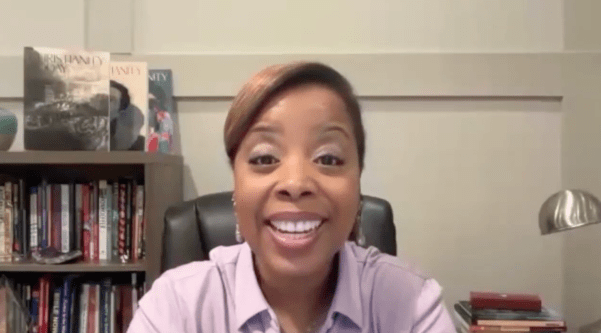
When Katie Frugé and her husband, Lafayette, decided to get married in 2007, they were 21 and did not know what they did not know.
“We were too young to get married and too young really to care,” said Frugé, who is now director of the Center for Cultural Engagement for the Baptist General Convention of Texas.
For guidance, the young couple turned to The Five Love Languages, a popular book by North Carolina author and pastor Gary Chapman. First published in 1992, the book explores different ways people express love—words of affirmation, physical touch, quality time, acts of service and giving gifts—in hopes of helping couples find happiness.
The book claims understanding each other’s love language can help create healthy marriages. Frugé recalls thinking the book held the key to a bright future.
“We thought, we’ll just learn each other’s love languages and everything’s going be hunky-dory,” she said. “We’re not going to ever have any fights and we’re both going to feel fully satisfied all the time.”
Married life proved more complicated.
Frugé said she and her husband are still happily married 17 years later but there were a lot of bumps, including several health crises—“We had the sickness and health part,” she said. And they needed more love along the way than a formula could provide.
“When I’m diagnosed with cancer, I don’t need my husband to go out and buy me a gift at that moment,” she said.
Once popular mostly in evangelical Christian circles, the Five Love Languages have exploded into a pop culture phenomenon. The dating app Bumble offers a Five Love Languages quiz, the concept has been featured on The Bachelorette and in major media outlets, while the Five Love Languages channel on TikTok has attracted tens of millions of views. Chapman has sold more than 20 million copies of his books and launched a cottage industry of conferences, related books and an online quiz taken tens of millions of times.
All of that attention has led researchers such as Emily Impett, a psychology professor and director of the Relationships and Well-Being Laboratory at the University of Toronto Mississauga, to ask if the claims of the Five Love Languages stand up to scientific scrutiny, and perhaps nearly as important—what can scholars learn from the popularity of Chapman’s work?
A new paper in “Current Directions in Psychological Science” suggests Chapman’s theory about how love works doesn’t quite add up. For the paper, Impett and a pair of colleagues looked at a series of studies that tried to test three key ideas about the Five Love Languages: that people have a primary love language, that five love languages exist and that people are happier with a partner who speaks their primary love language.
The studies, said Impett and her colleagues, don’t support that theory.
For example, people will choose a preferred language if forced to in a quiz. However, researchers found that if asked about all five love languages on an individual basis—people rate all of them highly. The researchers also found that some important ideas, such as supporting a partner’s or spouse’s goals, don’t fit in the five love language model and that people who have the same love languages aren’t happier than other couples.
“Love is not akin to a language one needs to learn to speak but can be more appropriately understood as a balanced diet in which people need a full range of essential nutrients to cultivate lasting love,” Impett and her colleagues wrote.
They did suggest Chapman’s book has filled a need for couples in that “it provides partners an opportunity to reflect on, discuss, and respond to one another’s need.”
In a follow-up email, Impett said that reading the love languages book—which includes examples of how to practice showing love in different ways—is much more helpful than using the online quiz. That’s in part because the focus on finding a partner’s primary love language can be too restrictive and ends up putting people into a box.
Instead, she told Religion News Service in an email, “all of the behaviors Chapman identified are important.”
“We are not suggesting that people necessarily are multilingual (skilled at all five behaviors) but that they should learn to be since the five behaviors that Chapman identifies are really important things people can do to maintain their relationships.”
On that point, Chapman agrees.

The 86-year-old author, who recently stepped down after 50 years on the staff of Calvary Baptist Church in Winston-Salem, North Carolina, said all of the love languages matter.
“There is absolutely no question that what makes one person feel loved doesn’t necessarily make another person feel loved,” he said in an interview. “But I don’t want to communicate that you only speak the person’s primary love language.”
Chapman, who still travels and speaks at marriage conferences and other events, said he was surprised by some of the paper’s findings but appreciates researchers taking his work seriously. The more research, he said, the better.
He said he continues to be surprised at how popular the idea of love languages has been. Chapman developed the idea for the book while counseling troubled couples at his church. Those couples, he said, were often at their wit’s ends, because each partner thought they were acting in loving ways, but the other partner felt unloved.
A master storyteller, Chapman recalled one husband saying he cooked dinner most nights, shared in the housework and lawn work, and did all he could to support the family. But his wife felt distant because he was so busy helping out at home that they never had time to talk.
Looking over his counseling notes, Chapman began to look for patterns and eventually came up with the five love languages.
“It’s a simple concept,” he said. “But I knew from my counseling and working with couples—it would help people if they could get that concept. In all of my writing, I’ve tried to put the cookies on the bottom shelf, so people can understand it easily.”
That approach is something researchers say they can learn from.
In their paper about the love languages, they said Chapman’s book has connected with people because it uses “intuitive metaphors, which may resonate with people and convey an easily digestible message free of scientific jargon.”
Impett also said the focus on finding a primary love language can overshadow the reason why so many people find Chapman’s book helpful. The book, she said in an email, “gets people to identify any currently unmet needs (areas of improvement) in their relationship and opens up lines of communication to address those needs.”
Chapman, who has been married 62 years, said that’s the point. He said love begins with emotion but is sustained by having the right attitude and by acting in ways that put your spouse or romantic partner first.
That right attitude, he said, can be summed up this way: “I want to do anything and everything I can do to help you become the person that you want to be. I want to do everything that would be good for you.”
Meleah Smith of Chattanooga, Tennessee, who coaches “brands and bands” on marketing, said the idea of five love languages never really connected with her. She knows the book has worked for other people, but for her, it’s too simplistic, said the 40-something, who described herself as “single as a Pringle.”
Smith said she has plenty of love in her life, with friends, her church and her family—she helps manage her brother’s band—but no romantic relationship. She said the love languages can be too easy at times—tempting people to avoid the hard work of getting to know someone and paying attention to them.
“If I have to give you a list of things you have to do for me—maybe we are not a good match,” she said.
After 17 years of marriage, Frugé had some advice for those using the five love languages. Remember that people need all kinds of love, not just one kind. Pay attention to them—rather than running to a book for all the answers.
Sometimes the answers you need are right in front of you.
“Thriving relationships occur when you have a partner who understands and knows you, sees what your need is and meets you in that moment.”