Culture

‘Wildcat’ Is as Unsettling as Flannery O’Connor Would Have Wanted

Ethan Hawke has made a movie as scandalous as one of the writer’s short stories.

Maya Hawke (center) as Flannery O'Connor in Wildcat.

Maya Hawke (center) as Flannery O'Connor in Wildcat.

Christianity Today May 2, 2024
Courtesy of Oscilloscope Laboratories

Why not write something that “a lot, a lot, of people like?” Regina O’Connor asks her daughter, the writer Flannery O’Connor, in the middle of the new biopic Wildcat. The same question might be put to the film itself. It’s not a movie that a lot of people will like. But unlike the author’s mother, I mean that as a high compliment. Director and screenwriter Ethan Hawke has made a film worthy of Flannery O’Connor’s genius.

An epigraph from O’Connor’s essay “The Nature and Aim of Fiction” sums up what Wildcat sets out to do: “I’m always irritated by people who imply writing fiction is an escape from reality. It is a plunge into reality.” Fittingly, rather than depict the writer’s life from birth to death, Wildcat uses her fiction to discover what’s real, to “get down under things” to the problem of suffering, the limitations of human experience, the desire for goodness, the habits of evil, and, always present, the longing for God.

The result is a movie as scandalous as one of O’Connor’s short stories—“shocking to the system,” to borrow her words. Her devotees will applaud it; most of the audience will be left wondering what just clobbered them.

After that opening epigraph, Wildcat rolls a fake trailer for a 1950s-style horror flick inspired by O’Connor’s story “The Comforts of Home.” (A mother brings home a wayward, orphaned teen who tries to seduce her grown son. The son attempts to kill the teen, but shoots his own mother instead.) The trailer, starring Laura Linney and Maya Hawke—who also play the roles of Regina and Flannery— sets up expectations for Wildcat’s time period, for its gothic weirdness, and for its blending of fiction and biography.

Most of the movie’s action occurs in 1950, the year O’Connor returned home to Milledgeville, Georgia, and was diagnosed with lupus. Fictional stories, threaded throughout the biographical narrative, are drawn from all over her corpus—from “Good Country People” (a Bible salesman steals a crippled woman’s prosthetic leg) to “Revelation” (Mrs. Ruby Turpin is a warthog from hell capable of having her virtue burned clean).

Flannery O’Connor wanted to be a great writer and a good Catholic, and viewers witness her wrestle with disappointments as she tries to be faithful to both God and vocation. We hear voiceover petitions from her A Prayer Journal, composed while she was a student at the University of Iowa MFA program, with beautiful shots of the young woman as a pilgrim. She confesses to the priest Father Flynn (Liam Neeson) in a scene that mimics her story “The Enduring Chill.” (Asbury Fox returns home to his mother’s farm, sick and debilitated, and is catechized by the local priest.)

When O’Connor attends a graduate school party, she drops a bottle of rum before she arrives. This scene is drawn from her biography; in fact, her friend Sally Fitzgerald thought this incident was a real-life metaphor for how “Flannery seemed fated to asceticism.” Wildcat does portray O’Connor as an outcast from what her friend called “frolics”; she simply can’t compromise her zealous Christian faith. Through scenes both real and imagined, the film demonstrates the untiring dedication to truth that made O’Connor perhaps unpopular with her peers. That zeal also made her the great writer (and good Catholic) that she desired to be.

Wildcat also brings O’Connor’s writing to life, defamiliarizing even the most well-known of her stories. Take, for instance, the ahistorical treatment of “Parker’s Back” (1964). (This synopsis is a straightforward one: O. E. Parker has a tattoo of Jesus on his back.) We hear the name of the central figure, “Obadiah Elihue,” in the mouth of an editor at Rinehart Publishing. In reality, the editor had nothing to do with this story’s publication, though he did notoriously decide not to publish O’Connor’s novel Wise Blood.

Later, O’Connor reads “Parker’s Back” at Iowa in front of Robert “Cal” Lowell (Philip Ettinger). The scene is cast as a first meeting, though the two writers actually met at the artists’ retreat Yaddo in 1948, and Lowell didn’t teach at the university until 1950. But seeing his imagined response intensifies our own understanding of the story. The newly converted poet listens enthralled.

And later, Wildcat riffs on “Parker’s Back” yet again, dramatizing the story on screen. O. E. Parker (Rafael Casal) and his future wife Sarah Ruth (Maya Hawke, again) fall in love. Their marriage as portrayed here is even more believable than on O’Connor’s page—perhaps in part because of that final scene, when Sarah Ruth beats her husband’s back. Reading about Christ’s bleeding face is one thing; seeing it, droplets running over the tattoo ink, is another. Wildcat does not merely translate words into images; it glosses O’Connor’s stories for us, so that we can reimagine them anew.

Though fans are often tempted to deify O’Connor, Wildcat resists that temptation. It allows us to know the woman behind the artistry: her illness, her feelings for friends, her nuanced relationship with her mother. It’s one thing to hear about her deterioration from lupus; it’s another to see the rash on her face, to watch a young girl inject cortisone shots into her thigh with a needle the size of her hand.

Because of her sickness, O’Connor had to forego mild love interests that could have become something more. Biographers publicized her brief affair with Erik Langkjaer, a traveling textbook salesman from Denmark, who said kissing her was like “kissing a skeleton.” That unfortunate description casts O’Connor as less than flesh and blood. However, Wildcat shows a young woman enamored with her writing mentor (who seems just as drawn to her). One rightly wonders what might have happened had she been spared the ravages of lupus.

Instead, the dominant relationship in O’Connor’s life was with her mother, whom she called Regina from the time she was a child. Some have characterized Regina as overbearing and suffocating, much like the comic maternal characters in O’Connor’s short stories. Other biographers uplift her as sacrificing everything for Flannery, trying to support the daughter that she didn’t understand but to whom she was devoted until her death. The reality is likely a mix of both, which the film balances well.

In 1957, O’Connor’s short story “The Life You Save May Be Your Own” was made into a televised play starring tap-dancing sensation Gene Kelly. Everyone in Milledgeville thought that “Regina’s daughter who writes” had finally done something worthwhile (“They feel I have arrived at last,” O’Connor wrote) because her uncomfortable stories had been sanitized for public consumption. In a letter to a friend, O’Connor derides the congratulations: “The local city fathers think I am a credit now to the community. One old lady said, ‘That was a play that really made me think!’ I didn’t ask her what.”

Clearly, Flannery O’Connor did not take any pleasure in growing her audience by making her stories more palatable. (Thankfully she was not alive in the era of platform building!) She wrote not to placate lukewarm Christians, but to startle them. Like a 20th-century Kierkegaard, she knew the truth was absurd, and therefore it would have too few adherents. She had a prophetic imagination, which means that if she was true to using her talent, she’d have as many fans as Ezekiel or Jeremiah.

Wildcat is loyal to that prophetic gift. If 1950s adaptations of Flannery O’Connor’s work to the screen dishonored their maker, Wildcat accomplishes the opposite. It celebrates a writer who was once called “prematurely arrogant,” but who was, by much suffering that she did not deserve, beautifully transfigured.

Jessica Hooten Wilson is the Fletcher Jones Chair of Great Books at Pepperdine University and senior fellow at Trinity Forum. She is the author of several books, most recently Flannery O’Connor’s Why Do the Heathen Rage?: A Behind-the-Scenes Look at a Work in Progress.
News
Wire Story

United Methodists Strike Ban on LGBTQ Clergy

After years of disagreement and the departure of thousands of churches, the change passed without debate.

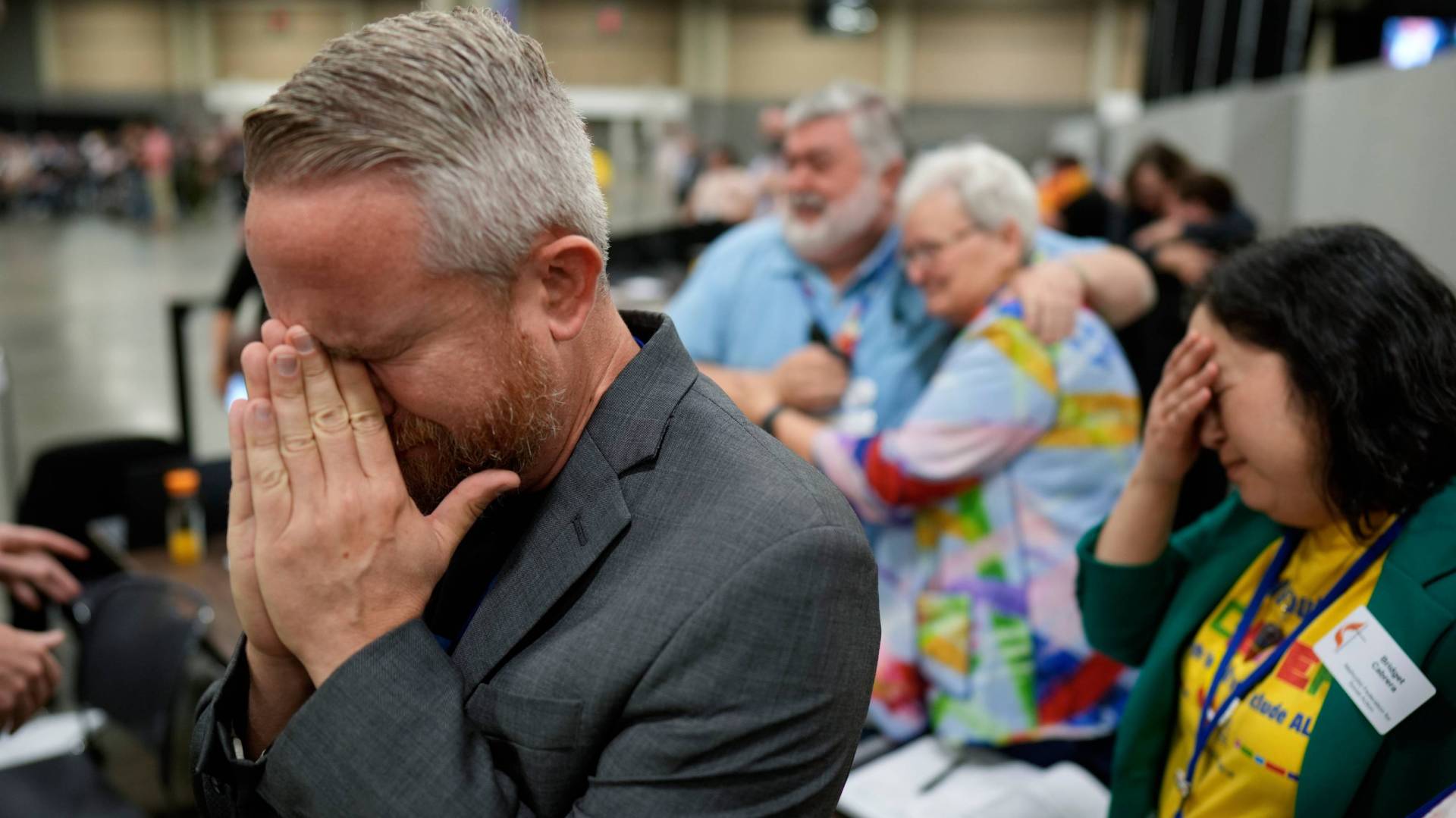
United Methodists react to the vote at their General Conference on Wednesday to repeal a ban on LGBTQ clergy.

United Methodists react to the vote at their General Conference on Wednesday to repeal a ban on LGBTQ clergy.

Christianity Today May 1, 2024
Chris Carlson / AP

United Methodists meeting for their top legislative assembly Wednesday overwhelmingly overturned a measure that barred gay clergy from ordination in the denomination, a historic step for the nation’s second-largest Protestant body.

With a simple vote call and without debate, delegates to the General Conference removed the ban on the ordination of “self-avowed practicing homosexuals”—a prohibition that dates to 1984.

With that vote, the worldwide denomination of some 11 million members joins the majority of liberal Protestant denominations such as the Episcopal Church, the Presbyterian Church (USA), the Evangelical Lutheran Church in America, and the United Church of Christ, which also ordain LGBTQ clergy.

“We’ve singled out one group for discrimination for 52 years,” said Ken Carter, bishop of the Western North Carolina Conference. “And we’ve done that on an understanding of homosexuality whose origins came when it was understood to be a disease and a disorder.”

That, he said, has now changed. “Increasingly,” he said, “people see that God’s spirit is in gay and lesbian people.”

The morning vote on the motion was part of a larger series of calendar items voted on in bulk. They also included a motion barring superintendents, or overseers, from punishing clergy for performing a same-sex wedding or prohibiting a church from holding a same-sex wedding, though the actual ban on same-sex weddings in churches has yet to be voted on.

The vote on the calendar items was 692–51, or about 93 percent in favor.

After the vote, LGBTQ delegates and their allies gathered on the floor of the Charlotte Convention Center to sing, hug, cheer, and shed tears. As they sang liberation songs, “Child of God” and “Draw the Circle Wide,” they were joined by Tracy S. Malone, president of the denomination’s Council of Bishops.

The votes reverse prohibitive policies toward LGBTQ people taken on at the denomination’s 2019 General Convention, when delegates doubled down and tightened bans on gay clergy and same-sex marriage. Most of those 2019 measures have now been reversed.

After the 2019 General Convention, some 7,600 traditionalist churches across the United States—about 25 percent of the total number of US churches—left the denomination, fearing that the tightening of the bans would not hold.

The absence of delegates from churches that left the denomination accounted for the quick reversal of the policies.

Wednesday’s vote follows several others approved Tuesday that removed mandatory minimum penalties for clergy who officiate same-sex weddings as well as a ban on funding for LGBTQ causes that “promote acceptance of homosexuality.”

Tom Lambrecht, vice president and general manager of Good News Magazine, a theologically conservative advocacy group, said the votes were expected.

“It indicates a consensus in the United Methodist Church that it wants to go in a much more liberal pathway,” said Lambrecht, who previously served as a United Methodist pastor.

Lambrecht, who is observing the conference along with some members from the Wesleyan Covenant Association, another dissenting group, wanted to reopen the time period churches may leave the United Methodist Church with their properties. That exit window closed at the end of 2023.

The General Conference instead voted to eliminate the pathway to disaffiliation that was created in 2019. In another motion, it directed annual conferences to develop policies for inviting disaffiliated churches to return to the fold, if they wish.

Still to be voted on is a larger measure to remove from the rule book, called the Book of Discipline, a 1972 addition that says homosexuality is “incompatible with Christian teaching.” The Book of Discipline also defines marriage as between one man and one woman. Those are expected to be debated as part of a revision to the denomination’s social principles on Thursday.

US Methodists are hoping that a radical realignment of the worldwide church would give different regions of the church greater equity to tailor church life to their own customs and traditions, including on issues related to sexuality. That so-called “regionalization” plan passed the General Conference but must still be ratified by individual conferences over the course of the next year.

The main group opposing the changes in policy toward LGBTQ were some African delegates, many of whom live in countries where homosexuality is illegal. The United Methodist Church is a global denomination and its footprint outside the US is greatest in Africa.

“We see homosexuality as a sin,” said Forbes Matonga, the pastor of a church in West Zimbabwe. “So to us, this is a fundamental theological difference where we think others no longer regard the authority of Scripture.”

Building Bridges Among the Persecuted Church

Hannah Nation sees Christianity Today’s global efforts amplifying the voices of the Chinese church.

Building Bridges Among the Persecuted Church
Trey Nation

Hannah Nation was not intentionally seeking to do ministry work in China. But as many stories in ministry go, she found herself right where God wanted her.

Hannah began her story with the Chinese church in college. When she visited China, she was overwhelmed by the immense amount of people.

“It is really hard to go to a country with more than a billion people and not be blown away by it—both culturally and by taking stock of what the Lord is doing there,” she said. “And also how much the next important chapters in church history are being written in China today.”

After becoming more familiar with the Chinese church and the unique social and political position of Chinese Christians, Hannah helped found and direct The Center for House Church Theology, an organization that publishes leaders in Chinese house churches and shares their stories with the rest of the world.

Typically, when people in Western contexts seek information about the Chinese church, they find material that is written by other Western voices or people who have an outsider’s perspective. The center’s aim is to amplify voices from inside Chinese house churches and share insights and stories with other persecuted Christians.

In 2023, Open Doors reported, the country saw the most church attacks and closures in the world (estimated at 10,000) and ranked in the top 20 countries where Christians are the most persecuted. Pew lists China as one of the countries with the most government restrictions on religion.

Because of the security concerns with sharing names or photographs online, Christianity in China can feel faceless. Although there are internal networks among Chinese Christians, it is hard for the outside world to get a firsthand view of what the church in China looks like. Hannah shared, “[the anonymity of house churches in China] can increase its otherness and it can increase the feeling that this is something really distant and really far away.”

Hannah wants to see the voices in Chinese churches emanate across the world and speak beyond their context, to the Chinese diaspora and to Christians being persecuted in other countries. Their experiences have the potential to resonate with those dealing with increasing Hindu nationalism in India or those in the Muslim-majority world—and we need to hear their story.

Hannah sees Christianity Today connecting those communities.

“My guess is that the American church is far more isolated from the global church than the global church is from American Christianity. American Christians struggle to know what is happening in churches in other parts of the world, and importantly, they struggle to understand why it matters,” Hannah said. “CT is working hard to change that reality.”

One of Hannah’s favorite pieces she has written was published at CT in 2021. “To Pray for Afghan Christians, I Look to China’s Church” is an example of the type of bridge building Hannah wants to see: connecting those in other countries with the stories and voices of those in the Chinese church.

Since writing that article, Hannah has been encouraged by what she sees at Christianity Today and in its work regarding China and the Chinese diaspora. She also sees Christianity Today being a leader in expanding the Western church’s perception of what global Christianity means.

“To be a good storyteller you first have to be a good listener,” Hannah said. “Otherwise, you’re just telling your own stories through other people’s contexts.”

She is particularly impressed by CT’s work with Song “Sean” Cheng, who worked at CT for over two years as Asia Editor and later Chinese Managing Editor . “I knew Song before he was hired, and I know a lot of the people he knows,” she said. “When CT hired him, that was probably the first time I really felt like a major publication was actually doing the due diligence and the work of finding an actual insider and bringing them on to execute their global vision for publishing.”

Sean has published pieces in English, traditional Chinese, and simplified Chinese. In the past year, he has published Chinese-specific content that is later translated into English, a first among CT’s global coverage. Along with the rest of the CT Global team, Sean worked diligently to reach Chinese Christians all over the world with stories of struggles and hope. And Hannah sees his impact.

“On social media and on Facebook, I am always impressed with how much I see the Chinese community … appreciating Sean’s work and appreciating what he has done at CT. They feel like someone who really understands them and knows them and knows China is helming CT’s work in the Chinese language.”

Sean has also connected Hannah and The Center for House Church Theology with CT’s Indonesian translation team to help in their efforts to translate resources from Chinese into Indonesian.

When asked about where CT can grow in its global efforts, Hannah said Christianity Today is already making a huge effort to have people from their own contexts be in the center of their church’s narratives.

In the past three years, Christianity Today’s global team has increased in size and scope. CT currently has staffers around the world, bringing global stories to the forefront of the church’s attention. Whether that is covering security laws in Hong KongChristian influencers in Brazil, or persecution in India, CT is dedicated to sharing stories and news from the entire global church.

Hannah is encouraged that CT shares her passion for amplifying the voices of the global persecuted church. She says, “My dream is that one day, we’ll have articles on American politics by writers in Hong Kong, Kenya, and India alongside content from our own leaders. If we could get there, we wouldn’t just be elevating the global church—we would be listening to it and letting it speak to us as much as we speak to it.”

Theology

Finding a (Real) Christian College

A professor explains why examining a school’s doctrinal statement isn’t enough.

Christianity Today May 1, 2024
Illustration by Elizabeth Kaye / Source Images: Getty, Unsplash, Wikimedia Commons

When I speak at churches around the country, the conversation after my talks often turns to the state of Christian higher education. I’m a professor at a Christian institution, and Christian parents and grandparents want to know where high school graduates can go to have their faith deepened rather than undermined. These concerns have only become more pressing given the ongoing rise in young people wandering away from the church and describing their religious convictions as “nothing in particular.”

The question many Christians have for me is which colleges are “safe” or “real” Christian schools, which usually means those that have a truly conservative theological ethos. For those who aren’t familiar with the world of Christian higher ed, it can be difficult to identify these schools from outside the campus community, and parents often (reasonably) conclude an institution’s stance on human sexuality is the simplest indicator of a college’s commitment to Christian orthodoxy.

LGBTQ questions are indeed important, and they can serve as a proxy for an institution’s broader theology. But by itself, this isn’t a reliable formula for finding a good Christian college. A school may stake out a bold position on sexuality and yet capitulate to what I’d suggest is the most overlooked and therefore most insidious threat to Christian education in America right now.

It’s not progressive theology. It’s a pervasive consumerist anthropology.

Theological anthropology concerns our assumptions about the nature and purpose of humanity. And by “consumerist anthropology” I mean the belief—often subconsciously held—that people are essentially consumers who should maximize their earning potential so they can consume as many entertaining experiences and products as possible.

When I speak with anxious parents and grandparents, I often try to explain this aspect of the college search by asking them to imagine a two-dimensional grid, a chart with an x-axis and a y-axis. The x-axis they already know: That’s the familiar range of progressive to conservative theological commitments. But I want them to begin to see the y-axis, which runs from that consumerist anthropology to a formational one.

A formational anthropology doesn’t imagine students as consumers who need to get a marketable degree leading to a high-paying job. It sees them as people bearing a tarnished imago Dei that, by the grace of Christ, can be burnished through disciplined, focused effort.

As Paul’s analogies in 2 Timothy 2 suggest, a college with a formational anthropology will shape the student experience according to the belief that Christians ought to live like disciplined soldiers, committed athletes, and hard-working farmers, reaping the rich satisfactions of formative work under the guidance of wise mentors. This formation can develop the moral virtues and practical skills that enable us to rightly love God and our neighbors.

In his 1943 book on education, The Abolition of Man, C. S. Lewis labels the opposing ends of this y-axis in terms of a distinction between career training or “applied science” on the one hand and virtue and wisdom formation on the other:

There is something which unites magic and applied science while separating both from the wisdom of earlier ages. For the wise men of old the cardinal problem had been how to conform the soul to reality, and the solution had been knowledge, self-discipline, and virtue. For magic and applied science alike the problem is how to subdue reality to the wishes of men: the solution is a technique.

The difference here is whether an educational institution should aim to give students the skills and techniques they need in order to satisfy their desires—or whether it should form students’ souls to know and desire what is true, good, and beautiful.

Formational education is often criticized as irrelevant or useless. In his introduction to The Evidence Liberal Arts Needs, Richard A. Detweiler summarizes the prevailing view that if a degree doesn’t have immediate career outcomes, it’s not valuable. In his essay “The Gift of Good Land,” however, author and farmer Wendell Berry gestures toward the very practical consequences that moral formation has on the shape and effects of our work. Career training, he explains, is a good and necessary thing, but it must be united with formational education, not isolated and treated as an end to itself:

The requirements of … charity cannot be fulfilled by smiling in abstract beneficence on our neighbors and on the scenery. It must come to acts, which must come from skills. […] How can you love your neighbor if you don’t know how to build or mend a fence, how to keep your filth out of his water supply and your poison out of his air; or if you do not produce anything and so have nothing to offer, or do not take care of yourself and so become a burden? How can you be a neighbor without applying principle—without bringing virtue to a practical issue? How will you practice virtue without skill?

If virtue without skill results in ineffectual warm fuzzies, skill without virtue results in careerist consumerism. Hence, Christian education ought to offer not merely a training in skills but also a criticism of those skills and the formation of the discipline and wisdom needed to use our skills in love. Without such charity, credentials and skills become means of satisfying consumer appetites.

Clearly, no Christian college brands itself as offering degrees in the service of consumerism. They make the decisions they think they must to keep their doors open. Yet the result is that far too many institutions give lip service to Christian moral formation while organizing themselves around a consumerist vision of education.

You can often get a sense of this reality in the marketing literature: It touts exciting new student amenities, career-oriented majors, a reduction in general education requirements, and an undue emphasis on college athletics and e-sports. One of my friends describes the Christian college where he used to teach as a “minor league sports franchise with a fundamentalist VBS attached to it.”

That pairing of very conservative theology with consumerist anthropology may seem surprising, but as far as I can tell, there’s no correlation between the x-axis and the y-axis: Theologically conservative colleges are no more likely to invite students into rigorous intellectual and moral formation than are theologically progressive colleges. (The two colleges where I’ve taught occupy very similar places theologically but dramatically different positions in their anthropology, which is why I’m very grateful to be working where I am now.)

Moral therapeutic deism can be coded left or right politically, but its adherents still imagine God as an enhancement to their preexisting desires and aspirations. And the real tragedy is that insofar as they simply cater to the superficial desires of 18-year-olds, colleges fail to invite young people into the deeper joys and satisfactions of Christian formation, intellectual rigor, and disciplined work.

So how, beyond the brochures, do you tell one kind of Christian school from another? As an outsider to an institution, it can be difficult to tell how committed it is to forming students into kingdom citizens. Every institution has different departments or enclaves that lean one way or another.

And, of course, I know plenty of serious, committed Christians who never attended college or who earned a degree at a secular school. They pursued discipleship and intellectual formation through other means. Attending a Christian college is certainly not the only way to undergo the vital work of conforming your soul and mind to Christ, nor is such work completed when a student receives a diploma from even the best of schools.

Still, for those interested in locating where schools fall along the y-axis of theological anthropology, here are some things to check:

  • Is the required core curriculum small or mostly choose-your-own-adventure style? A formational school will hold on to a larger foundational curriculum that requires all students to think theologically about God, humanity, and our world. Some colleges now offer a two-tiered model, in which most students take a watered-down general education curriculum while a select group of honors students takes a more rigorous set of courses. This isn’t ideal—spiritual formation shouldn’t be reserved for the academically advanced—but I suppose it’s better than total capitulation.
  • How many courses are offered online or in large sections, particularly undergraduate and general education courses? Does the goal seem to be merely information delivery or skills acquisition, or is there a commitment to rigorous formation and in-person mentoring?
  • Does the chapel program consist of praise songs and a TED Talk once or twice a week, or are there opportunities for students to be mentored in small groups and attend chapel events that dig into the weighty matters of faith and life?
  • Does the college present itself as a Christian summer camp with nice dorms and cafeterias—plus graduates get jobs? Or are there indications that the school aims to form students in the wisdom, virtues, and habits of mind necessary to live their lives in service to the kingdom of God? Are students invited to rise to a challenge?

Comfortable dorms are good. College athletics are good. VBS is even good—for elementary students. But none of these are essential to the mission of a Christian college, which should be to invite students into a robust intellectual community rooted in sincere Christian commitments.

Even when you know what to look for, though, it’s harder to locate colleges along this y-axis than the x-axis. Perhaps, however, the rise of AI will come to serve as a proxy for colleges’ anthropology just as sexuality statements have become a proxy on theology. My new tip for parents and graduating seniors may be: If a Christian college promises to teach students how to leverage AI for maximal productivity and satisfaction, don’t bother to apply.

Jeffrey Bilbro is associate professor of English at Grove City College and editor in chief at the Front Porch Republic. His most recent book is Reading the Times: A Literary and Theological Inquiry into the News.

Theology

Particular Wrongs Need Particular Remedies

Contributor

Every sin requires Christ’s atonement. But the Bible shows God punishing—and repairing—different sins differently.

Christianity Today May 1, 2024
Illustration by Christianity Today / Source Images: Getty

Christian theology consistently holds together truths that seem to want to fall apart: Jesus is fully God and fully human. People are sinners and created in the image of God. The church is local and universal.

And yet, despite what we affirm, in practice, Christians are often unable to walk and chew gum at the same time. Instead of holding two truths in tension, we tend to slide to one side or the other, distorting it in the process. We treat Jesus either as an invulnerable, transcendent being or as a mere prophet. We speak as if humans are either so degraded we are capable of nothing but sin or mostly fine with a few rough edges. We think of the church as if it were only our own sect or we minimize the local congregation.

Evangelical theologians have done great work in Christology, anthropology, and ecclesiology, respectively, to retrieve those three truthful tensions. But there is a fourth tension yet to be retrieved: All sins ruin us, and yet not all sins ruin us equally.

To start, let us be clear: Sin—however small—is a serious thing. And sin is only atoned for by the work of God in Jesus Christ. But saying that Christ is the only one who atones for all sin is different from saying that all sins do the same kind of work on us.

All sins break the sinner and create havoc around us. And yet the Scriptures consistently depict the sins we do as different, not only in effect on one another but before God. Within the Law, for example, different social remedies are given for different sins, and so are different sacrifices (Lev. 4; Ex. 21). Not everything requires a bull or a goat. Sometimes a dove will do. In the Prophets and Proverbs, God distinguishes—and even prioritizes—certain sins above others, and accounts for differences of intentional versus unintentional (Prov. 6:16–19; Ezek. 45:20).

Jesus names grieving the Holy Spirit in a category all its own (Matt. 12:31) and says some sins put us close to the fires of hell (Matt. 5:22). Paul likewise says that sins committed against our own bodies do particular kinds of damage that other sins do not do (1 Cor. 6:17–19).

Failing to hold these two truths about sin together has led us to moral confusion. For instance, there is a great deal of energy currently devoted to the matter of sexism in American churches. We should not hide the fact that the sin of sexism has done real damage within the church, but how we name that damage makes a great deal of difference.

As the accounting for these wrongs has begun, many discussions have bundled very different sins, lumping together anything from sexually abusive ministers to interpersonal biases. Every sin causes damage and requires repair, but common sense alone tells us these sins are meaningfully different. Raping a woman is not the same as having sexist assumptions about coworkers.

I don’t think that anyone would make the mistake of equating these sins. But once they’re grouped under a single label—sin—confusion sets in, because theologically, evangelicals treat this great range of actions as united in effect: Sin separates us from God, full stop. As we have already seen, this is true; but, in isolation, it misses much of the story. The payoff comes in our ethics. If our theology doesn’t let us distinguish between different sins with different kinds and scales of damage, we will have a hard time coming to appropriately different responses.

How did we get to this place? Part of the difficulty is overreading portions of Scripture—to confess with Romans 3:23, for example, that all have fallen short of God’s glory is not to say that all of the ways we fall short are the same. Saying that “there is no one righteous, not even one” (Rom. 3:10) is different from saying that all unrighteousness is alike in gravity or effect.

This ethos—that all sins are equal in nature—traces itself not to the New Testament but to the Reformation and later eras. Consider John Calvin, who argues, against an older tradition, that all sins—great or small—are damning ones. Or Jonathan Edwards’s contention that all sins by finite creatures are infinite offenses against an infinite God.

While treatments such as these have the effect of helping us to take all sins seriously, they also have the unintended effect of leveling all sins, such that it becomes difficult to say why accidental harm is different from intentional harm or why degrees of harm matter. When we simply frame all sins as damning sins, we ignore how Scripture recognizes that different sins break our relationship with God in different ways and, thus, require different temporal remedies. Christ’s atonement is the singular way that humanity is brought back into relationship with God, but restoring particular people to health requires different forms of repair.

Consider the example here of two disciples, Peter and James. Both disciples, we are told, are present with Jesus in the Garden of Gethsemane, and both flee (Matt. 26:56). But Peter’s flight from the Romans includes an active kind of denial (Matt. 26:69–75). Accordingly, Peter’s three-fold denial is met by Jesus’ three-fold question of whether Peter loved Jesus (John 21:15–17). A deeper and different kind of wound required a different kind of repair.

The older tradition of reflection on this question, seen in the work of theologians including Thomas Aquinas, differs from Calvin and Edwards in at least three important ways. First, it turns on the distinction between sins Christians commit intentionally and those we commit unintentionally. All sins are deviations from God’s will, but the ones we do deliberately are not the same as those we do in ignorance (Luke 12:47–48).

Second, while everyone is inclined toward sin, we are not all inclined to sin in the same way. Some struggle habitually with lust and others with pride. Though both sins lead us to destruction, we would be wrong to say they destroy our lives in the same way. The difference here is not their effect on others but on the nature of the sins themselves, the former being the desire for bodily pleasure and the latter the exaltation of the self above others and God. Lust may very well deform our minds and our desires, debasing us as creatures, but to nurse pride is ultimately to upend the moral universe, placing oneself above God.

And third, different sins require different remedies. To turn back to an earlier example, exposing sexual assault is different from exposing sexist thoughts. Both involve power, objectification, and sex. But they are also different: One is a violent act of will; the other is a mental or cultural habit. One requires legal intervention; the other requires interpersonal amends and discipleship.

Those differences are not only at the human level. God distinguishes between different sins too, and the way forward requires recognizing those differences. That means being able to say that some sins damage us more than others—the sins we deliberately commit are different from those done in ignorance or foolishness. It means understanding that all sin does damage, but different sins do different damage to sinner and victim alike. This recognition would make it easier to see what different responses to sin are needed.

Recovering this tension—that all sins ruin us, and yet not all sins ruin us equally—does not mean veering into the opposite error of self-serving sin ranking, of saying, Thank God, we are not like that tax collector (Luke 18:9–14). On the contrary, it means understanding that God knows each of us by name, knows our particular sins, and knows the particular virtues we need to recover from those sins.

This is the part of sanctification that comes after repentance: The lustful need chastity, the prideful humility, the violent peace, the uncharitable love. Scripture exhorts us to seek all these fruits of the Spirit’s work, which are perfected in the person of Jesus and given as God’s good gifts for particular sinners with particular wounds.

That all are broken by sin is without question. But the future for evangelicals must involve more nuance in our diagnoses, more recognition of the nature of each sin and its damage, and more attention to the slow path of virtue. For absent a remedy that attends to our brokenness in particular ways, we will continue to be like the house swept clean in Jesus’ parable in Matthew 12:43–45: There will be no new inhabitants of virtue to keep manifold demons at bay.

Myles Werntz is the author of From Isolation to Community: A Renewed Vision of Christian Life Together. He writes at Christian Ethics in the Wild and teaches at Abilene Christian University.

Theology

In a Divided World, Practice Patient Persuasion

A law professor shares lessons on respectful disagreement in the classroom, the church, and the wider culture.

Illustration by Elizabeth Kaye / Source Images: Unsplash / Pexels

Law schools can function as microcosms of society, gathering people from diverse backgrounds to debate highly charged issues of politics, morality, and religion. John Inazu, an evangelical constitutional scholar and professor of law and religion at Washington University in St. Louis, has long experience in this setting, and it forms one backdrop to his latest book, Learning to Disagree: The Surprising Path to Navigating Differences with Empathy and Respect. Readers follow Inazu and his students over the course of a year as they consider questions of empathy, fairness, cancel culture, faith, and forgiveness. CT national political correspondent Harvest Prude spoke with Inazu about his lessons for Christians on effective listening and persuasion.

Learning to Disagree: The Surprising Path to Navigating Differences with Empathy and Respect

Learning to Disagree: The Surprising Path to Navigating Differences with Empathy and Respect

Zondervan

224 pages

What have you learned from teaching in an environment where students navigate the discomfort of encountering different worldviews?

Part of being a Christian is being able to engage in messy and uncomfortable places, spaces, and relationships. We’ve got a pretty good model in Jesus and the disciples—where they went and the lines they crossed.

As a Christian teaching in a non-Christian university, I’m actually quite comfortable. And part of that comes from knowing that my Christian values aren’t in control here. When you know you’re not in control, it frees you to be more creative, more neighborly, and in some ways more faithful. So I don’t start with the premise of having a community whose narrative and power I control or seek to control. I start from the premise of being a welcomed member of this community who can engage it on that basis.

You write about one student whose thesis paper was shaping up to be a diatribe rather than a genuine attempt at persuasion. How have your students learned to wrestle seriously with views they would rather condemn or dismiss?

In law school, there are some very ideological students who are not interested in compromise. Some students just want to use the law as a tool for winning power. But the majority really are open to understanding other perspectives.

Some of this boils down to basic interpersonal dynamics. When you’re sitting together in the classroom while sharing meals and other aspects of student life, it can help build a sense of shared humanity.

One advantage of the classroom setting is having the time and space to build trust. Fundamentally, that’s what’s missing from so many conversations and relationships today. You can’t expect that willingness to engage across perspectives to exist on day one of any class or semester. It necessarily takes time.

Often, the church can seem to reflect or even exacerbate partisan tendencies. How can we learn to see political opponents inside the church without suspicion?

The most basic premise for Christians is that everyone we meet bears God’s image, no matter how wrongheaded we think that person is. But within the church, this becomes more complicated than simply acknowledging our fellow status as image-bearers. Because within the church, at least in theory, we open ourselves to being persuaded by an appeal to a common authority, whether Scripture or some denominational commitment.

So when we encounter people on the other side of the political aisle within the church, the first question is whether we’re on the same page in acknowledging that our political beliefs are subservient to the gospel and to our Christian convictions—or, to varying degrees, the denominational structures we’ve pledged to abide by.

If these premises aren’t shared, then it’s difficult to speak about political disagreements on the level of one believer to another.

What would you say to Christians who are tempted to opt out of churches where they might confront different worldviews or intense political discussions?

For Christians concerned about the influence of political ideology on our faith, it’s really important to keep channels of communication with those who are persuadable by gospel-centered arguments. Right now, lots of people in my circles are either dismissing that whole segment of the church or showing an unwillingness to engage patiently.

To give one example: When people throw around phrases like Christian nationalism and white supremacy, yes, those are real tendencies, including in segments of the church. But there’s another set of evangelicals—who are probably politically conservative and probably voted for Trump, but not in a nativist mode—who shouldn’t be dismissed with such alienating labels. There has to be ongoing relational work.

In some circles, conversation and compromise sound like dirty words because they represent treason toward one’s tribe. Is it possible to be persuasive when people don’t want to be persuaded?

At one level, if someone isn’t open to conversation or persuasion, then it’s nearly impossible to make progress. But for Christians, it helps to remember the difference between confidence and certainty. If you enter conversations with a posture of absolute certainty, it’s hard to follow up with efforts at persuasion where the other person disagrees.

This kind of certainty is something of a post-Enlightenment insertion into the way we think and see the world. The idea of confidence is much closer to what Scripture commends.

When we say, “I have confidence in these truth claims, and I want to tell you about them,” it sets the stage for conversation rather than mere condemnation.

In the book, you discuss the difficulty of achieving bipartisan legislation. What are some benefits of working across the political aisle?

In the arena of lawmaking, understanding competing positions has tangible benefits. It can strengthen your own argument and give you a better sense of what you believe. And it can hone your sense of where effective partnering and coalition building might happen.

The reality of politics is that very little gets done without coalition building. Few purists can implement their policy goals without compromise. By and large, the people who succeed in lawyering, politics, or other areas of our society are typically those who understand this best.

To what extent do you think anger and division in our world result from a decline in habits of forgiveness?

There’s a distinction between the theological imperative of forgiveness and its cultural salience. Scripture is clear: We are called to forgive, full stop, with few conditions or limits, regardless of how it plays out culturally.

A cultural ethic of forgiveness can have powerful effects. When Desmond Tutu told his South African countrymen that, post-apartheid, there was “no future without forgiveness” (to quote one of his book titles), his audience understood the language of forgiveness even if they weren’t all Christians themselves. But when a culture loses touch with the theological roots of forgiveness, this kind of shared understanding becomes harder to imagine.

Apart from Jesus, is there a biblical figure you see as best embodying the ideal of gracious disagreement?

One figure who comes to mind is the prophet Jeremiah, especially as he counsels the Israelites on how they should endure their captivity in Babylon. He exhorts them to love and care for the city, even though its people aren’t their own. He reminds them to be faithful to God and to care for their own families but says that doesn’t mean giving up on the surrounding society. That model is such a helpful framework for the cultural engagement we need today.

News

Holy Handouts: Venezuela’s Maduro Woos Evangelical Voters with Gifts and Cash

As the presidential election approaches, the incumbent government seeks to win support with aid to churches and pastors.

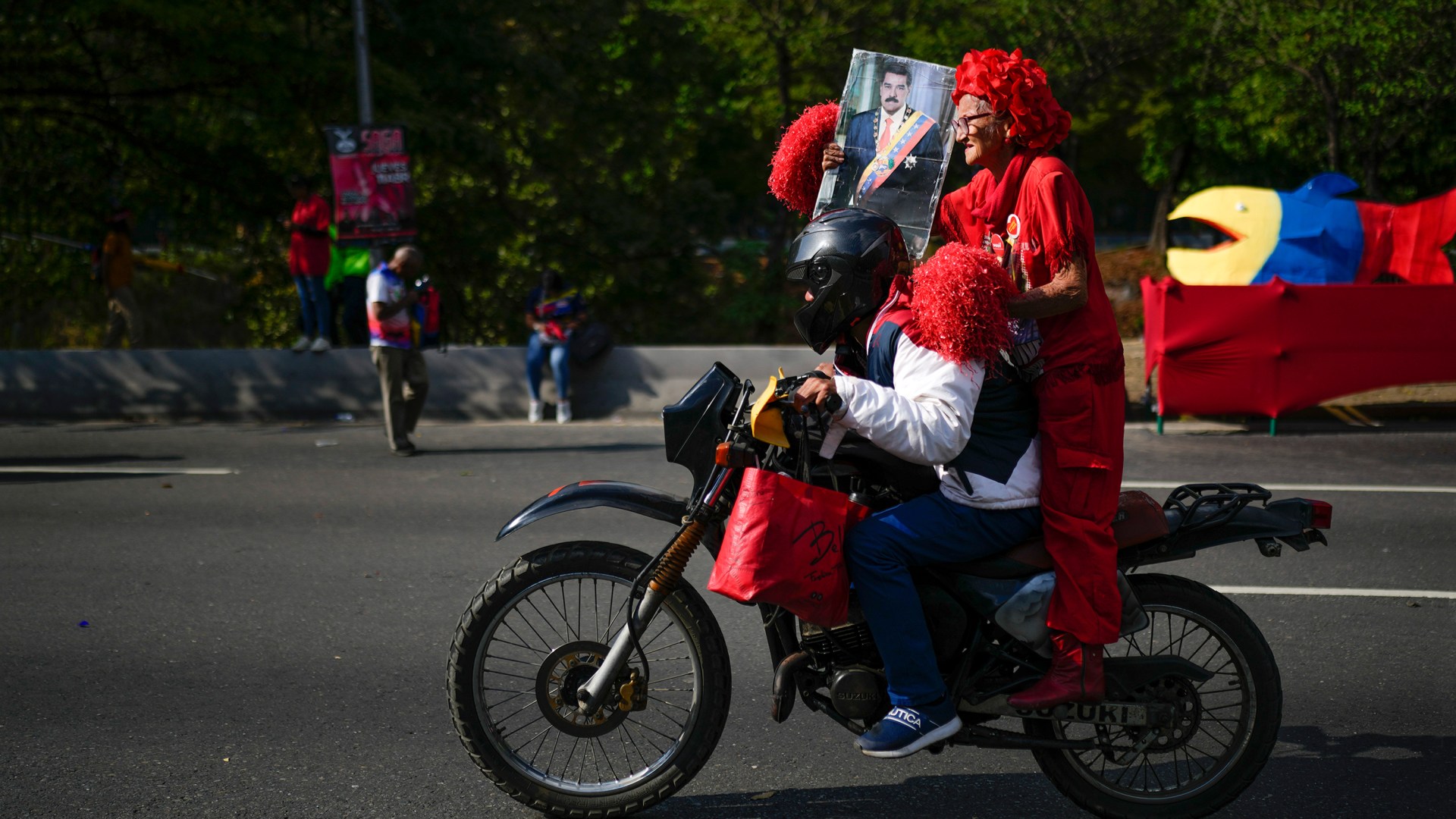
Government supporter rides on the back of a motorbike holding an image of Venezuelan President Nicolas Maduro.

Government supporter rides on the back of a motorbike holding an image of Venezuelan President Nicolas Maduro.

Christianity Today April 30, 2024
Ariana Cubillos / AP Images

In many countries, politicians try to win over religious voters by highlighting areas of shared interest between their agenda and the faithful’s priorities. In Venezuela, the current president is offering pastors cash.

With less than three months until Venezuela’s presidential elections, incumbent Nicolás Maduro is expanding two initiatives specifically aimed at the evangelical community, which represents 30.9 percent of the country’s population.

Bono El Buen Pastor (“The Good Shepherd Bonus”), created last year, and Plan Mi Iglesia Bien Equipada (“My Well-Equipped Church Plan”) offer resources to pastors and their churches, including cash, chairs, construction materials, and expensive sound equipment—no strings attached. Mi Iglesia Bien Equipada exists under Misión Venezuela Bella, a government program that invests in recreation and arts spaces, which has remodeled nearly 3,000 churches since 2019.

At the beginning of March, Maduro gathered 17,000 people in a pastors-only event in the northern city of Carabobo and announced that 20,000 additional pastors had become beneficiaries of the Bono El Buen Pastor program, which would deliver a monthly stipend of 495 bolivars (around $14 USD) to each new member. (Venezuela’s minimum legal monthly wage is 130 bolivars or $3.50.)

Officially, the government says the program aims to give churchgoers dignified spaces where they can develop their faith. There are, however, those who view the state’s generosity with some suspicion.

César Mermejo, president of the Evangelical Council of Venezuela and a leader of the Federación de Iglesias Mizpa de Venezuela, called these efforts by Maduro an attempt to buy the souls of evangelicals.

“As is the norm for political processes, [politicians] search for votes in every sphere of society,” he said. “Evangelical churches can’t escape this.”

The search for support from evangelicals dates back to the time of Hugo Chávez’s socialist revolution.

While those outside of Venezuela might be surprised to see a socialist ruler reaching out to evangelicals, its political leadership has long turned to evangelicals in search of political support.

In 2004, when confronted with a referendum about whether he should remain in office, then-president Chávez reached out to evangelicals. At one point, representatives from 2,000 churches gathered, petitioning for divine protection for the leader. In 2006, after clashing with Catholic church authorities, Chávez even declared himself an evangelical.

Maduro, who served as vice president starting in 2012, assumed the presidency when Chávez died the following year after battling cancer. He continued to court churches and their leaders in efforts that seemingly have culminated in the two initiatives he is now expanding.

The electoral success of the endeavor is uncertain, says David Smilde, professor of sociology at Tulane University, who has studied the relationship between “Chavismo”—the populist ideology associated with Chávez—and evangelicals for 30 years.

“No matter how much money the Venezuelan government spends on these programs, there is no evidence that Maduro has managed to control evangelicals,” he said.

For Smilde, the denominational diversity of the evangelical church in Venezuela makes it difficult for it to be manipulated by politicians. “Evangelicals have free will at the core of their beliefs. This includes the freedom to vote for whoever they believe is best for their country,” he said.

Leading this part of Maduro’s reelection strategy is his son, Nicolás Ernesto Maduro Guerra, who has personally delivered chairs and sound equipment to churches, as some government officials have enthusiastically posted about on social media. In March, he celebrated a new ruling that Venezuela would no longer tax new religious civil organizations, including church startup taxes.

“President Nicholas Maduro continues strengthening the spirituality of our people and facilitating the loving work for those in need in every corner of the country,” he wrote on Instagram.

One of the beneficiary churches of these government programs has been the family ministry called Ministerio Familiar Fe Renovada (also known as Miffer). It operates in the center of Caracas in an old building that was donated to the church by the local government.

Edgard Martínez, who pastors Miffer, is grateful for what the programs have offered—and doesn’t believe they have hurt his ability to speak his mind politically.

“I believe that one cannot curse those things that are a blessing to you,” he said. “Because we have received this aid, we have not abandoned the ministerial approach, and we will not stop calling the good, good, and the bad, bad.”

But the government is not the only one to blame for wanting to manipulate the evangelical church in these elections.

Mermejo believes that opposition candidates are not innocent and are also trying to woo churches for political support.

“For me, the most worrying thing in both cases is the ease with which the opposition and government discourse tend to create the conditions to achieve this conquest, trying to turn the evangelical people into ‘useful fools,’” he said.

For similar reasons, Gabriel Blanco, who pastors a young church in Valencia called Comunidad de Fe Valientes, has sought to keep his church’s independence.

“We pray for the authorities, we bless the authorities—but we have made the decision not to get involved in anything that has to do with politics or to receive assistance from the government,” he said. “Thank God our people contribute to the social events that we do as a church. It allows us to maintain our independence.”

Blanco also directs Festival Juventud Libre, a youth conference, where he’s booked international Christian artists like Alex Campos, Christine D’Clario, and Montesanto. Politicians often covet appearances at events like this one, which draws tens of thousands of young people. But Blanco has decided that it’s not worth opening the stage to political leaders.

“In our organization, we have always stated that our events are for lifting the name of Jesus and are not platforms for lifting the name of a party,” he said.

Martínez explains his church’s decision to receive government resources by comparing his case with that of Nehemiah.

“Many times the enemy also works for God without realizing it. Just as Nehemiah received help from King Artaxerxes to rebuild the walls of Jerusalem, we are using these resources in the moral reconstruction of Venezuela,” he said.

Despite this courting, Maduro may not need the evangelical vote, thanks largely to a recent decision of the supreme court of Venezuela to ban the candidacies of María Corina Machado and Leocenis García, two of the main opposition candidates.

“The government has committed two despicable acts,” García told CT. “First, a misogynistic act by removing María Corina, the only woman who could stand up to them in these elections. And also a racist act, by removing me from the race, the only black candidate in the race.”

These allegations of fraud have become increasingly common during presidential elections in Venezuela.

In 2018, numerous voters boycotted the elections, and outside observers, including those in the US, claimed the elections were fraudulent.

Only about 60 percent of Venezuelans plan to vote in the 2024 elections, according to a survey from March from the Venezuelan pollster Datanálisis. Of them, 15 percent said they were supporters of the current government, 36 percent said they were supporters of the opposition, and 41 percent said they did not identify with either side.

“Evangelicals from the poorest neighborhoods supported Chávez when he democratically came to power in 1999,” explained professor Smilde. “But the economic crisis generated by Maduro’s bad government has made him a tremendously unpopular president. That’s why he desperately needs evangelicals if he wants to win reelection without leaving any room for doubt.”

The economic and social crisis in Venezuela has spurred the most significant migration movement in Latin America this century. According to the UN refugee agency UNHCR, as of November 2023, there were more than 7.7 million Venezuelan migrants or refugees scattered across the world, mostly in Latin America and the Caribbean. The country’s population stands at 29.4 million.

A pastor running for presidency

Following the supreme court’s controversial decision to remove Machado and García from the ballot, eight candidates now vie for the Venezuelan presidency. Among them is Javier Bertucci, an evangelical pastor and deputy in the National Assembly who is running for the second time with the Christian center-right Hope for Change Party. In 2018, Bertucci finished in third place, winning more than 1 million votes and capturing 10 percent of the total.

In the past, Bertucci faced legal proceedings and was even briefly detained on charges of smuggling. He was also mentioned in the Panama Papers scandal, which exposed individuals from the political and business realms operating in offshore tax havens.

Bertucci noted that, through the two initiatives, the government has focused on delivering aid to churches in the poorest neighborhoods of Venezuela’s largest cities. But just because churches eagerly accept these donations doesn’t mean the congregations now support Maduro, he says.

“Although the pastors are receiving the things that [politicians] are sending them, these pastors are not actually being bought off,” he said. “[Politicians] are not managing to convince pastors to [accept] their socialist political ideology.”

Smilde believes the Venezuelan government is using Bertucci to divide the opposition’s votes.

“[Bertucci] believes in what he is doing and is convinced that he can become the first evangelical president of Venezuela,” he said. “However, Maduro is taking advantage of his candidacy to have a weak rival to beat easily on July 28.”

Bertucci has an answer to those who criticize him for participating in these questioned elections.

“The opposition has historically made a mistake by calling for a boycott. That has only served to continue socialism,” Bertucci said. “Surveys indicate that more than 60 percent of Venezuelans want to go out to vote because they want a change from this terrible government. Not [running for office] would be to fail those people who believe in the possibility of a return to democracy.”

Whether or not Maduro is reelected in July, the recent strategies launched by the government prove the political importance of the evangelical people in Venezuela. In 2023, Venezuela’s evangelical population grew faster than in any other Latin American country, according to a Latinobarómetro survey.

“With faith in political leaders—both government and opposition—disappearing, people have increasingly clung to religious beliefs,” said former presidential candidate García. “That is proportional to the levels of poverty and inflation. Politicians cannot move anyone today, but churches can.”

Hernán Restrepo is a Colombian journalist who lives in Bogotá. As of 2021, he manages the social media accounts for Christianity Today in Spanish.

Culture

Taylor Swift Can Do Whatever She Wants

But true liberty, in art and in life, is created by constraints.

Christianity Today April 30, 2024
Illustration by Elizabeth Kaye / Source Images: Getty

Taylor Swift answers to no one.

Not music industry executives: Her songs returned to TikTok in the middle of a licensing dispute between the app and her label.

Not mayors: When she graced their cities during her Eras tour, they declared days in her honor.

Not the international community: A Singapore-exclusive stop in Southeast Asia sparked a row between the city-state and nearby Thailand and the Philippines. The Japanese embassy issued a statement about her Super Bowl travel plans.

And Swift doesn’t plan on stopping anytime soon. She announced new music within minutes of winning her latest Grammy for album of the year.

You might take all this as proof of Swift’s business genius, nothing personal. But in her latest album, The Tortured Poets Department, there’s definitely an “above it all” attitude. These songs are snarly. America’s sweetheart may have nothing left to prove. But she certainly has scores left to settle.

Swift is hardly a stranger to revenge. This is the songwriter, after all, who brought us lyrics like “It’s obvious that wanting me dead / Has really brought you two together.”

But TTPD broadens her aggression and scorns the prospect of reconciliation. A small-town girl takes on her community over a controversial love affair and trolls her parents with a joke pregnancy announcement. A depressed performer boasts sardonically about how well she can sell happiness to frenzied fans. A woman seethes at being seen as a problematic starlet by her new boyfriend’s circle.

There’s a track suspiciously similar to an Olivia Rodrigo song (the two singers have a rumored feud). The title of another appears to name-drop Kim Kardashian, an older nemesis.

Critics agree that the album is bloated, with “quality-control issues.” It could “use an editor.” My favorite celebrity blog, Lainey Gossip, noted in exasperation that there are “so many are skips. Too many skips with unnecessarily silly lyrics that weaken the lyrics that are clever and insightful.”

In both lyrics and length, then, TTPD reeks of the “teenage petulance” that Swift herself sings about. The problem with her hubris here isn’t just aesthetic: an onslaught of stale arrangements with longtime musical collaborators, a plethora of visceral F-words, and one bewildering line. It suggests an artist either unwilling to accept the wisdom of others, or bereft of it.

“Everything is permissible for me, but not all things are beneficial,” Paul writes to the Corinthians (1 Cor. 6:12, AMP). He offers a variation on that theme in his letter to the Galatians: “You, my brothers and sisters, were called to be free. But do not use your freedom to indulge the flesh; rather, serve one another humbly in love’” (5:13).

Just because something is allowed—whether eating meat sacrificed to idols or putting out a 31-song record—doesn’t mean it’s prudent. True freedom, paradoxically, is created by limitation, dictated not by legalism but by consideration for others. When Paul lists the fruit of the Spirit, he includes self-control alongside love and kindness. Restraint isn’t just a private practice but one with ramifications for an entire community.

Again and again, Scripture teaches that we often don’t know what’s best for us; we need each other to discern what’s beneficial and what’s not. “Listen to advice and accept discipline, and at the end you will be counted among the wise,” says one of many Proverbs to this effect (19:20).

But where does Taylor Swift get her wisdom? Is it even possible to receive honest feedback at this level of celebrity? What happens when no one in your inner circle is empowered enough to keep you from publicly feuding with someone you already devoted an album to seven years ago?

Maybe there’s someone behind the scenes lovingly encouraging her to rethink her victim narrative or to take a pause before processing her personal life publicly. If there is, she’s not listening.

Or perhaps Swift’s problem is less a lack of advisors and more an abundance of inappropriate ones: her fans. Some of her angst in this album is directed at people who attempt to speak into her decisions without authority, in the absence of real relationship. Take “But Daddy I Love Him”:

I’d rather burn my whole life down
Than listen to one more second of all this griping and moaning
I’ll tell you something about my good name
It’s mine alone to disgrace
I don’t cater to all these vipers dressed in empath’s clothing

God save the most judgmental creeps
Who say they want what’s best for me
Sanctimoniously performing soliloquies I’ll never see

The fans may demand more music, track her every move, and obsess over her personal life. But even they aren’t really telling Swift no. She’s won their adoration, no matter what—TTPD obliterated Spotify streaming records. Last year, thousands of people watched TikTok livestreams of each Eras concert. It no longer matters if Taylor Swift’s albums are “good.”

And yet, there’s still insecurity. As several high-profile negative reviews of TTPD circulated over the weekend, links to raves began appearing on Swift’s X account. Despite the album’s enormous success, her public image came across as a woman who isn’t interested in feedback.

I flew across the country to attend Eras last year. I was once in the top 10 percent of all listeners of Midnights. I wore my Taylor Swift T-shirt last Friday to generate conversations with others about the release. But as I texted a friend last weekend, I “just want more” for her.

There’s a kind of freedom in songs with cringe lyrics like “You know how to ball, I know Aristotle,” and no stress about whether an album’s going to sell.

But freedom without introspection, and without accountability, quickly starts to look like foolishness and insignificance.

As even secular critics of TTPD concede, bypassing constraints may come at a cost to your work. They also may come at a cost to your soul.

Morgan Lee is the global managing editor at Christianity Today.

Luci Shaw Wants to Open the Windows

In Reversing Entropy, the 95-year-old poet looks lovingly at creation.

Christianity Today April 30, 2024
Kristin Karlsen / Unsplash

Editors’ note: Writer and teacher Luci Shaw died on December 1, 2025, at age 96. Shaw was prolific, publishing more than two dozen works of poetry, spiritual reflection, and anthology. Her final collection, An Incremental Life, was published in 2025.

Luci Shaw is a legend in Christian literary circles. Her many volumes of poetry—named for rivers and clay, the color green, the glint of seaglass—speak to the beauty of creation and the generosity of the Creator. She has written on faith and art, the Christian imagination, and prayer, including a few books co-authored with her friend, Madeleine L’Engle. Shaw is also a beloved teacher, serving as longtime writer-in-residence at Regent College.

Speaking with the poet about her latest collection Reversing Entropy (out this spring from Paraclete Press), I understood how she has served as an inspiration for generations of students and readers. She’s gentle, curious, and wise. Her way of seeing the world is wondrous—everything from lichens, to a shivering little lake, to “jewel dew” in the grass, is significant. All the world inspires praise.

Reversing Entropy doesn’t just look around; it looks ahead. Luci Shaw is 95 years old, and this collection is understandably full of endings. Leaves fall; ripe apricots drop from a tree; her brother passes away. There is “the inevitable decay / the leaving and the dying.”

But there’s also hope. From the collection’s final entry, a long, tumbling prose poem that Shaw says “poured out” of her “like a gift”:

Give praise, now, to our God, the Quickener, the One who stirs us into such new life that we, and all creation, may wake to the sound of a fresh music, and start to sing again the songs of love, and longing, and refreshment. …

Come Springtime, that most beneficent of seasons, all, everything, every thing, will be thawing, rising, joyful, laughing, tuning up for the evermore, and in every green plant, sap will begin again to up-rise, elated…

Entropy has been reversed. Decline denied entrance, or existence. Death has been utterly extinguished as we enter, and join, the Quickening.

—Excerpt from “The Quickening: To Be Sung in Procession to Heaven’s Gate”

My interview with Luci Shaw has been edited for clarity and length. Poems in italics were read by Shaw during our conversation.

Let’s start with the title of the collection: Reversing Entropy. I wonder how this phrase gets at what poetry (and living as a Christian) means to you.

Reversing entropy is important to me—pushing back against chaos and despair, replacing them with hopefulness, with joy, with creativity. The concept of entropy is that systems of an evolving creation are declining and losing energy. People of faith, people of Christian faith, are able, through the arts, to take and reclaim territory that has been lost.

This “reclaiming territory” can happen through our art—but also in daily living. One of your poems, “Clues for Perception,” begins: “To reverse entropy is to avert chaos, to restore order in a / system, to correct or forgive a wrong.”

And it ends: “I rejoice when the crumb on the floor falls victim to the broom!”

Oh, absolutely. You don’t wall off your poetry into a separate little room. You open up the whole house. You open up the windows and the doors!

I recently listened to an interview with Marilynne Robinson in which she said, “a mind at peace in any degree, and a mind that’s schooled toward good attention, sees beauty all the time.”

That line reminded me so much of your poetry. To take one example, in “Crossing the Cascades,” you are “noticing the small / miracles of green, / the stabs of survival / in the most / improbable places. / … We pay passing attention / and our observation / turns it real.”

That’s a wonderful word, you know, attend. It comes from a Latin root, ad tendere, to reach into or to reach toward something else. My life practice has always been to pay attention to beauty—in relationships, in nature, in politics, in our church life. I look for significance in whatever I see.

Isn’t it amazing that that creation can lead us to an understanding of the Creator? The fingerprints of God are on the solar system.

WHALE

“Monday. The Port of Bellingham posted a photo of a visitor along Bellingham Bay. Humpback whales are commonly the size of buses.”

The Bellingham Herald , March 24, 2022

O mighty one, you whose bulky vehicle visits
our islanded western Sounds in early spring,
who, breaching, lift your mass in opulent suspension
above the waves, its grand re-entry flinging wide
a rainbow spray. You, whose magnitude now courses
along the continent’s channel way, swimming
north to new, nutritious waters. You, leviathan,
astound us, a grandeur that causes godly fear
at your creation, and wonder at the deep sounding
of your uncanny songs. Whose fine baleen strains
from the waters a nutritious soup of krill,
the most minor of sea creatures nourishing the major.

May our fragmentary whispers of gratitude bless You,
the One among us who listens and, unearthly, speaks.

God can speak through the size of the whale, but also through tiny fish, the krill, that nourish that huge creature.

How does prayer fit into this?

I value the Book of Common Prayer because it addresses every aspect of life. It gives us prayers, liturgies, the psalms. The psalmist had to deal with very similar struggles, I think, to the lives we live now. The context is different, but the human spirit is always the same.

The terminology for many of the Old Testament prophets was the “burden of vision.” How difficult it was, in the middle of an ordinary life, to be given a vision by God and to rise to the challenge of being a prophet.

Take Jeremiah. Even though he was speaking divine truth, he got punished for it. His listeners put him in a muddy pit.

I’m not a prophet in that sense. But I do hope to speak truth into life.

“The burden of vision.” So often we hope for a direct word from God. But are we really prepared for what that word would require of us?

God appeared to Moses on Mt. Sinai. But he had to shelter himself behind a rock because his unshielded presence was overwhelming.

Let’s talk about a few other poems. One of my favorites is “New Leaf Restaurant.”

I have a dear friend who lives on one of the islands off the coast, a writer and philosopher. Every time I go and visit him, I get fresh insights into the life of the creative person. Sometimes, he’s the only person to whom I can honestly admit that I have doubts about my faith.

I wonder about how to live the authentic Christian life. I wonder about mystery; the Greek word is mystērion. It means “that which is hidden.” As a poet, I like to open things up, even trivial things, and examine them. That’s what’s happening here.

NEW LEAF RESTAURANT

With the camera of my mind I try
to teach myself the view, anticipating
a destination before arrival, expecting

the benediction of weather, a warm sun
and a cool wind from the ocean, almost
believing my desire will bring it to pass.

Waiting has been always a discipline
alien to me.
Yet I try to teach myself what

I need to know, to respond with gratitude
to guidance, perhaps salutatory,
yet offered with great generosity.

Wanting, as I wait, the message in the air
to be true, that when I arrive I may receive
with gratitude a friend’s long-harvested
wisdom and discernment.

Impatience consumes me. Like a candle,
my dark wick of certainty burns down to
a lonely thumb of wax destined for snuffing,
its pale smoke drifting to the ceiling
like an angel’s scarf, before vanishing.

Though I’ve been lonely, shorn of trust
and certainty, feeling bald and plain,
a friend’s gracious green and gold
speech fills the untidy field of my belief
with new growth. Today all my living
spreads ahead of me, like a field in Fall
dank with wet, decorated with
wild flocks of white geese.

I love how, as I watch,
their congregation lifts and lowers
over the field, like a woman’s white
sheets on a backyard line
raising their wings
in praise of the wide air.

When I didn’t have a clothes dryer, I had to hang up clothes in the backyard with clothespins. That experience gave me that wonderful image of the wind blowing through a sheet and filling it up, lifting it like a sail of a ship.

In spring the flocks of white geese settle on our plowed fields, which they like because the worms are available to them. I love movement: when the whole flock rises together, and then settles again, around all the fields.

It’s helpful to hear the story behind the poem. You go to the islands with concerns, and they’re addressed in several, fresh ways. There’s your friend, who can listen and respond with “wisdom and discernment.” And then there are the geese: speaking without language, somehow, and providing another kind of insight.

We learn in different ways—from literature, but also from observing the unpracticed beauty of nature. The trees don’t take lessons in looking beautiful. They just are.

THE DANCE OF THE LICHENS

A damp day, and walking the woods, we discover them,
sprouting like miniature lettuces, spreading their
minor mantles, hoary and moist, curling at the edges—
lichens green and fine as human hair, decorating the rotten
stumps and rocks of the woodland, charming us by their
pale
frills and baroque contours. You can’t call them plants,
but they like to pretend. Claiming distant relationship
with fungi, macrolichens float into the air pale fibers
delicate as lace, a curious embroidery on the forests’ face.

Enchanted, we photograph a dozen examples, some
fine as hair, some frilled as flower petals, pale, green,
gray, orange, dotted with red micro-spores, ready to fly,
to catch any minor air for conveyance, for symbiosis,
for claiming some damp environs as habitation.

Summer, and some, surviving the season’s heat, creep
across bare rocks, enter granitic cracks, split
giant boulders by the persistent force of mere existence.

Today, on the path down to our creek, we saw them
swarming,
dancing along the wooden handrail, balancing like
gymnasts.

Variants of symbiosis, ambient, fanciful, buoyant, spotted,
flaunting, frilled, flirting, feeding on the rot of forest floors,
they decorate the underworld in gray-green, and gold.

We have only a tiny fraction of understanding and knowledge, because we’re so limited and restricted as individuals. But, also, we have this calling, to go beyond the surface of the ordinary and to see significance in those ordinary things. It’s never a dead end. There are always open windows for us to lean out of and to see the larger world.

“Whale,” “New Leaf Restaurant,” and “Dance of the Lichens” from Reversing Entropy by Luci Shaw. Copyright 2024 Luci Shaw. Used by permission of Paraclete Press.
News

World Vision Brought Clean Water to More Than 1 Million Rwandans

How the world’s largest nongovernmental provider of the resource is delivering on its promise.

Christianity Today April 29, 2024
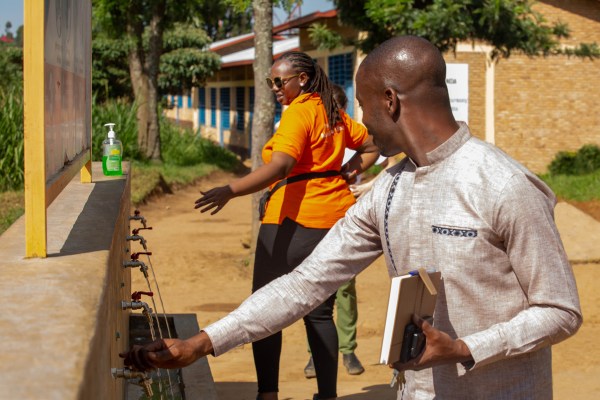
Photography by Jeez / Courtesy of World Vision

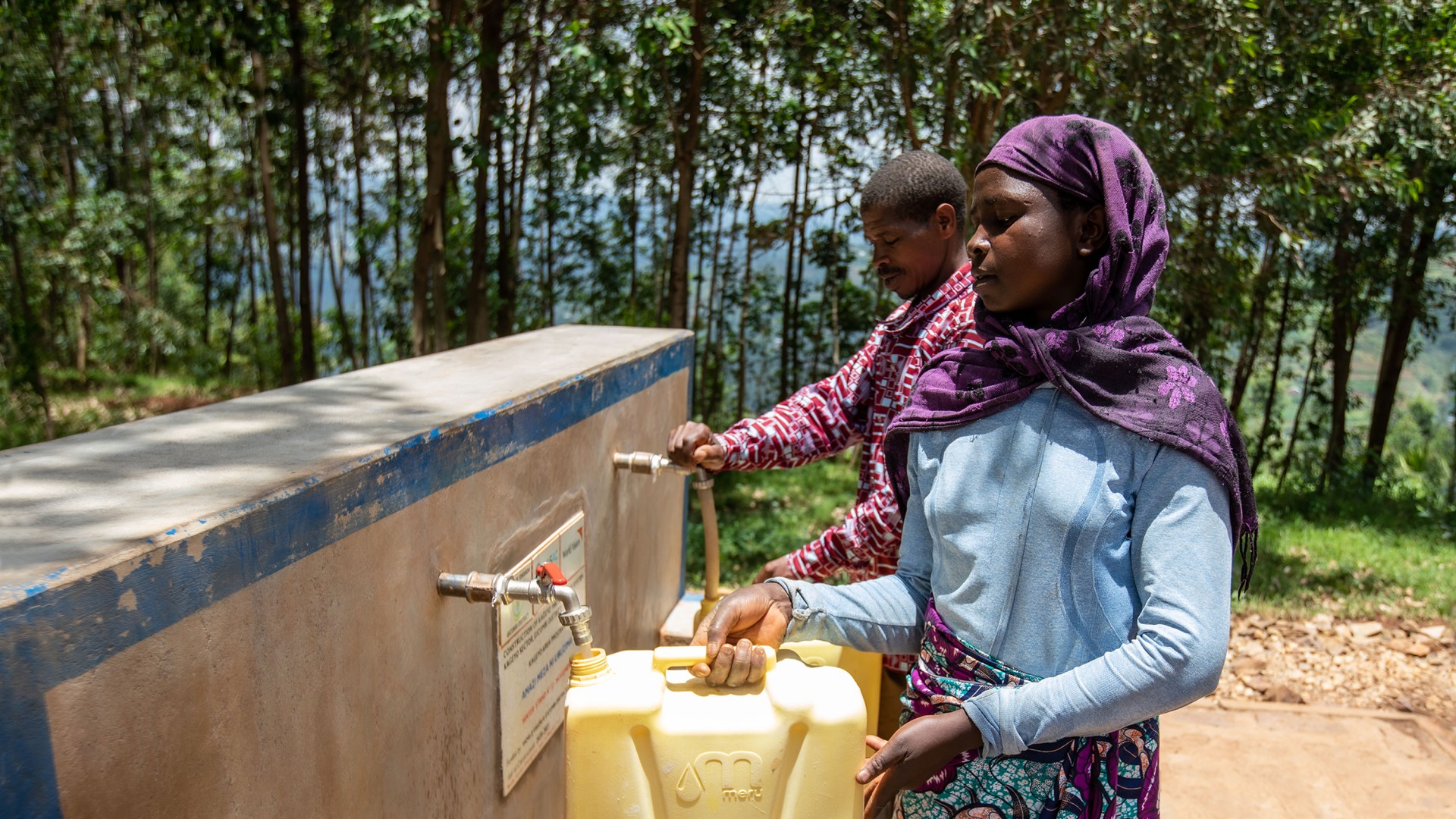
For years, whenever Regina Mukasimpunga sat in church, she found it hard to concentrate on anything other than the chore awaiting her when service let out: fetching water.

The never-ending task dominated the life of the rural Rwandan community, forcing residents to leave the house with jerry cans before the sun came up to take long walks in the darkness in the hilly terrain to reach a spring. There, they often competed with other families to fill jugs, everyone desperate to move on with their days as quickly as possible.

“We would wake up at 5 a.m. to get water, which often took two hours. When we finished, we were exhausted,” said Mukasimpunga, at her home in Gicumbi district, about 60 kilometers (37 miles) south of the capital, Kigali. “We couldn’t farm productively.”

Mukasimpunga and her husband, Fulgence Ndemeye, enlisted their three children to help, but the job could last so long it made the children late for school, their tardiness earning them reprimands from their teachers and challenging their ability to keep up in school and study when at home.

Then, in 2021, World Vision opened a water station about 50 meters (164 feet) from their home. The life change was immediate: Now, everyone could start their day on time, take more showers, and wash their clothes more frequently. Mukasimpunga and Ndemeye could grow tomatoes year-round and not just during the rainy season. They could triple the livestock water ration, which meant their cow gave them more milk, which they could sell to their neighbors. The family’s economics improved so much, they were able to join a savings group.

Mukasimpunga and Ndemeye’s story is just one of many. The same story has happened over and over again in Rwanda, changing the daily lives of 1 million people in this country of 13.4 million, thanks to one of the final commitments made by former World Vision CEO Richard Stearns.

Stearns met with Rwandan prime minister Édouard Ngirente in 2018 and launched a five-year plan to make Rwanda the first developing nation with universal access to clean water, starting from the 39 subdistricts or sectors where World Vision was operating at the time. Since then, World Vision has partnered with the government and achieved universal basic water service coverage in the targeted areas.

In 2023, current CEO Edgar Sandoval celebrated when the program reached a major milestone: 1 million Rwandans now have clean water within 500 meters (0.3 miles) of their homes.

“Access to essentials like clean water levels the playing field, empowering kids for achievements like finishing their education and discovering their God-given gifts,” he wrote. “As we do this work together in Jesus’ name, we demonstrate the truest meaning of victory … that Christ came to usher in a new kingdom where hope wins.”

A 30-year partnership

World Vision’s now 30-year history in Rwanda—the ministry has been serving in the country since the genocide ended in 1994—has played a critical role in allowing them to build physical and social infrastructure at scale. World Vision Rwanda is the largest NGO in the country, with an average annual budget of $34 million, and only six of their 303 staff are of non-Rwandese nationality. They are also the country’s largest non-governmental partner in providing clean water.

After the universal basic water coverage initiative kicked off in 2018, World Vision met leaders of the districts where its 39 areas are based to set goals. They signed memos of understanding stating that World Vision would contribute 60 percent of the project’s costs and that the government would contribute the remaining 40 percent.

“If you just look at the journey from 1994 to now, infrastructure development, compared to other countries, has gone very fast,” said Pauline Okumu, the national director of World Vision Rwanda. “The message is: We have to build our country. There’s intentionality around goal setting.”

For engineers, their first step of creating clean water infrastructure is studying the topography of a region and determining if they need to build a pumping station or if they can supply water by gravity, says Murebwayire Marie Léonce, a technical program manager for World Vision’s WASH (Water Sanitation and Hygiene) program. Engineers must design the correct water pumps and install them, and a technical team services the water treatment system.

“Most of the areas where we serve are not reached by road. Service providers transport all materials by car till the nearest road, and the community supports by transporting materials manually from the road to the designated site,” said Léonce.

Not everything has been smooth. Existing infrastructure has been vulnerable to floods and landslides. Land needed for new infrastructure sometimes runs through people’s private property. Negotiating with farmers takes time and occasionally requires the government to step in.

But Okumu, who has worked in a number of countries around the continent, noted that in contrast to public officials she has observed in other places, the Rwandan government has frequently reached out to engage World Vision. Public officials are regularly evaluated on whether they accomplish their goals, and in turn, this accountability spurs them to reach out to their NGO partners to ensure they are doing their part.

Unlike other organizations based in Kigali who might make trips to other parts of the country, “World Vision is community-based,” said Alice Muhimpundu, WASH’s health behavioral change manager. “We are there.”

Further, World Vision’s own vision casting makes them an ideal partner, said Parfaite Uwera, the acting mayor of Gicumbi District, an area of nearly half a million, where CT visited a water pump, a water point station, and a clinic, church, and school.

A water station in Rwanda provided by World Vision.Photography by Jeez / Courtesy of World Vision
A water station in Rwanda provided by World Vision.

World Vision’s own long-term planning aligns closely with the government’s own initiatives, making it easy for public officials to work “hand in hand” with them, she said. “World Vision really is special in the area of partnership. … They make sure that what they leave behind is safe and sustainable.”

Nowhere is this seen more clearly than in the government’s decision to allow World Vision to use its own procurement process to acquire the sanitation infrastructure materials, circumventing what would have been a far longer and more tedious process. They also allowed them to hire their own contractors and take care of tendering and operations.
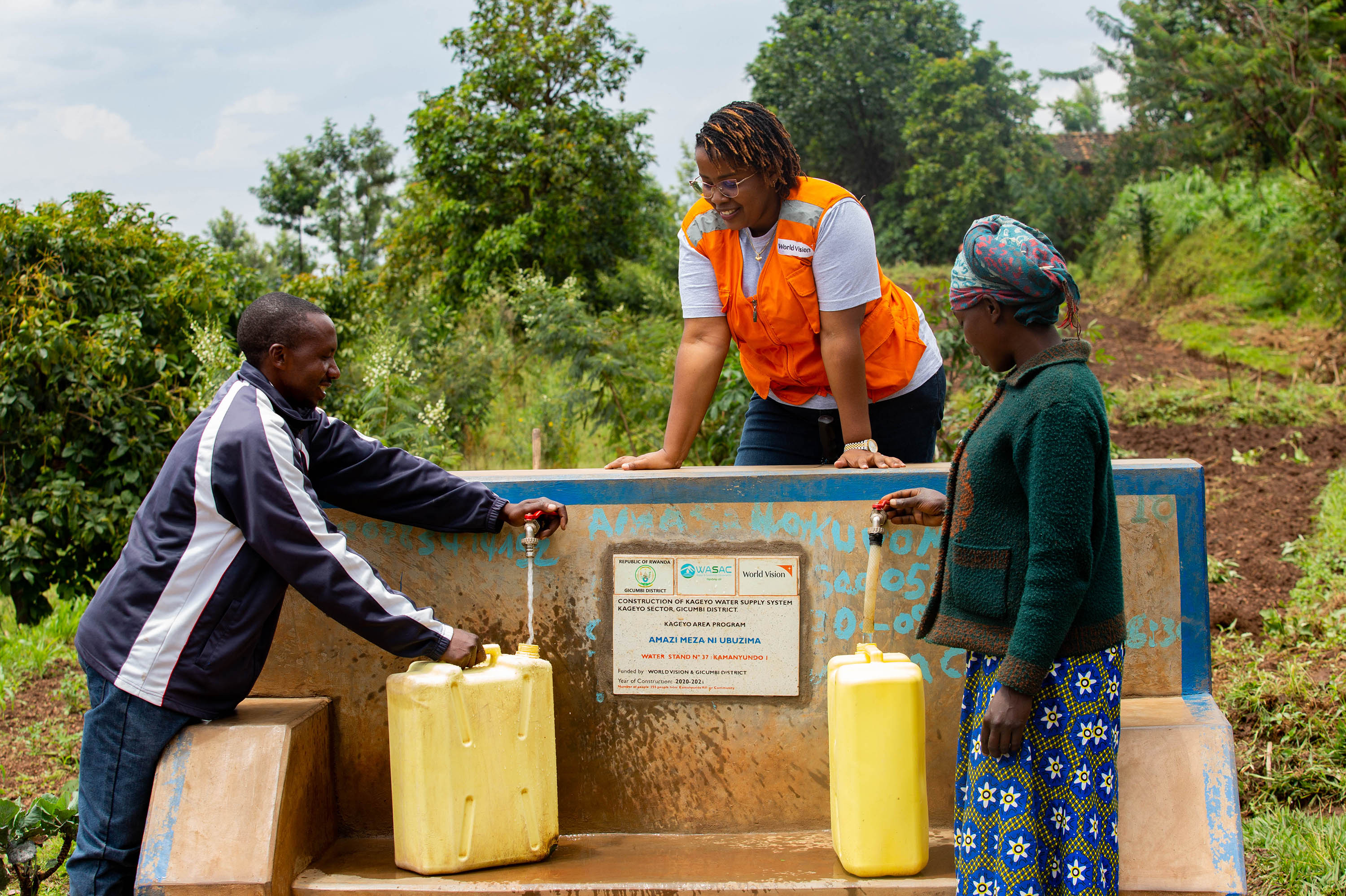
“As a Christian organization, the government believed they would not have to worry about fraud,” said Muhimpundu. “That was simply amazing.”
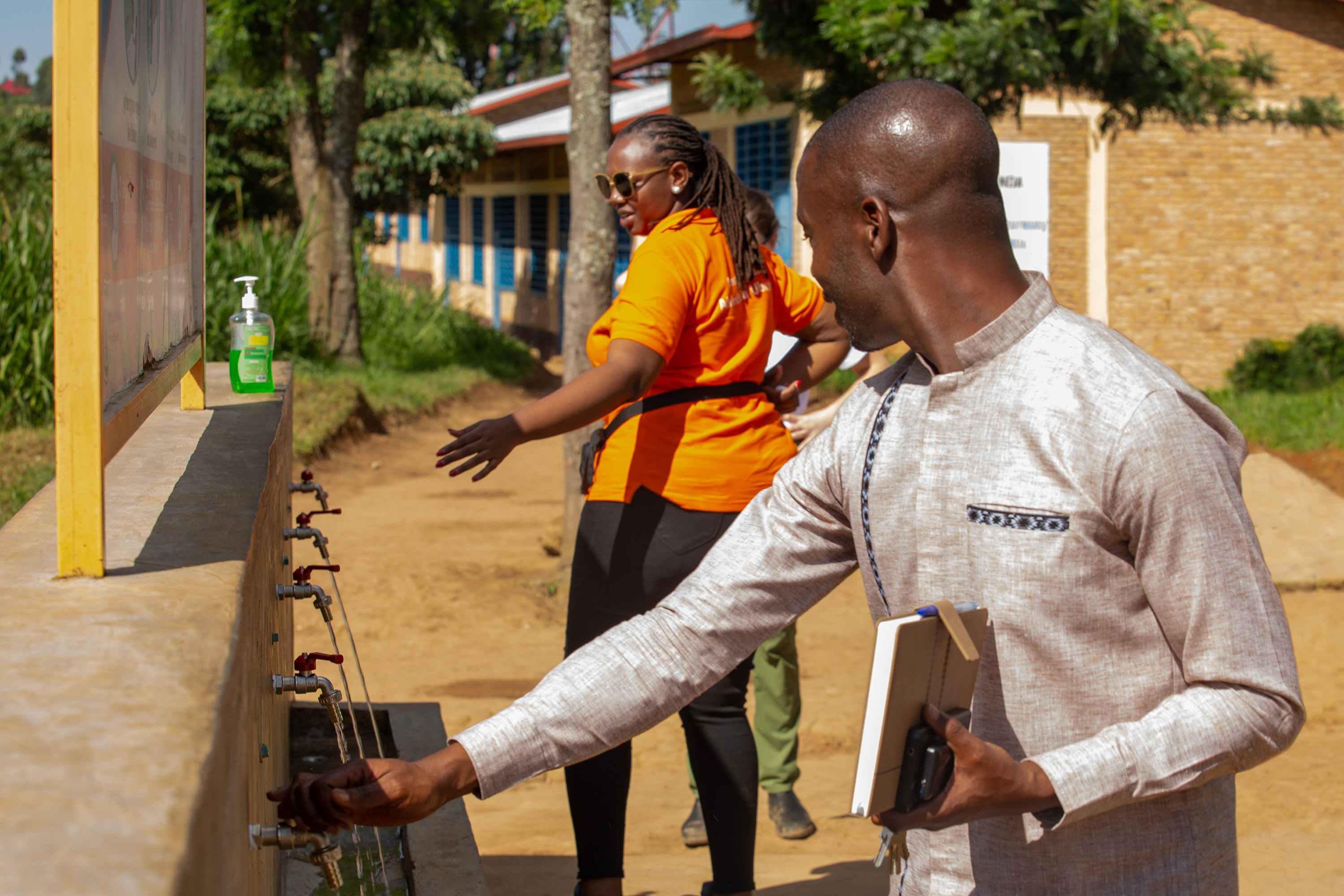
The Rwandan government also gave World Vision special permission to advance with its project during the pandemic. Rwanda was the first country in sub-Saharan Africa to issue a lockdown and had more stringent COVID-19 regulations than many neighboring nations, yet numerous water infrastructure projects carried on or began construction in 2020.

As these projects have wrapped up, World Vision has handed over control of the water to the government and local councils, which monitor water usage, report any damages or broken infrastructure, and maintain the sites.

Providing sanitation education

World Vision also works with churches from numerous denominations to teach sanitation curriculum, identifying priests and pastors as “key change agents” who can help students make connections between hygiene and Scripture. The most effective teacher, though, has been COVID-19. Anxiety about contracting the disease changed personal behavior and policy.

When churches closed during the lockdown, the government worked with religious leaders to determine its criteria for reopening houses of worship. One feature now necessary for churches: handwashing stations. When people met for the first time after lockdown at one ADEPR (Association of French Pentecostals in Rwanda) congregation in Gicumbi, greeters met them on the steps and directed them to handwashing stations, delivered to them by World Vision.

“Then they could hug and sit next to each other and not feel nervous,” said Sunday Emmanuel, one of the pastors. “Washing is now part of the culture.”

The church has a large outdoor baptismal font; previously, they used rainwater, but now they can take from their clean water supply.

Not all churches have had access to these types of hygienic facilities. For months, the ADEPR church has been hosting another congregation that has been unable to get its own building because of the sanitation requirements. Its leaders have submitted a proposal to World Vision to help them with the sanitation costs for their building.

Accessible clean water has also transformed numerous local institutions.

A water station from World Vision at a school in Rwanda.Photography by Jeez / Courtesy of World Vision
A water station from World Vision at a school in Rwanda.

At Groupe Scolaire Muhondo, a school that serves just over 2,000 students, more than half a dozen trophies sit behind the desk of principal Elie Habumuremyi. They finished second in the country last year in primary school girls handball. World Vision’s changes have made it easier for the school to organize sports teams by offering athletes clean drinking water, and the presence of extracurriculars helps incentivize students to stay in school longer. Meanwhile, girls miss school less because there’s more sanitation resources available to them when they’re on their periods.

Leaders at one local clinic that serves a community of 20,000 noted that prior to World Vision’s water installation, more than half of those who came in suffered from some hygiene-related issue. About 20 babies are delivered there a month, and many mothers were forced to return within weeks of giving birth because of a sanitation-related issue. Without access to running water, health care providers didn’t regularly wash their hands or bed sheets.

Some of these issues were mitigated when one of the staffers, Emmanuel Twagirumukiza, invented a water filtration system operated by foot pump. But the scale of World Vision’s new water system has dramatically reduced disease for kids under five, helped patients not contract other infectious diseases while getting help for unrelated issues at the clinic, and lowered the number of intestinal worm cases.

The ministry is not stopping at 1 million Rwandans with clean water, though. They’ve added wells to serve another 200,000 people and expanded into 30 more areas. They may also look at adding more wells to reduce the average distance to clean water from 500 to 200 meters (0.3 to 0.1 miles). (Donors can now support this cause through the organization’s new Believers for World Change subscription giving model.)

“Reaching this milestone has actually strengthened my personal faith as an individual, as a person,” said Innocent Mutabaruka, integrated programs director at World Vision Rwanda.“You can actually see things changing instantaneously. You see the impact that this has on people’s lives and you say, ‘This is God.’”

addApple PodcastsDown ArrowDown ArrowDown Arrowarrow_left_altLeft ArrowLeft ArrowRight ArrowRight ArrowRight Arrowarrow_up_altUp ArrowUp ArrowAvailable at Amazoncaret-downCloseCloseellipseEmailEmailExpandExpandExternalExternalFacebookfacebook-squarefolderGiftGiftGooglegoogleGoogle KeephamburgerInstagraminstagram-squareLinkLinklinkedin-squareListenListenListenChristianity TodayCT Creative Studio Logologo_orgMegaphoneMenuMenupausePinterestPlayPlayPocketPodcastprintremoveRSSRSSSaveSavesaveSearchSearchsearchSpotifyStitcherTelegramTable of ContentsTable of Contentstwitter-squareWhatsAppXYouTubeYouTube