Theology

The Goodness of Growing Smaller

How to trust God in a season of decrease

Phil Schorr

The bride belongs to the bridegroom. The friend who attends the bridegroom waits and listens for him, and is full of joy when he hears the bridegroom’s voice. That joy is mine, and it is now complete. He must become greater; I must become less.” — John 3:29-30

It is never fun to feel as though you’ve been replaced, and John the Baptist’s disciples really didn’t like it. As John and his followers were baptizing near Salim, Jesus also began baptizing in the Judean countryside nearby. Alarmed that this new teacher was enjoying more success than their own, John’s disciples voiced worry to John that “everyone” was going to Jesus to be baptized (John 3:26, CSB throughout), perhaps expecting similar indignation or a competitive response from their teacher. John instead showed them the beauty of gospel paradox.

His disciples feared the unexpected turn of events, but John reminds his followers of what he’d been saying all along: “I am not the Messiah, but I’ve been sent ahead of him” (v. 28). In fact, upon hearing the news of Jesus’ success, John says his joy “is complete” (v. 29). John’s popularity was ending. His success fading. His influence declining. For most of us, this would be cause for discouragement and envy, yet for John, it brought joy. This is the beautiful paradox of the gospel. The Christian life is about losing to find. Giving to gain. Dying to live. That means sometimes growing smaller, losing outward influence, or lessening in rank is a good thing.

John says, “He must increase, but I must decrease” (v. 30). In a season typically associated with busyness and increase—more things to do, more things to buy, and more people to see—maybe you are in a season of decrease. You may have lost a loved one and find fewer chairs at the table. Having lost a job, your calendar may be emptier and the pile of gifts around your tree may be smaller. Much like John’s disciples, we may worry or mourn the changes. Yet just before reminding his disciples that he is not the Messiah, John reminds them that everything is a gift from God (v. 27). You see, John had a proper view of his assignment. He didn’t think of himself too highly, as if he were Christ himself, but he also knew he had value and purpose in God’s plan. In John 1, the author reminds the reader that John “was not the light, but he came to testify about the light” (v. 8). Christ is the “true light” (v. 9). John knew his role was important, but it wasn’t the ultimate point.

During this Advent season, we can embrace the fact that any success we have is not of our own doing but is heaven’s goodness undeservedly poured out on our lives. We can defer to what God has for us, whether he gives or takes away, because our lives are not our own but belong to God (1 Cor. 6:19). No matter where we are in life, we can humbly trust the plans of the true light, and bear witness to his fame.

Reflection Questions:


1. In what ways can we find joy and purpose in seasons of decrease or diminishing influence

2. How does the reminder that all our gifts and successes are from God shape our perspective during the Advent season and encourage us to humbly trust his plans?

Laura Wifler is a writer, podcaster, and co-founder of Risen Motherhood, based in IA. She has authored several books for children, including Any Time, Any Place, Any Prayer.

This article is part of The Eternal King Arrives, a 4-week devotional to help individuals, small groups, and families journey through the 2023 Advent season . Learn more about this special issue that can be used Advent, or any time of year at http://orderct.com/advent.

Dutch Election: Right-Wing Surge Sinks Once-Dominant Christian Parties

Trump-like figure Geert Wilders campaigns on traditional identity and anti-Muslim rhetoric, dividing believers as society secularizes further.

Geert Wilders, Dutch right-wing politician and leader of the Party for Freedom, reacts to results that strongly indicate a victory for his party.

Geert Wilders, Dutch right-wing politician and leader of the Party for Freedom, reacts to results that strongly indicate a victory for his party.

Christianity Today December 14, 2023
Carl Court / Staff / Getty

Last month’s elections in the Netherlands caused a political earthquake.

Led by the Islamophobic and Eurosceptic Geert Wilders—often described as the Dutch Donald Trump—the populist Party for Freedom (PVV) won 37 seats in the 150-seat lower house of Parliament, more than doubling their 17-seat result in 2021. Winning a substantially larger share than the runner-up Labor–Green-Left coalition with 25 seats, the PVV, led by Wilders in singular authority, now has the inside track to forming a government.

The PVV clearly benefited from the brutal October 7 Hamas attack on Israel, demonstrating that extremism breeds radical responses not only in Israel but also in Dutch elections.

Left-wing parties continued their decline. In 1998 the Labor Party, Green-Left Party, and non-coalition Socialist Party together received 61 seats. The same parties sunk to 30 seats in 2023.

Wilders’s election and the rightward shift of Parliament is the capstone not of religious resurgence, however, but of a 70-year process of secularization that has seen faith-based parties decimated amid growing uncertainty about the cost of living.

Three denominationally based Christian Democratic parties dominated Dutch politics from the early 20th century, claiming 76 seats in 1965. In the 1970s, they campaigned under the motto of “ethical revival,” advocating a return to Christian norms and values in politics. And from their 1980 merger into the modern Christian Democratic Appeal (CDA) Party until 1994, no government could form without their participation.

In 2006, the CDA captured 41 seats and returned to power in a Liberal Party–led coalition in 2010, despite its decline to 21 seats. But in this election, it won a mere 5 seats, while the traditionally smaller Christian Union and Calvinist Reformed Political Party obtained 3 seats each. Never have Christians had so little representation in Parliament, with faith and ethics playing a negligible role in election debates.

Wilders, meanwhile, appealed to Dutch voters on the basis of “preserving the Christian character of the nation.” He campaigned under a slogan of “the Netherlands first,” combining anti-Muslim rhetoric with an unreservedly pro-Israel stance. Employing fear-based distortion of statistics on crime, he has called for the Netherlands to leave the European Union, for a halt to accepting asylum-seekers, for migrant pushbacks at Dutch borders, and for the “de-Islamization” of the Netherlands with methods that are clearly unconstitutional.

His version of populist conservatism never refers to personal faith.

Wilders has long been a far-right firebrand. In 2008, his film Fitna spurred death threats against him amid widespread criticism for its demonizing criticism of mainstream Muslim religion. At the time, I was in Egypt leading the Center for Arab-West Understanding (CAWU). We partnered with the Protestant Church in the Netherlands’s social action arm Kerk in Actie, churches in Egypt, and Cairo’s al-Azhar, the foremost religious center in the Sunni Muslim world, to diffuse the crisis.

In 2011, Wilders was brought to court for his aggressive, offensive, and abusive language against Islam. Though acquitted, the PVV combined his speech with patently false information on Christian persecution in Egypt. But in 2016, he was found guilty of insulting Muslims as a group—not the religion itself—and inciting discrimination.

In this election cycle, he moderated his rhetoric—but not the PVV platform—to better appeal to a diverse population. And after his victory, he presented himself as the potential prime minister for all Dutch people while warning that his opponents represented an “elite” who are trying to keep him out of government. Except for a brief period between 2010–12, other political parties did just that. It is yet unclear if, this time, a government can form without him.

Italian academic Antonio Scurati has written against a return to populist power politics in Europe. Such politics, he says, are based on reducing complex societal problems to a nebulous enemy, witnessed previously in the rise of Italian fascist leader Benito Mussolini, who at that time blamed all ills on socialists and Jews.

Today, populists around the world focus on immigrants and, often, Muslims. If elections had been held across the continent, it is likely that right-wing parties in other European nations would also have benefited from Hamas’s slaughtering of Israelis.

Though Wilders’s surge has caused a shock across Europe, the results of these elections were partially expected. Dissatisfaction with traditional Dutch politics has grown exponentially, related to the increasing cost of living and the largest housing shortage since World War II. Migration issues collapsed the previous government, while frustration boiled against the Liberal Party’s promotion of the business class over lower income citizens.

While accurate polling data about Christian voters does not exist, the PVV populist revolt included the support of Christians who fear further change to cultural values in the Netherlands. However, Marietta van der Tol, head of Oxford University’s Protestant Political Thought project, does not believe that Wilders attracted large numbers of Christian votes, despite the attention given him by established Christian networks.

Christian values, however, have long been part of the Dutch establishment, which was deeply religious until the 1950s. Preaching tours by Billy Graham attracted tens of thousands of people to stem the secular tide, and other evangelists followed in his footsteps. Evangelical churches were founded, largely taking from established Reformed congregations, and in the 1960s, the Evangelical Broadcasting Company strengthened conservative faith more widely. But secularization had already settled in as a social trend, and by 1966, one-third of Dutch citizens did not consider themselves to be members of any church.

Today only 34 percent are members, while only 11 percent attend regularly.

But many churches are uncomfortable with Wilders’s victory. This is especially true for those who support ministries in the Muslim world and are unhappy with his culture of polemics.

Samuel Zwemer, a 19th-century American Reformed missionary of Dutch origin, mobilized many Dutch Christians, especially doctors, nurses, preachers, and teachers, to serve in the Middle East. Their work helped establish Protestant churches and addressed the local widespread economic and educational poverty.

Over time, the focus shifted to intercultural and interreligious dialogue. Dutch ministries have realized that churches in minority positions will have no future if they do not engage in building peaceful relations with the Muslim majority. Wilders’s polemics, however, do not fit with the traditional inclusivity of Christianity, in which all are welcome regardless of their background.

But not all is bleak politically. In 2019, the agrarian right-wing populist Farmer-Citizen Movement (FCM) formed. This election, it won 7 seats. Another new party is the New Social Contract (NSC), formed in 2023 from internal splits within the CDA. It won 20 seats. Both parties have clear Christian Democrat roots, and while the FCM appeals only to traditional values—not Christianity—the NSC speaks clearly in reference to Christian principles.

But while the PVV won 25 percent of the vote, 75 percent of the population prefer someone other than Wilders. Migration policies will certainly change to become more stringent, while the next government will have to work hard to address social issues and regain the trust of the wider population.

Many Christians, however, have taken refuge in populist rhetoric, secular conservatism, or religious nationalism—all of which dilute the biblical message of love, peace, and justice. Neglecting the gospel call to care for one’s neighbor, their political choices are accelerating the exit of many from the church. Without a widespread and inclusive revival, Christianity in the Netherlands is expected to dwindle further.

Wilders is not the answer. He does not pretend to be.

Cornelis Hulsman is the senior advisor of Center for Arab-West Understanding, a former member of the Christian Democratic Appeal, and joined the New Social Contract when it was founded in August. He served as a freelance journalist for CT from 2000–12.

Inkwell

The Poetry of a Pastor

On Gerard Manley Hopkins & Gratitude for the Details

Inkwell December 14, 2023
Photography by Chris Andrawes

Glory be to God for dappled things –
   For skies of couple-colour as a brinded cow;
      For rose-moles all in stipple upon trout that swim;
Fresh-firecoal chestnut-falls; finches’ wings;
   Landscape plotted and pieced – fold, fallow, and plough;
      And áll trádes, their gear and tackle and trim.

  All things counter, original, spare, strange;
   Whatever is fickle, freckled (who knows how?)
      With swift, slow; sweet, sour; adazzle, dim;
He fathers-forth whose beauty is past change:
                                    Praise him.

                                                — Gerard Manley Hopkins

 When my English professor read us “Pied Beauty” by Gerard Manley Hopkins she warned us that she would not likely get through it. Her daughter has freckles. She made it through the “couple-colour” sky and the “rose-moles all in stipple upon trout that swim.” But, sure enough, when she got to “Whatever is fickle, freckled (who knows how?),” she broke down in tears. I thought I understood why. Maybe I did, at least to the extent that a twenty-year-old was capable of understanding.

She was often moved to tears as she read passages of poetry or prose out loud to our class. Her pauses were not for dramatic effect but because she would get choked up by the writing. One of my seminary professors would do the same as he moved from a discussion about Greek verbs to a reflection on the grandeur of God’s grace. My pastor in Gloucester, Massachusetts would regularly need to stop mid-sentence during his sermon to collect himself as he fought back tears. I loved this characteristic in all of them, partly because I too know what it is like to be overwhelmed with emotion in the midst of preaching. But, also because I know their tears came from a well of gratitude. And genuine gratitude comes only when you understand the details of life as a gift, as grace.

Like Hopkins, Brian Doyle was a poet who savored language. He wrote essays and novels, but even in his prose he couldn’t avoid being a poet. I read his first novel, Mink River, this winter. The novel is intended to show the confluence of lives and events in the characters of a small coastal town in the Pacific Northwest. It is not a novel you read for the storyline. My sister-in-law told me she tried to listen to it as an audiobook on a road trip and quickly gave up. Like Hopkins’ poetry, Doyle’s prose invites itself to be read out loud but not as a page-turner. You want to savor each description, pause, and read them again.

Doyle introduces Mink River by claiming there is nothing exceptional about the town. It is “not an especially stunning town, stunningtownwise. . . but there are some odd sweet corners here.” He then introduces those odd sweet corners through the eyes of a soaring eagle:

And down the street goes the eagle, heading west, his capacious shadow sliding like a blanket over the elementary school, where a slim older woman with brown and silver hair and brown and green eyes is holding court over the unruly sixth grade, her eyes flashing;…

and over a lithe woman called No Horses in her studio crammed with carving tools as she is staring thoughtfully at a slab of oak twice as big as she is which isn’t very big at all;

and over a man named Owen Cooney who is humming in his shop crammed with automobile parts and assorted related ephemera as his pet crow sits quietly on an old Oregon State University football helmet watching;…

and so many more stories, all changing by the minute, all swirling and braiding and weaving and spinning and stitching themselves one to another…

What unfolds throughout the rest of the novel is Doyle’s attempt to capture a few of the stories, “braided and woven and interstitched,” of the people and creatures of Mink River, Oregon.

As you can tell in the passage above Doyle is not concerned with adhering to grammatical norms. Call me old fashioned but I like quotation marks and a sentence break every once in a while. Still, his frantic unraveling sentence structure offers us a way to see the world, the stories of the membership of Mink River all flowing into and out of one another. 

Doyle’s story is filled with nouns. Entire paragraphs are sometimes just lists of things—“their gear and tackle and trim.” The novel is a literary junk store of people, places, and things. Who doesn’t love a book with a hand drawn map in the opening pages like Tolkien’s Middle-Earth? The nouns are concrete and particular. It is not just a crow on a football helmet in Owen Cooney’ shop, it is a crow on “an old Oregon State football helmet.”


I AM CURRENTLY sitting in a Smoky Row coffee shop in the suburbs of Des Moines. On the table in front of me is my drip coffee in a for-here mug with a splash of 2% milk. My keys and phone and the camo-duct-tape billfold my kids made for me (fashionably decorated with yellow Minion stickers from Despicable Me) are resting next to my black Moleskine notebook because I don’t like sitting with stuff in my pockets. Eudora Welty’s One Writer’s Beginnings lies on top of the notebook. To the right of the laptop is my backpack, red and worn, chosen because it has a built-in rain-cover for when I lived in Aberdeen, WA, where it rains 300 days of the year. The gray buckle on the sternum strap is missing a prong and so it no longer secures across my chest. My gray and black stocking hat sits slanted on the pack. We live in a tactile world and this is the gear and tackle of my trade.    

One of Mink River’s members is a dying man. He is never named. Doyle first introduces us to him “as the man who has twelve days to live.” He resides in hospice care in the guest-room of the doctor’s home. With only six days to live, he has a conversation with Danny, a boy injured in a bike accident, who is recovering at the doctor’s house. He gives Danny a list of the objects he will miss as his life comes to an end. He says:

These are the things that matter to me. The way hawks huddle their shoulders angrily against hissing snow. Wrens whirring in the bare bones of bushes in winter. The way swallows and swifts veer and whirl and swim and slice and carve and curve and swerve. The way that frozen dew outlines every blade of grass. Salmonberries thimbleberries cloudberries snow berries elderberries salalberries gooseberries. My children learning to read. My wife’s voice velvet in my ear at night in the dark under the covers. Her hair in my nose as we slept curled like spoons. The sinuous pace of rivers and minks and cats. Rubber bands. Fresh bread with too much butter. My children’s hands when they cup my face in their hands. Toys. Exuberance. Mowing the lawn. Tiny wrenches and screwdrivers. Tears of sorrow, which are the salt sea of the heart…

The list continues for an entire written page. It wanders from “the postman’s grin” to “raccoons” to “cigar-scissors.” The list concludes with “My wife’s eyes, as blue and green and gray as the sea. The sea, as blue and green and gray as her eyes. Her eyes. Her.”

The list works. I have found myself picking up the book and re-reading this list all week. But it is not because I share the dying man’s affinity for furnaces or raccoons—no offense to either. It works because this is the stuff that makes up a life. You get the sense that this unnamed man with only six days to live has lived all of his previous days with wide open eyes and a wide open heart. Doyle’s list invites me to pay attention to the things that matter to me. What would I include in a similar list?

These are the things that matter to me. The cold quiet mornings at Apgar campground. The taste of a hotdog cooked over a campfire. Letting my mind wander on a walk in the woods. The smile on Jackson’s face when he hits a double. Mornings when Katie hits the snooze button on her phone and rolls over to rest her head on my shoulder; why do those 9 minutes go by faster than any other? Reading out loud to my kids. Chopping garlic and onions. The beginning of a season, the beginning of a new book, the beginning of a semester. Syllabi. Wrigley Field. Addie’s feet thundering on the hardwood in the kitchen when she first wakes up. Sunday mornings in the sanctuary before anyone else arrives. End-of-the-year book lists. The way the garden looks after weeding. Eating all the raspberries on the walk from the backyard before I get them into the house to rinse. Grandma Caswell’s tomatoes. Sweet corn. Tomato pollen, the smell it leaves on my hands, my fingerprints yellowed after harvesting. Watching Isaac sneak a half dozen cherry tomatoes into his mouth when we send him out to pick our dinner salad. Pat Hughes calling Cubs games on the radio.      

Your list would no doubt be different from mine. Try it. But, even though your list is different from the dying man’s list in Mink River or my list above, I would guess some of the items were likely, laughably, familiar. The specific details of anyone’s life often have a universal appeal. Gerard Manley Hopkins’ poem “Pied Beauty” is, in one sense, simply a list of things that are spotted. Doyle’s Mink River is a series of lists of objects and people and their happenings in a fictional town on the coast of Oregon over a period of a few months. Each, however, is brimming with life.   


I started writing this essay several weeks before Easter but as I was reading John’s account of the resurrection this week in preparation for my Easter sermon, I was struck again by the specificity of the details John chose to include. 

After Mary Magdalene finds the stone moved from the entrance to the tomb, John goes out of his way to mention three times that he beat Peter to the tomb as if it was some kind of foot race (John 20:4, 6, 8). He notes how the linen cloths used to wrap Jesus’ body were on the ground in the tomb in three consecutive verses and how his head covering was neatly folded and placed by itself in the corner of the cave (20:5-7). It dawned on me that perhaps the first thing the risen Lord did after he defeated death, as his heart once again began to beat, was to fold his grave clothes. This seemed to me to be good news for laundry doers everywhere—and especially to moms who probably still carry out the bulk of this mundane chore. The risen Christ folded his laundry. I suppose the angels could have done it but angels probably don’t have much experience with laundry.

John goes on to relate the moving encounter between Jesus and Mary in the garden after he and Peter leave. Mary is weeping. Weeping because she is grieving Jesus’ death. Weeping because the Jesus movement that she had become a part of looked like it had come to a violent and sudden end on a Roman Cross. Weeping because she could not even find Jesus’ body. The angels in the tomb ask her about her tears. And then a man she mistakes as the groundskeeper, the gardener, asks her the same question. “Woman, why are you weeping? Whom are you looking for?” (John 20:15). Mary begins to leave in despair until she hears the man call her by name and she recognizes his voice. She turns and looks and sees Jesus, alive and well. She runs and embraces him. Her tears turn to joy.

Death had been defeated. The life and teaching and miracles and promises and atonement of Jesus had been fulfilled. Sin was judged and its power overthrown. New creation had begun. The final enemy had been conquered. But instead of dwelling on the cosmic realities of the resurrection, John tells the story of Easter by mentioning a foot race, folded grave clothes, and Mary’s wet tears. The close of the gospel of John is just as ordinary. Jesus hosts lunch with his disciples on the shore of the Sea of Galilee.

If Jesus really was alive that first Easter morning, and I believe he was, then all the stuff of life matters. The resurrection is God’s “yes and amen” to life—not to some disembodied spiritual world of clouds and harps and angels in white but life on earth. Life we experience with our senses—taste and touch and smell and sight. Life with laundry that needs to be folded and fish-fries with friends.

Easter Mondays are hard. As a pastor I am worthless on Mondays in general but on Easter Mondays I feel most acutely the incongruity of what was declared the day before and the realities of everyday experience. The victorious declaration, “Christ is Risen!” and then the response, “He is Risen indeed!” starts our service. We sing resurrection songs and celebrate the promise of new creation. We hear about an empty tomb and Thomas touching the risen Lord’s hand and side. We feast. And then Monday morning I have to drag the kids out of bed for school and pack yet another peanut-butter and Nutella sandwich. The lawn needs to be cut and the edging done. And the unwashed Easter meal dishes sit on the counter taunting me. Christ is Risen! Fold the laundry.

Reading Mink River and Doyle’s lists of the objects and happenings of everyday life was a refreshing reminder of the real world Jesus came to rescue. It is the stuff of life that makes it life. Reminding the congregation of this is part of my job as a pastor. We were made physical beings and our great hope in Christ is that even after death we will one day, once again, have physical bodies and live in a physical place.

For many years, whenever I would read “Pied Beauty” my first thoughts would turn to my English professor’s tears. Actually, for a while, my first thoughts were of spotted Yellowstone cutthroat trout, then to my English professors’ tears. Then I had a freckled son of my own. Jackson is a wonder—compassionate and focused with a predisposition for justice. His thick, blonde hair comes from Katie’s dad and his subtle smile from her but he lives for sports as much as I did at his age. He reads great books and laughs with me at The Princess Bride. The world, and its stuff, is all before him.           

May God grant me a heart soft enough to always be a preacher who is moved to tears when I think of the gift that is captured in something as simple and perfect as the freckles on my son’s face. Glory be to God for dappled things indeed.

Doug Basler has been published in Christianity Today, The Presbyterian Outlook, Story Warren and The Rabbit Room. He is currently a D.Min student in the Sacred Art of Writing program at The Eugene Peterson Center for Christian Imagination at Western Seminary. 

News
Wire Story

Documentary Follows Pastor’s Harrowing Rescue Missions Out of North Korea

In “Beyond Utopia,” a Korean ministry has helped over 1,000 people escape the brutal regime.

Christianity Today December 13, 2023
Courtesy of Beyond Utopia / RNS

For pastor Seungeun Kim, accompanying North Korean defectors as they trek toward freedom through the jungle between Vietnam and Laos is, as he put it, “just going to work.”

“People are shocked about this rescue mission, but for me that’s part of my breakfast, lunch and dinner, morning, day and night,” Kim said in an interview conducted in Korean via translator. “It’s just regular life for me.”

Over the last 24 years, Kim estimates his organization, Caleb Mission, has helped rescue over 1,000 defectors from North Korea—in fact, he told RNS, he was in the jungle assisting defectors just days ago. But for many viewers of the new documentary, Beyond Utopia, now streaming on platforms including Amazon Prime and Apple TV, the footage of Kim’s rescue missions is extraordinary.

There’s the video of the Roh family huddled in a shack on China’s Changbai Mountain, begging Kim to provide resources for their escape. There’s the footage of the family scrambling through the jungle on foot, at night, led by brokers demanding more money. There’s the interview with the family in a safehouse, still recovering from years of North Korean propaganda, praising Kim Jong Un even while fleeing his government.

For director Madeleine Gavin—whose last project, City of Joy, documented women leaders in the Democratic Republic of the Congo—acknowledging the people of North Korea and hearing their stories is long overdue.

“I had to do it in a way that is up close and personal that really forces us to acknowledge people who we’ve ignored for such a long time,” Gavin told RNS.

Courtesy of Beyond Utopia / RNS

During a trip to South Korea in 2019 to scope out ideas for a film on North Korea, Gavin met Kim, who told RNS he eventually agreed to the documentary “in order to help the people who are suffering from human rights abuses.”

That group includes the Roh family, who, around the time filming started in 2019, were informed they would be banished to an unlivable territory in North Korea for having relatives who had recently defected. The family of five fled across a river into China, where, through a series of chance encounters, they learned of Kim. The pastor mobilized his underground network and met the family in Vietnam, along with Gavin and a small film crew that captured the group’s escape through Vietnam, Laos, and to the border of Thailand.

“I think, for all of us, we felt that what we were doing was so important and potentially meaningful in terms of getting the voices of North Koreans finally out to the world, that there was no turning back,” said Gavin. “As scared as everybody was at certain points, we felt we had to plow through and push through the fear because we really felt this was a necessary film.”

Coordinating these missions is a matter of faith for Kim, a Presbyterian pastor who first helped his wife, a former North Korean army commander, escape from North Korea over two decades ago. “I like to follow the Bible, which says we need to help the people who are in need, the orphans and widows. This led me to do these missions,” he said.

Gavin added that Kim’s commitment to God motivates him to not just oversee the missions, but to join defectors along the way wherever possible.

“He’s got many pieces of metal in his neck. He’s fallen off a cliff in Laos. You wouldn’t know it, but he’s always in pain. And yet he treks through the jungles. He goes on the boat across the Mekong when a group makes it that far. He has been shot at, in the past, on that boat.”

Kim is never shown proselytizing or forcing his faith on anyone, though he does pray openly and hopes the defectors experience God when prayers are answered. In a pivotal scene of the documentary, Kim prefaces a meal at a safe house in Laos with a prayer thanking Jesus for safety. At the end, he invites the Roh family to say “Amen.”

“That was the first time they heard the words, ‘In Jesus Name,’ because they were fresh from defecting,” said Kim. “That was the first prayer we did together, before the meal, even though they’d never heard about Jesus … Even though it was a simple, humble meal, to me that was the best meal, a meal from heaven. It made me forget all the hard time we went through.”

Though Gavin doesn’t consider herself religious, she described moments of feeling aligned with what she calls “the force,” a spiritual entity that’s “similar to what for some people would be God,” she told RNS. While filming this documentary, Gavin experienced a “heightened awareness” of “whatever this thing is.”

In a way, Gavin also created the documentary on faith. As recent defectors, the Rohs didn’t immediately understand what a documentary was, and Gavin felt she couldn’t ask them for consent to be in the film until they had time to “really get their heads around what’s happened,” she told RNS. The film’s other subject, Soyeon Lee, didn’t know at the start of filming what would happen to her teenage son, who was attempting to flee North Korea. Gavin and her team decided to wait as long as possible to get consent to use the footage.

Lee’s decision to be in the film was fraught. Between 2019 and 2023, Gavin’s team captured Lee’s optimism at the hope of being reunited with her son after over a decade, her fear after losing contact with him, her despair at learning he’d been caught and returned to North Korea, her desperation to organize another escape attempt and, finally, her unspeakable sorrow at learning he’d been sent to a political prison.

“I needed a lot of courage to even say yes,” Lee told RNS in an interview conducted in Korean with the assistance of a translator. “When I thought through it, my son is in a political prison in North Korea, the worst place in the world to be in. There’s nowhere he can go worse than where he is currently in. What can I do to help my son? I thought, if I say yes to this film, his story will go around the world. That way I can get international support and find any way to help my son.”

When she saw the film for the first time at the Sundance Film Festival this year, where Beyond Utopia won the Audience Award for US Documentary, Lee wasn’t moved by the images of life in North Korea or the footage of the escape—as a defector herself, none of that was surprising.

“When I think about Beyond Utopia, I just think of the vivid image of my son’s picture on the big screen at Sundance,” Lee said. “Even now, I’m always thinking about trying to talk to brokers, if there’s any way possible to help him. This is always my thought.”

As the film becomes available to view on streaming platforms, Kim hopes it might inspire viewers to support Caleb Mission’s goal of aiding as many defectors as possible. Recently, he told RNS, China increased the penalty for being caught helping a North Korean defector, and since COVID, the cost brokers charge to transport defectors has skyrocketed to $20,000 a person.

In October, Human Rights Watch reported, Chinese authorities forcibly deported at least 500 refugees—mostly women—back to North Korea, where they are at risk of imprisonment, torture and execution. Kim said he currently knows of 200 people waiting in China for Caleb Mission to rescue them.

Gavin hopes the film humanizes the plight of the 26 million North Koreans cut off from the rest of the world.

“Every news organization, every person in every country, when we talk about North Korea, every single time we have to talk about the people. We can’t just talk about the missiles or the parades,” said Gavin. “I believe, and this is a form of spirituality, too, that there will be a ripple effect. Change is possible.”

Theology

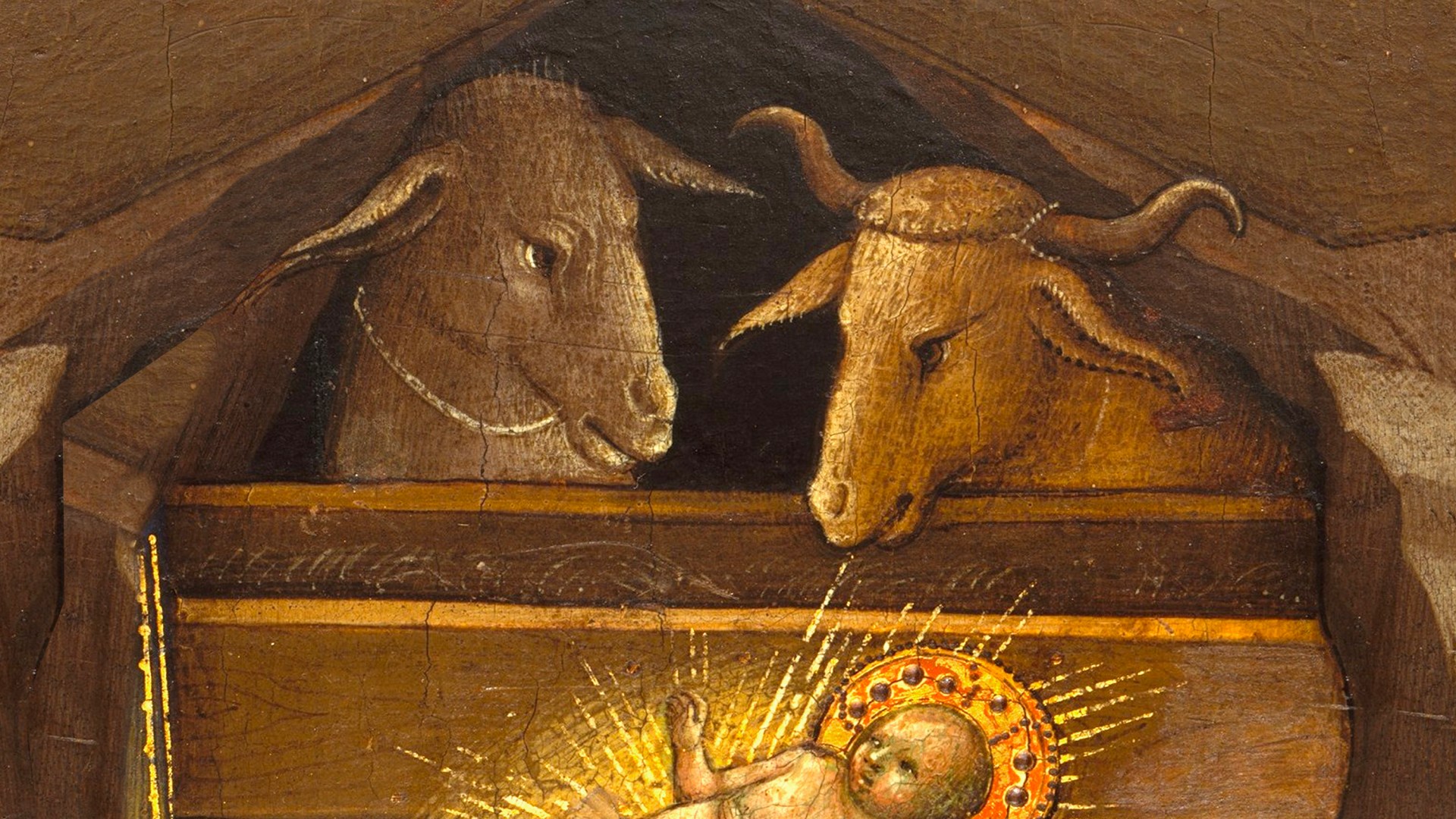
Where Ox and Ass Are Teaching

Many traditional Nativity scenes aren’t strictly historically accurate, but they teach us deeper biblical truths.

Detail from The Nativity of Jesus painted by Lorenzo Monaco

Detail from The Nativity of Jesus painted by Lorenzo Monaco

Christianity Today December 13, 2023
WikiMedia Commons / Edits by CT

Here’s a holiday tradition we should abandon: Well, actually-ing Nativity scenes in Christmas art and song.

It’s true that baby Jesus wasn’t surrounded by a petting zoo, that Mary didn’t give birth in a cave, that the Bible doesn’t say there were three wise men, and that those wise men were not literally kings. But this kind of “Nativity knocking” often stems from a basic misunderstanding of artistic depictions of the Christmas story.

The intent is good: to refocus our attention on the biblical text. Yet in practice, nitpicking the way Christian artists have long interpreted the Nativity misses deliberate artistic references to profound scriptural and theological themes. If we can stop sneering at their supposed lack of historical sophistication, these renderings can help us recover the wonder of Jesus’ birth.

Let’s start with the animals. Paintings and songs about the Nativity often show farm animals crowded around the manger. “Why lies he in such mean estate,” we sing, “Where ox and ass are feeding?”

It’s possible he didn’t. When Luke tells us there was no room for Mary and Joseph in the “inn,” he doesn’t mean Jesus was born in a separate building specifically for animals, as we think of a stable. The Greek word sometimes translated “inn” is kataluma (Luke 2:7, ESV), which meant the lodging space in ancient houses, typically an upper room or loft space. Because this was full, Mary and Joseph were compelled to stay downstairs, where animals sometimes lived.

The mention of the manger suggests animals were present, but Luke doesn’t specify cattle and donkeys. However, the ox and ass are rich symbols: They represent all creation coming to receive peace from the new king.

Adam and Eve dwelt with the animals in the garden (Gen. 2:19); God commanded all the animals to come to Noah in pairs (Gen. 6:19–20); and the prophet Isaiah says that in the new creation, all creatures will dwell in peace:

The wolf will live with the lamb, the leopard will lie down with the goat, the calf and the lion and the yearling together; and a little child will lead them. The cow will feed with the bear, their young will lie down together, and the lion will eat straw like the ox. (11:6–7)

Additionally, in the Old Testament, this pairing represented the joining of extremes. The ox is a clean animal (representing Israel), while the ass is an unclean animal (representing the Gentiles; Ex. 13:13). Together, then, these two animals signify the whole body of Christ.

“Do not plow with an ox and a donkey yoked together,” the Israelites are commanded in Deuteronomy 22:10, one instruction in a long list of purity rules. But Christ yokes together Jews and Gentiles in his body (Eph. 2:13–14), so the ox and ass side by side at his birth symbolize how this child will bring unity to Jews and Gentiles. The artistic choice to depict these two together gestures toward the eventual harmony of all creatures.

Many images of Christ’s birth—perhaps including your Nativity set—also depict Mary and Joseph in or emerging from a cave. Admittedly, Scripture never mentions a cave as the birthplace of Christ. In fact, his birth happens in a house. So why has a cave become a traditional setting?

The idea comes from early church fathers in the second through fourth centuries, including Justin Martyr, Origen, and Jerome, though it could also be influenced by the convert Emperor Constantine, who designated a cave—now the site of the Church of the Nativity—as the traditional site of Jesus’ birth in 335.

Beyond that history, however, caves appear in Nativity scenes for several theological reasons.

First, in Scripture, caves are often hidden places of protection and shelter. Lot and his daughters live in a cave when they are afraid to live in Zoar (Gen. 19:30). Obadiah hid a hundred prophets in a cave to protect them from king Ahab and Jezebel (1 Kings 18:4). David hid in a cave when king Saul was hunting him (1 Sam. 22:1; Ps. 57).

Throughout the Old Testament, caves protect people from death, so depicting a cave at Jesus’ birth teaches us that God will protect this child from all unwanted harm. He will bring his plan of redemption to completion.

Second, the cave is also a place of death. Caves were often used for tombs in the ancient world and thus came to represent access to the underworld. This is why artists often place the child Christ not only in a cave but in a sarcophagus. Jesus’ birth thus signals his death and descent to the dead. His life begins in a cave to remind us it ends in a cave.

Artistic depictions of the “three kings” are forward-looking too. These images draw on Matthew’s mention of the “wise men” who come from the east, bringing three gifts (Matt. 2:1, 11), and they’re seared into Western Christian memory with the song “We Three Kings.”

Of course, as scholars note, Matthew doesn’t tell us how many wise men there were, and he calls them “Magi,” specialists in dreams and astrological phenomena. But the “three kings” tradition in Christmas art isn’t arbitrary.

The Greeks and Babylonians divided the world into three parts: Asia, Africa, and Europe. This division predates Christianity, but it was received by Jews, and later, Christians, who thought (with ethically and biblically unjustified embellishment) that each continent was populated by the descendants of Noah: They believed Asians came from Shem, Africans from Ham, and Europeans from Japheth.

The three Magi, then, are symbolic representations of the three parts of the world. Like the ox and ass, they sketch the redemption of the whole earth.

The association with royalty also has scriptural roots. The prophet Isaiah predicted that the Lord’s glory would be seen in the midst of global darkness: “Nations shall come to your light, and kings to the brightness of your dawn … to you the riches of the nations will come … bearing gold and incense and proclaiming the praise of the Lord” (60:3, 5–6, emphasis mine).

Magi were not themselves royal, but they were often associated with royal courts. We can see this in the stories of Joseph, Moses, and Daniel, in which kings ask magicians for interpretations of dreams (Gen. 41:8; Ex. 7:11, 22; 8:18, 19; 9:11; Dan. 2:2, 10). Matthew’s account (2:11) may also deliberately echo Psalm 72:8–11, which says “kings of Tarshish and of distant shores bring tribute” to God’s king, falling down before him. Artistic integration of these themes communicates that all the nations will ultimately bow to Jesus.

Accuracy in historical reconstruction is valuable. But strict historical accuracy is not every artist’s primary goal, and we’ll miss deeper truths if we forget how to “read” art symbolically.

Nativity images in painting, sculpture, and song aren’t always trying to tell us precisely how Jesus’ birth occurred. Often, their purpose is to help us press into the meaning of the Incarnation. They remind us to ponder the significance of the Son of God taking on flesh to reconcile Jews and Gentiles, accomplish his plan of redemption, and return in glory as the King of Kings.

Patrick Schreiner teaches New Testament at Midwestern Baptist Theological Seminary in Kansas City, Missouri. He is the author of numerous books, including The Visual Word and Political Gospel.

Creation Waits in Eager Expectation

… for American Christians to take climate change seriously. At the COP28 climate summit, fellow Christians wait too.

Christianity Today December 13, 2023
Illustration by Mallory Rentsch / Source Images: Unsplash

The 28th annual meeting of the United Nations Climate Change Conference—commonly called COP28—is winding down in Dubai. I’ve been here with the Christian Climate Observers Program (CCOP), which brings 30 emerging leaders from around the world to bear witness to conference events. COP28 includes both intense climate action negotiations with officials from 200 countries and something like a world’s fair, with pavilions from almost every country as well as many different interest groups.

One group that is noticeably underrepresented is the American church. There’s a faith pavilion here for the first time, and I’ve seen presentations from Muslims, Jews, and many Christians from other parts of the world. But aside from Americans involved via CCOP, I’ve not seen anyone representing Christians in the US.

Perhaps that’s not surprising. Christians are less likely than other Americans to think climate change is a serious problem, and evangelicals have the least concern about the environment of any American religious group. With fellow climate skeptics, they’re apt to argue that there are “bigger problems in the world,” and anyway, “God is in control of the climate.”

Those rationales for inaction may sound realistic, practical, even biblical. But they miss deeper scriptural themes of love, justice, and the responsibility for creation that God has shared with humanity on this side of eternity—and the next.

It’s true that many people have more immediate problems than climate change, but once you grasp the scale of the risk here, it’s hard to imagine a more significant threat to so many people’s way of life and livelihood, and even to life itself.

Not for nothing does the Department of Defense recognize climate change as a threat multiplier, which amplifies the potential danger to US national security from wars, immigration, and natural disasters. And when you hear directly from people whom climate change is affecting now, the seriousness of the problem is palpable.

I attended a session at COP28 at which the representative from Tuvalu was given the floor. He spoke passionately about his small island nation in the South Pacific where the highest elevation is just two meters above sea level. Families have already had to relocate away from the shore because of sea level rise, and storm surges now flood their fields and wells with salt water, rendering them unusable.

Tuvalu’s representative was dismayed over the lack of meaningful progress at COP28 to cut greenhouse gas emissions. “How can I go home from this meeting and tell them our country’s future has not been secured, and the world doesn’t seem to care?” he pleaded with the assembly.

Our CCOP group met with Rev. James Bhagwan, the general secretary of the Pacific Conference of Churches. He too testified to the imminent catastrophe for the 15 million people of these island nations, 90 percent of whom are Christians. They wonder why fellow Christians in America seem so unwilling to hear their cries, he reported. “Are we not your neighbor?” he asked, referring to the parable of the Good Samaritan (Luke 10:25–37). “Are our lives worth less than your comfort?”

If appeals to faith or justice don’t motivate us, Bhagwan added, maybe we would consider a more pragmatic angle: “I’m not just fighting for Pacific Islanders; I’m fighting for you too. It’s going to happen to us first, but it will happen to you eventually, and by then it will be too late to do anything about it.”

A common response to such pleas is that second rationale given by people who don’t think climate change is a serious concern: God is in control, they say, so it doesn’t really matter what we do. I asked Bhagwan how he’d respond to that view. “They need some rainbow theology,” he answered with a little laugh. “Our islands are being destroyed by water, but after Noah’s flood, God put a rainbow in the sky and promised never again to destroy the earth with water. So it must not be God’s doing now. It is us!”

I would point the American church beyond Genesis to Revelation: We need a better eschatology. Too many Christians believe that because this world is our temporary home, it doesn’t matter what we do to it. We can extract and consume the earth’s resources and treat it as a landfill, they think (or act and vote as if they think), because it will be replaced by heaven for eternity.

I believe there’s a better and more biblical way of looking at God’s intent for our world—at what it means for him to be in control and the role he wants us to play in his plan of redemption. The earth as we know it is not our ultimate home, but neither is it unconnected to our ultimate home. Theologian N. T. Wright reminds us that the New Testament does not say the earth gets trashed and we’re all whisked away to some immaterial heaven. We are resurrection people. And resurrection is not a second creation ex nihilo; it is a transformation of what now exists.

Jesus’ earthly body didn’t stay in the tomb or simply disappear. It was transformed into a resurrected body that wasn’t limited by the same natural laws. But, crucially, his resurrected body still bore the scars of how his earthly body was treated (John 20:24–29).

The heavens and the earth will be transformed and renewed at the consummation of God’s kingdom (Rev. 21:1). This redeemed creation will last for eternity, not subject to decay like our current universe. But will it too bear the scars of how we have treated it? Does our behavior now place parameters on what the renewed earth can be? In this Advent season we might also ask whether God is waiting to fully inaugurate the kingdom (2 Pet. 3:9) in part because we haven’t yet learned to care for his creation.

Our climate problems are complex, and I offer no simple solutions. But there is a path toward caring: Start by learning about and praying for those on the frontlines of climate impacts (maybe join Climate Intercessors). Then take action to reduce your own carbon footprint and suggest your church take steps in this direction too. And consider getting involved with organizations like CCOP, the Evangelical Environmental Network (EEN), BioLogos (where I work), and A Rocha, all of which take both Christian faith and climate science seriously.

What we do here and now matters for eternity, and not just for our souls. Bodies matter, land matters, water matters. Bhagwan suggested we could learn something about this from the Pacific Islands’ indigenous culture, which recognizes that humans “are part of creation” and rely on the land and sea to flourish.

We Christians—of all people—should understand this aspect of our dependence on God. We should take an active interest in the present flourishing and eternal future of the planet and its people. In the American church, we have been apathetic about God’s world, and it is time for us to care.

Jim Stump is vice president for programs at BioLogos, host of the podcast Language of God, and author of the forthcoming book The Sacred Chain: How Understanding Evolution Leads to Deeper Faith (HarperOne, spring 2024).

Theology

A Korean Sect Targeted New Zealand Christians. Did Churches Respond Effectively?

Former members describe how Shincheonji infiltrated traditional churches and campus ministries with deceptive practices and heretical beliefs.

A Branch of the Shincheonji Church of Jesus

A Branch of the Shincheonji Church of Jesus

Christianity Today December 13, 2023
Jung Yeon-Je / Getty

Laura was volunteering at the welcome desk of LIFE Central church in Auckland in April 2015 when a friendly man introduced himself, asked a few questions about her church, and then left.

Unbeknownst to Laura, after this brief encounter, the man organized one of his coworkers to return to the church the next week. The woman explained that she had just moved from South Africa as a student conducting research on education. After talking for a bit, Laura started to open up to her about some of her struggles and questions about the faith. In response, the woman suggested Laura meet with her mentor, who she said could address Laura’s problems about the Bible.

She began meeting with the woman’s mentor, a Korean woman also visiting from South Africa, for weekly Bible studies. After a few weeks, the mentor began pestering Laura to join a larger six-person class that met three times a week. Laura eventually agreed.

As someone who had experienced hypocrisy and lukewarm community at the mainline Presbyterian and Pentecostal churches she attended in the past, Laura found the intense, Bible-based classes compelling. Laura recalled a tight-knit group of South Africans, Koreans, and New Zealanders eager to learn God’s Word. Laura said the instructor taught her how to read Jesus’ parables and the Book of Revelation as prophecies foretelling Jesus’ Second Coming. The teacher stressed that she and her fellow students needed to know the secret meaning of certain Bible verses to obtain true salvation.

“At the time, I thought it was a beautiful way to read the Bible—it was so poetic,” Laura said. By the end of the year, she and her five classmates officially joined (or “passed over”) into a group she then learned was called Shincheonji. (Laura asked to use only her first name as she still has friends in the group.)

Shincheonji, which means “new heaven and new earth,” is a religious movement established in South Korea in 1984 by Lee Man-Hee. Members are taught that Lee is the “promised pastor” of the New Testament—the messenger mentioned in Revelation 22:16—and that the Book of Revelation is written in parables that only he can understand. The group is known for its intensive Bible studies, recruitment of members from existing churches and Christian fellowships, and use of deceptive practices like withholding names and affiliation.

After spreading in South Korea, Shincheonji expanded internationally in 1990. The group’s internal statistics from 2019 obtained by CT said that almost 32,000 of the group’s about 240,000 official members live outside of Korea.

In response, Christians around the world have pushed back. In South Korea, churches routinely put up signs that read “Shincheonji is not welcomed here.” Former members have shared their stories on websites, podcasts, and internet forums like Reddit to debunk Shincheonji’s theology and expose its deceptive practices. In New Zealand, pastors have held talks and seminars to inform church leaders on how to protect their flock. Christian counselors provide counseling for people leaving Shincheonji.

CT tracked Shincheonji’s spread in New Zealand over the past eight years, interviewing former members, pastors, and experts on what churches around the world should look for and how churches can respond to the group. Shincheonji in New Zealand did not respond to CT’s request to comment by publication time.

From humble beginnings

Born in 1931, Lee Man-Hee is a Korean War veteran and farmer who claimed that he experienced “visions and revelations from divine messengers and from Jesus himself,” according to a 2020 article by sociologist Massimo Introvigne, who interviewed Lee and other Shincheonji members. (Introvigne, founder of the Center for Studies on New Religions (CESNUR), has been criticized for being sympathetic to groups like Scientology.) In the ’60s, Lee joined a fast-growing religious group called the Olive Tree, whose founder, Park Tae Son, claimed to have the power of healing and to be the last prophet before the millennial kingdom. Eventually Park started teaching that he was the Messiah and the Bible was wrong. This led Lee and many others to leave the group.

Lee Man-HeeWikiMedia Commons
Lee Man-Hee

Lee was then a member of Tabernacle Temple, a group founded by eight people who gathered on Cheonggye Mountain for 100 days and believed the Holy Spirit gave them an inspired interpretation of the Bible. Yet the group fell into corruption and division, with its founder arrested for fraud. Lee was outspoken about the corruption of the Temple and eventually started his own religious group called Shincheonji in 1984.

“It wasn’t successful at first,” explained Ezra Kim, a California pastor with an active ministry counseling current and former Shincheonji members. The group, which primarily focused on Lee Man-Hee’s interpretations of the Book of Revelation, had less than 120 members in 1986, according to Introvigne. Growth began to pick up after the formation of an in-house “seminary” called Zion Christian Mission Center in Seoul in 1990, which prepared members through courses and exams. By 2007, Shincheonji had 45,000 members.

To grow their numbers further, Shincheonji members began targeting Christians from existing churches to join their Bible studies, Kim said. From 2010, the group began employing deceptive tactics (described by members as practicing “wisdom”) that grew its numbers exponentially. By 2016, Shincheonji reported having 170,000 members.

Shincheonji’s first overseas branch opened in Los Angeles in 1996, with subsequent branches in Berlin (2000), Sydney (2009), Cape Town (2012), and elsewhere. By 2019, Shincheonji mission centers had been established in 29 countries.

Shincheonji reaches New Zealand

Shincheonji’s first “missionaries” arrived in New Zealand on visitors’ visas from South Africa in March 2015, a month before making contact with Laura and her classmates. After Laura officially joined the group, leaders in South Korea appointed her and two other members as key leaders and legal trustees for Shincheonji’s official presence in New Zealand, under the name Rakau o te Ora (meaning “The Tree of Life”).

“[When] they asked us to sign and become trustees, we were like ‘peak passion,’” Laura recalled. “It was like the beginning of a relationship, [when] you’re only seeing the good things.”

By the time news of Shincheonji had reached New Zealand media in 2017, the group’s ranks had increased to around 70 members and recruits, most of whom were poor college students, according to Laura. Most of Shincheonji’s growth in Auckland came from Shincheonji members visiting church congregations and campus ministry groups and inviting Christians to join Bible studies, she said. When asked, they would say they were part of Zion Mission Center, New Heaven New Earth, or Mount Zion. (In recent years they have also used names like Cornerstone and Pathways Ministries.) They also falsely claimed their instructors were theologically trained at New Zealand’s Bible colleges, according to Laura.

Members often recruit unsuspecting friends and acquaintances. For instance, in 2017, Jeremy Chong (no relation to the author) had recently graduated from the University of Auckland when his friend and fellow campus ministry volunteer persuaded him to attend a new class led by his mentor. When he showed up at the address for the class, he was surprised to find a lecture room set up inside a suburban home.

In his class of 10 students, Chong later discovered that half of them (including his friend) were already Shincheonji members pretending to be first-time learners. Initially the lessons took place once a week but eventually grew to twice and then three times a week. Gradually, the teachers began to say, “We’re part of something more, but we’ll reveal the truth when you’re ready,” Chong wrote in an online testimony. They also instructed Chong and his classmates to cut ties with their churches, calling them “false seeds” who were not from “the true river.”

Eventually, Chong’s instructors announced a special session where he and his classmates had to dress up nicely in a white shirt and a suit. What he thought was another class turned out to be a big worship service at a rented office building in central Auckland that Shincheonji used as its temple. There, he and his other students “passed over” into the group.

“There were a lot of people cheering,” Chong recalled. “We bowed down to a screen of Lee Man-Hee. In my head, I thought: ‘Why am I doing this?’ But it happened. And after this, they then told us, ‘Now you know that we’re part of this group called Shincheonji.’”

Lying and deception in Shincheonji

Shincheonji teaches its students not to let their friends and family know about their classes until they have become sufficiently conditioned to accept their more controversial teachings. For instance, Josh was the student president of Auckland Student Life (a campus group affiliated with Cru) in his senior year when he was first asked to lie to his family about attending a thrice-weekly “Bible study” with a man who claimed his name was Matt. Josh had first met Matt in October 2018 through a high school friend. When Josh shared that he was going on a summer mission trip, Matt then invited him to some “mentoring sessions” he was leading. (Later, Josh found out that Matt was using a fake name).

Josh recalled that his new mentor said a couple of “outrageous things,” such as God doesn’t answer prayer. “But to me, it seemed like they were all from the Bible, because he was just able to say Scriptures off the top of his head.” (Josh asked to only use his first name, as he continues to counsel current and former Shincheonji members.)

Shincheonji instructors eventually convinced their recruits that God permits lying if it is done for “God’s will.” Before Josh’s sessions commenced in January 2019, his mentor warned him to keep them a secret, pointing to Abraham’s silence before heading out to sacrifice Isaac in Genesis 22. Josh concocted a story about teaching private guitar lessons three mornings a week, a lie he told his parents, his girlfriend, and Student Life colleagues.

When church leaders and a campus staff worker confronted Josh with evidence that he was attending Shincheonji classes, his Shincheonji instructors gave him step-by-step instructions on how to deny his involvement. They even gave Josh pre-written letters expressing “inexplicable hurt and confusion” about his family and friends’ accusations and claiming that he was no longer involved in Shincheonji activities. Josh sent the letter to the church yet continued his classes, and in May 2019 he “passed over” into the group.

Inside Shincheonji

Life inside Shincheonji in New Zealand was relentless for the former members who spoke to CT. Chong said that after “passing over,” Shincheonji became church for him. Lessons were scheduled for every day of the week, and he was scolded for working and urged to abandon his family to “evangelize.”

Leaders asked Chong to give them the names of all his friends, including private information such as “physical descriptions, their relationships, what their weaknesses are, how well they knew their Bibles … so we would know what to target,” he wrote.

Alannah (then a close friend who is now married to Chong), recalled how tired he was all the time. “There were a couple of times we’d be hanging out together … and he would say: ‘I’ve got to go out and meet someone.’” She wondered if he was seeing his ex.

For Josh, the lying continued. “I was fully dependent upon them for my decisions … [the question] ‘What do I say?’ was always filtered through them.”

Zealous to give his life to spread these teachings, Josh worked his way up the ranks to become a cell leader and began to recruit others into Shincheonji using the same methods he was recruited with. Josh and other members were given “unrealistic goals to achieve” and challenged to change their mindsets since the “second coming of Jesus” had come with Lee Man-Hee. To justify studying until 4 a.m. for tests, “I was told that I should not be able to sleep if I perceived how important this work was,” Josh wrote.

Shincheonji’s slowing spread in New Zealand

By July 2022, there were at least 200 Auckland-based members from a broad range of ethnic groups, according to internal lists obtained by CT. In contrast, numbers in the capital city of Wellington had grown more slowly: Between the time Laura and several other members started a branch there in 2018 and 2022, Wellington had only grown to 35 members. Laura remarked that Auckland’s large immigrant and ethnic church populations have proved more fertile soil as “Asian culture takes more easily to the ‘heavenly culture,’” which is what Shincheonji calls traditional Korean culture.

Pacific Island culture is also very hierarchical, Laura said, so in 2023, New Zealand–based Shincheonji members began sending locally trained missionaries to Samoa.

In contrast, the more Pakeha (New Zealanders of European descent) population in Wellington proved to be more independent, individualistic, and skeptical, Laura said. “It’s a lot harder for them to accept the Korean culture and collectivist ideas of [Shincheonji].”

Another factor for the slow growth in Wellington could be an increased awareness of Shincheonji and its tactics.

Since 2021, New Zealand–based members of the Shincheonji forum on Reddit have frequently posted “sightings” and warned about the group’s deceptive recruitment strategies, such as impersonating a local Bible college and using various front groups like Heavenly Culture, World Peace, Restoration of Light (HWPL). Local media have reported on ex-members’ stories, and evangelical church leaders in Wellington have also been proactive in warning their congregations, other local churches, and the general public about Shincheonji.

In 2019, Andrew Southerton, senior pastor at City on a Hill in Wellington, wrote on his church website that while Shincheonji’s classes appear like Bible studies, they are in reality “an exercise in social engineering.”

He added that “the cult has sought to exploit many of the best aspects of City on a Hill for its own ends—our open and welcoming culture, our love for sharing the gospel with others, and our deep desire to be learning and growing from God’s Word.”

Churches throughout New Zealand report that Shincheonji had swept up entire families, including key leaders, into the group. Often, the extent of deception and damage is only discovered after months of covert activity. Steve Worsley, lead pastor at Mt Albert Baptist in Auckland, said Shincheonji targeted his church extensively between 2016 and 2018.

“When asked what attracted members to Shincheonji, I was stunned by the answer: ‘Biblical truth,’” Worsley wrote on his denomination’s website. “If people are experiencing greater hunger for Bible knowledge in cults than in regular New Zealand churches, what should churches do about that?”

Chong’s experience mirrored Worsley’s sentiment. He felt “super religious” during his time in Shincheonji. “After all, I was going to a religious thing five times a day, learning the Bible,” Chong wrote. “It makes you feel hyper-religious. When I did everything, I felt very connected to God. But ultimately, it was a completely works-based group.”

The turning point for Chong was when his teachers couldn’t give a proper answer to why they denied the divinity of Christ. Chong left Shincheonji in 2018 with the help of a Christian friend.

Help getting out of Shincheonji

What can family members do when they find a loved one is involved with Shincheonji? Kim, the pastor in California who leads Bible studies for ex-members of Shincheonji, suggests three steps to take.

First, do nothing, he said. People usually want to say, “Shincheonji’s a cult” or “Your Bible study is wrong,” Kim noted. Yet Shincheonji instructors have already conditioned them to believe these claims are a form of persecution.

The next step is to foster a stronger relationship with the person without speaking negatively about the group. Members of Shincheonji and other cults typically spend more than 20 hours a week together and experience a heightened sense of community and deep purpose. In contrast, Kim points out that most families struggle to have meaningful relationships and rarely talk about issues together.

“How can you do deep conversation suddenly when you’ve never done this kind of conversation in real life?” Kim said. “To save your loved one [from Shincheonji], you need to restore your relationship with them first.”

Only within the safety of a trusted relationship—a process that often takes months or years—is the final step of gently restoring them (Gal. 6:1) possible. Options include introducing Shincheonji members to former members or experienced pastors, sharing the stories of former members, or passing along resources explaining Shincheonji’s frequent doctrine changes, Lee’s past involvement in doomsday sects, and ultimately the better and completed ministry of Jesus Christ (Heb. 1:2).

For Josh, it was through discovering these resources and seeing the numerous contradictions within Shincheonji’s teachings that he was eventually convinced to leave the group in 2022. “What had once started as such a logical word [referring to Shincheonji’s teachings], was now so illogical,” he said.

Christian leaders should also be aware of cultural practices in their own ministries that commit the same sins as Shincheonji. “If cults keep their real agendas from new recruits, then are we fully transparent when we promote or invite people to attend church programs that have evangelistic content?” Worsley observed. “If cult leaders may not be questioned, do we pastors allow our leadership and Bible teaching to be open to question?”

For instance, a recent investigation into Arise Church, New Zealand’s largest megachurch, revealed an internal culture with several features similar to Shincheonji such as centralized power and the practice of “uplining,” or passing private information on to superiors without consent.

Tore Klevjer, an Australia-based biblical counselor who frequently ministers to former members of Shincheonji, suggested viewing Shincheonji through the lens of an abusive relationship. Former members who struggle to engage with the Christian faith will “need love and care and space to heal at their own pace,” Klevjer said.

For those who choose to keep reading their Bible, he recommends changing to a translation different from what was used in Shincheonji (typically the 1984 New International Version) to read God’s Word with “new eyes and not automatically see the cult interpretation.” When reading the Bible is too difficult, Tore counsels ex-members to pursue other spiritual disciplines or to reflect on God’s creation and his attributes of love and mercy.

Josh points out that most people will eventually leave Shincheonji but need help rebuilding their lives, and that it will take time for them to reconsider Christianity. The eventual death of Lee, who is now 92 years old, could also prompt doubts. (According to Introvigne and former leaders, prophecies taught in Shincheonji claim that Lee will not die.)

“Try and be there for them when the time comes,” Josh said. He regularly prays for his fellow ex-members as well as members who are unable to leave Shincheonji or those who have considered leaving. As for his former mentor, “He’s just a brick wall,” Josh said. “I hope he leaves and can realize all the wrong things he’s done. I just see him as a victim—conditioned, exploited. I do feel sorry for him.”

Laura’s decision to leave Shincheonji was sparked by a phone call from a former senior Shincheonji member she admired, who told her that she had left the group. “It gave me permission to think about my own doubts,” she said in an interview with Radio New Zealand. She cut ties with the group in 2020. However, it took another year before Shincheonji finally removed her name as one of its New Zealand trustees and guarantors for its building’s lease payments. Today, she no longer identifies as a Christian.

Laura was circumspect when asked what followers of Jesus could have done differently for her. Like Kim, she noted that if Christians had tried to use doctrine to convince her that Shincheonji was wrong, she would have been prepared with answers for their questions. She would have assumed that she was being persecuted.

“So the best thing you can do is to show love,” Laura said. “That’s what Christianity is about, right?”

Additional reporting by Angela Lu Fulton.

Theology

We Forget We Belong to God

The healing balm of finding our true identity

Phil Schorr

But you are a chosen people, a royal priesthood, a holy nation, God’s special possession, that you may declare the praises of him who called you out of darkness into his wonderful light. — 1 Peter 2:9

To celebrate the eternal king’s inauguration is to celebrate how, through Jesus, we find freedom from the bondage of sin and death. We who were far off have been brought near into a restored relationship and eternal rest with God (Eph. 2:13).

Peter’s words were written to Gentile Christians living as “foreigners and exiles” in the Roman Empire (1 Pet. 2:11). They were noncitizens or temporary residents in a world that highly valued citizenship in its social hierarchy. It was also a time when Rome’s tolerance for religious freedom was diminishing. Peter was writing to marginalized and persecuted Christians, suffering for their allegiance to King Jesus. In 1 Peter 2:9, the apostle provides his readers with a healing balm, a reminder that God, not people, determined their true identity. Peter uses four phrases to describe their identity in Christ: a chosen people, a royal priesthood, a holy nation, and God’s special possession.

His words point back to Exodus 19:4–6, where God explained to Moses the purpose behind his desired covenant with Israel. Israel had been set apart to show the world what it meant to worship the one true God. They would experience his blessing as they served as a conduit for God’s blessing to the world.

Suffering and persecution can dehumanize and demoralize a people, stripping them of their dignity and hope. What the world tried to take from these Christians, Peter sought to restore. He reminded these “foreigners and exiles” of their elevated status. Through Christ, they were members of the family of Abraham with direct access to the divine. They had an eternal status as royal priests set apart to lead the nations to God.

Through the gospel, we who have been dehumanized are rehumanized, clothed with strength and dignity because of the one in whose image we are made. But in a world infected with sin and evil, it can be easy to forget.

We forget we belong to God. Blinded by the struggles of life, we have difficulty seeing the eternal hope we have simply because we are his.

But in the words of Shirley Caesar, “This hope that we have, the world didn’t give it to us, and the world can’t take it away.” No matter how dark the night is, we always have hope. Through Christ, God’s steadfast love and faithfulness follow us forever. So, in the midst of suffering and persecution, our eyes look to the eternal, not the temporal. We remember that our identity, value, and calling are determined by God, not by man. We will be his people for eternity; our forever home is with him.

Reflection Questions:


1. How does understanding our identity as a chosen people and God's special possession shape our perspective on suffering and persecution?

2. In what ways does the world try to define our identity and value? How can we guard against forgetting that our true identity is determined by God?

Elizabeth Woodson is a Bible teacher, theologian, author, and the Founder of The Woodson Institute, an organization that equips believers to understand and grow in their Christian faith.

This article is part of The Eternal King Arrives, a 4-week devotional to help individuals, small groups, and families journey through the 2023 Advent season . Learn more about this special issue that can be used Advent, or any time of year at http://orderct.com/advent.

News

Mike Bickle Confesses to Past ‘Moral Failures’ But Not Sexual Abuse

The International House of Prayer founder speaks out for the first time as the ministry launches a third-party inquiry.

Mike Bickle, founder of IHOPKC

Mike Bickle, founder of IHOPKC

Christianity Today December 12, 2023
Courtesy of IHOPKC

International House of Prayer Kansas City (IHOPKC) founder Mike Bickle has admitted to “inappropriate behavior” and “moral failures” that took place more than 20 years ago—but he says the claims of sexual abuse that emerged against him this fall are false.

Bickle publicly addressed recent allegations of abuse for the first time Tuesday, saying he had repented for his “past sins,” apologizing for how the situation has affected his family and ministry, and asking followers not to come to his defense online.

“Some may wonder why I am just now making a public statement 20+ years later? It is because I was recently confronted about things that I said or did 20+ years ago—things I believed were dealt with and under the blood of Jesus,” he wrote. “Since this has now become public, I want to repent publicly.”

A group of former IHOPKC leaders released a statement in October saying Bickle had been accused of sexual misconduct “where the marriage covenant was not honored” and that they had heard corroborating testimony from “several victims.” In The Roys Report last week, a woman alleged that Bickle sexually abused her while she was an intern at IHOPKC 27 years ago.

Bickle has been on leave from the ministry since October 26 while IHOPKC leaders looked into the allegations. On Sunday, after weeks of back-and-forth, the church announced a third-party investigation. Bickle said he drafted a statement on October 28 but was advised by legal counsel to wait.

Bickle, 68, did not describe his past “inappropriate behavior” other than to say he wasn’t admitting to the “more intense sexual activities that some are suggesting.” He also referred to “false allegations” of sexual abuse.

He said he had previously “quickly and sincerely repented,” though he was still sorrowful over his sin.

Earlier this fall, a group of former IHOPKC leaders—referred to by the ministry as the “advocacy group”—had learned about allegations against Bickle spanning decades.

Dwane Roberts and Brian Kim, who had previously served on IHOPKC’s executive leadership team and board, and Wes Martin, former Forerunner Christian Fellowship pastor, said they attempted to meet with him directly and then brought their concerns to IHOPKC leaders when he refused.

Leaders calling for transparency and accountability from IHOPKC believe Bickle’s confession to “inappropriate behavior” falls short.

“This is a fraction of what Mike is actually guilty of,” preacher Joel Richardson posted. “This is nothing more than a public relations move.”

IHOPKC has brought on a new spokesman, Eric Volz, with the international crisis resource agency David House. Volz called Bickle’s statement “a step in the right direction” and said, “We clearly have two sides to this story and this is 100% why we need an independent third party investigation.”

Bickle is a major figure in charismatic Christianity, and his prayer movement has spurred hundreds of “houses of prayer” around the globe. In Brazil, the Florianópolis House of Prayer was the first church to distance itself from Bickle while the investigation took place.

Bickle referred to the social media debates and online distain surrounding the allegations. He advised family and friends to not come to his defense and to not insult his detractors. “I have confidence the Lord will speak concerning what He sees and says about me in His timing,” he said.

https://twitter.com/mikebickle/status/1734609844886499431

IHOPKC shared Tuesday’s statement on social media and told followers, “Please continue to pray …”

Bickle plans to refrain from public ministry for an “extended season” and possibly indefinitely.

“I see this as God’s ‘delayed’ loving discipline on my life (Heb. 12:6, 11). I will look to other leaders to determine how long this season will last—it may be long and it may be even permanent,” the letter said. “I will only reengage in my preaching ministry if God confirms it through others.”

Books
Excerpt

God’s Last Word Is Jesus

Christmas celebrates the finality of Christ’s incarnation.

Christianity Today December 12, 2023
Illustration by Mallory Rentsch / Source Images: WikiMedia Commons

Christmas is the celebration of a conclusion. A baby who cannot yet talk is the divine Word of God spoken to humankind. A child lying in a manger on a dark night in a poor town completes thousands of years of sacred history.

Lights a Lovely Mile: Collected Sermons of the Church Year

Lights a Lovely Mile: Collected Sermons of the Church Year

Waterbrook

320 pages

$9.42

Mary’s firstborn is God’s last word. “In many and various ways God spoke of old to our fathers by the prophets; but in these last days he has spoken to us by a Son, whom he appointed the heir of all things, through whom also he created the world.” (Heb. 1:1–2, RSV).

God’s first recorded speech in Scripture consisted of words of one syllable: “Let there be light” (Gen. 1:3). The first thing we are told about God is that in creating a place for humanity, he provided visibility. He did not leave us to grope in darkness. God let humankind see where they were going.

The simplest and most elementary condition of human existence is the subject matter for God’s first word. Beyond the satisfaction of her needs, light is the first reality a baby shows awareness of. Before she can see a face or distinguish a father from a mother, she sees and can re­spond to light. Just so basic is the content of God’s first word in creation. He offered no complicated notions on predestination, reconciliation, or sanctification—only the one-syllable words “Let there be light.”

The early chapters of Genesis are a primer on God. God spoke using words that everyone could grasp: day, night, earth, trees, waters, stars, birds, fish, beasts, man. Before we have read past the first chapter, we have heard God speak a basic and decisive word to us in terms that a child can understand. We turn the pages and hear of sin and murder, war and judgment, music and crafts, build­ing and history. We hear the profound words of God speaking to us of his will and his ways.

We come to the great names of Abraham, Isaac, Jacob, and Joseph. God was still speaking, and his word was expanding. The history and lives of these people became the vocabulary of God’s message. There was still no mistaking it for anything other than the word of God, but he filled out the narrative and filled in the details of each life situation.

God called Abraham, accompanied Isaac, changed Jacob, and saved Joseph. The message still carried a majestic simplicity, but the context grew more intricate and com­plex to match the intricacy and complexity of our lives.

The words multiplied in Moses’ story. Thousands of people were forged into a new nation. Their lives were placed in relation­ship and formed countless possibilities for sin, faith, rejection, re­bellion, worship, and love. And with each new event came a new word. Moses transmitted the word of God in commandment, regu­lation, and exhortation to the people of God (Israel).

Because many people were living in close proximity, Moses had to render fine ju­dicial decisions. Because long stretches of time separated promise from fulfillment, he had to preach convincing sermons. The word of God found new applications and fresh situations. The primer of Genesis chapter one gave way to an advanced-level textbook.

The centuries passed, and in imitation of Moses, many tried their hands at speaking the word of God. They shouted advice, counsel, rebuke, and guidance to the people. Some of the speaking bore authenticity; some of it was patently spurious. But the net ef­fect was confusion.

With so many “words” of God being spoken, who could hear the word of God? God restored authority and le­gitimacy to his word by inaugurating a kingship in Israel: Saul, David, and then Solomon. No longer could people set themselves up to speak to the nation. God had his anointed through whom he ruled and spoke. Credentials accompanied the spokesperson for God. Organization and coherence again encompassed the word of God.

But then, as so often happens, the organization became profes­sionalized. The word of God turned into a formal edict. The insti­tution became dead to its Lord. The kings grew more interested in politics than in prayer, more engrossed in government than in God.

And this created a new way of speaking the word of God: through the prophets. Isaiah thundered, Jeremiah wept, Amos denounced, and Hosea pled. Indifference gave way to sensitive response. Deaf ears were traded for alert minds. The prophets were gifted with eloquence and insight. They spoke the word of God with power and clarity. It was an exciting word, a glad word. No human word could stand in comparison to it.

This passage from Isaiah reverberates down to our times:

How beautiful upon the mountains
are the feet of him who brings good tidings,
who publishes peace, who brings good tidings of good,
who publishes salvation,
who says to Zion, “Your God reigns.”
Hark, your watchmen lift up their voice,
together they sing for joy;
for eye to eye they see
the return of the Lord to Zion.
Break forth together into singing,
you waste places of Jerusalem;
for the Lord has comforted his people,
he has redeemed Jerusalem.
The Lord has bared his holy arm
before the eyes of all the nations;
and all the ends of the earth shall see
the salvation of our God. (Isaiah 52:7–10, RSV)

As all this was written down and pondered by succeeding gen­erations, it brought bewilderment and confusion. It needed inter­pretation. A new profession came into being to guide the people through the forest of words. Scribes and rabbis became the peo­ple’s allies in hearing the word of God. They in turn wrote com­mentaries and interpretations of what had been written, and their words soon engulfed the word of God in an ocean of comment.

Yet what the people needed was not another commentary but a conclusion—not another book but a last chapter to the book they already had. The process could become interminable, so there had to be a stopping place. The logical search for complete truth would never end. The people needed a revelation.

So, God spoke a last word: Jesus. But there is a surprising dif­ference in this word. Jesus is not just a speechmaker for God; he is God. His whole being is a word of God—his presence, his action, and his talk. We complain that the deeds of some people speak so loudly that we cannot hear what they say.

Yet we cannot make that complaint of Jesus, for his deeds and words are identical. Jesus became an event. He was a stopping place for sacred history. The birth of Jesus was like arriving at the top of a mountain peak after a long, difficult climb: You can look back and see the whole trip in perspective, see everything in true relationship. And you don’t have to climb anymore.

But I have been talking as if everyone has spent years struggling with the meaning and conclusions of the Old Testament. More likely, you have not read it through for years, or maybe you have never read it at all. What does this text say to you who have not pondered the first words, who have not been bothered by the frag­mentariness of Scripture? Will the last word have any meaning if you have not read the first word? Will the answer make any sense if you have never asked the question?

A great many Old Testament prophecies had been left unful­filled. Many things were said of the future that never came to pass. Many hopes were articulated that no reality ever confirmed. And then Jesus was born in Bethlehem. One of the great thrills of the early church was seeing this great mass of unfulfilled detail sud­denly come together in fulfillment in Jesus Christ. The Old Testa­ment suddenly had a point to it—and the point was Jesus.

We can see the operations of their excited minds in all the New Testament letters: “This was done in fulfillment of Isaiah … of Moses … of Jeremiah …” (see Matt. 2:17, 4:14; Luke 24:44). All the loose ends were tied together. All the strained interpreta­tions they had been forced to manufacture to hold things together could now be thrown out because Christ held things together in a conclusion. All their labored attempts to explain away inconsis­tencies and gaps now were done away with because Jesus gave all the words wholeness and integrity.

This is why the church has consistently insisted on the necessity of keeping and reading the Old Testament. There was a strong movement in the first centuries of the church to abolish the Old Testament. Those believers reasoned that since we have everything in Christ, why bother with all the incompleteness and fragmentari­ness of Israel?

Why plow through all those genealogies (such as 1 Chronicles 3:10, RSV, which says, “The descendants of Solomon: Rehobo’am, Abi’jah his son, Asa his son, Jehosh’aphat his son”) when one really needed to know only the name above every name—Jesus? But the church didn’t accept this reasoning.

All of that really is the word of God spoken to humankind in various conditions and times: The word is as true as ever. Although it is old, it is not obsolete. Although it is ancient, it is not antiquated. And if it is not read, the foundation of Jesus is never understood. To skip reading the Old Testament would be to skip the first thirty-nine chapters of a forty-chapter book.

The Confession of 1967 summarizes the church’s stance: “The Old Testament is indispens­able to understanding the New, and is not itself fully understood without the New.” This is why it is the usual practice to give an exposition of the Old Testament during Advent, so that the gospel of Christmas is seen in its true setting.

But while the importance of reading the Old Testament cannot be too strongly emphasized, I cannot say that everything depends on it. If you are one of the many who do not read it or have not read it enough, you will still find a meaning in the text. The reason is that God has not confined his speaking to what is recorded in Scripture. That is where his authoritative word is written, but he has spoken many other times and in many other places—in places where we have been and at times when we have heard him.

If each of us were to write a completely honest and thorough history of our personal life up to the present, that would in many ways parallel the writing we call the Old Testament. That autobi­ography would begin with the simplest facts: birth, life, light, food, parents, disobedience, and rebellion. And as the years increased, the words would become more difficult and the arrangement more complex.

From the simple elemental realities of infancy would come the intricate emotional, physical, and mental realities of ado­lescence and adulthood. Nothing that we would thus record would be untrue, but we would have to confess that much of it did not make sense. Many thoughts, events, feelings, and experiences would appear to be in contradiction and at cross-purposes.

The body makes promises for which there is no fulfillment. The emo­tions cry out for satisfaction that is never given. The mind asks questions for which no answers are found. As we look back on them, our lives quite undeniably happened, but do they go any­where? Is there any central meaning or any conclusion?

Our private doubts, disappointments, frustrations, and strangely incomplete joys can fill in the details of such a story.

Whatever its specifics, it will echo in a remarkable way the experi­ence of the men to whom God spoke in “many and various ways … by the prophets.” This experience is the context for the last word of God in Jesus. The word of God conclusive in Jesus gives sense and meaning to every person’s life. This gospel is the affirmation to what in W. B. Yeats was only surmise:

What the world’s million lips are thirsting for,
Must be substantial somewhere.

For many people, Christmas is a dreary time. Maybe it is that way for more people than we think. The labored and frantic ef­forts to bring merriment into the holiday lead us to suspect that the good cheer is not rooted in “substantial” joy. The demand for happiness and well-wishing that society and friends impose on one and all pushes some who have hearts full of despair and unhappi­ness only further into gloom.

And all of us—even the relatively happy and optimistic—when we look into our own souls discover great areas of emptiness. We live on the surface; frivolity is charac­teristic of us. Can joy spring from such a well? Can merriment be structured on such a foundation?

It can, if we have another word to listen to besides the words from our own inadequate, fragmentary pasts.

When the stories about Jesus’ birth took form in the early church, they emphasized the fact that it was night when he was born. The shepherds were keeping watch over their flocks by night; the wise men were following the star through the night; in Herod’s gloomy midnight councils all the little children of Bethlehem were to be slain, and in every way it was against encompassing darkness that Christ’s coming shone out.

When people now say that these are dour times in which to keep Christmas (the time of the Vietnam War, of world poverty, of secularism, of commercialism, of nuclear terror), they forget this basic fact about the Christmas stories. This is indeed a dark time. In easier times we left the night out of the picture and made of the Christmas season a light­hearted holiday of festival and merriment, but now we are back where Christmas started—with its deep black back­ground behind the Savior’s coming, like midnight behind the star.

In many and various ways God spoke of old to our fathers by the prophets; but in these last days he has spoken to us by a Son, whom he appointed the heir of all things, through whom also he created the world.

He reflects the glory of God and bears the very stamp of his nature, upholding the universe by his word of power. When he had made purification for sins, he sat down at the right hand of the Majesty on high, having become as much superior to angels as the name he has ob­tained is more excellent than theirs (Heb. 1:1–4, RSV).

To us a child is born, to us a son is given (Isaiah 9:6). Amen.

Excerpted from Lights a Lovely Mile by Eugene H. Peterson. Copyright © 2023 by Eugene H. Peterson. All rights reserved.

No part of this excerpt may be reproduced or reprinted without permission in writing from the publisher.

Eugene H. Peterson is the late translator of The Message: The Bible in Contemporary Language and author of more than thirty books, including As Kingfishers Catch Fire and A Long Obedience in the Same Direction.

Apple PodcastsDown ArrowDown ArrowDown Arrowarrow_left_altLeft ArrowLeft ArrowRight ArrowRight ArrowRight Arrowarrow_up_altUp ArrowUp ArrowAvailable at Amazoncaret-downCloseCloseEmailEmailExpandExpandExternalExternalFacebookfacebook-squareGiftGiftGooglegoogleGoogle KeephamburgerInstagraminstagram-squareLinkLinklinkedin-squareListenListenListenChristianity TodayCT Creative Studio Logologo_orgMegaphoneMenuMenupausePinterestPlayPlayPocketPodcastRSSRSSSaveSaveSaveSearchSearchsearchSpotifyStitcherTelegramTable of ContentsTable of Contentstwitter-squareWhatsAppXYouTubeYouTube