Ideas

The Old Testament Foretells the Crucifixion. What about the Resurrection?

Columnist; Contributor

Even before the coming of Christ, a “third day” refrain runs through Scripture.

Illustration by Christianity Today / Source Images: WikiArt / Getty

If you were asked to summarize the gospel in one sentence, which passage might you choose? My guess is any shortlist of candidates would have to include 1 Corinthians 15:3–5.

The gospel, Paul says in those iconic verses, is “that Christ died for our sins according to the Scriptures, that he was buried, that he was raised on the third day according to the Scriptures, and that he appeared to Cephas, and then to the Twelve.” Fundamentally, the gospel is the life, death, burial, and resurrection of Jesus Christ in fulfillment of Scripture. It is more than that, of course, but not less.

Famously, however, there is a problem. It is relatively easy to identify passages pointing to the suffering and death of Christ for sins. The four Gospels invoke plenty of them, as do Psalm 22, Isaiah 53, and Zechariah 12:10–14. But what does Paul have in mind when he says that Jesus “was raised on the third day according to the Scriptures”? Is there a verse hidden somewhere in the Hebrew Bible that predicts as much?

Even my study Bible is perplexed. Usually overflowing with cross references, the only Old Testament text it suggests here is Hosea 6:2 (“on the third day he will restore us”), which appears to be talking about Israel as a whole. There are clear proof texts for the Crucifixion, like Isaiah 53, but no equivalent for the Resurrection, let alone resurrection on the third day.

Yet this is not because the idea of rising to new life on the third day is nowhere in Scripture. In fact, it’s everywhere in Scripture. Seeing how and why this is can teach us how to read the Bible more attentively—which, more often than not, means listening for refrains and echoes in a symphony rather than Googling phrases for an exact match.

Scripture’s first example of life rising from the ground on the third day appears in the opening chapter of Genesis. On day three, the land brings forth plants and fruit trees, and they carry seed “according to their kinds” (Gen. 1:12), with the capacity to continue producing life in subsequent generations.

From that point on, the rising to life of God’s life-giving “seed” on the third day becomes a pattern. Isaac, the son destined for death on Mount Moriah, is raised on the third day (Gen. 22:1–14). So is King Hezekiah (2 Kings 20:5). So is Jonah (Jonah 1:17). Joseph’s brothers are released from the threat of death on the third day (Gen. 42:18), as is Pharaoh’s cupbearer (40:20–21). Israel, dying of thirst in the wilderness, finds life-giving water on the third day (Ex. 15:22–25). And on arrival at Sinai, the people are told to “be ready by the third day, because on that day the Lord will come down” (19:11). Queen Esther, with the Jewish people under sentence of death, enters the king’s presence on the third day, finds favor with him, and brings her nation from death into life (Esther 5:1).

So when Hosea talks about Israel being raised up on the third day, he is not plucking a random number out of nowhere. He is reflecting a well-established theme originating in the Bible’s first chapter. As Hosea says,

Come, let us return to the Lord.
He has torn us to pieces
but he will heal us;
he has injured us
but he will bind up our wounds.
After two days he will revive us;
on the third day he will restore us,
that we may live in his presence. (Hos. 6:1–2)

This is exactly what happened on Easter Sunday. Christ was not merely raised; he was raised on the third day in accordance with the Scriptures. He is the fruit tree with the capacity to bring new life according to his kind. He is the one and only Son, destined for death and then returned to his Father well and truly alive, having proved how deep the Father’s love really is. He is the new Jonah, vomited out of the depths after three days to preach forgiveness to the Gentiles. He is the new Esther, turning his people’s fortunes upside down by interceding in the heavenly throne room, finding favor with the King, conquering their enemies, and ultimately giving them rest.

On the third day, promised Hosea, God will restore us so that we may live in his presence. Now he has. So we can.

Andrew Wilson is teaching pastor at King’s Church London and the author of Remaking the World.

Testimony

I Hated ‘Church People.’ But I Knew I Needed Them.

As I attended my second funeral in three weeks, two Christians showed me a kindness I couldn’t explain.

Photography by Doug Levy for Christianity Today

I had been standing in line for more than an hour, waiting to meet a woman whose daughter, my son’s girlfriend, had just died in a car crash.

As I waited, I took a deep breath to keep my emotions in check. Fate had overwhelmed us. My career in finance had just tanked because I was fired as a whistleblower. We were drastically cutting spending and in danger of losing our home. And I was attending my second wake in three weeks.

Nineteen days before Kira died, my other son’s girlfriend, Ashley, had committed suicide. Her funeral was small and somber. But something remarkable happened. Debbie, a friend of Ashley’s family, had approached my wife and me with kindness. Numerous times, she came over to ask if we or our sons needed any support. In a sea of darkness, Debbie was the only light we saw that day. I was surprised, comforted, and drawn in by her warmth and compassion.

Yet I soon forgot about her, consumed by the many tragedies that had taken over our lives.

Now as we waited in line to pay our respects to Kira’s mom, I saw Debbie again. She asked about both of our sons, concerned that our family had experienced two losses in such a short time. More kindness, more light, more carefully measured sweetness just when we needed it.

As she walked away, I turned to hide the tears in my eyes. Silently I wondered, Who is like that?

My thoughts returned to my two sons, who looked like they had just returned from war. I knew they needed help piecing their shattered lives back together.

The line was getting shorter as I considered what to say to Kira’s mom. Having never met her, I knew only two things about her: She had been very close to her daughter, and she was a Christian. I didn’t like “church people.” In my opinion, Christians were simple-minded and hypocritically judgmental. But I set those feelings aside to mentally rehearse the condolences I would share.

As I readied myself to speak, she reached out and took my hand in a friendly manner. Then she surprised me by speaking of my family’s grief rather than her own. “I am so sorry Zach lost Ashley,” she said. “We are friends with the family, so we know what a tragedy it was. When all this is over, would it be okay if I spend a little time with Zach?”

I was stunned. Speechless. My wife picked it up from there, said all the right things, and moved us along.

As I walked away, I asked the universe, What is going on here? She just lost her daughter, her best friend, and she wants to care for my son? Who does that?

A few minutes later, Debbie came by again and said, “Hey, you know, our pastor is here. Would you like to meet him?”

My mind split in two. On one side, I thought, No! I don’t meet pastors. I don’t like pastors. I don’t like church people. On the other side, Hmm … something is weird here, and I am curious. If this guy is even half as nice as these two women, maybe I should meet him.

I found my lips forming the words seemingly by themselves: “Sure, that would be fine.”

It turns out Pastor Peter was half as nice, and even more than half. He was strong and comforting. And he invited our sons to a new grief group he was starting. I didn’t know how to help my sons, but he did.

On the way home, my wife turned to me and said, “I’m going to start going to church.” It was not a request or an invitation to join her. She knew I hated church. Still, I volunteered to come along.

At the funeral the next day, my wife heard words of life drawn from Scripture, and her memories of going to church as a youth came flooding back to her. She was saved right then and there.

But my unchurched youth and my rebellious spirit locked me in a battle that would rage for months. Sure, I felt something stirring at that funeral and on the ensuing Sunday mornings. But I’m not much of a feeler. I’m a thinker, and foremost in my mind was every argument against Jesus Christ and the Bible.

A few weeks after the funeral, my father-in-law sent me a study Bible in the mail. Again I struggled: Should I read the book I swore I would never read—the book that, in my view, was written by ancient kings to control the masses? I picked it up and said, “God, if you are in this book, I am going to be super upset, because I will have been wrong for 50 years. But I guess … I want to know.” I made the decision to read it, cover to cover.

Three months later, I was in the book of Leviticus when I started hearing from God. It was nothing audible—just a sense. A sense of someone loving, kind, encouraging, strong, personal, and available.

Meanwhile, I started reviewing my character with God. Every night when I was reading my Bible, I would have a conversation about how I measured up or fell short. This might sound strange, but it seemed natural to me. I had been reading about the Israelites, who were treated so well and promised so much by God with only one condition—to remain faithful. So after hearing about the Israelites being fickle in Genesis and Exodus, I was primed to evaluate myself.

Soon, God began working in me, changing bad habits and moral failures. Step by step, we worked on improving my character. This went on for two years, as God helped cleanse me of every willful sin in my life, including alcoholism.

During this process, I fell in love. I couldn’t wait to open my Bible each night. Soon, I started talking with God during the day too. He was always with me, encouraging me in my failures and celebrating with me in my victories.

Why, I wondered, had nobody told me I could live like this? I had the God who created everything talking to me personally every time I wanted. And he wanted me to be with him!

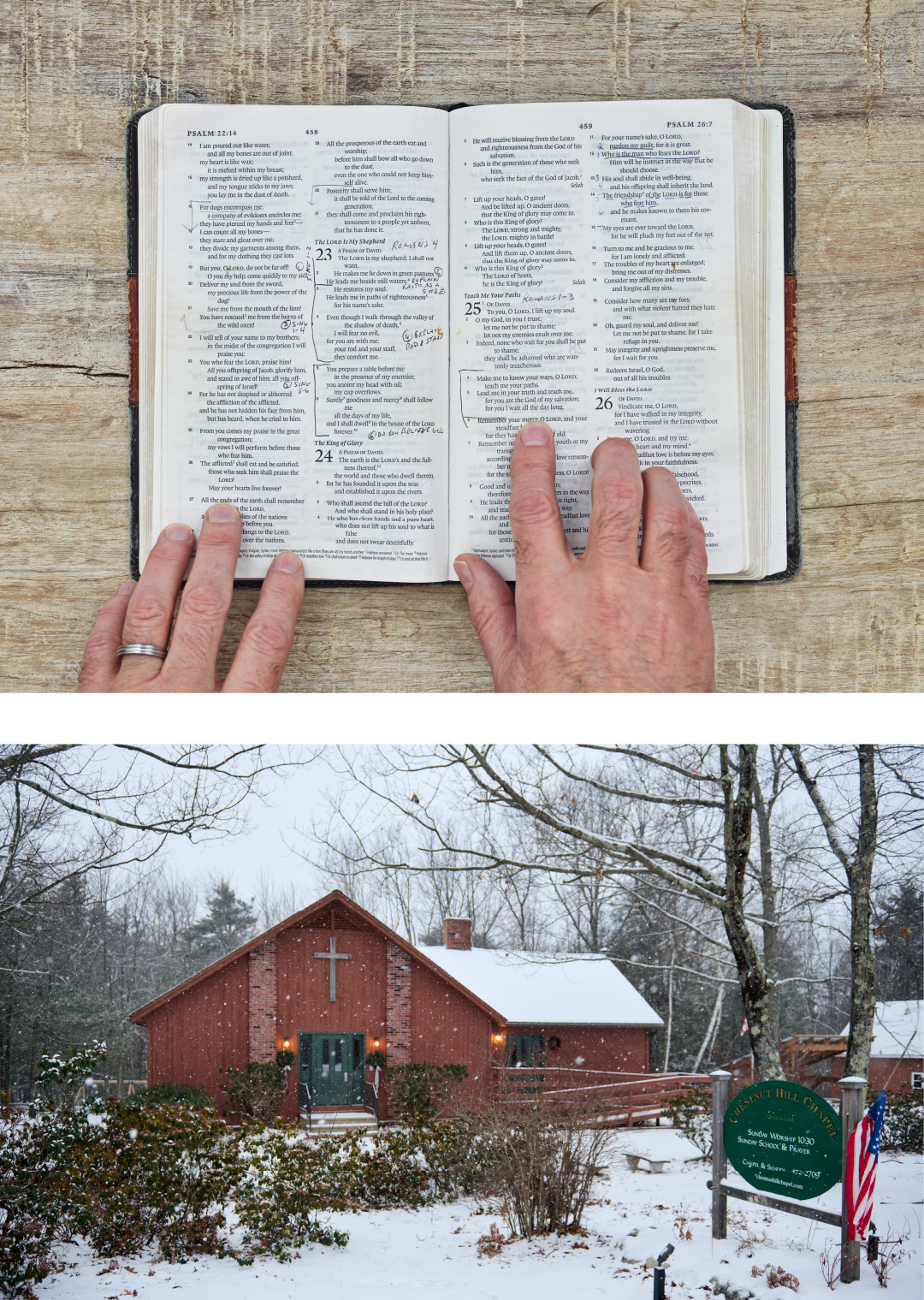
Top: Randy Loubier’s personal Bible. Bottom: Loubier’s church in New Boston, New Hampshire.Photography by Doug Levy for Christianity Today
Top: Randy Loubier’s personal Bible. Bottom: Loubier’s church in New Boston, New Hampshire.

It took me 14 monthsto thoroughly digest the Old Testament. When I got to Malachi, I started getting nervous. I was about to leave my God—the God of Abraham, Isaac, and Jacob—to meet Jesus.

By this time, I was meeting every week with my pastor, peppering him with my old arguments. He had also set up a weekly men’s breakfast with strong Christians who could answer my questions and encourage my faith journey.

Yet I was still nervous to meet Jesus. I had learned a good deal about him from people I respected. Weirdly, though, for a left-brained, science-oriented, just-the-facts kind of guy, head knowledge wasn’t enough. I had built a relationship with the God of Abraham, Isaac, and Jacob; he was my love, my sanctuary, my refuge, my ever-present help in times of trouble.

Imagine my delight, then, when I started reading Matthew and the relationship didn’t change at all! When I got to John and read about the Word who became flesh and dwelt among us, I discovered I’d been talking to Jesus all along.

Today, I remain a voracious Bible reader. Jesus, the Word, is everything to me. He saved me. It wasn’t words I said or heard from someone else. It was the Word.

But make no mistake, the church first sparked my curiosity. If God’s people hadn’t made me wonder about their peculiar love, I never would have cracked open God’s Word, and I never would have fallen in love myself.

Randy Loubier is pastor of Chestnut Hill Chapel in New Boston, New Hampshire. He is the author of several nonfiction books and novels, including Slow Brewing Tea.

Theology

How a Radio Current Jolted a Christian Leader into Staying in Ministry

After an accident on a radio tower, Federico Magbanua went on to inspire a generation of pastors in the Philippines.

Christianity Today February 16, 2024
Illustration by Mallory Rentsch Tlapek / Source Images: WikiMedia Commons / Portrait Courtesy of FEBC

When the late Federico “Fred” Mission Magbanua Jr. preached a radio sermon on offering one’s body as a living sacrifice, he probably didn’t imagine he’d one day hear these words again as a 10,000-watt radio frequency current surged through him in a near-death accident.

It happened one night in early 1961, while Magbanua was working at the Far East Broadcasting Company (FEBC) gospel radio ministry. He was mulling over a job offer in the United States with a salary far greater than what he currently made as an FEBC engineer and as a pastor of a small Baptist church.

Suddenly, the warning lights on the 308-foot radio tower went out. Magbanua loaded some new bulbs into a bag and began climbing the structure. From his home nearby, his daughters and his wife, Aliw, watched him scale the tower.

What Magbanua didn’t realize was that the grounding system—which diverts energy to the ground to prevent surges—wasn’t working. A radio frequency current “hit his head using his body as a lightning rod,” his friend Harold Sala later told God Reports. “Literally, he was being executed by the tremendous surge of electrical power.”

The program that was airing at that moment was one that Magbanua himself had hosted on Romans 12:1–2. “Through the sparking, he heard his own voice in his head saying, ‘Therefore, I urge you, brothers, in view of God’s mercy, to offer your bodies as a living sacrifice,’” recounted former FEBC head Dan Andrew Cura.

Miraculously, Magbanua was released by the current and fell to a step that was several feet from the top of the tower instead of falling 300 feet to the ground. He managed to climb down the ladder and get to the company nurse’s office, where he collapsed. When Aliw later saw him in the clinic, he was swaddled in towels like a baby, his whole head of hair burnt. He ended up hospitalized for months, as doctors had to graft skin from his thighs to cover the lost skin on his head.

Yet the experience “literally jolted him out of his reasoning” to leave the country, Cura said. Once he was healed, Magbanua lived and served in the Philippines until his death in 2013. He worked for FEBC for the next 33 years, including as its first non-American managing director. After that, he went on to start a church-planting movement that sought to establish “a church in every barangay” (or neighborhood). He also influenced a new generation of Filipino evangelical leaders, including Efraim Tendero, the former secretary general of the World Evangelical Alliance.

In a day and age where church scandals go viral far too often in the Philippines, many church leaders say they found in Magbanua a model for living a life of integrity and finishing the race well.

“He showed me how to have a heart that genuinely serves God,” Tendero told Evangelical Today TV. “He exemplified how to conduct one’s self and, when dealing with controversy, not to be swayed.” Tendero added that Magbanua maintained this principle in ministry to stay “right before God.”

Humble beginnings

Magbanua was born in 1932 in the central Philippine province of Negros Occidental, the son of a fisherman. His family was poor, and as a young boy, Magbanua walked five kilometers (about three miles) barefoot to attend school. He was in high school when he heard the gospel and committed his life to Christ while listening to an FEBC program under a mango tree. He ended up studying civil engineering at the Mapúa Institute of Technology (now Mapúa University) in Manila while working odd jobs.

In 1957, Magbanua met and married Viola Aliw Cachola, then an English teacher. He bought a wedding ring for 20 pesos (36 cents) and the wedding ceremony took place at a missionary’s garden on Thanksgiving Day.

Magbanua’s first ministry assignment was to start a local church in the town of Victoria in the province of Laguna. He and his wife would receive 35 pesos (62 cents) a month as ministry support, which meant that sometimes they would eat only one meal a day.

“You married a pastor and now you’re going to die of hunger,” Aliw remembers her mother telling her. She retorted, “Don’t worry, I’m happy here even if we’re not eating.”

As their family grew—the Magbanuas would have five children—the pastor was tempted to find more profitable work in the United States. When he told Aliw that the move would allow him to give the money he made to God, she was firm: “I do not agree with your plan,” she remembers saying. “We have to stay here.”

Then, after the shocking tower experience, Magbanua himself felt convicted to stay.

FEBC and beyond

In 1965, Magbanua became chair of the newly founded Philippine Council of Evangelical Churches (PCEC), which then had only 11 member churches. A breakaway entity from the progressive National Council of Churches in the Philippines, PCEC wanted to emphasize evangelism over social justice. Today the umbrella group has 55,000 member churches.

For the next three decades, Magbanua worked at the gospel radio station. At first, he was the head of engineering, and he eventually worked his way up to managing director of the ministry. In 1971, Magbanua became the first Filipino to head FEBC Philippines, causing some jealous murmurs. His colleagues were used to “imported leaders” from America, his daughter, Joy Magbuana-Huerte, said.

While at the helm of FEBC, the ministry expanded into several local radio stations, including one that reached indigenous tribes on Mindoro Island. It also launched a Filipino gospel music label that produced 20 albums and earned awards from the Philippine press.

In a move that some find controversial today, the radio ministry remained silent when President Ferdinand Marcos declared martial law in 1972, ushering in his dictatorship. While other media groups who critiqued the move were shut down, FEBC was allowed to continue broadcasting.

Planting churches in the barangay

Magbanua stepped down from FEBC in 1992 as he reached the retirement age of 60. “But I’m still young,” he said in the early 2000s. “I think I may still be useful in advancing God’s kingdom.”

He looked to his country’s rural areas, where many of the estimated 42,000 barangays—the smallest administrative unit in the Philippines, overseen by the local city or municipal government—didn’t have an evangelical church.

Official portrait of Fred Magbanua in the 1980s as managing director of FEBC.Illustration by Mallory Rentsch Tlapek / Source Images: WikiMedia Commons / Portrait Courtesy of FEBC
Official portrait of Fred Magbanua in the 1980s as managing director of FEBC.

“I made a promise to the Lord that I will look for barangays without a church and help pastors working there,” Magbanua said in the video. He explained that pastors serving in remote areas usually leave and give up because of hardship. “In those barangays, you’d be blessed if you had a monthly offering totaling 500 pesos,” he said, an amount around $10.

Magbanua-Huerte, who served as her father’s executive assistant after he retired, said her father wanted to plant holistic churches that not only preached the gospel but provided health care, education, and financial help. Because of Magbanua’s own experience growing up in poverty, he understood the difficulties that pastors and their families face when planting churches in impoverished areas.

“People [there] don’t have jobs,” he said. “They would tithe chicken, eggs, banana, pumpkin, and fish. Yes, the pastors would have something to eat, but when their children get sick, they have no money for medicine. When their kids need to go to school, [there’s] no money for fees.”

The idea to plant holistic churches in unreached barangays, however, didn’t pan well with his fellow Baptists, who were more focused on discipleship, according to Magbuana-Huerte. Instead of causing conflict, Magbanua decided to leave the denomination and, with their blessing, he started Christ Jesus Our Life in 1992, a church-planting movement.

His movement started a pastoral support fund inspired by 2 Corinthians 8:15, where 40 percent of a local church’s income went into a common fund that was then divided among all the pastors within the movement. This was to help church leaders serving in more economically depressed areas.

He urged Filipino church leaders to prioritize church planting and was also mindful of the church’s location, emphasizing that it must be at most a ten-minute walk from where members lived so they wouldn’t have to pay for public transportation to get to church.

“His desire is [that] every barangay, every Filipino who needs to know the Lord, will have access to a place where they can hear the gospel,” Aliw said. “Even if they are deeply impoverished, they can still afford to go to church.”

Today Christ Jesus Our Life has around 160 churches. Magbanua-Huerte pastors in the Philippine province of Palawan and oversees around 40 congregations, half of which are in indigenous communities. Reminiscent of where her father first heard the gospel, several congregations conduct their services under a mango tree.

Mediator and religious statesman

Several people close to Magbanua noted the consistency in his witness. For instance, he maintained the same rigor and discipline in preparing for his sermons well into his 70s. On a sheet of paper folded into thirds, he would jot down his outline filling each section with the beginning, middle, and end. His wife said he would usually prepare for his preaching at least a week in advance.

“My dad really preached from the Word,” said his eldest daughter, Grace Vowell. Regardless of the sermon’s topic, he would always end it with an invitation to commit one’s life to Jesus Christ.

As a founder of a growing denomination and an elder among evangelical leaders, Magbanua offered advice to other church leaders who came to him and mediated internal conflicts. Rey Corpuz, the former head of the Philippine Missionary Association, recalls a time when evangelicals and Pentecostals did not work with each other.

“There’s a funny side to Manong Fred,” Corpuz said, using the title for an elderly person or person of stature. “He baptized himself as a Bapticostal.” A conservative Baptist, Magbanua actively built relationships with Pentecostals, which drew criticism from his peers.

In July 2012, family and friends celebrated Magbanua’s 80th birthday with the theme “From a son of a fisherman to a fisher of men.” Vowell said that her father prayed to live another ten years, as he hoped to see Christ Jesus Our Life plant 300 churches by 2023. Yet she also recalled him saying, “If [God] wants to take me, that’s fine—I’m ready.”

Several months later, Magbanua went to get an endoscopy and doctors informed him that he had stage IV stomach cancer. He died three months later on January 21, 2013.

“He started strong, he started well in the ministry, and up until his last breath, he was anointing a new, younger leader,” said Noel Pantoja, who viewed Magbanua as a second father. Pantoja served with Magbanua planting churches with Christ Jesus Our Life and later established several Filipino-American congregations in Washington, DC.

“If you … rely on your own strength and your own wisdom, you cannot do it,” Pantoja remembers Magbanua telling him from his hospital bed. “If you feel you’re not capable of doing it, that you are not qualified, that’s the first qualification, because you will depend on the power of God, the power of the Holy Spirit.”

Theology

‘God & Country’ Preaches to the Choir

Rob Reiner’s documentary makes a strong case against political extremism in the name of Christ—for those who already agree.

Flags lifted in a Trump rally in the documentary, God & Country.

Flags lifted in a Trump rally in the documentary, God & Country.

Christianity Today February 16, 2024
©2024 Oscilloscope Laboratories

Heave an egg out a Pullman window,” social critic H. L. Mencken famously said in 1925, “and you will hit a fundamentalist anywhere in the United States.” I often think about Mencken’s line when I read the coverage of evangelical Christianity at left-leaning websites such as Salon, Rolling Stone, Mother Jones, and MSNBC—drop an egg out of a Boeing 737 at 30,000 feet above red America, and you will hit a “Christian nationalist.”

Discussion of Christian nationalism has exploded in the last three years. The phenomenon has been blamed for the Trump presidency, the January 6th insurrection, the overturning of Roe v. Wade, and the possibility of another win for former president Donald Trump on Election Day. The latest offering in this vein is God & Country, a documentary film that arrives in theaters this month.

Directed by Dan Partland and produced by Rob Reiner, God & Country astutely includes interviews with high-profile Christian intellectuals, activists, and authors including Jemar Tisby, David French, Kristin Kobes Du Mez, Phil Vischer, Skye Jethani, Doug Pagitt, Rob Schenck, and CT editor-in-chief Russell Moore. Yes, the selection communicates, even these people think Christian nationalism is dangerous.

In one sense, God & Country is a brilliant piece of documentary filmmaking. It succeeds in warning against political extremism in the name of Christ and makes a significant and necessary contribution to our understanding of American religion and politics in the Trump era.

Many scenes are hard to forget: There are Seven Mountain dominionists in a packed arena reciting the “Watchman’s Decree,” a prayer to “take back and permanently control positions of influence and leadership” in business, entertainment, media, government, family, education, and religion. There are Christian flags and “Jesus Saves” signs at the Capitol as rioters smash windows and assault police. And there’s Christian Coalition politico Ralph Reed bragging about how his lobbying group would help turn North Carolina red using an invasive collection of voter data.

But though the core message of the film is true—this kind of extremism is antithetical to the gospel of Jesus Christ—God & Country suffers from a consistent failure to define its terms and distinguish its subjects. In the end, the movie raises more questions than it answers and will be limited in its persuasiveness to viewers who don’t already share its concerns.

Here’s one such question: Is there a difference between American evangelicalism and Christian nationalism? If asked, I’m sure all the evangelicals who speak in the film would answer with a resounding yes, and I suspect the other interviewees as well as Partland and Reiner would too. But the distinction is blurry in God & Country.

For example, a few minutes into the movie there are, by my count, 22 historical images that flash across the screen as the mid-20th-century Pentecostal and prosperity gospel preacher Jack Coe’s rendition of the gospel song “Job’s God Is True” plays in the background. A few of these images show Christians near an American flag, but most of them portray ordinary believers raising their hands in worship, bowing their heads in prayer, or listening to a sermon. What makes them Christian nationalists? How do they pose a threat to democracy?

Likewise, images of evangelist (and CT cofounder) Billy Graham appear in the film. Is the argument that he was a Christian nationalist, as the larger context and historical arc of the movie suggests? Or, in another scene, we see churchgoers singing the popular hymn “Faith of Our Fathers,” which celebrates Catholic martyrs in Reformation-era England. Does singing this song make one a Christian nationalist?

Also unanswered is whether evangelicals who want to bring our faith to bear on public life are necessarily Christian nationalists. Again, I have no doubt that the film’s makers and participants would answer in the negative. But there are multiple places in God & Country—footage of Jerry Falwell Sr. preaching against abortion and George H. W. Bush proclaiming he is pro-life and opposed to partial-birth abortion, to name just two—where the storytelling conflates politically active evangelicalism with Christian nationalism.

I’m guessing other experts drew this distinction in their interviews, but only Moore’s definitive statement distinguishing defenders of the traditional family and the unborn from Christian nationalists survived Partland’s cutting room.

Likewise, what’s the difference between Christian nationalism and symbols of American civil religion? God & Country leaves viewers with the impression that the slogan “In God We Trust” on our currency or “under God” in the Pledge of Allegiance are somehow connected to what happened on January 6th. It’s true that the differences between such vestiges of civil religion and the dominionism undergirding actual Christian nationalism are not easily parsed. But Partland and Reiner seem uninterested in trying to make a nuanced distinction.

That kind of loose history and language are regrettable and will limit God & Country’s reach. This is a film for people who read those articles in Salon and Rolling Stone. For those already inclined to believe that conservative evangelicals are plotting to create a theocracy in the United States, God & Country will confirm their fears about politically active born-again Christians and maybe motivate them to vote in November. It will give the left side of the culture war plenty of additional ammunition and perhaps some new insight into—but little sympathy for—the motivations of Trumpist evangelicals.

It probably won’t shift those motivations, though. Christians who supported the insurrection at the Capitol or attend MAGA rallies, if they watch God & Country at all, are unlikely to come away with changed hearts and minds. If you liked French before seeing the movie, you might like him even more when you’re leaving the theater. But if you think he’s selling out to secularists, God & Country will only confirm that feeling of betrayal.

Some interviewees in God & Country call for a different kind of “Christian nationalism,” one that cares for the sick, welcomes the stranger, and tends to the hungry. “If we do this right,” says Poor People’s Campaign co-chair William Barber in the final scene, “what a country we will be!” I hope this message will get through to some evangelicals. Yet as a veteran of the battle against the kind of extremism depicted in the film, I am not optimistic that it will, given the tone of the rest of the movie.

We need a deeper and more complex conversation about evangelicals and politics. For all its cinematic brilliance, God & Country just preaches to the choir.

John Fea is distinguished professor of history at Messiah University and executive editor of Current.

Theology

How Contemporary Christian Music Explains American Christianity

When the CCM business model faltered, it gave way to what sells even better: politics and fearmongering.

DC Talk winning the Best Rock Gospel Album award for their album, Jesus Freak, in 1997.

DC Talk winning the Best Rock Gospel Album award for their album, Jesus Freak, in 1997.

Christianity Today February 16, 2024
Vinnie Zuffante / Stringer / Getty

This piece was adapted from Russell Moore’s newsletter. Subscribe here.

A friend and I were talking once about the first concerts we ever attended. His was Van Halen; mine was Amy Grant.

“Okay, second concert?” he asked.

Him: Mötley Crüe. Me: Petra.

After a minute or two of silence, he said, “You realize we would have hated each other in middle school, don’t you?”

One of us was part of a sheltered subculture quickly passing away. The other listened to music that was a gateway drug to what some say led to riots and rebellion. Turns out, my musical taste, not his, was the dangerous one.

In her new book, God Gave Rock and Roll to You: A History of Contemporary Christian Music, scholar Leah Payne argues that anyone wishing to understand some of the most epochal shifts in American culture and politics over the past 30 years ought to listen to the radio—specifically to the contemporary Christian music (CCM) genre of a generation of white evangelicals.

Payne writes that teenage kids like me were actually not the market for the CCM industry of the 1980s, 1990s, and early aughts. Our moms were. Payne reveals industry executives even had a collective name for the suburban middle-class mother who sought out Christian alternatives to popular music for her children: “Becky.”

The second avenue was the vibrant youth group culture of the time (where I came to love CCM). Payne writes: “The quirk of CCM’s business model—that the bulk of its sales came not through mainstream retailers marketing directly to teens, but through Christian bookstores who marketed primarily to evangelical caregivers interested in passing the faith to their children—became its defining characteristic.”

The problem for “Becky,” according to Payne, was that in households where only “Christian music” was allowed, the very way a parent could convince an adolescent that he or she wasn’t missing out on anything became the very problem the caregivers were trying to overcome. Some of these kids, Payne notes, used the CCM comparison charts “to reverse engineer their listening tastes.” She quotes one CCM listener saying, “The charts said I would like Audio Adrenaline if I liked the Beastie Boys. That’s how I fell in love with the Beastie Boys.”

How does an industry solve that problem? Payne argues that one key way was to convince the Christian kids that they were the edgy ones—the non-conforming “Jesus Freaks” willing to pray in public and to abstain from sex until marriage. Citing DC Talk’s “Jesus Freak” music video, Payne writes: “Christian teens who listened to CCM were not just geeky youth-group kids, the video suggested—they were rebels fighting against immoral, oppressive mainstream culture.”

I disagree with her at the margins, here, in that I think “Jesus Freak” was well within the bounds of a call for Christian distinctiveness. But Payne is certainly correct that an entire genre of songs went beyond this to suggest that the kid who feels made fun of for attending a See You At The Pole prayer event is being persecuted by a hostile culture in almost the same way as Shadrach, Meshach, and Abednego.

Should conservative Protestant teenagers and college students be rightly equipped for the fact that they will be out of step with their peers in modern American culture? Yes.

The problem, though, is that Augustine’s City of God would not sell very well in a 20th- or 21st-century American Christian market. The nuanced truth that “You will be made to feel strange at times for following Christ, but you’re not under persecution (and, by the way, you’re not nearly strange enough in the ways Jesus actually called you to be)” isn’t nearly as exciting as, “This is the terminal generation. The elites are out to destroy you, and you are the only thing standing between Christian America and the New World Order.”

“God wants what you want (for you to be happy and healthy and flush with cash)” sells. So does “You’re the real America and everybody else wants to kill you.” Messages of actual cross-bearing and a cruciform life, however, do not sell well at all.

In Payne’s analysis, the business model of CCM looked to the marketplace “for signs of God’s work in the world,” with the top-selling artists and products reflecting “a consensus among consumers about what constituted right Christian teaching about God, the people of God, and their place in public life. Certain ideas thrived in large part because they appealed to white evangelical consumers. Other ideas faltered because they could not easily be sold.”

To some degree, that’s to be expected. The music business is, after all, a business. But, as Payne points out, some reformers (including my now CT colleague Charlie Peacock) warned of ways the business model could be at cross purposes with the teaching power of music—and many artists (such as the late Rich Mullins and Michael Card) charted a different, more theologically grounded and biblically holistic course.

When the consensus determines what’s acceptable as a Christian and what’s not, one cannot help but end up with what The Guardian identified as a “market-driven approach to truth,” in which a group ends up “finding most hateful to God the sins that least tempt its members, while those sins that are most popular become redefined and even sanctified.”

The problem for all of us is that ideas of God’s blessing and spiritual warfare can be reverse engineered too. When the business model for Christian bookstores and CCM faltered, what many found would still appeal was politics. When music about God and Christ were not bringing in money, talk radio stations using apocalyptic language about flesh-and-blood enemies still could.

The alcoholic whose life is being messed up by his addiction is often in a stressed state of crisis because of the alcohol—a problem that he or she believes can be solved by more alcohol. A Christianity fearful of a secularizing America can often become shrill and extremist, driving away many people to whom we can then point and say, Look at how the country’s secularizing! We need more fear of it!

So the cycle moves ever along.

And, as with every ideology in any generation, once a religion becomes perceived as a means to an end, it first draws those who care about the religion, and then it draws those who care about the end—be it “values voters” politics or “liberation theology” politics. After that, it ends up with those who really care about the end and start to see parts of the religion as the problem. Finally, it results in those who figure out they can get to the end without the religion. One can eat lots and lots of food and play football, even without following anybody to their Father’s house—as long as you fight for your right to party.

On the Left and now on the Right, the kids can look at the comparison chart and go for the real thing, whatever it is—whether it’s the Marxist dialectic or the white identity ethno-nationalism. When the market is the measure of truth, and the market becomes disenchanted with its own mission, it is very hard to remind people who they once believed themselves to be.

Contemporary Christian music, flawed as any human endeavor is, was a positive force in my life. The music of Amy Grant and Rich Mullins went with me through an adolescent spiritual crisis and are probably part of the reason I came out of it more Christian than I went in. I’m amazed by how much of my incipient theology—convictions I teach to this day—was taught to me by Petra lyrics. I have never, not once in 30 years of ministry, preached Romans 6 without hearing their “Dead Reckoning” song in my mind.

I learned how to read biblical narrative Christologically, how to understand parable and poetry and paradox, from the lyrics of Michael Card. I might be embarrassed to tell you how often, in the middle of dark times, what strengthens me are words like “Where there is faith / There is a voice calling, keep walking / You’re not alone in this world” or “I’ll be a witness in the silences when words are not enough” or “God is in control / We will choose to remember and never be shaken.” None of that may be rock-and-roll, but I will die believing that God gave that to me.

And I see a new generation of musicians and songwriters who are preparing—often without institutional props—to drive others to the actual Bible, to the actual Jesus, whether it sells or not. The path from CCM glory days to an evangelicalism in crisis should inform us—and Payne’s book does that brilliantly.

But it’s also true that some of the reverberations of grace from those years still ring in some of our ears. I don’t want to reverse engineer that. We need all the music we can get, especially that which doesn’t just reinforce what already stirs our passions, what already makes us afraid.

There’s room for that. It’s a big, big house.

Russell Moore is the editor in chief at Christianity Today and leads its Public Theology Project.

News

Black Americans Who Leave Church Don’t Go Far

How their disaffiliation stands to have a bigger impact on their communities and why leaders are hopeful they’ll come back.

Christianity Today February 15, 2024
Michael Heuss / Unsplash

Black Americans are the most religious non-religious group in the country.

In a new Pew Research Center report on the growing segment of unaffiliated “nones” in the US, they stand out for their faithfulness. Nearly all Black nones believe in a higher power, and a third still believe in the God of the Bible. Barely any consider themselves atheists.

Even among those who no longer label themselves with any faith, they pray more, attend church more, and see religion as more significant than any other unaffiliated demographic.

“Black nones are far more connected to the Black church than white nones are connected to Christianity overall,” said sociologist Jason E. Shelton, a professor and director of the Center for African American Studies at the University of Texas at Arlington. “These are not qualitatively the same kinds of people.”

Though Black nones make up less than 10 percent of all nones in America, their disaffiliation is particularly significant for a culture historically tied to church and faith. One in five Black Americans are religiously unaffiliated.

Black Americans leave religion for some of the same reasons as others do: They feel the church isn’t open to addressing their questions and doubts; they’ve been hurt by bad experiences; they’ve found a sense of community and identity elsewhere.

Plus, there’s a segment of Black Americans who have left white evangelical churches and ministries as a result of the intense polarization around race and politics in recent years.

“They say, ‘I don’t want to be a part of this if this is what Christianity is about and you dehumanize me,’” said Lisa Fields, apologist and founder of the ministry the Jude 3 Project. “When Black people have been in white evangelical or multiethnic churches, I find they use the language of ‘deconstruction’ a little bit more than Black people that came from the Black church.”
As more Americans overall deconstruct or drop their religious affiliations, so have more Black Christians; the proportion of nones who are Black has held steady at 9 percent for at least the past decade of Pew polling.

Across the board, though, Black nones don’t feel as negatively about religion or as adamant about their disaffiliation compared to any other demographic; in Pew’s findings, they stand out by double-digit margins for many questions.

A quarter of Black nones say they feel like they don’t need religion in their lives, compared to 41 percent of nones overall. Thirty percent of Black nones don’t like religious organizations, versus 47 percent of all nones.

More than 80 percent of unaffiliated Black Americans believe in the spiritual world, the soul, and a higher power, and more than half still believe in heaven and hell. For this group, the typical apologetics bent on proving the existence of God isn’t necessary. They already agree.

“We are just so connected to faith as a community, from our families to how many of us were raised,” Fields told CT. “It’s hard for us not to believe there is a God that exists, that God helps us navigate this world and has brought our people out of slavery.”

That sense of history and legacy for Black faith anchors many to their beliefs, though nones may lose ties with the church services, celebrations, and ministries that Black churches continue to put on. While Black nones are four times more likely than white nones to keep going to church, three-quarters have largely stopped attending services.

Research shows that religious disaffiliation—particularly for the “nothing in particular” group that the vast majority of Black nones find themselves in—is correlated with a drop in community involvement and engagement. While that’s true of all nones, Shelton worries that loss will have a disproportionate impact on Black America, which has relied so heavily on the church.

“The church has always been the vessel that we as Black people have used to have community and solidarity,” he said. “It’s the church that connects [Black society], so as the nones fall away from that, what does that mean for community? What does that mean for Black music? What does that mean for Black politics? And what does that mean for the long-standing legacy of racial discrimination in this country?”

“If we who fall away from organized religion aren’t there … to hold our nation to its standard of progress and equality for all of us, then who’s gonna do it?”

Shelton analyzes the implications of the big shifts in Black faith in his upcoming book, The Contemporary Black Church: The New Dynamics of African American Religion, out in August from New York University Press.

He sees the Black church, in some ways, getting stung by its own success. It’s because of the Black church’s role in education, civil rights, entrepreneurship, and community organizing, he says, that today’s African Americans reached a position where they have other options and opportunities outside of it.

And Black churches across denominations see that playing out in their neighborhoods and Sunday sanctuaries. Shelton found that the nones now represent the second-biggest religious group among African American denominations, trailing only the Baptists.

“The future does not look good for organized religion in Black America, especially the historic traditions,” he said. “The Baptists are still the largest, but they’re losing people. The Methodists are really down small. The Pentecostals are losing, but they’re not losing nearly as many since they’ve always been small.”

Even with emptier pews and a next generation that is less tied to the Black church than any other in history, the lingering beliefs among Black nones is also a sign of hope.

Religious statistician Ryan Burge, who authored a book on the growth of religious nones, found that “the data indicates that Black nones have a stronger faith background and are much more likely to embrace religion in the future than nones of other racial groups.”

Shelton said churches should open up to people’s questions rather than shutting them down. In the Pew study, Black nones are less likely than nones overall to leave religion over their skepticism, but just under half say they question “a lot of religious teachings.”

The growing field of urban apologetics has taken up the challenge in Black communities, including addressing misgivings about the faith that come from racism and injustice.

“It is giving Black people a reason for the hope of the gospel despite the cultural, historical, spiritual, and theological barriers Blacks have to the Christian faith,” writes Eric Mason in his 2021 book on the topic. “And at the core of urban apologetics is a restoration of the imago Dei.”

Fields takes the strategy of careful listening to hear and understand the stories of Black Americans who left the church.

A few years ago, Jude 3 hosted a discussion series called “Why I Don’t Go,” engaging and listening to African Americans who have left the church or are on the fence. Some of the areas of hurt, doubt, and disconnect inspired Fields’s latest book, When Faith Disappoints: The Gap Between What We Believe and What We Experience, which comes out this summer.

The book acknowledges “how, for some, Christianity may have failed to meet those very valid needs, so they turned to various counterfeits” like syncretistic beliefs and spiritual practices like crystals or sage.

Fields called it her plea for them to “come back or to stay.”

“I’m very optimistic,” she said. “What people are searching for, Christianity possesses. We have the hope the world is looking for.”

Can Self-Help Books Really Help?

Self-help books are wildly popular, including among Christians. But can they keep their promise to improve us?

Illustration by María Jesús Contreras

Heaven helps those who help themselves.” So opens Samuel Smiles’ 1859 book Self-Help; with Illustrations of Character and Conduct—an appropriately self-published work that birthed the modern genre.

Today, more than 10 million self-help books are sold annually, with topics ranging from time management to pop psychology to discovering one’s true calling. While some focus on how to navigate career or relationships (think Dale Carnegie’s 1936 How to Win Friends and Influence People), others guide readers to success through reformation or reassessment of their unique interior worlds (such as Brené Brown’s 2010 The Gifts of Imperfection). What unifies the genre is a message of self-improvement delivered in a personal way by a confident figure who inspires readers to pursue their “best life now.”

But if heaven helps those who help themselves, what exactly is the role of “heaven”? And how should citizens of heaven read these books—if we should read them at all?

Despite its current popularity, improvement literature is not new. Ancient Egypt produced conduct books like The Maxims of Ptahhotep, while Rome left us Cicero’s On Duties. The Bible contains its own form of “self-help” in the genre of Wisdom Literature: Proverbs, Ecclesiastes, and even Job help readers make sense of the world and their roles within it. And in the Middle Ages, “courtesy books” taught courtiers how to navigate the social norms of the palace.

For much of history, such writings were limited to the upper classes, intended to train and develop future leaders. (Ptahhotep, for example, was a vizier, a high-ranking official analogous to a prime minister.) But today’s self-help books are decidedly egalitarian, teaching the masses how to rule themselves. Self-improvement is now available to—and expected of—all of us.

That shift was already underway in Smiles’ era. His work emerged in the context of Victorian social reform, with a distinct emphasis on the individual’s ability to overcome his or her circumstances. He empathized with the plight of workers and the underclass but critiqued those he believed pandered to them—such as politicians who would sell a culture of victimhood to stay in power.

For Smiles, personal success was the work of the individual, not social or political systems. “Every human being has a great mission to perform, noble faculties to cultivate, a vast destiny to accomplish,” he said in an 1845 speech that would become the basis of Self-Help. “He should have the means of education, and of exerting freely all the powers of his godlike nature.”

This sense of the individual’s “godlike nature” may explain why so many Christians gravitate to self-help books today. In The Evangelical Imagination, scholar Karen Swallow Prior traces the relationship between post-Reformation “improving literature” and modern Christianity.

“It is no coincidence that the Evangelical Revival (which became the evangelical movement) began in the same century that saw the rise of the novel, the industrial revolution, and the very idea of social mobility,” she told me. “The same evangelical value of each individual soul that led to an emphasis on individual conversion led naturally to an emphasis on individual improvement.”

Given this connection, it’s no surprise that some of the most famous self-help titles have been penned by religious leaders. The Power of Positive Thinking (1952) was written by ordained Reformed minister Norman Vincent Peale (who also had strong ties to the Trump family). Stephen R. Covey, the author of The 7 Habits of Highly Effective People (1989), was a leader in the Church of Jesus Christ of Latter-day Saints. And management guru John C. Maxwell, of The 21 Irrefutable Laws of Leadership (1998), is an ordained Wesleyan minister with a doctorate of ministry from Fuller Theological Seminary.

Today, the gap between self-help and spiritual-living books is almost nonexistent, with readers and authors traversing it effortlessly. For example, Rachel Hollis’ s 2018 Girl, Wash Your Face (whose subtitle calls readers to “Stop Believing the Lies About Who You Are So You Can Become Who You Were Meant to Be”) was released by evangelical publisher Thomas Nelson. In it, Hollis writes, “You, and only you, are ultimately responsible for who you become and how happy you are.” The book has sold over 4.5 million copies and reached No. 1 on The New York Times’s nonfiction bestseller list.

While shared social history explains part of why Christians gravitate toward secular self-help, author and pastor Sharon Hodde Miller believes that something else fuels contemporary demand.

“One of the implications of the gospel is that we are being restored to right relationship to God, and we are being restored to one another,” she said. “But we’re also being restored to ourselves and in ourselves.”

The church she and her husband colead intentionally incorporates “self” into spiritual formation, Miller said, because they’ve seen it neglected in other congregations. “We wanted to name the full implications of the gospel for our lives. I do think that there is a sense in which self-help is a very important subcategory of the implications of the gospel.”

In Miller’s thinking, when churches fail to articulate how the gospel restores the self, secular (or functionally secular) authors and publishers fill the gap. Whether these messages are consistent with the gospel is beside the point for many readers striving to better themselves however they can.

Miller confessed discomfort with the genre insofar as “self” becomes an end unto itself—so much so that she authored her book Free of Me to challenge this focus. “One of the reasons I wrote my first book,” she told me, “was because I felt like a lot of the language around self-help—its vision—was too small.” Citing Augustine, she noted that Christianity has historically understood the self as “being bent in on itself, and what the grace of God does is unbend our souls and reorient us back toward God—toward love of God and love of others.”

Miller’s concerns about the genre are not unwarranted, especially given the relationship between medium and message. “Form very much determines content,” Prior wrote to me, “and this is no less true of the form (or medium) of books. Reading is (generally) a solitary, individual activity, one that generates one’s sense of self and one’s sense of personal agency.” In other words, self-help books by their very nature assume that personal growth is an individual pursuit, the product of our own agency.

Alastair Roberts, an author and lecturer with the Theopolis Institute , is a longtime observer of self-help literature aimed at young men—books like Jordan Peterson’s 12 Rules for Life. He too believes that the question of agency lies behind the genre’s appeal.

When the modern era ushered in social mobility and the possibility of changing one’s life, it brought a kind of social fragmentation and disorientation too, wherein individuals struggle to find themselves in a “healthy relationship with reality, with God, and with yourself,” Roberts told me.

“But,” he continued, “part of it is that agency is really important. It’s a recovery of one’s active involvement in reality. When people feel that they’ve lost that, when they don’t feel like they have traction in reality, there’s a sense of ennui or a sense of alienation.” Roberts points to Scripture, noting that recovering “a sense of involvement and investment in reality is something that Wisdom Literature speaks to.”

Unfortunately, Roberts argues, excessive focus on personal agency can also lead to a kind of myopia in which the individual finds himself unable to navigate the world or find his place in it. “If [young men] are overly caught up in themselves, it ends up being something that can actually undermine their sense of agency within the world,” he said. “What they need really is something to draw them out.” What they need is community.

In this way, the current boom of self-help literature may belie a larger social upheaval where individuals have been left to navigate the world on their own. “Common knowledge” is no longer common. And folk wisdom, once handed down from generation to generation, is now the purview of experts who pass it along for .95 a volume.

This disconnect not only shapes the form and content of self-help books; it may also hinder our ability to implement the changes we read about. We may be committed to personal growth, and a book may convey some truth, but without community, the possibility of real change is slim. Ironically, though, the very lack of communal bonds is what drives many of us to look to strangers for instruction.

Granted, the digital age has allowed self-help authors to form a kind of community around their books. In some cases, though, it’s hard to tell which serves which: the online audience or the publishing contract. As follower counts and sales totals grow, they become mutually necessary to one another, and communities of camaraderie morph into sales floors.

The work of author Glennon Doyle is a good example of how online community and self-help writing merge. Her message of courage and commitment to one’s truest self began attracting a following in 2009, when she started blogging about the struggles of parenthood, marriage, and mental health.

As her fan base grew, readers found each other in the comment section and eventually on social media. True friendships formed, and Doyle led her community to work together for charitable and political action. When she released her first book in 2013, Carry On, Warrior, it sold modestly. But her next book, Love Warrior (in 2016), was chosen as an Oprah Book Club selection, and her 2020 memoir, Untamed, debuted at No. 1 on The New York Times bestseller list, remaining there for seven weeks.

Perhaps even more significantly, Doyle’s journey shows how tightly an author’s own process of change shapes the advice they offer. When she started blogging, Doyle was married to a man and wrote from an explicitly Christian perspective. A decade later, however, she was divorced, remarried to a woman, and leading a spiritual-but-not-religious following. And it all played out in public.

She was and is unabashedly a work in progress, with transformation itself perhaps the only constant, and her role as a self-help influencer seems to have created a feedback loop that drives that change ever forward.

But even at its best, an online community can only offer support for our individual journeys. We may be able to cheer each other on, but the work still rests on our shoulders and ours alone. And here the weakness of the self-help genre really begins to show: If personal growth is within our grasp, what does it mean when we don’t grow? What happens when mental health challenges or neurological differences like ADHD make time management and efficiency impossible? What happens when a marriage can’t be saved despite all the good advice in the world?

The gap between what self-help books promise and what they can actually deliver does not sit well with everyone in the genre. Visitors to best-selling author and Duke Divinity School professor Kate Bowler’s website are asked, “Are you living your best life now? Not always? [Bowler’s work] is for you.”

Using the industry’s own tools—social media, podcasting, and speaking engagements—Bowler subverts the typical approach to self-help by challenging its core assumptions. She calls its message of always upward, always achieving a source of “toxic positivity.” Instead, Bowler regularly reminds her readers that life is beautiful—and hard.

Despite her publishing success, Bowler is no stranger to suffering. She was already interested in the spiritual tensions embedded in the rhetoric around personal success (her doctoral work focused on the prosperity gospel) when she was diagnosed with stage IV cancer at age 35.

Against all expectations, she survived and is currently cancer free. But the experience left her with a profound sense of human vulnerability and of our inability to control much of anything about our lives.

“We can be people of deep hope,” she observed in a 2021 Washington Post interview. “That is not the same thing as saying our lives are going to work out. As a person of faith, I believe God is drawing us toward a future that is fundamentally a story of love and the salvation of the world. That’s not the same thing as saying that my life in its particularity, in all my hopes and dreams, is going to play out the way I imagined.”

It can be hard, even for Christians, to tell the difference between toxic positivity and godly hope. And it may be particularly hard for those who are accustomed to reading their Bibles as a form of self-improvement.

Despite the fact that the Bible speaks to suffering—most notably in Job, Ecclesiastes, and Christ’s own passion—the very act of coming to a text in search of personal change shapes our expectations of how change happens. In this sense, Christian readers may be uniquely primed to embrace the message of self-help books because they’ve already experienced a kind of self-improvement through reading.

Among the books Prior says have shaped the evangelical disposition toward self-improvement is John Bunyan’s 1678 classic, The Pilgrim’s Progress. Bunyan’s allegory has several common features of novels of the period, Prior writes in The Evangelical Imagination, including a focus on a character “in oppressive circumstances laboring through individual will and determination.”

Notably, the book opens by showing Pilgrim with “a book in his hand.” That book is the Bible, and its warning of impending judgment is what sends Pilgrim on his personal journey. In other words, reading starts his progress.

For modern Christians, this may not be remarkable, but in Bunyan’s day, mass literacy was not normal and so neither was biblical literacy. Correspondingly, Christian growth was not considered an individual pursuit—so much so that when Bunyan followed his conscience to preach outside the auspices of the Church of England, he was thrown into jail. But is it fair to say that we modern Christians read the Bible the same way we read self-help books? And if we do, is that wrong? Aren’t we supposed to read Scripture and be changed by it?

Author and CT columnist Jen Wilkin, a staunch advocate for Bible literacy among the laity, believes “the Bible is for everyone.” (The title of her latest book, coauthored with pastor J. T. English, proclaims, “You Are a Theologian.”) Despite this, Wilkin warns against reading the Scripture as a project in self-improvement. “It’s true that the Bible changes us,” she told me. “But it may not do so in the time frame we would demand. Many have come to expect that the Bible exists to make them feel better in bite-sized servings, often in ten minutes or less. But the Bible is not meant to be cherry-picked for a quick emotional fix.”

In other words, while the Bible contains texts that will improve us—if we let them—the goal is not to offer life hacks. The goal is transformation. When we spoke, Roberts argued that biblical Wisdom Literature always moves toward embodied wisdom. The goal of books like Psalms, Proverbs, and Ecclesiastes “is very much a movement through Law to internalization,” he said. “You’ve taken the Law, and you’ve chewed over it, and it’s become part of you.”

In this sense, true change is a much larger undertaking than most self-help books suggest. The problem is not that these books envision too much for our lives but that they envision too little.

Christian tradition holds that the work of personal transformation is so large that it requires an entire community (Eph. 4:11–13). Self-help books grapple with universal questions, but they do so at the individual scale. How do we navigate a cursed world? How can we make our work more effective? How can we heal our deepest wounds and sorrows?

For many, including Samuel Smiles, the answer begins with each person making choices and building habits alone. Larger social reform comes as we each reform ourselves. But just as the Bible cannot be read for quick fixes or in isolation, our journeys of improvement are not quick, straightforward, or solitary either. As Wilkin said, “We should study the Bible for ourselves, but not by ourselves. The Bible is meant to be understood in community—both the community of the local church and the community of the saints.”

In this sense, the biggest concern for Christians who read self-help books may not be the content or even the goal of self-improvement. It may be the method—how we go about the project of bettering our lives and what we do when we can’t.

After all, if we have the power to improve ourselves, we start to think we have a duty to do so. As author Alan Noble summarized the plight of modern humans in his book You Are Not Your Own, “Virtually every … voice we interact with will tell us, ‘No. Keep striving. You haven’t done enough. If you quit now, your life will be a waste. Do something else to make it worthwhile.’ ” But not all problems are within human power to control. Even many of our personal problems are outside our own power to fix.

So not only do we need community to help us grow; we also need community when we cannot grow. We need the support of others and the love of like-minded saints who come beside us in our struggles and grieve with us when life continues to be hard despite our best efforts.

In this way, reading self-help books as a Christian means doing so in community, with an eye toward both lament and transformation. It means confessing our dependence on God and others in a way that both honors our limits and invites our growth.

The next time you reach for a self-help book, remember that this is just the first step in making a change. The next might be gathering a reading group or sharing your journey with a trusted friend. Or as Paul puts it in Galatians 6:2, “Carry each other’s burdens, and in this way you will fulfill the law of Christ.” Heaven doesn’t help those who help themselves so much as heaven helps us help each other.

Hannah Anderson is an author who lives in the Blue Ridge Mountains of Virginia. Her latest book, Life Under the Sun, considers the wisdom of Ecclesiastes.

2023 Year In Review

Thank you to CT’s 1,683 partners in 2023.

2023 Year In Review

Download the 2023 Year In Review to see what donors made possible last year. Download now.

Theology

Try to Talk Before You Go

Cutting off “toxic” people is social media’s go-to mental health advice. But Jesus commands us to seek conversation and reconciliation.

Christianity Today February 15, 2024
Illustration by Mallory Rentsch Tlapek / Source Images: Getty

Toxic. Abusive. Oppressive. Unhealthy.

I’d never heard those words used so often as I have in the last four years. At times, it has seemed like everyone I know is deciding to handle conflict with friends, colleagues, and churches by deciding to leave.

Maybe some of this is a generational shift as younger generations embrace the idea of “breaking the cycle,” or perhaps some of it stems from how the COVID-19 pandemic led many of us to reassess our lives. And nowhere has the pattern been clearer than on social media, where people have filmed themselves leaving their jobs, written posts torching the churches they’re exiting, and shared video diaries explaining how a breakup would help them heal.

For many, leaving has become the gold standard of mental health—and staying has become suspect, maybe even delusional.

Leaving and staying, though, are neutral terms. Leaving isn’t inherently good, and staying isn’t inherently bad. We need to better examine the ways in which we’re doing both. Instead of leaving (or staying) by default, we need to learn to pursue healing, accountability, repentance, forgiveness, and endurance.

Let me start with a necessary caveat: If you’re in a church, organization, or relationship that is hurting you, leaving may well be the right choice. It’s impossible to give universal advice here, but I am not suggesting that anyone live under abuse. In a large organization, if a domineering leader isn’t even available to talk, let alone repent if needed, it likely makes sense to leave outright.

My concern here is the more ambiguous situations, the situations where we too often make decisions based on our imagination and assumptions rather than on love, truth, and conversation that seeks clarity.

In general, as believers, we’re called to be agents of reconciliation (2 Cor. 5:18) who, by God’s Spirit, seek to cultivate healthy and clear communication and relationships. That’s what Jesus urges when he twice commands us (Matt. 5:23–24; 18:15–20) to talk to and be reconciled with people whom we have offended or who have offended us.

It can be overwhelming to talk through our feelings and confusion, yet it’s important that we follow this command with a posture of openness. We must be ready to ask and wrestle with hard questions. If you’re going to have a conversation that seeks clarity, for example, have you considered that there may be something new you’ll learn about the other person or even yourself? You may find that the other person or organization wasn’t the only “toxic” part of the situation.

Conversation can’t bring us to clarity or reconciliation if we live in the presumption of our own perpetual innocence. “As it is written: ‘There is no one righteous, not even one’” (Rom. 3:10).

We also can’t reach clarity or reconciliation if the conversation never happens. Living in that unresolved tension can damage our mental, emotional, and spiritual health. We may begin to live with a chorus of opponents in our minds or lose our ability to connect emotionally with others. Jesus told us to reconcile before we come to worship (Matt. 5:23–24) and even warned that “if you do not forgive others their sins, your Father will not forgive your sins” (Matt. 6:15).

On the other side of the relationship, when we walk away from people and leave them clueless or confused about our concerns, we place a heavy burden on them. They may feel like they were just a resource to be used and quickly discarded. (I can’t lie; I’m still not over the fact that people who had me on speed dial for emergencies one year lost my number the next.)

“If it is possible, as far as it depends on you, live at peace with everyone” (Rom. 12:18), and “in humility value others above yourselves, not looking to your own interests but each of you to the interests of the others” (Phil. 2:3–4). That may require having difficult conversations about complex truths for the sake of the other person.

Those conversations won’t necessarily end in agreement. Reconciliation and agreement aren’t the same. Years ago, at a church I pastored, a key member had different goals for the congregation than I did. He said, “Pastor, you have a vision, and I have a vision, and two visions create division.” We disagreed, but it was such a relief to have him conclude that he was going in a different spiritual direction without demonizing me or others in leadership.

That type of disagreement might lead to a kind of reconciled leaving. But if you decide to stay, that can produce good fruit too. I’ve seen people stay and continue the conversation well. They fought for change in love, sought clarity, and, over time, were able to create a healthier environment through prayer and clarified relationships. And whether we leave or stay, we have a duty to practice gratitude and bless others as our heavenly Father has so graciously blessed us.

Lastly, when we pursue clarity, we build endurance in our souls. We can “glory in our sufferings,” Romans 5:3–4 says, “because we know that suffering produces perseverance; perseverance, character; and character, hope.”

The passage begins in suffering but ends in hope—and that’s the fruit of endurance. You get to see the other side of suffering by going through the trials and tensions of life with people. You see fruit years later from patiently talking through wounds with others. When we offer our suffering, pain, and trials in relationships and organizations to Jesus, he gives us his strength to endure (2 Thess. 2:16–17). We can learn to reject the false hope that broken people could ever provide us with ultimate peace and instead come to have true hope in Jesus.

James Roberson entered college ministry in 1999, later earning a degree from Southeastern Seminary. Committed to social justice, he has tackled issues like youth empowerment, AIDS, substance abuse, and domestic violence and has played a key role in planting churches across multiple states. He founded and pastors The Bridge Church in Brooklyn, where he resides with his wife Natarsha and three daughters.

News

Why Evangelicals Aren’t Afraid of Being Outnumbered by Nones

Church leaders believe Christ still offers the answers that the religiously unaffiliated are looking for, even if religious baggage is driving them away.

Christianity Today February 14, 2024
Priscilla Du Preez / Unsplash

With 28 percent of Americans saying they don’t belong to a religious tradition, the “nones” now outnumber any single faith group in the US, according to a Pew Research Center study released last month.

Their retreat from church, Pew polling shows, is fueled not only by secular disbelief but also by negative perceptions of Christian institutions and leaders. To evangelical Protestants—currently 24 percent of the country—the trend might seem like a defeat. Or like a massive opportunity.

Evangelical leaders recognize the factors that are leading people away from faith: Christian environments where they feel their questions aren’t welcome; hurt and distrust around scandals in the church; and societal shifts that make orthodox beliefs less culturally acceptable, to name a few.

But they still say the church shouldn’t feel threatened by the trends around disaffiliation and deconstruction or fear the rise of the nones.

“We have an opportunity to reach them by going back to the center of our faith and the message,” said theologian Katie McCoy, director of women’s ministry at Texas Baptists. “The gospel is still the gospel. It doesn’t matter the cultural trends; people are still looking for everything that Jesus provides.”

Most religious nones aren’t atheists or agnostics. Over 60 percent of the unaffiliated consider themselves “nothing in particular.” Americans in this group were often raised Christian; 83 percent still believe in God or some higher power, and 59 percent say their spirituality is an important part of their lives.

“They want to look beyond themselves, but they’re suspicious of organizations, including the church,” said Mark Teasdale, evangelism professor at Garrett-Evangelical Theological Seminary, who cited the country’s overall decline in institutional trust. “The problem is that it leaves them lonely and without a sense of purpose because they cut themselves off from community. … That leads to anxiety, and there’s no real sense for how to solve that.”

Americans whose faith is “nothing in particular” are the least involved across the board. “They are less likely to vote, less likely to have volunteered lately, less satisfied with their local communities and less satisfied with their social lives,” Pew researchers wrote.

“As the relational ties are less strong, people try to fill that void,” said McCoy, who writes on issues of gender, sexuality, and relationships and has seen identity politics take the place of Christian formation.

Those outside the church are also seeking out their own form of spiritual connection, as New Age trends like crystal charging, sage smudging, and energy healing become more mainstream. Americans who fall under “nothing in particular” are more likely than any other group to use crystals (20%), jewelry (19%), or tattoos or piercings (14%) for spiritual purposes and to believe objects and places can have spiritual energies, Pew found.

So why aren’t they turning to religion? Among nones, around 30 percent don’t see a need for it. Over half (55%) say they dislike religious organizations or have had bad experiences with religious people.

Women and younger people are more likely to say they left their faith due to past interactions with religious people.

Compared to the rest of the population, nones skew young; most are under 50. But Gen Z isn’t approaching faith exactly the same as skeptics in previous generations. Apologist Mary Jo Sharp has noticed that today’s teens and 20-somethings tend to frame theodicy questions with how they see Christians living out their professed faith.

“For instance, the traditional question of evil morphs to, If God is good, why do Christians behave so badly?” said Sharp, founder of Confident Christianity and a professor at Houston Christian University. “The hypocrisy of Christian believers has become one of their more frequent apologetics concerns.”

Multiple leaders told CT about how Gen Z takes a more holistic approach to faith, looking for its implications for politics, social issues, and daily life.

And for the unaffiliated of all ages to trust the church and see its value, it’s going to take Christians working against some of the negative perceptions.

“We show we care about the common good, particularly in physical ways, because they can appreciate that,” said Teasdale. “And we show that we actually care about their concerns; we meet them in their anxiety and their loneliness. The best way we can do that is by offering our relationships.”

Sharp similarly said that, rather than just bringing people along to church, Christians “now need to think about emphasizing the local church’s engagement … in ways that visibly demonstrate commitment to the two greatest commandments: in short, love God, and love others as ourselves.”

Nones were ambivalent over whether faith actually encourages people to treat others well—45 percent in the Pew study said it doesn’t. Compared to atheists and agnostics, the unaffiliated who are nothing in particular hold a better view of religion, but half still said they believe religion does “equal amounts of good and harm.”

More than a quarter of nones associate “superstition and illogical thinking” with religion. Eric Hernandez, an apologist with Texas Baptists who specializes in reaching younger generations, emphasizes the importance of the church being a safe space for questions and intellectual engagement.

Hernandez said Q&A events in the state have drawn unchurched and unaffiliated members of the community. “We’re seeing more people check the ‘none’ box.” He’s excited to get to answer their questions about science and faith or to correct what might be a distorted or incomplete view of Christianity.

Even if people say they were raised in the church, “I’m not so sure that they do understand,” he said. “We want to make sure the God they’re rejecting is the biblical view of God.”

Erik Thoennes at Biola University’s Talbot School of Theology said the rise in disaffiliation can also offer a helpful “clarifying effect” that comes with “a greater difficulty of being a Christian in a public way.”

Rather than feeling the pressure to appeal to the unaffiliated or the next generation, Thoennes has seen his Gen Z students turned off by attempts to market the church or make it cool. They’re still asking questions and wrestling, but they’re looking for an authentic and genuine expression of faith.

So Thoennes, a pastor at Grace Evangelical Free Church in La Mirada, California, is leaning on what the church has always been built around: the power and beauty of Christ. More people may be lost and seeking, but Christians believe the church still has the answer.

“I don’t have to stay atop of the latest trends to make sure dechurching doesn’t happen at my church,” he said. “It’s simple: Stay focused on Jesus.”

addApple PodcastsDown ArrowDown ArrowDown Arrowarrow_left_altLeft ArrowLeft ArrowRight ArrowRight ArrowRight Arrowarrow_up_altUp ArrowUp ArrowAvailable at Amazoncaret-downCloseCloseellipseEmailEmailExpandExpandExternalExternalFacebookfacebook-squarefolderGiftGiftGooglegoogleGoogle KeephamburgerInstagraminstagram-squareLinkLinklinkedin-squareListenListenListenChristianity TodayCT Creative Studio Logologo_orgMegaphoneMenuMenupausePinterestPlayPlayPocketPodcastprintremoveRSSRSSSaveSavesaveSearchSearchsearchSpotifyStitcherTelegramTable of ContentsTable of Contentstwitter-squareWhatsAppXYouTubeYouTube