Tucker Carlson Interviewed Putin. Ukraine’s Evangelicals Explain More.

Following the former Fox News host’s attempt to probe the Russian president’s religious mindset, CT highlights the accumulated perspectives of local Christian leaders since the war began.

Russian President Vladimir Putin gives an interview to US talk show host Tucker Carlson at the Kremlin in Moscow on February 6, 2024, in this pool photograph distributed by Russian state agency Sputnik.

Russian President Vladimir Putin gives an interview to US talk show host Tucker Carlson at the Kremlin in Moscow on February 6, 2024, in this pool photograph distributed by Russian state agency Sputnik.

Christianity Today February 9, 2024
Gavriil Grigorov / Pool / AFP / Getty Images

Tucker Carlson is reviving American interest in Ukraine.

Approaching two years since the Russian invasion on February 24, 2022, the Slavic conflict has been eclipsed by the Israel-Hamas war in Gaza in the forefront of US attention.

Many Americans, however sympathetic they remain, have tired of foreign wars in lieu of pressing domestic issues at home. Others, however, see continued US support for Ukraine as a low-cost check on Russian imperial ambitions.

Carlson, the controversial pundit, is presenting the views of Vladimir Putin.

While many American media outlets have requested an interview with the Russian president, Carlson was granted the interview as his perspective “is in no way pro-Russian, it is not pro-Ukrainian,” stated the Kremlin spokesman. “It is pro-American, but at least it contrasts with the position of the traditional Anglo-Saxon media.”

Carlson said it would allow viewers to see the “truth” obscured by Western reporting.

Christianity Today invited Ukrainian evangelical leaders to comment on any religious remarks conveyed. Seven stated they had no intention to watch what one called a “propagandist” in conversation with “the killer of my people.”

Putin gave them little to work with during the two-hour interview.

“There was nothing new in this interview,” said Valentin Siniy, rector of the Kherson-based Tavriski Christian Institute. “It looks like nothing more than an attempt to play on the feelings of religious freedom in the West.”

But he did, Siniy emphasized, again put forward his oft-repeated Russki Mir (Russian World) ideology.

Putin described the coming of Christianity to Eastern Europe within a nearly uninterrupted half hour answer detailing Russian history, during which he called Ukraine an “artificial state.” Pressed how as a professing Christian he could order violence, Putin spoke only of Russia’s “moral values.” And probing the head of state’s personal faith, Carlson asked Putin if he saw God at work in the world.

“No, to be honest,” the Russian president replied, after a pause. “I don’t think so.”

CT has provided extensive coverage of the Russia-Ukraine war, including descriptions of the polarized American public, Russian-American pastors combating propaganda, and advice for interpreting misinformation no matter the source.

To understand any conflict requires knowledge of its background. CT has published articles about how Christianity came to Ukraine and Russia, the 160-year spiritual history behind today’s divide, and why Ukraine calls upon Michael the archangel. Concerning more contemporary pre-war history, CT covered Ukrainian politics and the efforts of evangelicals to win influence, in addition to the tomos of autocephaly that gave ecclesial independence to one-half of Ukraine’s Orthodox church.

But while Ukrainian sources declined to engage Carlson’s effort to understand the war through the rhetoric of Putin, they have informed most of CT’s ongoing coverage.

As Russia marshaled troops on the border, two articles provided Ukrainian evangelical perspective while waiting in limbo. And after the invasion, two more described the reaction of Christian leaders to their new wartime reality. As the previous Mennonite-inspired pacifism of Ukraine was pushed aside in defense of the homeland, reporting also provided the response of the foreign missionary community. Subsequent articles described ways in which concerned Christians can help.

An immediate need was with the millions of refugees dispersed around the world. CT’s June 2022 cover story featured this issue, with other reporting zooming in on the evangelical response in Moldova, among believing Roma minority communities, and among Slavic churches in the US. Coverage was also given to the controversial reception Ukrainian refugees received in Russia.

One of Carlson’s objectives is to present Americans with Russian perspective. CT has consistently aimed to do similarly through the Russian evangelical church. While many sources requested to shield their identity to avoid prosecution under Russian law—such as in making a theological case for peace—one Russian leader offered Ukrainians a public apology.

But the need for security was real. One Russian pastor spoke out against the war and was forced from his church. A prominent Russian Baptist leader fled into exile prior to his arrest. Early reports about hundreds of Russian clerics opposing the invasion further developed into an article about overall Russian Christian opinion of the “special military operation.”

CT then asked five European evangelical leaders whether Russia needed more “Bonhoeffers.”
Europe was not the only region impacted by the war, even as evangelicals in Russian-allied Belarus feared greater isolation. Christian leaders debated if the welcome extended to Ukrainians signaled racism toward rejected Syrians and other Muslims. Taiwanese wondered that if Russia was not pushed back, China might similarly invade them. Israel dealt with an influx of Jews from both Russia and Ukraine, while a seminary in Estonia did its best to reconcile believers.

But primary CT coverage followed the wartime prayers and favored verses of Ukraine’s evangelical community, the impact of destruction upon seminaries and churches—first tallied at 500 religious sites, then updated last month to 630 sites—and the ministry they continued nonetheless. As evangelical women and seminarians pleaded for help, the toll of war was described in Irpin, Bucha, and Kherson.
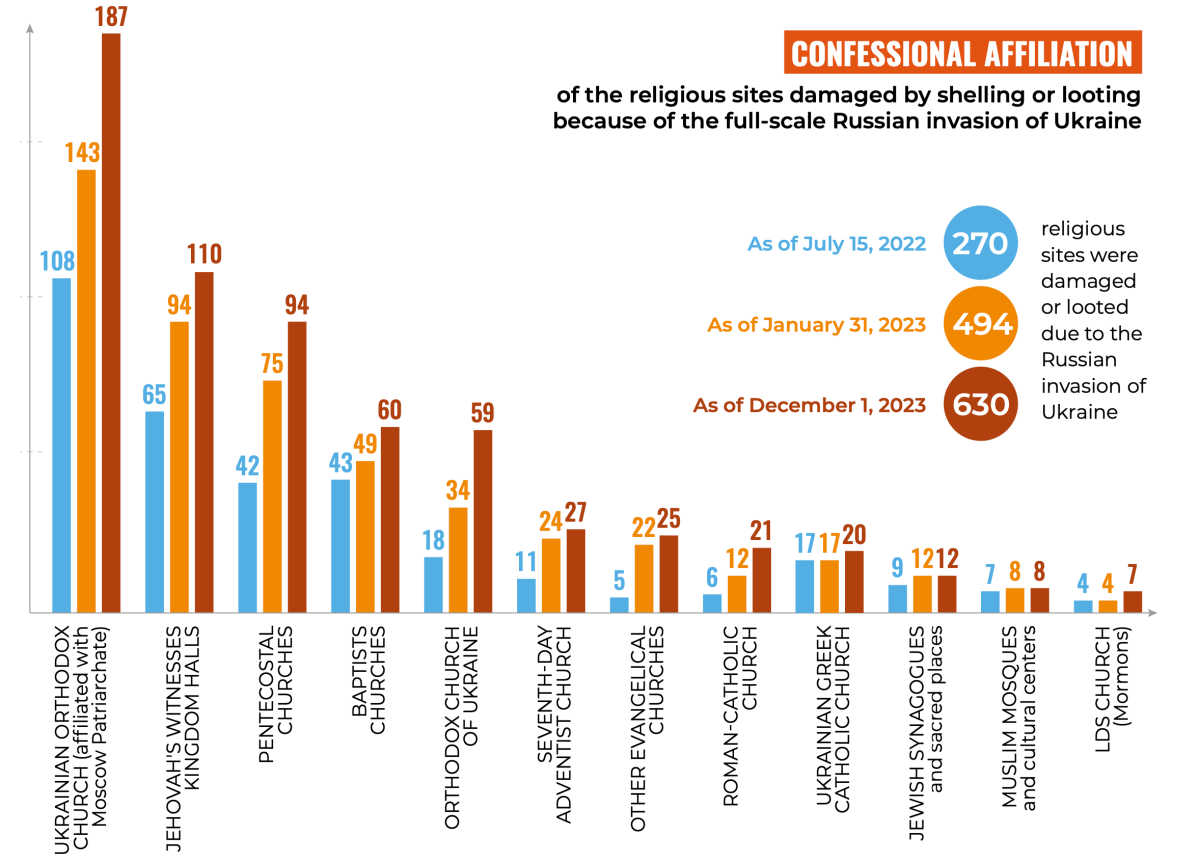
Ukraine Institute for Religious Freedom

And as CT’s February 2023 cover story featured how evangelical leaders were ready to “meet God at any moment,” a photo essay provided a window into the life of frontline chaplains. Service continued in Ukrainian Christian schooling, prison ministry—including to Russian POWs—and radio outreach, despite restrictions on use of the Russian language.

Such restrictions have often been highlighted by commentators like Carlson, with particular emphasis of those recently enacted and threatened against the Moscow-linked Ukrainian Orthodox Church (UOC). CT covered the UOC’s initial efforts to signal its independence from Russia, and the local reactions as Ukraine threatened and then recently passed a law that allegedly would “ban” the historic denomination altogether.
Amid the controversy, Ukraine switched its Christmas celebration from the traditional Orthodox date of January 7 to the Western date of December 25. A holiday-themed article described the Ukrainian origin of Carol of the Bells, while an Easter article featured the Ukrainian Pysanky eggs.

But while most of CT’s reporting aims to reflect nuance in its presentation of the mutual recriminations, coverage has also sought to faithfully convey evangelical perspectives, as offered in “Christmas Epiphanies from the Ruins of Ukraine.”

God may have been minimally invoked during the Carlson-Putin interview. But even as Ukrainian evangelicals struggle to make sense of their national ordeal, they keep God at the forefront (as seen in Ukraine’s top 10 Bible verses last year). One emphasized after the interview released late Thursday that he is praying for victory.

“I relate to the Psalmist’s prayers for delivery from the evil deeds of evil men, and many biblical examples give me hope,” said Maxym Oliferovski, a Mennonite Brethren pastor and project leader for Multiply Ukraine. “But even if he doesn’t I will continue to praise him, for God is good and sovereign.”

Editor’s note: CT offers select articles translated into Ukrainian and Russian.

You can also join the 10,600 readers who follow CT on Telegram: @ctmagazine (also available in Russian and Chinese).

News

Super Bowl Gambling Grows, But Pastors Are on the Sidelines

A surge in betting on the Vegas-based game between Kansas City and San Francisco has not pushed church leaders to speak about the issue.

A view of the field for Super Bowl LVIII that will take place Sunday in Las Vegas.

A view of the field for Super Bowl LVIII that will take place Sunday in Las Vegas.

Christianity Today February 8, 2024
Ethan Miller / Getty Images

With the Super Bowl this weekend, don’t expect many pastors to place a bet on Kansas City or San Francisco to win the game, but a few may have more than a rooting interest riding on the game.

Despite its legalization across many states, US Protestant pastors remain opposed to sports gambling, but they’re not doing much about it, according to a Lifeway Research study. Few pastors (13%) favor legalizing sports betting nationwide and most (55%) say the practice is morally wrong.

“Anything can happen in sports, and many Americans want the same allure of an unexpected win in sports to translate into an unexpected financial windfall,” said Scott McConnell, executive director of Lifeway Research. “Most pastors see moral hazards in sports betting and believe American society would be better off without it.”

Pastoral opposition

A majority of pastors (55%) believe betting on sports is morally wrong, including 33% who strongly agree. Around a third (35%) disagree, while 10% aren’t sure.

“While the Bible does not explicitly say, ‘Thou shall not gamble,’ biblical principles regarding work and wealth indicate that gambling is unwise,” said Miles Mullin, Ethics and Religious Liberty Commission vice president and chief of staff. “The Bible teaches that sin has a ripple effect that harms not only the participant but those around him. This seems particularly true for addictive behaviors, and gambling is no different.”

Evangelical pastors (62%) are more likely than mainline pastors (50%) to see sports gambling as morally wrong. Baptist (65%) and non-denominational pastors (63%) are more likely than those at Lutheran (42%) or Presbyterian/Reformed churches (46%) to agree it is wrong.

While there is some difference of opinion over the morality of sports betting, almost all pastors agree on what the legal status should be. Few (13%) agree sports betting should be legalized across the country, including 2% who strongly agree. Three in 4 pastors (75%) oppose nationwide legalization, and 13% aren’t sure.

Younger pastors, those aged 18–44, are the most likely to support making sports betting legal across the U.S. (20%) and the least likely to oppose those efforts (64%). White pastors (76%) are more likely to oppose legalization than Black pastors (63%). Pastors in the South (78%) and Midwest (75%) are also more likely to disagree with legalizing sports gambling nationwide than those in the West (64%).

Again, evangelical pastors are more likely to oppose gambling than their mainline counterparts, with 80% of evangelical pastors compared to 64% of mainline pastors opposing legalization across the country. Pentecostals (85%) and Baptists (83%) are more likely to disagree with legalizing sports betting than Methodist (72%), Presbyterian/Reformed (71%), Lutheran (66%) and nondenominational pastors (66%).

The overall numbers are similar to a 2018 Lifeway Research study of US Protestant pastors conducted shortly after a Supreme Court ruling opened the door for an expansion of sports gambling across the country. In late summer 2018, 59% of pastors felt sports betting was morally wrong, and 12% thought it should be legal nationwide.

Pastoral apathy

Currently, some form of sports gambling is legal in more than 30 states and Washington, DC. But few pastors see it as an issue for them or their churches to address. This demonstrates a shift from their stated intentions in 2018, a few months after sports betting became a legal possibility across the country.

In 2018, pastors were asked, “If sports betting is legal or soon becomes legal in your state, which of the following will your church do?” Almost 9 in 10 (88%) said they would offer counseling for those struggling with addiction and debt. Two in three (65%) said they would have private conversations to discourage participation, and 60% would offer support groups for gambling addictions. Another 42% said they would advocate for stricter laws on sports betting. And 33% planned to use sermons to discourage participation. A little more than five years ago, 5% of US Protestant pastors said they wouldn’t feel the need for their church to address the issue.

Today, few of those stated ambitions have been realized, and most pastors say they don’t feel like they need to do anything about sports betting. Within the last year, 44% of pastors say they’ve offered counseling for those struggling with debt or addiction and 32% have used private conversations to discourage participation in sports betting. Few say they have offered support groups for gambling addiction (11%), advocated for stricter laws on sports betting (8%) or used sermons to discourage participation (7%). Most pastors (56%) now say they haven’t felt the need for their church to address the issue in the last year.

Asked directly about their own participation, 2% of US Protestant pastors say they have placed one or more bets on sporting events in the last year.

“Pastors are still not supportive of sports betting, but their plan for responding has changed in the last six years,” said McConnell. “Pastors’ 2018 intentions were to fight to keep our culture from hurting itself by lowering a standard. Now that most states have legalized sports betting, pastors appear less interested in focusing on this behavior. Many will likely follow through on their intentions if a specific need arises, but the reality is that intentions are easier than actions.”

Baptist and Methodist pastors are often the ones most likely to be involved with the issue. Baptists are among the most likely to say they’ve used sermons (13%) and private conversations (39%) to discourage participation. Methodists are among the most likely to have offered support groups for gambling addiction (16%). Both Methodists (14%) and Baptists (12%) are among the most likely to say they’ve advocated for stricter laws on sports betting in the past year and to say they’ve offered counseling for those struggling with debt or addiction (Methodists 48%, Baptists 46%).

Pastors 65 and older (49%) are less likely than those 18 to 44 (61%) and 55 to 64 (59%) to say they haven’t felt the need to address sports betting. Lutherans (71%) and Presbyterian/Reformed (67%) are more likely than Methodists (53%), Baptists (47%) and Pentecostals (42%) to believe it’s not necessary to get involved.

Theology

Reading the Old Testament Through Ancient Egyptian Eyes

Learning about the land of Pharaoh helps us understand the people of Israel in their context.

Christianity Today February 8, 2024
pgaborphotos / Getty

We all know the Bible was not written on a blank slate. It records for us the life and times of ancient people who were embedded in a unique historical and cultural context, which was influenced in large part by its geography.

Outside the Promised Land, one of the places of greatest importance for the Israelites was Egypt. Not only did God’s people live there for some 400 years but Abraham and the prophet Jeremiah both traveled there. Even Jesus spent his formative years in Egypt, taken there by his parents when they fled from Herod.

Over the past four years, while writing a commentary on the Book of Exodus, I’ve read a lot about Egypt and realized just how much the ancient Egyptians can teach us about how to read and understand the Bible in its proper context. This was underscored by the study tour I took last month with Dr. James Hoffmeier, a renowned Egyptologist. Getting to visit pyramids, temples, museums, and tombs in person made so many familiar passages come to life.

The Book of Exodus is filled with references to the Israelites’ life in Egypt—including borrowed words from Egyptian and particular motifs that resonated in that context.

During their lengthy stay in Egypt, generations of Israelites would have been exposed to certain motifs over and over—and many of these pictorial representations informed the Bible’s own imagery. After all, the biblical authors chose conventional means to communicate eternal truths about Yahweh. These visual concepts would have made sense to their audience—and now, having seen some of them with my own eyes, they make more sense to me too.

Below are six examples which I found especially insightful.

The Garden Temple

I’ve read before that people of the ancient Near East styled their temples after gardens, but I was able to witness this phenomenon with my own eyes.

Many of the temples we visited featured pillars shaped like papyrus plants. The famous Hypostyle Hall of the great Temple of Amun-Re at Karnack had a whopping 134 papyrus-shaped pillars of an enormous size—seven people could barely reach their arms around a single pillar. On one end of the hall, the papyrus buds were closed, but on the other end, the plant’s petals were open wide in full bloom. Each pillar was decorated with brightly colored reliefs (carvings in the stone) with dyes made from plant powders.

Temple ceilings, where preserved, invariably featured paintings of a deep blue sky with yellow stars. And though the temples were made wholly of stone, they gave the impression of luxuriant gardens—with depictions of trees and plants like papyrus and lotus common throughout.

It’s no wonder Israel’s own temple had a deep blue ceiling held together by gold fastenings to twinkle in the light of the lampstand (Ex. 26:1–2, 6, 31–32). It’s no wonder that the lampstand inside the temple was styled as a tree with branches and buds—and that pomegranates dangled from the robe of Israel’s high priest (Ex. 25:31–40; 28:31–33). A garden temple recognizes God as Creator and acknowledges God’s role in the flourishing of the natural world.

The Wings of Protection

In Egypt’s temples, we saw winged creatures everywhere we looked—sometimes seraphim and sometimes other deities with wings outstretched, offering protection to the Pharaoh. The sacred barque (or boat) carrying the divine image was invariably flanked with winged protectors.

These images reminded me of the cherubim embroidered on the curtains of Israel’s tabernacle and temple (Ex. 26:31) and the gold cherubim with wings outstretched over the ark of the covenant in the Holy of Holies (Ex. 37:9, 1 Kings 6:27). I also have a clearer sense of why Boaz would have described Ruth as seeking protection under the wings of Yahweh (Ruth 2:12) and why the psalmist referred to people taking refuge under God’s wings (Ps. 17:8; 36:7; 91:4).

The Giving of the Spirit

Giving of life to Pharaoh Rameses IICourtesy of Carmen Imes
Giving of life to Pharaoh Rameses II

Perhaps you’ve noticed that most ancient Egyptian statues are missing their noses. While this may be explained in part as the nose being the most vulnerable part of a statue if it tips over, it’s also true that the fastest way to decommission a statue—and indicate that a Pharaoh no longer has the right to rule—is to break its nose.

The Egyptians believed that souls entered and exited through the nose. A dead Pharaoh with no nose would be doubly dead—not just physically, but spiritually—with no hope of resuscitation. The Pharaohs went to great lengths to protect their bodies so that they would be intact and therefore viable in the afterlife. A mummy was housed in a coffin inside a coffin inside a coffin, like Russian nesting dolls.

In many of the tombs and funerary temples we visited, we saw scenes carved in stone in which a deity offered the ankh, or symbol of life, to the Pharaoh by holding it up to his (or her) nose. By receiving life from the deity after his death, the Pharaoh would be spiritually animated to carry out the will of the gods.

These “giving of life” scenes remind me of Genesis 2, where God breathed life into the first human being. Hoffmeier also pointed out that when David prayed in Psalm 51:11, “Take not your Holy Spirit from me” (ESV), he was probably not worried about losing his salvation but rather about losing divine legitimacy for his rule. Recall that God had taken his Spirit from Saul to remove him from kingship (1 Sam. 15:23; 16:14); David did not want the same to happen to him.

The Strong Arm of Pharaoh

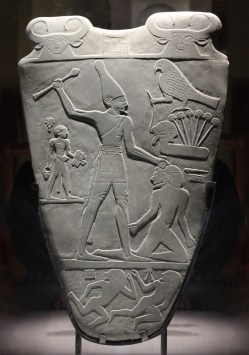
For thousands of years, Egyptian artifacts depicted Pharaohs in their favorite so-called “smiting pose” to indicate their military might. You can see a good example of it on the famous Narmer Palette, from 3100 B.C. In it, Pharaoh stands with one hand stretched out behind his head, grasping a mace, and another stretched out in front, grasping the hair of his defeated enemy.

Narmer PaletteCourtesy of Carmen Imes
Narmer Palette

What I didn’t realize is how ubiquitous this visual was. We saw it in every temple, sometimes dozens of times. In the temple of Rameses III, the first pylon (entryway wall) and every pillar in the first chamber shows the Pharaoh in this pose, each depicting a different defeated foe in his grasp. In essence, the hall functions as a visual resumé of Rameses’ military successes.

The depiction is not just pictorial but textual. On one of the outside walls is an inscription above the scene that reads “the one with a strong arm,” indicating one of Pharaoh’s preferred titles: “Strong-armed.”

Does this sound familiar? Throughout the Old Testament, Yahweh refers to himself as one with “a mighty hand and an outstretched arm”—usually used in reference to God’s actions during the Exodus. In fact, the phrase referring to God’s “outstretched arm” is reserved almost exclusively for Egyptian contexts (Ex. 6:6; Deut. 4:34; 5:15; 2 Kings 17:36; Jer. 32:21).

In other words, Yahweh posed a direct challenge to Pharaoh and Pharaoh’s worshipers—as if to say, “You think you have a strong arm? Just watch what I can do!”

Daily Life in Ancient Egypt

Aside from how such figurative imagery illuminates the biblical text, I learned much from the artwork about the daily life, work, and gender roles of men and women in ancient Egypt.

In the tombs of the nobles and workmen as well as in the museums that held the artifacts found in these tombs, I saw statues, paintings, and sculptures depicting bread making, beer making, brick making, sculpting and writing, planting and harvesting, tanning leather, scenes depicting childbirth, and more. I saw combs, makeup palettes, and jewelry, tools for spinning and dying wool and flax, and models of ancient looms. I saw carpenter’s tools and flint knives, hoes and grinding stones, a handsewn tent, beds, and chairs.

Ancient Egyptians believed that a person would need everything in the afterlife that they needed in this life. They expected to work in the fields of the god Osiris, so they stocked their tombs with a variety of practical implements such as plows and shovels, plus a bed, chair, and clothing. In contrast, the Hebrews at that time mostly concerned themselves with how their “name” or reputation would be remembered after they died and said almost nothing about life after death—that is, until the latest Old Testament periods.

Looking back, the Egyptians had the right impulse about the continuation of human vocation in the afterlife—similar in some respects to how we now conceive of the New Jerusalem—but it would be many hundreds of years before God revealed any particulars to the Jewish people.

These are insights we miss out on whenever we ignore the geographical context of the Old Testament. And yet, thanks to the dry and sandy climate in Egypt, we have the privilege of traveling more than 3,000 years back in time to catch well-preserved glimpses of a culture that profoundly shaped the Israelites—and all the people of God who came afterward.

Carmen Joy Imes is associate professor of Old Testament at Biola. She’s the author of several books, including Bearing God's Name: Why Sinai Still Matters, and she is currently writing a commentary on Exodus for Baker Academic.

Books
Review

The Cross Is Poetically Profound. But Prose Can Help Us See It Clearly.

Brian Zahnd’s meditation on cruciformity is theologically rich, but sometimes theologically risky.

Christianity Today February 8, 2024
Illustration by Mallory Rentsch Tlapek / Source Images: Unsplash

It would be natural to assume that Brian Zahnd, most recently the author of The Wood Between the Worlds: A Poetic Theology of the Cross, is a megachurch pastor. After all, he’s published half a dozen popular books and has a large following online.

The Wood Between the Worlds: A Poetic Theology of the Cross

But the “gigantic” parking lot of Zahnd’s church in Missouri was “desolate” when journalist Tim Alberta visited while researching his own recent book. “There must have been spaces for 800 vehicles,” Alberta observed, but maybe a tenth were occupied.

The short explanation for the decimation of Zahnd’s congregation, as Alberta tells it, is faithfulness. Years into his pastoral career, leading what was then a megachurch, Zahnd felt God calling him into a deeper and more demanding Christian life. He dove into theological study, especially of early church fathers like Irenaeus and Augustine, and emerged with a changed faith—not “backsliding,” he told Alberta, but “front-sliding,” becoming “more committed to Jesus than [he’d] ever been.”

That included a newfound commitment to Christian nonviolence and a rejection of politicized Christianity, which in Zahnd’s context—a red state during George W. Bush’s first presidential term, with the Iraq War under active debate and a re-election campaign in full swing—meant the near-complete integration of many evangelicals’ Republican and American identities with their faith. “God raised up Jesus, not America,” Zahnd recalled telling his congregation. “They got it. And they left.”

Two decades later, the Zahnd of The Wood Between the Worlds is no less dogged in his sheer enthusiasm for Jesus. Even his punctuation is excited about Christ. (“This is what God is like!” one section header trumpets.) And the subtitle is apt, insofar as this is the most cross-centered book I’ve read in years—a worthwhile meditation on theodicy, atonement, and the shape of a cruciform life. But Zahnd’s “poetic” mode of theology leads to occasional imprecision and, as a result, some questionable theological moves.

Followers of a suffering God

Early in the book, Zahnd writes, “The most emotive and persuasive argument against Judeo-Christian faith is not an argument against the existence of God, but an argument against the goodness of God.” He bolsters his case with accounts—inspired by true stories—of the torture and murder of small children in Fyodor Dostoevsky’s The Brothers Karamazov.

It’s a sickeningly effective illustration, but perhaps unnecessary in an era when news of evils across the world is broadcast so constantly and rapidly. Footage of disastrous earthquakes reaches us in real time; terrorists livestream their abductions and rapes; any casual scroll through Facebook is likely to turn up an online alms collection for a toddler with cancer.

Such horrors tend to result less in a confident atheism than in a weary, vaguely spiritual preoccupation with injustice and a decided lack of interest in any God who tolerates it. And much of what is trotted out as biblical theodicy, Zahnd argues, is nothing of the sort. The Psalms regret the suffering of innocents but don’t really explain it. The Book of Job models trust in God in our most vulnerable ignorance, but it too leaves the central question of evil unanswered.

So where, asks Zahnd, “is God in unspeakable human suffering?” He is there too, the book concludes, in the solidarity of the Cross. “The only theodicy I know is that God too has hung, suffered, and died,” he writes. “When we see Christ in agony upon the cross, we see a suffering God who refuses to allow his beloved creatures to suffer alone.” This same God is not dead but alive, not defeated but victorious, and he will one day bring justice and restoration to all things (Acts 3:21).

This is not only theodicy for the 21st century, of course. It is also theology proper. It tells us, as that enthusiastic section header puts it, “what God is like!” And Zahnd’s engagement with atonement theories has a similar end. How we explain the Cross is of utmost importance, he correctly observes, because the Crucifixion is “the pinnacle of divine self-disclosure” (Col. 1:15–20), and our understanding of God necessarily shapes our understanding of what God wants of us.

Zahnd doesn’t advocate any single theory of the Cross, though he favors René Girard’s scapegoat theory and the ancient family of metaphors (ransom, recapitulation, redemption, etc.) we collect as the Christus Victor model. For Anselm’s satisfaction theory and John Calvin’s penal substitution model, Zahnd issues a fierce critique, arguing that they present a sub-Christian, “paganized soteriology” that “import[s] an unspeakable violence into the Trinity.” (I’ll return momentarily to the farthest point Zahnd reaches in repudiation of these theories.)

Atonement models that emphasize how Christ suffers and dies for his enemies rather than killing them (Rom. 5:10) are foundational to Zahnd’s understanding of what it means to live as a follower of Christ. Readers who disagree with him on atonement may at this point expect Zahnd to be some sort of theological liberal: “soft on sin,” perhaps, or inclined to teach exclusively from the red letters that land comfortably with modern social justice types.

A fair reading doesn’t permit that conclusion. On the contrary, he rebukes “liberal theology [that tries] to separate the teaching ministry of Jesus from his suffering and death,” making the Cross “nothing but a tragic catastrophe” and Jesus merely an “unfortunate victim of the machinations of bad religion and cruel empire.”

Zahnd vehemently rejects bad religion and cruel empire, to be sure. (He has ties to the neo-Anabaptist movement.) But he does so quoting theologian Søren Kierkegaard’s bracing insight “that Christ’s life is a demand.” He does so calling Christians to a cruciform life that renounces war, idolatry, and fornication—to a life of following Jesus even if it gets us killed or empties our gigantic church parking lots.

Poetry or precision?

“Not all theological language is the same,” Zahnd writes in a short prelude:

Though in modernity we have a penchant for technical prose when engaging in theological conversation, earlier ages—and the Bible itself—have a fondness for the less precise but also less limiting language of poetry. Theopoetics is, in part, an attempt to speak of the divine in more poetic language. It is an attempt to rise above the dull and prosaic world of matter-of-fact dogma that tends to shut down further conversation. If in this book I occasionally veer away from prose to employ slightly more poetic language in how I see the cross, this should not be regarded as fanciful, but as the best recourse I could find to describe the truth I believe the Spirit is helping me to see.

Two notes are necessary here. First, in this sense, I’m very modern. I like the straightforward arguments of the Epistles. I value the precision of prose. But I don’t want to render a theological verdict on what may mostly be a difference of personality, so let me disclose this bias.

Second, most of The Wood Between the Worlds is prose. Zahnd talks of theopoetics and quotes some hymns and poems, but it’s only in a final, unnumbered chapter that he fully shifts into a theopoetic mode himself. In the prose that makes up the bulk of the book, Zahnd is extremely precise when he wants to be (on points like the divinity of Christ, the necessity of the Cross, and the reality of the Resurrection). And there are points where he’s deliberately more freewheeling, hoping to provoke thought, raise questions, and leave readers with a spiritually productive lack of resolution.

But there are also points where Zahnd’s chosen style raises questions that feel less productive—more in need of a concrete answer. Two in particular stood out.

First was his repeated description of the story of Cain and Abel as a “founding” moment. Pilate couldn’t understand Christ’s kingdom, Zahnd says, because it is not of this world, which “is the one founded by Cain through the slaughter of brother called other and enemy” (emphasis mine). Similar constructions pop up several times. Because Cain was “the founder of the first city,” Zahnd contends, his “founding murder” of Abel was the “cornerstone of human civilization.”

As someone who basically shares Zahnd’s convictions about nonviolence (which he graciously explained in an interview for my first book in 2018), I’m sympathetic to what he’s attempting here. But the New Testament doesn’t use the story of Cain this way; it is content to cite the Fall as a sufficient narrative explanation for evil in our world, violence included.

There may well be a persuasive case for interpreting the Cain story this way. Zahnd is almost certainly drawing on Augustine, who describes Cain-as-murderer as “the founder of the earthly city.” The idea of Cain’s murder as an “original violence” is echoed by Thomas Hobbes, Girard, and modern scholarship, and Zanhd is likely influenced at least by Girard. But he doesn’t share any of that background with readers, foregoing an explanation for why violence is a “special” sin with its own “Fall.”

The second case, where Augustine can’t be marshaled in defense, is more likely to get Zahnd in hot water. In his critique of the satisfaction and penal substitution theories of the Atonement, his main objection is the role he sees these views assigning to God the Father. Christus Victor makes the Devil the obstacle to reconciliation between God and people; to choose one metaphor, it is the Devil who demands a ransom for humanity’s freedom (Heb. 2:14–15, 9:15). But these later theories swap things around, portraying the Father as the one demanding satisfaction or punishment before reconciliation may occur. In Zahnd’s view, this suggests a God “who inflicts pain and suffering upon the Son.”

Pushing back on this notion, Zahnd approvingly quotes a Russian Orthodox theologian, Sergius Bulgakov, who wrote that in “the human crucifixion of the Son and the divine co-crucifixion of the Father, love itself is co-crucified.” Two pages later, Zahnd himself acknowledges that to “speak of the entire Holy Trinity as co-crucified with the Son is daring language, to be sure, but it is far more theologically sound than doing violence to the Trinity by positing the Son as an object of the Father’s wrath.”

Once again, I am sympathetic to Zahnd’s aims here. I too prefer the Christus Victor model, and on similar grounds. But the concept of co-crucifixion of the whole Trinity is not simply “daring.” It at least approaches the ancient Trinitarian heresy of patripassianism (which says God the Father suffered on the cross) and associated heresies like modalism (which describes the three members of the Trinity as different revelations, or modes, of a single person).

To be clear: I don’t think Zahnd is a modalist, and I doubt he could be fairly labeled a patripassian. But slightly more precise and, yes, prosaic language could have made the same points about the Trinity’s loving unity of purpose in the project of redemption without introducing the same uncertainty about the Trinity’s nature.

That imprecision is the matter of a few pages, and the great bulk of The Wood Between the Worlds rests on surer ground. Zahnd writes as a Christian who has long “resolved to know nothing … except Jesus Christ and him crucified” (1 Cor. 2:2), and he has ably invited his readers to do the same.

Bonnie Kristian is the editorial director of ideas and books at Christianity Today.

Ideas

The Selfish Ambition of Our Immigration Debate

Contributor

Migrants, border states, and sanctuary cities alike are suffering because of our leaders’ spiteful rivalries.

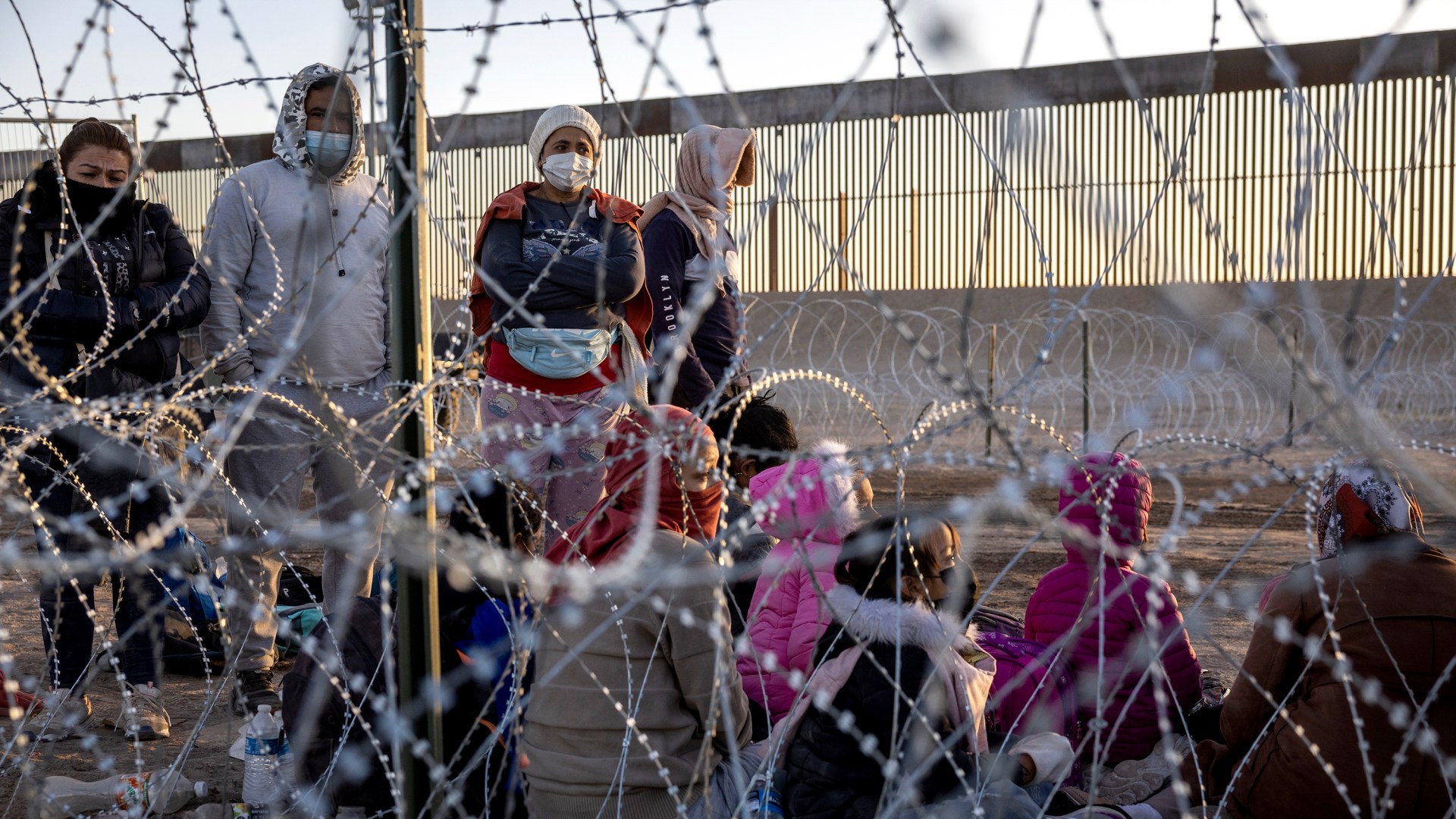
Immigrants wait to be processed by US Border Patrol agents at an encampment near the US-Mexico border.

Immigrants wait to be processed by US Border Patrol agents at an encampment near the US-Mexico border.

Christianity Today February 8, 2024
John Moore / Staff / Getty

In Galatians, the apostle Paul writes about the “fruit of the Spirit” and the “works of the flesh.” The former is a product of God’s influence in our lives, and the latter are actions that come from humanity’s corrupted and unredeemed disposition (Gal. 5:19–26).

Among the works of the flesh, Paul mentions what the English Standard Version refers to as “rivalries,” which the New International Version calls “selfish ambition” (v. 20). These are quarrels born of self-seeking. They divert our eyes from what’s good and true, shifting our focus toward spiting those who stand in the way of our gaining worldly treasure. Preoccupied with antagonism and winning the argument, we devalue doing what’s right. The fight becomes more important than the solution.

Our country’s immigration policy has long been a casualty of this dynamic, and the partisan rivalries obstructing the pursuit of comprehensive immigration reform exemplify so much of what’s wrong with our politics.

America’s immigration problems on the southwest border are no small matter, involving both a humanitarian crisis for migrants and, on the home front, security and scarcity issues. In 2023, US Border Patrol reported over 2.4 million encounters with migrants on the Mexican border. Texas alone has a backlog of 458,630 immigration cases in its court system.

But migrants keep coming and applying for asylum because they believe the United States offers a better life—and that if they can just get across our border, they’ll be able to stay. Many migrants arriving at the southern border have left their native lands, like Venezuela and Colombia, to escape both economic and political hardship. “It’s wrong to claim that nobody arriving at the border is a refugee, as many have very legitimate claims of asylum,” explained Mexico-based journalist Ioan Grillo. “Yet it’s also wrong to say there aren’t any economic migrants. Or that people don’t flee both poverty and bullets.”

God told his people to take care of immigrants because of their often desperate situations (Zech. 7:9–10), and that age-old desperation is still our world’s reality today. Yet too many of our political leaders have been, at best, half-serious about fixing these problems. Selfish rivalries, pettiness, and fearmongering have frustrated years of efforts to address immigration reform with the cooperation and sobriety it requires.

People on both sides of the aisle were optimistic about the prospects of immigration legislation after then-president Barack Obama’s re-election in 2012. “I think 2013 is the year of immigration reform,” Sen. Lindsey Graham declared. The bipartisan “Gang of Eight” drafted the Border Security, Economic Opportunity, and Immigration Modernization Act of 2013 and passed it in the US Senate, but the House never took it up. The bill died in the 113th Congress.

Soon, bipartisan immigration reform became anathema in the Republican Party. A loud minority of Tea Party activists found that hard-line border rhetoric got more attention than talk of comprehensive solutions. In 2014, Republican House Majority Leader Eric Cantor lost his seat, at least in part, because of his support of immigration reform, which his primary opponent characterized as amnesty for illegal aliens.

On the presidential campaign trail the following year, Sen. Ted Cruz took Gang of Eight member Sen. Marco Rubio to task for the unforgivable sin of working with Democrats on a bill that would’ve given some illegal immigrants a path to citizenship. “The Gang of Eight voted as a gang against enforcing and securing the border,” Cruz said, though his own record on immigration reform was far less restrictionist than he’d claim once public opinion turned.

The rise of former president Donald Trump, who infamously launched his 2016 presidential campaign suggesting most Mexican immigrants are violent criminals, guaranteed the Gang of Eight approach had no near-term future in the GOP. And now, almost a decade later, migrants, border states, and local governments are all unnecessarily suffering because of the selfish ambition of a few.

The situation came to a head early this year, with the Biden administration in a “standoff” with Texas Gov. Greg Abbott and more than a dozen other red-state governors, after the Supreme Court ruled in favor of the federal government in a border dispute. Given the urgency of the moment, another bipartisan group of senators crafted a narrower compromise deal—but apparently such a solution isn’t politically expedient in an election year.

Trump publicly opposed the deal, and Senate Minority Leader Mitch McConnell, in private, reportedly pressured Senate Republicans to do the same, saying the former president wanted to campaign on a broken immigration system and urging his colleagues not “to do anything to undermine” Trump. That version of the deal died, and a new version, announced this past Sunday, died on Wednesday in the Senate.

This is civic malpractice. Foreclosing an opportunity to address a major national problem to win an election is a violation of public trust. This zero-sum gamesmanship has gone much too far. Legislators don’t have to accept the first proposal placed on the table—the deal that failed this week included unrelated war funding—but they do need to engage in good faith, with an eye toward solving the problem.

And the problem is not exclusive to Republicans. While Democrats have demonstrated a greater commitment to reform, some on the Left have reflexively resisted strong border control. “I hope Democrats can understand that it isn’t xenophobic to be concerned about the border,” Democratic Sen. John Fetterman recently said. “It’s a reasonable conversation, and Democrats should engage.”

Whether they will remains to be seen. Over the years, Democrats have responded to Republican opportunism and harshness with some rivalry-motivated antics of their own. This theater may help them win elections, but it has done a disservice to our country by downplaying the hardships that border states endure.

In some cases, Democrats’ own constituents have suffered for their selfish ambition. For instance, cities far from the southern border—like Chicago, Denver, and New York City—virtue-signaled and bragged about being sanctuary cities without adequate budget or plan for actually supporting thousands of migrants. Progressive mayors and governors used the border crisis as an opportunity to capitalize on national partisan polarization. They used a caricature of conservatives as a foil, talking about sanctuary city status as a cheap way to spite Republicans without having to deal with any of the real costs of our broken system. They boasted of generosity but were never forced to seriously consider what they would do if they had to govern Texas.

That performance was cut short when Texas Gov. Greg Abbot began sending asylum seekers up north to cities that only intended to support them symbolically. His decision was morally and ethically suspect, but he effectively called the Democrats’ bluff and forced them into the conversation in earnest. Instead of selling wolf tickets to the media, they now had skin in the game. And after receiving tens of thousands of migrants, they started screaming bloody murder. Even New York City Mayor Eric Adams criticized the Biden administration on immigration. The charade has been exposed.

We don’t have to pretend both sides are equivalent on this issue to recognize that it’s more complex than simply being kind and letting migrants in or mean-spiritedly keeping them out. While the Christian call to treat the immigrant with compassion is clear, that general disposition doesn’t prohibit us from acknowledging the practical reality. We don’t let everyone in the street into our homes, because we don’t have enough food or rooms for all. America has wealth, but it’s not without those same considerations when it comes to immigration. Encouraging people to come to a place that is not prepared to accommodate them is not kind.

It’s time to get serious. We need comprehensive immigration reform, and we should encourage our leaders to do the hard work of democracy, to sit down and thoughtfully find solutions that both sides can accept.

What we need right now is to start thinking and acting like a united country. We can’t afford these partisan rivalries and the selfish ambition that perpetually stalls important legislation until the next election. We can’t afford to only worry about our party, region, state, or city. This is not how to maintain a healthy republic.

We also can’t belittle the struggles of our political opponents. Regardless of which party we’re in, Christians should have no tolerance for the denigration of immigrants, self-interested gamesmanship, or political theatrics where the lives of hurting people are concerned. The Bible calls us to love the foreigners among us, to feed and clothe them (Deut. 10:18; Jer. 7:5–7). We can’t let our self-interest or contempt for the other party make us lose sight of that command.

Justin Giboney is an ordained minister, attorney, and the president of AND Campaign, a Christian civic organization. He's the co-author of Compassion (&) Conviction: The AND Campaign's Guide to Faithful Civic Engagement.

Theology

What’s the Impact of Asbury’s Outpouring? John the Baptist Offers 3 Lessons

How the prophet’s ministry helps us understand what may come next a year after revival broke out.

The Preaching of John the Baptist by Bartholomeus Breenbergh

The Preaching of John the Baptist by Bartholomeus Breenbergh

Christianity Today February 7, 2024
WikiMedia Commons / Edits by CT

We often only realize that we are living through historic events by looking back on them.

Consider the Moravians. In 1727, this group of Christians fleeing persecution in the modern-day Czech Republic began a 24-7 prayer vigil. They couldn’t foresee that their non-stop prayer session would ultimately last for 100 years and launch a global missions movement.

Or take the example of John Wesley and George Whitefield. In 1738, in a New Year’s prayer meeting, where the men and others were gathered, at “about three in the morning, as we were continuing instant in prayer, the power of God came mightily upon us, insomuch that many cried out for exceeding joy” later wrote Wesley in his diary.” The preachers likely had little idea that in the ensuing months, they would start traveling across the UK teaching the word of God, a campaign that would mark the beginning of the Wesleyan revival and the First Great Awakening in the US.

Church history has taught us to never underestimate the long-term impact when God’s tangible presence comes upon a group of people; this understanding has led me to closely track the aftermath of the 2023 outpouring at Asbury University.

For those who need a refresher: One year ago this week, as a seemingly ordinary Wednesday morning chapel ended, 18 or 19 students lingered to worship and pray. Though the school in rural Kentucky has a history of revivals, few likely believed that this meeting would continue for the following 16 days, drawing over 60,000 people, including students from 300 university campuses and Christians from almost every continent.

While we have yet to see a global revival since Asbury’s concluded, there is more going on than our eyes can see. I believe that we have entered a season of spiritual preparation. I’ve observed parallels between this event and a biblical preacher who also hailed from the countryside and who also drew a crowd: John the Baptist.

Prophesied by Isaiah as “the voice of one calling in the wilderness” (John 1:23; Is. 40:3), John called the people to repentance and consecration. He was the embodiment of answered prayer and devoted his ministry to proclaiming that something greater would soon be following him. Seeing evidence of these elements all around the world provokes me to wonder what next global move Asbury might have heralded.

A call to repentance and consecration

From the wilderness, John the Baptist earned his nickname by “preaching a baptism of repentance for the forgiveness of sins” (Mark 1:4). Crowds followed him into the desert to confess their sins, get baptized, and reconcile themselves to God.

In a similar way, crowds entering Hughes Auditorium were confronted with the state of their own hearts. Here is how David Thomas, who was in the core leadership team stewarding the outpouring, described it to me in an email interview:

For the first few days of the Outpouring, it seemed that repentance and forgiveness were almost all we could do. All over the room, people were making their way to another, tumbling over one another to make the first move of offering apologies, owning mistakes, forgiving grievances, and explaining misunderstandings. The front steps of Hughes were populated by people on their phones sending texts of reconciliation and restoration.

Thomas’s remarks were echoed by one of the transatlantic visitors. Al Gordon, a London pastor, reported feeling a weight in the air even in the parking lot.

“I was met with an overwhelming sense that I have to get right with Jesus,” he recounted. “Before I stepped into the chapel, I was crying out in repentance, confessing my pride, humbling myself before God.”

Asbury students led the way in modeling this wave of repentance. From the stage, hundreds shared their testimonies. Their stories would vary from simple things like, “I sensed Jesus inviting me to text a friend asking forgiveness for something in our relationship that was not quite right,” to dramatic transformations such as, “Three days ago I renounced witchcraft and gave my life to Jesus.”

Student leaders would also not allow anyone to lead worship who was not “authentically right with Jesus,” said Thomas. Instead of offering them and the guest speakers who came a standard green room, they created a “consecration room” where they were asked to receive prayer and ask for God’s forgiveness for any sins, prior to sharing anything from the platform.

A call to prayer

John the Baptist was born out of prayer, specifically those of his elderly parents. When the angel appeared to his father, Zechariah, his first words were, “Do not be afraid, Zechariah; your prayer has been heard” (Luke 1:13).

In the same way, there was an unwavering conviction among the Asbury leadership that “everything that happened in Hughes Auditorium those 16 days was the fruit of prayer,” said Thomas. When people entered the space in small-town Kentucky from other cities or continents, he would thank them for coming. But they would correct him. “Don’t thank me. I had to come. I had to get here and put my eyes on what I have been praying for all these years!”

“People from all over had been praying, and this story was theirs,” Thomas shared.

The prayer temperature globally has increased significantly this last year. The Asbury outpouring “released fresh hunger and fresh hope” in the life of Pete Greig, the founder of 24-7 Prayer, as well as among the ministry itself, which has 25,000 prayer rooms in 78 nations.

“There’s a rise in prayer,” Grieg said. “There’s a deeper expectancy.”

In New York City, Church of the City is organizing prayer events every morning, afternoon, and evening, Monday through Friday. Its pastor, Jon Tyson, visited the outpouring himself and was deeply impacted by it.

“It was extraordinary,” he said. “Having studied revivals extensively, I witnessed what I only had read about.”

This hunger for awakening has also been felt across the ocean. Three London churches have organized all-night prayer evenings held every other month, where around 1,000 students and young adults have shown up and called out to God for revival. The atmosphere is so dense with the presence of God, “you could light the air with a match,” said Al Gordon, one of their pastors. Another pastor, Pete Hughes, remarked, “And we’ve committed to keep going until we see an awakening in our city.”

A similar longing is seen on other continents. “Here in Australia, Asbury has caught many people’s attention,” said Mark Sayers, a writer and the pastor of Red Church in Melbourne. As a response to Asbury, the congregation opened a prayer room.

After several months, one evening “the room filled with the most tangible sense of God’s presence,” he said. “No one wanted to leave. Quiet, peaceful, unlike anything I have experienced in a prayer meeting or service. That moment radically changed a number of people who were there and significantly deepened our church’s spiritual life.”

Pointing to something bigger yet to come

John the Baptist was always clear that his role was to point to the one coming after him: “He must become greater; I must become less” (John 3:30). He was also keenly aware that his ministry was a preparation for a movement that would follow.

In the same way, Asbury kept Jesus at the forefront with a countercultural message of “no celebrity except Jesus.”

Asbury leadership hopes that their experience will one day be part of a plethora of chapters about how many met God.

“We look forward to a day soon when there will be another outpouring story that will eclipse this one at Asbury,” said Thomas. “I hope that story will come from where you are—your city, your campus, your church and family, your own life.”

The leadership pointed to Asbury as being the opposite of Las Vegas. The saying goes that what happens in Vegas, stays in Vegas. But what happens at Asbury should not stay in Asbury. Instead, they called for the revival to go across campuses, churches, streets, and society.

“If it doesn’t get to the streets, if it doesn’t get to the nations, it didn’t get where it was meant to be,” stated Thomas.

From Asbury to the world

The crowds who visited John the Baptist in the wilderness foreshadowed multitudes listening to Jesus in Galilee and the church taking the gospel to the ends of the earth. Only a year has passed since Asbury, but already Christians across the globe, particularly university students, are hungry to learn from those central to Asbury’s outpouring.

At the most recent Passion Conference, which drew 55,000 young people earlier this year, Louie Giglio shared openly about the impact of Asbury in his life, and the conference had various times of lingering in worship, with students spontaneously singing the chorus of ‘’Agnus Dei” a cappella for more than 15 minutes. After Zach Meerkreebs, the preacher at that first Wednesday Asbury chapel service, shared about the outpouring from the stage, students gathered in small groups asking God for an awakening on their own campuses.

A similar longing can be seen across the pond in Europe. At the most recent Revive Europe conference, which gathers about 3,000 university students from 87 nations across the continent, students spontaneously sang a cappella the same chorus of “Agnus Dei” for 40 minutes. Revive Europe has also been hosting the Asbury leaders in their gatherings to learn from them and to stir faith in what God can do.

At Arise Asia, a conference which brought together 1,700 students from nearly every Asian country, Asbury Theological Seminary’s president Timothy Tennent shared a message, which included extended times of worship and prayer for revival. When the Lausanne Movement convenes 5,000 leaders of the global church in Seoul for its 50th anniversary in September, Tennent will also teach about the role of the Holy Spirit in the mission of the church.

The hunger in this generation is palpable. Jennie Allen, the founder of the IF:Gathering, who herself was deeply impacted by Asbury, says, “I could weep right now for an hour about what God is doing in and with Gen Z.”

Allen goes on to share that she had been preaching at Auburn University on a Tuesday night some months ago. “At the end, one girl wanted to be baptized. I said, ‘Would anybody else like to be baptized?’ We baptized over 200 students! It was crazy! We finally had to stop at midnight.”

No more business as usual

It is easier to recognize the beginnings of a movement of God when we are centuries removed. But what if we are in the midst of a new beginning? If God sends a global revival in our generation, surely you and I don’t want to miss it.

This is not a time for business as usual. It is an invitation to wherever God placed us, to prepare the way for the King. It is a call for repentance and to get straight with God in our personal lives, our ministries, and our vocations. How are we preparing the way in the places where God has placed us? How are our university campuses, local churches, and mission organizations preparing the way? For those of us in the marketplace and businesses, what are we doing to be sensitive to a work of God?

“God is closer than we think and more ready to move than our faith would often allow for,” wrote Gordon, the London pastor who attended the outpouring. “The ceiling is thinner than our eyes can see, and at some point it’s going to break open.”

One year has passed. And it is only just beginning. Will the global church be ready to make way for the King?

Sarah Breuel is the executive director of Revive Europe and serves on the board of directors of the Lausanne Movement.

News

How Indigenous Conflicts in Chile Ended up Targeting Christians

Mapuche attacks against the government and environmental companies have included the arson of numerous churches.

Mapuche Huilliche communities have indefinitely taken over the Osorno Cathedral in Chile.

Mapuche Huilliche communities have indefinitely taken over the Osorno Cathedral in Chile.

Christianity Today February 7, 2024
NurPhoto / Contributor / Getty

Last week, the Argentine government blamed a fire that has consumed more than 7,000 acres of a national park in Patagonia on arson by an armed indigenous group known as the Resistencia Ancestral Mapuche (RAM).

The Mapuche, an indigenous community who have lived for generations in a territory now belonging to Argentina and Chile, have long been at odds with governments and businesses, often over land rights, environmental concerns, and fears of forced assimilation.

Despite the presence of Mapuche Christians, for a period of years, members of groups like Weichán Auca Mapu (WAM) and Coordinadora Arauco-Malleco (CAM) targeted numerous churches. The number of torched congregations reached more than 80. The government struggled to arrest and prosecute the attackers.

But after several intense years of terror, slowly the situation seems to be improving.

“We will continue to bear witness to the gospel,” Abelino Apeleo, an Anglican bishop in Araucanía and also an ethnic Mapuche, said in 2017, in the thick of the situation. “We have to apply the teachings of Jesus: to forgive, to have mercy, and to love our enemies. At some point they may need our help, and we will be there for them.”

Answered prayers?

In 2016, Elías Fuentealba witnessed WAM members burn down the small Pentecostal church he pastored in Niagara, a city in the southern division of Araucanía.

“The day of the arson, we gathered and prayed outside the church, ‘Lord, you give, and you take away. Blessed be your name,’” Fuentealba told CT. “When we finished praying, the police told us that, nearby there, they had caught some suspects of the crime.”

The five gunmen were charged with being members of WAM; at that point, the group had already claimed responsibility for several arson attacks against Catholic and evangelical churches and schools in the region of Araucanía. WAM’s attacks on churches often came with demands, though ones that most congregations were unable to respond to, such as the release of Mapuche prisoners or the return of Mapuche land, which the Chilean government annexed in the 19th century.

The arrest of the Niagara suspects was the only such intervention in all of the church arson cases and these actions initially encouraged Fuentealba’s flock. But the government failed to prosecute as harshly as Fuentealba had wished; it dropped the terrorist charges and sentenced just two of those five initially arrested to ten years in jail for “common arson.”

In 2021, after serving just two years in prison, they were granted early release on parole.

“We are law-abiding people, but it was hard to realize that the government only met with the perpetrators, and that justice didn’t work for us victims,” said Fuentealba, who added that he and some church members were threatened and intimidated during the trial.

‘Because it is foreign’

Araucanía in southern Chile has the highest percentage of Mapuche (a quarter of all those over age 14) of any of Chile’s 16 regions. For more than 300 years, the Mapuche controlled the southern bank of the country’s second-largest river, the Biobío, which runs through the region. Except for a few Franciscan missions, which were largely accepted by the indigenous people during the Spanish period of that area, the Mapuches avoided Western colonization until after Chile gained its independence in 1818. When the new government sought more centralized control, it began to forcibly assimilate and displace many in the community.

While the majority of Mapuche converted to Catholicism in the past, today evangelicals make up 35 percent of the population, largely due to the efforts of 19th-century Anglican and Methodist missionaries, who delivered health care, education, and the gospel to indigenous communities. Many also converted as a result of the Chilean Pentecostal movement in the early 1900s.

While most Mapuche live peacefully among non-indigenous Chileans, WAM and CAM have led different land occupation protests, road blockades, and attacks on forestry companies, including burning machinery. But in 2016, their targets became churches, which, beyond their religious purposes, also often served as schools, meeting places, and shelters for those fleeing natural disasters. Many belonged to the poorest sectors of the poorest region in Chile and were attended by Mapuches themselves.

“What they want is territorial control,” Patricio Santibáñez, president of Araucanía’s trade association, told CT. “They don’t want the children going to school, so they burn the schools down. They don’t want people going to church, so they burn the churches. It is to subdue the population in that area.”

The Institute for Economics and Peace ranked Chile at No. 17 on its 2023 Global Terrorism Index. “To measure the severity of the conflict in this area, we are talking about at least 25 highly serious criminal acts per month. Sometimes we have reached almost 60,” said Santibáñez.

Many Mapuche believe they are the rightful owners of the land now owned by businesses and the government. They also resent what they see as a relentless infiltration of a foreign culture, which has coincided with the decline of the traditional Mapuche identity.

According to community leaders, many of these tensions came to a head in 2015, when the government forcibly evicted a Mapuche community occupying lands belonging to a Catholic monastery near Lake Budi. In retaliation for that, “[The radicals] began to say, We are going to burn all the churches!” said Fuentealba. “But there is also a deeper issue, where evangelical Christians are sometimes seen as enemies of traditional Mapuche culture.”

Christian leaders often forbade Mapuche converts from participating in indigenous religious practices or ceremonies and openly condemned cultural aspects that they felt endorsed occultism or violated the Bible. Though these measures were meant to help new Christians grow in their faith, many Mapuche who held on to their traditional beliefs saw these restrictions as dividing their community and separating Mapuche Christians from their heritage.

For radical Mapuche groups, everything from the outside is considered an “invasion” of their culture, religion, and territory, said Joel Millanguir, a Mapuche Christian who serves as the Anglican bishop of Araucanía.

“They see the gospel as an intrusion; and because it is foreign, they reject it,” he said. “Those who carry out these attacks are a new generation of Mapuche leaders who are unaware of the great work that the churches have done in this area.”

This polarization has made it harder for Mapuche Christians to both practice their faith and participate in their culture.

“Churches are based in Mapuche communities where terrorist groups operate,” said Stephan Schubert, an evangelical in Chile’s Chamber of Deputies whose district represents part of Araucanía. “This has restrained some of the most extreme violence, but it poses a challenge for those who are evangelical Christians, because they do not engage in some of their pagan practices.”

But not all the animosity toward Christians is unjustified, said Omar Cortés, a former Protestant pastor who now leads the National Office of Religious Affairs.

Christian organizations have a “burden of colonization” and a “history of demonization” of Mapuche spirituality.

“Radicalized groups seeking to draw more attention to their demands resort to attacking churches,” he explained.

‘Face to face’

Santibáñez currently sees a parallel between his country’s situation and that of other countries in Latin America.

“I find similarities with what happened in Colombia, with the FARC. On the ideological side, it also resembles the extremism of the Sendero Luminoso in Peru. But finally, it mixes in organized crime, like drug trafficking, lumber theft, animal trafficking, and vehicle theft,” said Santibáñez.

In response to these attacks, the federal government has issued a state of emergency in Araucanía and has dispatched soldiers to guard main roads. Santibáñez notes that in recent years, land seizure crimes have significantly decreased.

“But not armed attacks and arson,” he said. Nevertheless, Chile has never appeared on Open Doors’ World Watch List, which identifies the top countries in which it’s most difficult to be a Christian. And in recent years, though protests and violence have continued overall, attacks on churches have become far less frequent, thanks to the mediation of Christian leaders. The last arson attack on a church in Araucanía occurred in August of last year when one group started a fire that destroyed numerous parts of a town.

Still, despite the overall decrease in attacks, “very few people have been detained and convicted,” said Millanguir, the Anglican bishop.

Schubert would like the Chilean National Congress to appropriate more money for security in Araucanía.

“We face a violation of the human right to freedom of religion, he said. “And the state of Chile has done almost nothing to prevent this.”

Regional funds allocated from the national budget for terrorism victims can be used to rebuild churches, says Cortés of the National Office of Religious Affairs. But that was not the case for Fuentealba’s Pentecostal church in Niagara, which instead relied on the funds of community members and international Christian organizations to rebuild—which it sought to do immediately.

“We ensured that our new building was entirely made of solid and fireproof materials,” Fuentealba told CT.

And despite the terror faced in 2016, he says his congregation has not been frightened by the violence.

“We don’t hate them,” he said, referring to the Mapuche attackers. “We want them to be converted and someday talk to them about Christ face to face.”

Ideas

The Case for a Journalism Tithe

Staff Editor

Not a literal 10 percent—but the long Christian tradition of patronage of truth-seeking writers and artists is worth preserving.

Christianity Today February 7, 2024
Illustration by Elizabeth Kaye / Source Images: Lightstock / Unsplash

American journalism experienced a minor apocalypse in January.

The Los Angeles Times laid off more than 20 percent of its newsroom. Time cut 15 percent and Business Insider 8 percent. The Wall Street Journal laid off 20 people in its DC bureau. Sports Illustrated laid off so many people that it is expected to close entirely. Pitchfork, also subject to mass layoffs, already closed up shop as an independent outlet and will now exist as a subsection of GQ. And a news startup called The Messenger shut down entirely, after just a year in existence—though in that case, where $50 million in investments produced just $3 million in revenue, the story may be less about journalism than about simple mismanagement.

All told, more than 500 journalism positions went away last month, continuing a two-decade trend of industry contraction. Jobs and entire outlets are falling left and right—last year, an average of 2.5 newspapers shut down every week in the United States—and there’s no reason to think they’re coming back. Journalists can be hyperbolic and unduly self-flattering when talking about the decline of our industry, but it really is shrinking at a remarkable rate.

Still, I say January’s apocalypse was “minor” because this is but one round of many. A few months prior, it was The Washington Post shedding jobs. It’s always happening somewhere. Even a multi-outlet layoff and shutdown blitz like this one is but the sounding of a single trump. There will be more. In fact, as Post columnist Perry Bacon Jr. recently argued, it may not be too soon to say journalism will never be broadly profitable again.

I’m still hopeful that we’ll figure out a new business model, one that works in the digital era and doesn’t depend on advertising or social media, with all the unfortunate incentives they bring. But if that’s a pipe dream, as it may well be, I have a proposal for fellow Christians: Consider a journalism tithe.

It doesn’t have to be a literal tithe—though if you want to donate 10 percent of your income to support good journalism, don’t let me stop you. My actual suggestion, though, is less ambitious. It is simply that Christians should deliberately continue our long history of supporting writers (and artists and musicians) working to reveal, examine, and advance truth in our particular context. It is that we become patrons of journalism, and not only in the modern sense (I am a patron of this coffee shop) but in the older sense too—the kind of patronage that paid for the artistic flourishing of the Renaissance.

You may remember this model of arts funding from history class. In Renaissance Italy, as CT has noted, “Christianity, society, and art were inextricably linked. Works of art were not made to hang passively in museums. They were essential parts of the public landscape, with specific purposes,” including political and spiritual aims.

“Patrons who commissioned these works—whether popes, churches, monastic orders, town guilds, or individual citizens—did so because they knew that art was powerful. It could establish social status, assert authority, teach doctrine, evoke emotions, incite someone to prayer or action, and lead to social change.”

In our more literate culture, paintings and sculpture typically don’t play that role in the public square. Instead, for better and worse, journalism often does. So just like visual arts in the Renaissance, the style and content of journalism today is “not just a matter of taste. It [can] have profound—even eternal—consequences.” Patronage of good journalism can help keep this essential part of the public landscape focused on truth.

A few caveats are in order here. Most of us are not Medicis and will never have a Brunelleschi on the payroll. We will not fund the journalistic equivalent of il Duomo. By its nature, journalism is more ephemeral and time-bound. It is culturally influential in aggregate, but only rarely does any single article have lasting effect. Journalism will always be the sum of many little things. But it is worthwhile to be trustworthy with little things, to use even small amounts of money well (Luke 16:10–13; 21:1–4).

Another caveat is that much depends on that last word: well. I began reading Bacon’s piece expecting to disagree with his journalistic priorities, because his headline mention of “mission” journalism led me to think—in light of recent debates about journalistic norms and purpose—he’d call for activism in the guise of reporting.

I thought wrong. His actual recommendation is to prioritize three kinds of journalism: “Government and policy news, particularly at the local and state levels; watchdog journalism that closely scrutinizes powerful individuals, companies and political leaders; and cultural coverage, from important books and movies to faith and spirituality.”

This strikes me as exactly right, though I’d add two more specifications. One is that quality matters as much as topical focus. Bad journalism about politics and especially faith is worse than none at all. The other is that we needn’t exclusively patronize explicitly Christian journalism, but it should receive special consideration: “Why spend money on what is not bread, and your labor on what does not satisfy? Listen, listen to me, and eat what is good, and you will delight in the richest of fare” (Is. 55:2).

Finally, the obvious: I am a journalist saying you should give money to journalists. On this subject, I am as biased as they come. I think that journalism, for all its foibles and failures, plays a crucial role in a free society with a limited government; that it may need to evolve but should not be permitted to go extinct; that it is a powerful weapon in defense of religious liberty and other First Amendment rights; and that Christian journalism will only grow more needful as our society continues to secularize. Journalists are uniquely positioned to explain Christianity to a culture forgetting what it means.

Preserving journalism as an industry does benefit me personally, but these bigger goods matter far more than the future of my career. So don’t worry, I’m not going to end this with a link to my Venmo. You could, however, mosey over to CT’s donate page and start your patronage now.

Bonnie Kristian is the editorial director of ideas and books at Christianity Today.

News

Brazil’s Doug Wilson Debacle Revives Debate Over Cancel Culture

Is dropping the controversial American pastor from a conference a biblical move or a political one?

The annual Encontro para Consciência Cristã takes place starting Thursday, February 9, in Campina Grande, Brazil.

The annual Encontro para Consciência Cristã takes place starting Thursday, February 9, in Campina Grande, Brazil.

Christianity Today February 7, 2024
YouTube screenshot / Consciência Cristã

The decision to remove pastor Doug Wilson from the lineup of an evangelical conference in Brazil has brought both an unusual moment of unity between progressives and some conservatives—and spurred a debate over whether cancellation is a political or a biblical response for Christians.

Visão Nacional para a Consciência Cristã, a conservative association led by various evangelical churches, pulled Wilson from its upcoming event after theologian and anti-racism activist Ronilso Pacheco characterized the American pastor as an advocate for slavery in a text published by Intercept Brasil.

Held during the Carnival days in Campina Grande, Paraíba— February 8–13 this year—the Encontro para Consciência Cristã (Meeting for Christian Conscience) features prominent Brazilian Reformed theologians and draws in well over 10,000 attendees.

Last month, event organizers justified the removal, citing concerns for Wilson’s safety. In his response, Wilson wrote a blog post titled “A Word to the Good People of Brazil,” saying he doesn’t endorse slavery but opposes the wars fought to try to subvert it: “My argument has never been that slavery was necessary, but rather that the carnage was not necessary.”

“I believe that Wilson’s name should not even have been considered,” said conservative evangelical theologian Norma Braga, who is based in Rio de Janeiro. “The invitation damaged the reputation of Consciência Cristã not only among non-Christians but also among many Christians who understood the problem of his presence here.”

https://twitter.com/normabragaven/status/1748390362761019476

The pressure to take Wilson out of the event came from some conservatives like Braga as well as from progressive evangelicals who challenged the decision to give him a platform. (His views on slavery aren’t the only point of controversy; on his YouTube channel, Baptist pastor Yago Martins addressed “very dark and painful” allegations of sexual abuse and cover-up at Wilson’s church.)

The Moscow, Idaho, pastor stands out in Brazilian Reformed circles; more than two dozen of Wilson’s titles have been translated into Portuguese. Alongside his wife, Nancy, he is a prominent figure in topics related to family and child-rearing.

“This unique combination makes their books warmly welcomed in various Christian circles,” said Felipe Sabino, the founder and editorial director of Editora Monergismo, which publishes Wilson’s books.

Last week a Brazilian Christian app called Pilgrim posted a Portuguese version of Wilson’s Black and Tan: Essays and Excursions on Slavery, Culture War, and Scripture in America as a free download.

Plenty of Wilson’s Brazilian followers were disappointed to miss the chance to hear from him—and also frustrated with what they saw as a progressive instinct around political correctness influencing evangelicals rather than a biblical sense of grace and justice.

“This sometimes leads to the unjust defamation of fellow believers, denying them the opportunity to provide a rebuttal,” said Sabino and Thiago McHertt, a pastor at the Reformed Church in Joinville, Brazil, in a statement to CT.

https://www.instagram.com/p/C2Pb0-Uu-rV/

They’d rather see Christians hold a higher standard, with the Bible as their benchmark and a presumption of innocence extending to ministers of the gospel.

“Many believers and Christian leaders condemned him hastily, even though they certainly would not appreciate being judged similarly,” Sabino and McHertt continued. “It is important to note that they are not only disregarding judgments from civil and ecclesiastical tribunals, retractions, and clarifications of past issues but also overlooking a fruitful ministry of over 40 years from a man whose children and grandchildren remain steadfast in the Lord.”

Sabino said Wilson’s Brazilian followers appreciate his lively and joyful approach to faith (what Wilson calls “Chestertonian Calvinism”), optimistic view of the church’s future, and commitment to building a distinctly Christian culture.

Critics of Wilson, though, see his popularity stemming from reactionary politics in Brazil. Braga worries that evangelicals are overlooking stances that could be considered misguided from a Christian perspective as long as leaders decry issues like militant feminism, abortion legalization, and sexualization of children.

“There is an entire configuration of sins that are left out if the majority of leaders only denounce issues related to progressivism,” she said, “protecting religious institutions instead of safeguarding and supporting abuse victims, predominantly women.”

The profound political polarization in Brazil is mirrored within evangelical churches—and the responses to the Wilson saga.

In recent years, disagreement over support for former president Jair Bolsonaro disrupted evangelical churches. Many churchgoers left over political clashes. They remain concerned over what they see as the church’s devotion to political power and the lingering divisions fueled by aggressive and violent politics.

https://www.youtube.com/watch?v=oB4s5BpxgOM&t=111s

Presbyterian pastor Pedro Lucas Dulci in Goiânia says many discussions within churches are being shaped by ideological, cultural, economic, and political preferences rather than theological considerations.

He wants to see the church instead offer a response to contemporary challenges without subjecting the message of the gospel to partisan preferences.

From his perspective, the decision to cancel Wilson’s visit, far from suggesting unity among various theological currents, does precisely the opposite by establishing a culture in which controversies are silenced. Without the presence of the pastor, neither his vision nor that of those who oppose him can be heard. For this reason, Dulci argues that cancellation should never be an option when the goal is to address theological and intellectual differences.

“A change of opinion arises through arguments, dialogue, prayer, understanding, and even repentance,” he said, “but never through cancellation.”

Work Matters to God Because We Matter

The creation mandate fills a hole in the faith and work movement.

Christianity Today February 7, 2024
Illustration by Christianity Today / Source Images: Unsplash / Pexels / Getty

If one were to summarize the underlying thesis of the contemporary faith and work movement in a single sentence, it would likely be “Your work matters to God.”

Dozens of books have been published on the subject and a seemingly significant movement of conferences, websites, and resources has gained traction in the past two decades. The answers to why our work matters to God and what that means practically may vary, but the message “Our work matters to God” has shaped much of the conversation in churches and Christian workplaces alike.

But I believe we need a more Kuyperian understanding of this concept. Our work matters to God because all of the created order belongs to Christ, and we find in the creation account not just the anthropological truths that matter to this subject (mankind is an image bearer of God) but the ontological truths as well (our very being is connected to our pre-Fall mandate to be the workers and cultivators of God’s creation). This foundational appeal to a theology of work requires a pre-Fall understanding of work and purpose and then a post-Fall application.

A Kuyperian understanding of this theology provides a vision for work that is, like all of nature, tainted by sin yet under the redemptive work of God’s plan in history. Human beings as image bearers of God, created with an incomprehensible capacity for productivity and creativity, demonstrate the lordship of Christ even in a fallen world and participate in the glorious redemption process as our earthly endeavors build God’s kingdom, business by business.

“Some people imagine the state of glory around God’s throne as though all labor will have ended, to taste heavenly bliss in pleasant idleness,” Abraham Kuyper has said. “These people know neither God nor his angels nor life as it will be in heaven.”

A declining view of work in the culture at large has managed to portray work as a meaningful contributor to stress, anxiety, desolation, and isolation. Humanistic assumptions, often subconsciously wedded to elitism, have given birth to the idea that standard market professions—often blue-collar or not requiring of a post-graduate degree—are “less than,” contributing to a societal nose-thumbing and to a severe worker dissatisfaction. This cause-and-effect dynamic is a vicious cycle that undermines fulfillment and flourishing.

The faith and work movement promises to be an antidote to this negative feedback loop. A high view of work negates the need to succumb to the thinking of a “dead-end job” and certainly avoids the temptation to exit the workforce all together (where degrees of despair are most magnified).

But I would argue that in the very creation mandate itself (Gen. 1–2) we find meaning in our earthly endeavors, which offers a remedy for this crisis of despair. Not only can we avoid the terribly counterproductive notion that work is causing these problems, but we can embrace the resolution that work may provide in solving these problems.

Western society seems to suggest that high social strata and economic value in the marketplace are meaningful, yet surrenders to the idea that other forms of work cannot deliver meaning and fulfillment. But is the faith and work movement prepared to do better? Have a few decades of saying, “Your work matters to God,” really prepared us for the occasion at hand? Or does “Your work matters to God” only count for the same demographic that secular culture is speaking to—elite, well-paid, highly educated, white-collar members of the workforce who gain significant cultural accolades in their professions?

I may be an imperfect candidate to make the claim that our work matters universally to God, not merely when accompanied by affluence and gravitas. I freely recognize that I am a white-collar worker who has achieved financial success in a field known for cultural recognition (on Wall Street). The frustrated busboy or exhausted machinist may not be interested in hearing that their work matters from a wealthy coastal elite wearing cufflinks. And yet the universal value of all work is the crux of a properly ordered understanding of work, calling, creation, and the theological commitments surrounding this subject.

A 21st-century appeal to the integration of faith and work, as well as any pleading for the significance of all work, dies when not connected to a creational understanding of the human person, purpose, and plans.

The message that our work matters to God is accurate, but the implication that this is true to the extent it leads to corner-office success is exclusionary, arrogant, and worst of all, theologically lacking, even if well-meaning. The world, and too often the church, struggle to give purpose to the workforce because the very foundation of the message that our work matters to God is flawed or incomplete.

Our foundation for work and calling is always about the human person. God cares about the work because he cares about the worker, and in a distinctly Christian anthropology, we are not dealing merely with producers and consumers and unit economics but with human beings made by God with purpose and dignity.

While some work requires more skill or education than others, all work is being performed by a human made in the image of God and for the benefit of humans made in the image of God. The economic reality that people will only pay for work that provides value is paramount. Our labor plays some part in the production of goods or services that meet human needs. At a basic economic level, this was as true when I swept the floors of my neighborhood movie theater at age 16 as it is now at age 50 managing investment portfolios.

That the subject of work (the worker) matters to God is the message of Genesis 1. There can be a wide variance of the value in the object of the work, sociologically, culturally, and commercially. What does not change is the subjective value of work embedded in a creation that gave dominion and dignity to the subjects. God, in his infinite love and wisdom, and who is no respecter of persons, tasked all of human creation with the blessing of work—of a creative, productive, and innovative process of service and activity.

Throughout history, both technology and capital have changed the objective ramifications of this by altering the means and circumstances by which goods and services are produced. But they have never altered the subjective reality of Genesis 1, that the creation mandate was universal and was inseparably connected to the human person as the protagonist of economic activity.

And if the human person is that protagonist, it is work that is the verb of economics. In this framework, we divorce ourselves from class envy, class struggle, and a caste system for the faith and work movement. Market forces provide different values for certain skills and functions, yet cannot alter the creational reality at play in this discussion. Varying levels of compensation and status are not going away, nor should they, when we think about the objective dimensions of work and vocation.

The fact that a diversified workforce will always have variances in market pricing of different skills, services, and endeavors ups the ante for those of us calling for the integration of faith and work.

The Kuyperian message of Christ’s lordship is upheld in the restaurant kitchen and in the executive boardroom when the message starts with creational truths about anthropology. The foolishness of the world’s message is that work matters to the extent that it builds status, which leads to a high population of those dissatisfied with how such status is hard to come by. The message for the 21st-century faith and work movement must be that work matters because the worker matters.

David L. Bahnsen is the founder, managing partner, and chief investment officer of The Bahnsen Group and author of Full-Time: Work and the Meaning of Life (2024).

addApple PodcastsDown ArrowDown ArrowDown Arrowarrow_left_altLeft ArrowLeft ArrowRight ArrowRight ArrowRight Arrowarrow_up_altUp ArrowUp ArrowAvailable at Amazoncaret-downCloseCloseellipseEmailEmailExpandExpandExternalExternalFacebookfacebook-squarefolderGiftGiftGooglegoogleGoogle KeephamburgerInstagraminstagram-squareLinkLinklinkedin-squareListenListenListenChristianity TodayCT Creative Studio Logologo_orgMegaphoneMenuMenupausePinterestPlayPlayPocketPodcastprintremoveRSSRSSSaveSavesaveSearchSearchsearchSpotifyStitcherTelegramTable of ContentsTable of Contentstwitter-squareWhatsAppXYouTubeYouTube