Church Life

People Say Worship Music All Sounds the Same. They Might Mean Something Else.

Complaints about the emerging genre may have to do with the discomfort with monoculture surrounding it.

Christianity Today November 14, 2023
Illustration by CT / Source Images: Unsplash

The first time I taught Music History I, a student came to my office worried about an upcoming listening exam. “This is impossible,” he said. “The music all sounds the same.”

That semester, we studied everything from ancient Greek music theory to Bach’s St. Matthew Passion. We covered Gregorian chant, Notre Dame polyphony, Renaissance madrigals, Counter Reformation Masses, and more.

The music spanned centuries. There are works in complete vocal unison, others with intricate harmonies. Some are in Latin, some in German. But undergrads don’t spend their time listening to chant and madrigals. I don’t blame them for having a hard time with the exam, and I know that their dislike and discomfort mostly comes from unfamiliarity.

So, when I hear someone say, “Contemporary worship music all sounds the same,” I think of my music history students and wonder if that person simply doesn’t like the music very much.

What does contemporary worship music sound like? Is it fair to say that it all “sounds the same”?

“(Almost) 100% of the Top 25 Worship Songs are associated with just a handful of Megachurches,” was the headline of a post by Worship Leader Research earlier this year. Most of the songs on the list were written or recorded by artists associated with Elevation, Bethel, Hillsong, or Passion, “the Big Four.”

Because so much influence is concentrated within a small group of creators and organizations, the number of people creating the most popular worship music is small (and getting smaller). But does this concentration of influence and popularity mean that contemporary worship music is starting to sound the same? Or does it just sound like it’s part of the same genre?

Over the past 25 years, contemporary worship music has matured into a recognizable musical style and industry force, with its own conventions and characteristics. A few decades ago, “worship music” was considered either a subgenre of CCM or a body of music marketed primarily to churches and worship directors.

Now, the genre is distinct within the Christian music world and the mainstream music industry. Worship albums have their own category at the Dove Awards; Spotify has multiple curated playlists devoted to the genre. Like most genres, contemporary worship music has a small group of influential stars (the Big Four) reliably producing its most popular hits. The songs don’t sound the same, but they do sound like they belong together.

“In any genre, there will be key markers,” said Shannan Baker, a member of the Worship Leader Research team and a postdoctoral fellow in music and digital humanities at Baylor. “There are similar themes, text devices like ‘broken chains,’ but the more you’re in the music, the more you’ll hear the differences and pieces that make certain artists unique.”

“It all sounds the same” is an easy criticism of any musical genre, and it usually arises from dislike. “Country music all sounds the same” is a way of saying “I don’t like country music.” Those who don’t prefer that particular genre probably imagine it according to their own generalized perceptions of its hallmarks—twang, steel guitar, something about trucks or dirt roads.

Those who spend more time listening to a genre, as Baker notes, recognize the diversity within it. There is some obvious musical variation in the songs on the researchers’ top 25 list. “This Is Amazing Grace” (Phil Wickham) is an upbeat four-on-the-floor with a rhythmically simple and singable chorus. “Oceans” (Hillsong UNITED) famously begins with a quiet, sparsely accompanied verse and chorus often performed in a slow, flexible tempo to showcase an expressive vocalist.

“Reckless Love” (Bethel Music, Cory Asbury) is in a minor key and driving 6/8 meter. Passion’s energetic “Glorious Day” begins with a subdued guitar-driven verse, “I was buried beneath my shame,” and builds in anticipation until the shout-sung chorus, “I ran out of that grave.”

Perhaps some of the perceived “sameness” in worship songs arises from the presence of common themes and Christian truths.

“There is an underlying hopefulness for which the Gospel allows,” wrote Nick Lannon, an Anglican pastor in Kentucky in an article for Mockingbird, “Why All Christian Music Sounds the Same (Even When It Doesn’t).” “The beats and the lyrics may change, but you’ll feel like you’re hearing the same song … and it’s instantly recognizable.”

It’s true; the rhythms, melodies, and lyrics vary—as they do in any genre—but themes like love, grace, and hope are consistent. And an array of common musical features might not be perfectly consistent, but a combination of them can place a song in the genre.

Contemporary worship songs usually contain a clear demarcation between verse and chorus, a climactic bridge, simple harmonic structure, and heavy use of pads and keyboard effects to create a washy foundation of texture. Dynamic contrast and vocal range guide singers and listeners through moments of thoughtful calm and celebratory exuberance (as in “Glorious Day”).

These devices and harmonic language are not unique to contemporary worship music; the genre borrows heavily from pop, rock, and country. And given a recording by one of the Big Four, it’s not certain that the music of Bethel or Elevation would be instantly recognizable aside from perhaps the voice of a well-known vocalist like Kari Jobe.

One thing that makes contemporary worship music distinct as a genre is its intended purpose and function: the facilitation of worship. And the genre has evolved to reflect the musical practices of a particular kind of worshiping community, modeled by its most popular artists.

There are audible clues in recordings of sacred music that point to what kind of religious practice and gathering space they are for—a gospel choir or an organ, for example. Contemporary worship music in the vein of the Big Four borrows from mainstream pop and rock; the instrumentation (synths/keyboard, electric guitar, drums, bass) tells the listener that this music is for churches with a rock band setup.

Beyond these top worship outlets, popular artists like Keith and Kristyn Getty, Sovereign Grace, or CityAlight write music that uses similar instrumentation but borrows more heavily from the musical structures and text-setting style of 18th- and 19th-century hymnody. And yet the music from this segment of the niche still seems comfortably placed in the genre “contemporary worship music.”

Someone who claims “All worship music sounds the same” might be thinking beyond the actual sound of the songs to a broader perception of sameness or monoculture around contemporary worship.

All musical genres can feed and attach themselves to their own subcultures and communities, which use the body of music to project an identity. The same goes for today’s worship music, to an extent, where fans are also drawn to the personalities, fashion, and aesthetics that go along with it.

For some worship leaders and church musicians, the music of Bethel, Hillsong, and other popular worship artists has become associated with engaging, Spirit-filled worship. This music often comes with professionally produced visual media on platforms like YouTube and Instagram, so songs are attached to imagery that tells viewers what kind of worship experience the music can create: how it looks and feels, how worshipers will act.

A survey of worship leaders found that over half of the respondents said that they sometimes wished their church’s worship style/musical culture more closely resembled these artists.

“It wasn’t just about the band and music sounding a certain way,” said Baker. “It was about wanting their congregations to physically and visibly engage.”

Marc Jolicoeur, another member of the Worship Leader Research team and a worship and creative arts pastor in New Brunswick, Canada, says that many worship leaders aspire to recreate some aspects present in video and sound recordings because they have had firsthand, deep experiences with the music (at conferences or concerts, for example) and want to share it with their local churches.

“We think, I want that for my people, for my local church and my congregation,” said Jolicoeur. But it’s not about wanting the flashy production and professional quality for their own sake. It’s about the power of a particular model and culture of musical worship.

For many American Christians, worship conferences and concerts are places where we have experienced moving, dramatic, emotional worship. So it’s not surprising that those settings and the music they accommodate have become aspirational models for leaders and musicians.

The music of the Big Four and other popular worship artists doesn’t all sound the same, but it does evoke these desirable “mountaintop” worship experiences.

Perhaps if there is any danger of “sameness” in today’s most popular worship music, it’s in the narrow vision of what meaningful musical worship can or should be. The songs don’t all sound the same, but the conventions of the genre increasingly rely on access to multitracks, a big sound system, and a whole team of musicians. For most churches, Sunday morning worship looks nothing like an arena concert.

Leaders who want to use popular worship hits face the challenge of adapting and reimagining these songs for their local churches. The process requires creativity, flexibility, and a willingness to let go of some of the audiovisual associations that come with a particular song.

Adapting music for the local church and its particularities has always been the task of a music minister or worship leader. And, says Jolicoeur, the balance between pursuing musical excellence or ideals and recognizing the needs of your congregation is part of the calling.

Worship leaders “just want to create an environment where people are free to experience Jesus.”

News

Free Speech Victory for Finnish Politician and Bishop Who Said Homosexuality Is Sinful

Appeals court unanimously affirms that the traditional interpretation of the Bible is not criminal hate speech.

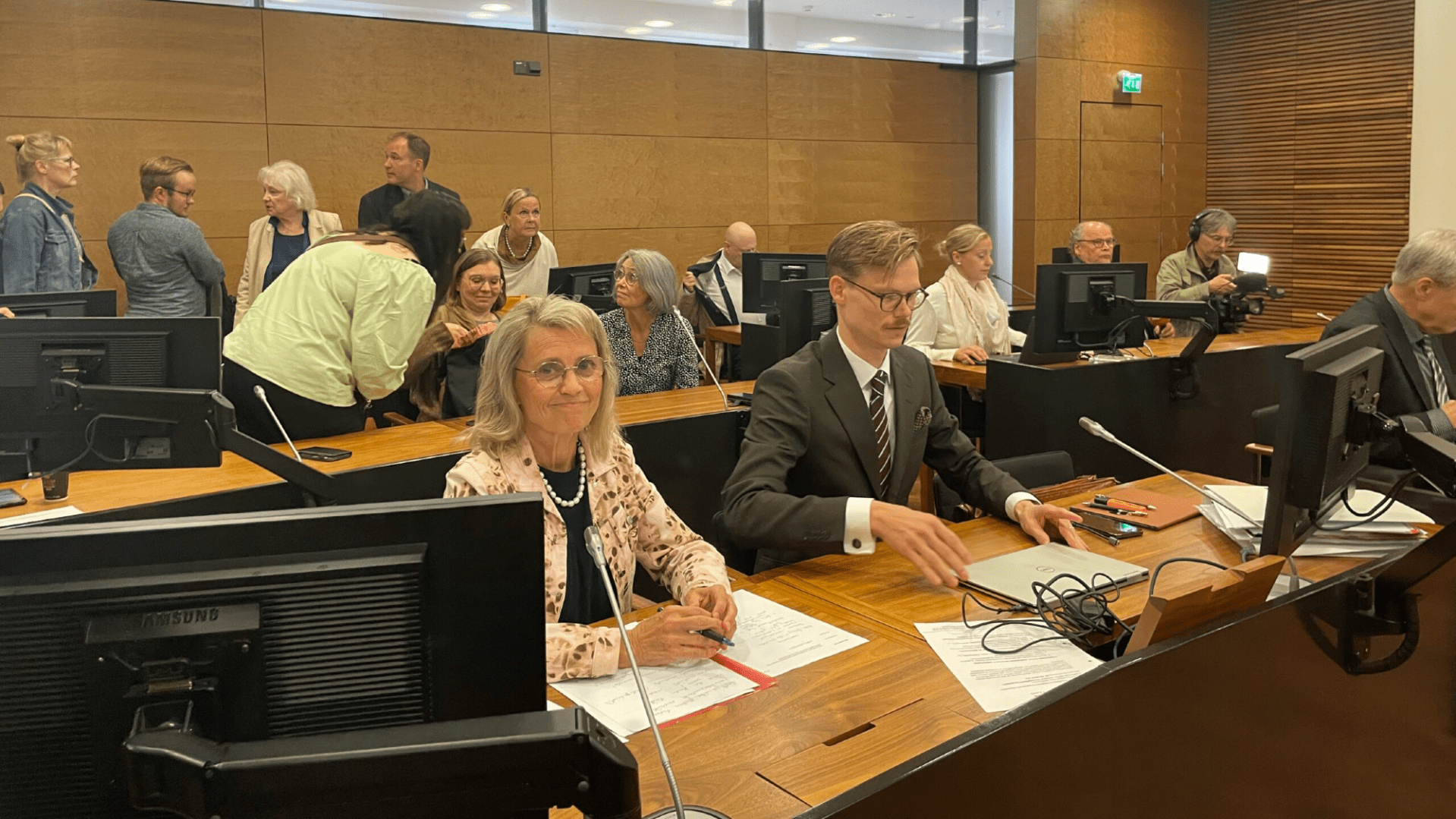
Päivi Räsänen and her lawyer Matt Sankamo in a Finnish courtroom facing hate speech charges.

Päivi Räsänen and her lawyer Matt Sankamo in a Finnish courtroom facing hate speech charges.

Christianity Today November 14, 2023
Courtesy of Alliance Defending Freedom

A Finnish court ruled in favor of the free speech of a member of Parliament and a Lutheran bishop on Tuesday morning, affirming they have the legal right to say that homosexual acts are sin and marriage should be between a man and a woman.

The ruling was unanimous, upholding a lower court decision for last year, which was also unanimous.

“I’m overjoyed,” said Päivi Räsänen, a Christian Democrat who has served in Parliament for 28 years. “This is a tremendous victory for us but also for everyone concerned with the protection of fundamental freedoms. … No one should be punished for peacefully expressing their faith.”

Juhana Pohjola, bishop of the conservative and confessional Evangelical Lutheran Mission church, said he and his family stopped and read Psalm 103 when they received the verdict: “Praise the Lord, my soul; all my inmost being, praise his holy name. Praise the Lord, my soul, and forget not all his benefits” (vv. 1–2).

Pohjola was charged with hate speech for publication of Räsänen’s 23-page booklet, Male and Female He Created Them, in 2004. The text was part of the church’s catechetical series of Christian teachings on important issues.

Räsänen was charged under the criminal hate crime statute for the booklet as well as for a tweet condemning the mainline Lutheran church’s support for a Pride event in 2019 and a follow-up radio interview where she said that, according to the Bible, “homosexual acts” are “sin and shame.”

According to prosecutors, these statements were not only offensive but likely to incite hate and violence against LGBT people.

The Office of the Prosecutor General argued such speech is not protected because it causes “intolerance, contempt, and hatred” and thus endangers lives.

More than 70 percent of Finns support same-sex marriage, which has been legal in the country since 2017. A majority of the members of the Evangelical Lutheran Church of Finland, the mainstream church that Pohjola’s denomination broke from in the early 2000s, also hold that position. The church does not currently perform same-sex marriages, but 54 percent would like that to change.

Many in Finland see protection of LGBT people as the most critical civil rights issue of the day.

Prosecutor Anu Mantila ran for office on the promise to do more to protect LGBT people. Her case against Räsänen and Pohjola has received lots of national attention and wide support from Finns.

“Offensive speech has a damaging effect on people,” she argued before the court. “If you put all the statements together, it is clear that they are derogatory towards homosexuals. Condemning homosexual acts condemns homosexuals as human beings.”

Mantila argued religious freedom—which is enshrined in Finnish law and international law, which Finland recognizes—does not protect every reading of the Bible. Some interpretations, according to the prosecutor, should be punishable by law.

“You can’t say anything under the guise of religion,” Mantila said. “You can cite the Bible, but it is Räsänen’s interpretation and opinion about the Bible verses that are criminal.”

All three judges rejected her arguments.

“There must be an overriding social reason for interfering with and restricting freedom of expression,” the court said. “There is no reason to alter the final result of the District Court’s judgment.”

In 2022 the lower court ruled that “it is not for the District Court to interpret biblical concepts.”

The legal team defending Räsenän and Pohjola said in an online press conference that they were celebrating “the fantastic verdict.”

Paul Coleman, the executive director of Alliance Defending Freedom International, described the ruling as a monumental victory.

“In a free and democratic society, all should be allowed to share their beliefs without fear of censorship,” he said. “Criminalizing speech through so-called ‘hate-speech’ laws shuts down important public debates and poses a grave threat to our democracies. We are relieved to see courts enforce the rule of law when state authorities overstep by seeking to penalize and censor statements that they dislike.”

Räsänen and Pohjola both said they didn’t seek this legal conflict but were committed to seeing it to the end.

“I will not apologize for what apostle Paul has stated in the Book of Romans,” Räsänen said. “I decided whatever comes, whatever the conclusion or the result will be, I will not give up.”

Pohjola said when he was first called into the local police station for questioning, officers told him the case would go away if he took Male and Female He Created Them off the internet. But he refused.

“To me, this is not only a cultural and legal battle but a spiritual battle,” he said. “This is my calling as a Christian, as a pastor: to guard the faith and teach it publicly and carry the cross.”

Many in the Evangelical Lutheran Mission were relieved by the ruling, though. Pohjola said ministers texted him when they learned of the ruling on the news, with messages like, “We are so happy that our bishop is not labeled as a criminal.”

There was a real fear, he explained, that the small Lutheran denomination might be branded “a criminal group, with a criminal agenda.” They’ve been reminded that speaking publicly can come at a cost.

“We cannot take freedom of speech and religion for granted. We have to defend it and use it,” Pohjola said.

The case may not be over, however. Government prosecutors can file an appeal with the Supreme Court. The top court in Finland takes, on average, about 6 percent of cases.

News
Wire Story

Nashville Pastor Scott Sauls Resigns After Apologizing for Harsh Leadership

Sauls spent 12 years leading Christ Presbyterian Church and had been on leave since May.

Scott Sauls

Scott Sauls

Christianity Today November 14, 2023
Christ Presbyterian Church / YouTube screengrab

Editor’s note from CT: The Nashville Presbytery issued a statement this week clarifying some details of its process and stating that Scott Sauls has been restored to his ordination. The presbytery had temporarily suspended his ordination six months ago, after an investigation revealed “a pattern of relational, emotional, and spiritual neglect.” Sauls confessed to those findings, as well as “fostering a culture of mistrust among the [church] staff.” The presbytery had since found that he had “engaged in intensive counseling, pursued a process of repairing injured relationships, expressed his confession and repentance to Christ Presbyterian Church, and sought reconciliation with those he had wronged,” it said. The presbytery approved of Sauls’s resignation from Christ Presbyterian Church, but he is now is in good standing and will continue as a minister in the Presbyterian Church in America.

Scott Sauls, an influential pastor and author, has resigned from the Nashville megachurch he had led for the past 12 years.

Members of Christ Presbyterian Church (CPC) voted to accept Sauls’s resignation during a congregational meeting on Sunday night.

Sauls had been on an indefinite leave of absence since May after apologizing for an unhealthy leadership style. A group of church leaders known as the session had asked the Presbyterian Church in America (PCA) congregation to accept Sauls’s resignation.

In addressing the congregation, Sauls apologized to those he had hurt and said that he and his family would continue to serve Jesus.

“We had hoped to continue forward and help with CPC,” Sauls told the congregation during the meeting, according to The Tennessean, which first reported the news of Sauls’s resignation. “But we now believe the most merciful thing to do is step aside so the church can seek new leadership and we can seek the Lord’s will for whatever comes next as well.”

The church declined to comment on news of Sauls’s resignation.

Sauls’s tenure at the church began with great promise and was marked by growth. A protege of the late Tim Keller, Sauls promoted a Christianity marked by kindness and grace, rather than culture war politics, in books like A Gentle Answer: Our “Secret Weapon” in an Age of Us Against Them, Befriend, and Irresistible Faith.

Sauls admitted earlier this year that he had been harsh with church staff and used the power of the pulpit as a weapon against those who disagreed with him.

“I verbalized insensitive and verbal criticism of others’ work,” he said in an apology to the congregation earlier this year. “I’ve used social media and the pulpit to quiet dissenting viewpoints. I’ve manipulated facts to support paths that I desire.”

During Sunday’s meeting, he apologized again.

“To anyone who has been hurt, whether known or unknown to me, I am deeply sorry,” he said. “I make no excuses and I ask for your forgiveness.”

According to the PCA Book of Church Order, the end of Saul’s tenure at Christ Presbyterian has to be approved by the Nashville Presbytery—a regional group that oversees pastors.

The stated clerk of the presbytery did not respond to a request for comment.

After announcing his leave from Christ Presbyterian in May, Sauls was indefinitely suspended by the presbytery. The process of pastoral discipline in the PCA has been criticized because of a lack of transparency.

Concerns about pastoral leadership styles have come under increased scrutiny in recent years.

Many megachurch pastors followed a top-down, corporate leadership approach popularized by such pastors as Bill Hybels and Mark Driscoll, which has led in some cases to unhealthy and sometimes abusive leadership cultures. And the line between church conflict and spiritual abuse is much debated.

According to The Tennessean, Sauls told the congregation that a presbytery committee planned to lift his suspension and that the decision to resign was his.

“It has been an honor serving this community,” Sauls told the congregation at Sunday’s meeting, according to the newspaper.

“We’re going to miss you. We wish you the best and we love you.”

Theology

Keeping—and Learning—the Peace

An American Christian’s view of US-Taiwan-China relations and what to do in the event of war.

Chinese Soldiers

Chinese Soldiers

Christianity Today November 14, 2023
Handout / Getty

This article is published in collaboration with Campus, a Taiwanese evangelical magazine.

In the summer of 2021, American public opinion reached a new milestone: Just over half the country, per a survey by The Chicago Council on Global Affairs, supported sending US troops to defend Taiwan if China were to invade.

Since then, as cross-strait tensions have heightened and the US began supporting Ukraine in its defense against Russian aggression, American opinion has wavered. Though increasingly likely to say Taiwan-China tensions are a very serious problem for the United States, Americans are not of one mind on what our country’s policies toward Taiwan and China ought to be.

Our disagreements on this subject don’t follow clear partisan or religious patterns. Though Democrats and Republicans are strongly polarized on many issues, when it comes to Taiwan, polling shows mixed views across partisan lines.

Americans increasingly view China as an enemy and are increasingly worried Beijing will choose to invade. But ambiguity isn’t just an official US strategy; our national thinking on this subject really is ambiguous, and American Christians generally and evangelicals specifically aren’t distinct from our compatriots here.

What if China attacks Taiwan? What the United States should or would do is a truly open question in American politics, and what Taiwanese Christians should do is an even more complex question.

The last two years of escalation in tension in US-Taiwan-China relations are worrisome—most of all in those cases where such escalation could have been avoided. Careless rhetoric from US president Joe Biden and provocative but ultimately unnecessary US political visits have exacerbated relations with China without meaningfully enhancing Taiwanese security.

Meanwhile, it has become commonplace in American politics to assume US-China military conflict is inevitable, and US policymakers and politicians seem to be spending too much time hyping that threat and too little effort taking pragmatic steps to forestall it. It is easy to arrange a photo-op in Taipei and burnish one’s own political brand. It is more difficult to attempt the long, halting, often frustrating work of preventing an open war between nuclear powers that would upend the world as we know it.

Troublingly, the current shape of US-Taiwan-China relations looks like a classic example of what political scientists call a “security dilemma.” As Harvard University international relations scholar Stephen M. Walt has explained at Foreign Policy, a security dilemma is what happens when “the actions that one state takes to make itself more secure—building armaments, putting military forces on alert, forming new alliances—tend to make other states less secure and lead them to respond in kind.”

Walt gives several examples of contemporary security dilemmas, and Beijing’s recent behavior is among them: “China regards America’s long position of regional influence [around the Indo-Pacific]—and especially its network of military bases and its naval and air presence—as a potential threat,” and it has responded with regional military buildup of its own.

And this, in turn, has “made some of China’s neighbors less secure,” and some of those neighbors, including Taiwan, “have responded by moving closer together politically, renewing ties with the United States, and building up their own military forces.” All of which, Walt explains, has led Beijing to “accuse Washington of a well-orchestrated effort to ‘contain’ it and of trying [to] keep China permanently vulnerable.”

The result? A “tightening spiral of hostility that leaves neither side better off than before.” This is a grim prospect; and grimmer still is the possibility of war between China and Taiwan, or China and the US, or both.

In 2022 the Center for Strategic and International Studies, a US think tank, arranged a war game to explore the consequences of US involvement in a hypothetical Chinese invasion of Taiwan. In their hypothetical simulation, China lost—but the victory came at a high price. A war like this “would likely devolve into brutal large-scale combat,” a report on the exercise concluded. The death toll would be “historic by any modern measure,” and that’s without the real chance of a nuclear exchange.

But, crucially, the assumption that such a war is inevitable is wrong. Tense and rivalrous but functionally peaceful coexistence remains possible—just as it has been for decades. In the US, for our part, keeping the peace would require a strategic reorientation toward prudence and restraint, a recommitment to working-level diplomacy with both Taipei and Beijing, and an eschewal of performative politics that needlessly and fruitlessly tighten the spiral of hostility.

In the years during and after my time in seminary, I was a member of a Mennonite church. Like other Anabaptist Christians—a category in which I still place myself, though I’ve moved to a new city and, therefore, a different congregation—my Mennonite community believed that Jesus was to be taken seriously and literally when he told us to love our enemies (Matt. 5:43–48).

We believed, too, that the category of “enemy” included not only our annoying family members or political competitors but our national enemies—people who would do us real harm. We believed, and I still believe, that Jesus asks us to reject violence, even when that choice is very costly, because it is the choice he made for us in choosing to suffer the violence of the cross rather than inflict it on his enemies (Rom. 5:8, James 4:4).

But Anabaptists also recognize that this is a very difficult thing to ask. In sermons and other church teachings about enemies and nonviolence, my church returned again and again to a particular story from church history that encapsulates how we tried to think about this hard teaching in our own lives.

The story is about another Anabaptist, a Dutch man named Dirk Willems who lived in the 16th century. Willems was imprisoned by Catholic authorities for his faith, but he was able to craft a rope out of rags in his jail cell and use it to escape out the window. He ran off as fast as he could—with a prison guard in close pursuit.

It was winter, and Willems soon came to a frozen pond. He was thin from his time eating prison rations, and he ran lightly across the surface of the ice. The guard followed, but he was better fed and too heavy for the ice to support him—so he plunged into the frigid water and began to drown.

And although Willems could have escaped, he didn’t. Instead, he turned around and rescued the guard from the icy pond at the risk of his own life.

And what did the guard do for the man who had saved his life? He arrested him again, returning him to prison. A few months later, Willems was executed, burned at the stake—his screams reportedly heard more than a mile away as the wind blew the fire off his upper body, prolonging his suffering.

Dirk Willems loved his enemy, and in return, his enemy handed him over to a horrible death.

Mennonites tell this story, terrifying though it is, because Willems knew what would happen to him when he turned around on that ice. He wanted to live and not suffer—he was escaping, after all. Perhaps he had a passing hope that showing the prison guard mercy would mean he would be shown mercy. But surely, he realized there was no such guarantee. Yet he rescued his enemy anyway.

Not only did Willems rescue the guard, but he must have done so without hesitation. Drowning in an icy pond can be very quick. If the guard had gotten stuck under the ice or become too cold, he would not have lived.

That means Willems must have run back as soon as he realized what had happened. He had no time for ethical calculation, no time to weigh whether Jesus really expected him to love this enemy this way. He had to act immediately. He had to act on instinct. He had to act with a speed that would’ve only been possible if loving his enemies was something he had long since learned to do well. Willems was able to save his enemy when every second counted because he had already conformed this part of his life and character to the peace of Christ.

That is why the Anabaptist Christians I knew told this story so much: It is not easy to love an enemy, even with God’s help. It does not come naturally to us. And it is not something we can simply decide to do in the moment of action. What we do when an enemy is before us—when we are furious or terrorized or in anguish—will be less of a choice than an instinct. It will be less something we consciously decide to do than an expression of who we are.

It is all very well to say, I would turn the other cheek. I would not strike back. But we don’t and can’t really know what we’ll do until the first strike hits.

One of our teachers at my Mennonite church used to say that he truly believed Jesus called him to nonviolence, but he did not know what he’d do if a burglar threatened to kill his wife or child. He could only hope and pray that his response would be Christlike. He could only ask God to prepare him, through sanctification, so that if that day of violence ever came, his instinct would be “conformed to the image” of Jesus, like Dirk Willems’s instinct was (Rom. 8:29).

For many of us in modern, wealthy countries, the first strike may never come. It is easy for me, in this sense, to talk about a Christian call to love our enemies and the need to build an instinct of peace. As a middle-class woman in America, my instinct may never be put to the test.

But in Taiwan, it well could be. If tensions across the Taiwan Strait lead to war, how should Christians in Taiwan respond?

I don’t expect all—or even most—Christians to agree with me about what Jesus meant when he told us to love our enemies. I realize many deeply faithful Christians have interpreted that command differently than I and other Anabaptists do. Maybe you aren’t convinced that Jesus has called his followers to a principle of nonviolence at all costs. Maybe, if China were to invade Taiwan, you would take up arms to defend your home and do the aggressors violence in return.

By the standard of the venerable Christian philosophical tradition of just war theory, your cause would unquestionably be just. And even though I believe Jesus commanded his followers to lay down our arms, writing in peace and safety 8,000 miles away, I could hardly condemn you if you didn’t. I don’t know what I’d do if the Chinese military threatened my family, life, and home. I can only hope and pray my response would look something like Christ. That is what I hope and pray for Christians in Taiwan too.

But first, I hope and pray that war will never come. Mercifully, as serious as the situation has become, war remains far from certain. Peace, though uneasy, has lasted. And God willing, it will last longer still.

Bonnie Kristian is the editorial director of ideas and books at Christianity Today.

News

As Erdoğan Goads on Gaza, Turkish Christians Prefer Peace

Amid centenary of the secular republic, Erdoğan inaugurates a significant new church as local believers navigate Muslim society’s stance on Palestine.

Turkey's President Recep Tayyip Erdogan speaks during a rally in solidarity with Palestinians in Gaza.

Turkey's President Recep Tayyip Erdogan speaks during a rally in solidarity with Palestinians in Gaza.

Christianity Today November 14, 2023
Burak Kara / Stringer / Getty / Edits by CT

Defending Hamas, Turkish president Recep Erdoğan upstaged his own nation.

One day prior to last month’s 100th anniversary of the modern state of Turkey (now formally called Türkiye), an estimated 1.5 million people gathered for a pro-Palestinian rally October 28 and heard their Islamist-leaning leader denounce Israel as a “war criminal.”

“Hamas is not a terror organization,” Erdoğan had previously stated October 25. “It is an organization of liberation, of mujahedeen, who fight to protect their land and citizens.”

Observers noted that immediately after the October 7 terrorist attacks by Hamas that killed 1,200 mostly civilian Israelis and took 240 hostage, Erdoğan had struck a cautious tone. Reports circulateddenied by Ankara—that Turkish officials quietly asked Hamas leaders to depart the EU candidate country. And in advance of the rally, the president reiterated that he could never excuse acts that target civilians.

Then something changed.

Despite efforts over the past year to heal a diplomatic rift with Israel, Erdoğan now questioned its existence.

“What was Gaza and Palestine in 1947, what is it today?” he asked rhetorically, in reference to the establishment of Israeli statehood in 1948. “Israel, how did you get here? How did you get in? You are an invader.”

And widening his scope, the head of the NATO-member nation impinged his allies in religious terms, calling the Gaza attack “revenge” for the 15th century fall of Constantinople.

“Oh, West, I cry out to you, do you want to start your crusade against the Crescent again?” Erdoğan asked. “If you are making such efforts, know that this nation is not dead.”

The next day, in a muted celebration, he laid a customary wreath at the grave of Mustafa Kemal Atatürk, who abolished the Ottoman caliphate and established a secular republic in 1923. In attendance was the ecumenical patriarch of the Eastern Orthodox Church, Bartholomew I.

Two weeks prior, Erdoğan attended the inauguration of Mor Ephrem Syriac Orthodox Church, honoring the estimated 25,000 Assyrian Christian citizens of Turkey. It was the first church to be built with state funding since Atatürk’s founding.

And since Erdoğan’s party took power in 2002, 20 churches have been restored.

“The church we have built is a symbol of freedom of religion and belief in our country,” Erdoğan stated. “At a time when divisions, conflicts, and hate crimes based on religious and ethnic origin are increasing in our region and the world, this embracing attitude of Turkey is very important.”

His October 15 remarks were poignant, with the Israel-Hamas war raging. In between the church ceremony and the Palestinian rally, Erdoğan sent Sweden’s NATO application to the Turkish parliament for ratification. And this month, the Incirlik air base in southeast Turkey received the deployment of a pair of United States B-1 Lancer long-range bombers.

Last week, Turkish protestors tried to storm it.

Turkish Christians have had a complicated relationship with Erdoğan, and generally do not speak out on political matters. But one believer voiced his strong displeasure with the president’s comments.

“It is not acceptable. Hamas is a terrorist organization,” said Gokhan Talas, founder of Miras Publishing Ministry. “Calling its attack anything else could cause another painful trauma for victims and their families.”

The small evangelical community in Turkey, he said, has diverse views about Israel—stemming from both political and eschatological differences. Some speak in terms of unconditional support for the prophetically reconstituted Jewish state. Others, rejecting such theology, find justification for the Palestinian militant response.

But Ali Kalkandelen, president of Turkey’s Association of Protestant Churches, made clear their unified position.

“As Christians, we believe that God is the judge over everything,” he said. “We are against any war, killing, and the death of innocent people.”

They are praying for both sides, he added. And also Erdoğan.

Talas believes that Israel’s first reactions were “fair and balanced,” in line with its right of self-defense. But he also believes what he calls its later “unbalanced attacks” and “insufficient measures” to protect civilian lives warrant criticism for contributing to a humanitarian “tragedy.”

He wants all people to push both sides toward peace.

But most Christians, Turkish and foreign, are staying silent, cautious about being labeled pro-Israel, said Daniel Brown, director of the Istanbul-based Institute for the Study of Religion in the Middle East. Other than calls for peace, Christian leaders have made few public statements.

The church is tiny, and reticent to comment on sensitive issues.

“There is a recognition of serious problems all around the world,” Brown said, “and that God's people shouldn't be taking sides against anyone God loves.”

But if the war in Gaza has divided—or quieted—Turkish Christians, Turkish society is decidedly pro-Palestinian. A recent survey shows overwhelming support for a ceasefire and for subsequent Turkish participation in peacekeeping forces. Recognizing the public pulse, Erdoğan has “written off” Benjamin Netanyahu. An opposition newspaper, meanwhile, has caricatured the Israeli prime minister as a vampire.

The Turkish parliament proceeded to boycott Coca-Cola and Nestlé.

Most Turks do not support “inexcusable” Hamas terrorism, said Mustafa Akyol, the Turkish author of Islam Without Extremes: A Muslim Case for Liberty. Their Palestinian sympathy, like that found in most Muslim-majority nations, is currently tied to the thousands of children killed by Israeli bombs.

This does not mean they are antisemitic, he said. Pro-Hamas and antisemitic attitudes do exist in Turkey, including within Erdoğan’s political base. But the driver, Akyol said, is the “decades of plight” of the Palestinian people. The United States and the West are blamed as well.

“The more that horrific suffering continues,” he said, “the more anti-Israel Turkish sentiments will become.”

At the same time, another poll on the centennial anniversary found 64 percent of the Turkish population endorsing secularism. Only 19 percent supported Islamic governance. A solid plurality (45%) supported becoming like Germany, with Qatar placing second (9%).

Contrary to the low-key celebration, Talas observed widespread popular commemoration and excitement. He said the nation was “proud” to be both secular and democratic, and believed Erdoğan is posturing for upcoming municipal elections.

Kalkandelen does not believe the rupture with Israel is serious.

“Turkey has been a very good ally to Israel for many years,” he said. “I believe they will keep this positive relationship in the future.”

Nonetheless, Erdoğan’s stridency “surprised” him. Despite the president’s religious attachment to the Palestinians, Kalkandelen said the Turkish leader is adept at keeping a balanced foreign policy. He trusts Erdoğan will not embroil the nation further in geopolitical controversies, and suspects Israel will recognize the sensitivity of this topic and not allow it to jeopardize relations.

Appearances are otherwise, however, as both nations have pulled their respective ambassadors.

Even so, Turkey has not broken diplomatic relations, maintaining intelligence contacts while proposing a role to help broker hostage negotiations. And reports stated that Turkey facilitated the delivery to Israel of one million barrels of oil from Azerbaijan.

Still, the Turkish TRT network hosted a Hamas leader who declared October 7 “paved the way” for removing Israel as he called on clerics to “incite the Islamic nation [to] take action.”

Shortly thereafter, the Qatar-based International Union of Muslim Scholars issued a fatwa summoning Muslim nations for military intervention.

Previously strong Turkey-Israel ties were broken in 2010 when Israeli forces stormed a Turkish vessel trying to break its blockade on Gaza. In the following years, relations between the two countries were shaky. In 2014, Erdoğan stated that what he believed was Israel’s disproportionate response to Hamas-led violence was “keeping Hitler’s spirit alive.”

Ties were moderately repaired, however; but then in 2018, Turkey withdrew its ambassador in the wake of Donald Trump moving the US embassy to Jerusalem. Two years later, relations were restored once more. Following the 2022 earthquake in southeast Turkey, Israel stated it delivered the second-largest humanitarian aid delegation, paving the way one month later for Israeli president Isaac Herzog’s visit to Ankara, for the first high-level delegation since 2008.

And last September, Erdoğan met Netanyahu for the first time.

“Both sides approach the other opportunistically,” said Talas. “But what happens in the long run is built on mutual interests.”

Yet Christian interests, he said, must pursue peace. He believes that the failure of international powers to address the ongoing Israeli occupation has created a culture of hatred in the region—and that the response of vengeful terrorism has only harmed Palestinians further.

Too many American Christians, however, have an “incomplete” understanding that overlooks the social, cultural, and historical issues of an entrenched conflict, said Talas. And worse, he said, uncritical support for Israel ignores their fellow Palestinian believers who struggle and sacrifice daily for the gospel.

It is this gospel that informs his advice to everyone.

“Love your enemy. Love your neighbor. Pursue goodness and all that is good,” Talas said. “Any motivation other than these commandments only creates complex and useless discussion.”

Editor’s note: CT now translates select articles into Turkish.

It’s Tempting to Rely on the IDF. But My Hope Is Messiah Yeshua.

Amid chaos in Israel, I will trust in the Lord.

People look at a wall with photos of hostages kidnapped in the Hamas attack.

People look at a wall with photos of hostages kidnapped in the Hamas attack.

Christianity Today November 13, 2023
Amir Levy / Stringer / Getty

What’s the time? The room was dark, but I was awake. I reached over to my phone and saw that it was too early. It was Saturday, October 7, a little before 7 a.m., and I was hoping to sleep in.

But as I looked at my phone, I noticed an unusual number of messages waiting to be read on WhatsApp and iMessage. As I began reading of what was happening in Israel, my stomach dropped and my eyes teared.

In a shocking and devastating turn of events, the terrorist group Hamas had launched a highly coordinated attack on Israel—what the world now calls Israel’s 9/11, a surprise strike by more than 3,000 rockets as well as by ground forces from the land and sea. In less than 24 hours, this evil attack left hundreds dead and injured, mostly Israeli civilians, but also some tourists and visitors. Scores more were kidnapped by Hamas.

It would be two weeks before my wife and I would be able to travel to Israel to be with our family, friends, and staff at Jews for Jesus, where I am the chief operating officer, during these unimaginably difficult days.

Stepping off the plane, we sensed a deep sadness and grief. You can feel it in the air and see it on people’s faces. Tel Aviv’s bustling and energetic nightlife is gone. Instead, there are constant memorials and gatherings to mourn. You must stay near known, safe locations so you can take shelter if a siren sounds.

Now, a month later, the numbers have tragically increased: more than 8,500 rockets have been fired from Gaza, more than 1,400 innocent Israelis have been murdered and over 4,500 injured, and more than 240 hostages are being held in Gaza. And, since arriving in Israel, I have found time to reflect on the reality of this war.

It is impossible not to think about the crisis. Stories about the war are constantly on TV, and billboards all over the country show the faces of kidnapped hostages. Every Israeli either knows someone who has been murdered or kidnapped or has friends with family among the victims. This kind of personal impact is inevitable in a small country (only 7 million Jews live in Israel). There is a deep sorrow over the loss of innocent life and the kidnapped suffering in captivity.

Now, hundreds of thousands of Israeli men and women have left home to serve in the Israeli Defense Forces (IDF), risking more trauma for more families. Parents are worried for children, and children are worried for parents who are serving on the front lines.

Israel’s armed forces, intelligence, and security have always been a source of national pride. Sure, we’ve had terrorist attacks and our fair share of rockets, but, for the most part, Israelis and diaspora Jews alike felt safe and secure in our homeland. Many Christians traveling to Israel from overseas would comment how safe they felt even amid long-running conflict.

The reason for that feeling is that Israel takes security seriously. Israelis know it, feel it, and trust it. Prime ministers have won and lost elections on the promise of security. But one consequence of October 7, now known in Israel as Dark or Black Sabbath, is that Israelis feel we can no longer trust the current government’s security promises.

Many have compared this crisis to the Yom Kippur war, where Israel was also caught off guard. But there is one big difference: In 1973, the dead and kidnapped were all soldiers. This time, they were overwhelmingly civilians. The brutality of this evil has shaken Israelis, causing many to lose all sense of trust and security. People are genuinely afraid. Everyone is on high alert.

We are also grieving, but we are grieving together. Next to the billboards with pictures of the kidnapped, there are billboards with the slogan Yachad NeNatzeach: Together We Will Be Victorious.

It’s ironic—or maybe providential—that this great unity has come during the most divided period in Israel’s history. Before the attack, and for the previous 10 months, the nation was fragmented over a controversial judicial reform, causing major protests. Some said that the country is on the brink of civil war.

No more. After October 7, the nation has united in what our prime ministry called a fight for our survival. Never in Israel’s history have so many people come together so quickly. It seems like everyone is lending a hand in whatever is needed during this crisis. Thousands upon thousands are volunteering to help one another.

This unity gives strength. The comradery, fellowship, and togetherness that is exhibited in Israel now is inspiring.

It is especially inspiring in the body of Messiah in Israel. Many Christian ministries and congregations have united to love and serve our people, providing care for displaced families and soldiers. It has been wonderful to see firsthand how the church can share the love of Messiah in tangible ways.

These are undoubtedly challenging times, and the loss of our beloved sons and daughters to the cruelty of terrorism has left many people grappling with questions and yearning for hope and comfort. The IDF has a long track record of success, and the United States has shown strong support for Israel. Trying to draw hope from these things is tempting—but honestly, I know it is futile and temporary. As Psalm 20:7 says, “Some trust in chariots, and some in horses; but we will remember the name of the Lord our God” (NKJV).

I need to be reminded daily—sometimes at every moment of the day—that my trust must be firmly rooted in the Lord. Only when I look up to him, only when I draw strength from his Word and sit in his presence in prayer, do I feel grounded. Only then am I reminded of the eternal hope that I have in Messiah Yeshua. He is our present and future hope.

The October 7 attack will be remembered as one the most severe attacks on Israeli soil ever. We are praying day and night for the God of Israel to arise and save our people. The God of Israel is alive. He holds his daughter Zion in the palm of his hand. He has parted the sea, torn down walls, and stopped the sun for her. He will not abandon us today.

Dan Sered was born in Israel but came to faith in Jesus while attending Stony Brook University in New York. He is the chief operating officer of Jews for Jesus and has served with the organization in Israel, where he also pastored a church and taught at Israel College of the Bible.

Theology

I Do Belong; Help My Unbelonging

Making disciples in a secular age requires retrieving an old catechetical pattern: belonging, believing, behaving.

Christianity Today November 13, 2023
Edits by CT / Source Images: Lightstock

Christians, wrote Tertullian in the third century, “are made, not born.”

The African church father, in chapter 18 of his Apology, was reflecting on the Great Commission of the risen Christ, who challenged his followers to “make disciples” by “baptizing them in the name of the Father and of the Son and of the Holy Spirit, and teaching them to obey everything [he had] commanded” (Matt. 28:19–20).

The challenge of making Christians today is the same as it was in the third century. As a pastor once shared with me about his congregation’s ministry, “We are doing a pretty good job of evangelizing and baptizing people, but we are falling short in our obligation for teaching them to obey everything that the Lord commanded.”

The task of teaching everything Jesus commanded is not a matter of conveying a checklist of beliefs and behaviors necessary to belong to the church. Christian formation has always presupposed that believing, behaving, and belonging constitute a holistic approach to disciple-making. But over time, Christian catechetical practice settled into a pattern that prioritized believing as primary, while behaving and especially belonging were emphasized less.

Basic catechetical instruction in this traditional pattern started by learning the creeds and the basic teaching of Scripture, followed by baptism and reception into the membership of the church, followed by participating in the worship and practices of the faith. The content of catechesis in this traditional pattern varied depending on one’s particular denominational doctrine, but for centuries the order was consistent across Western Christianity.

If you were a Protestant in North America prior to 1960, chances are your confirmation class read Luther’s Small Catechism, the Westminster Catechism, the Heidelberg Catechism, or the Episcopal Catechism. If you were a Catholic, you probably studied the Baltimore Catechism. And if you were a Baptist, you may have been introduced to the faith through the Baptist Catechism based on the Philadelphia Confession.

The assumption in that traditional pattern was that the first task of Christian formation was acquiring right belief—and not right belief as in basic trust in God or the simple faith Jesus praises in a child (Matt. 18:1–5), but affirmation of a significant set of doctrinal formulations. Only after that kind of belief, in this model of discipleship, do we adopt right behavior to be ready to belong to the church.

That pattern of first believing, then behaving and belonging, functioned well enough so long as the relationship between Christianity and Western culture was stable. It is stable no longer.

The rise of secularization made it possible to conceive of a world that makes sense without God. As philosopher Charles Taylor observes, the transition to secularity constituted a major shift “from a society where belief in God is unchallenged and indeed, unproblematic, to one in which it is understood to be one option among others, and frequently not the easiest to embrace.”

For decades, the US was unusually religious by Western standards. But it is no longer an exception where secularization is concerned. As in other modern industrialized countries, religiosity here is in rapid decline. The “dones,” who have left the church in droves, and the “nones,” who claim no religion in particular, make this abundantly clear.

And in a secular society like ours, starting with believing alone is not enough. We must change our catechetical pattern from believing, behaving, and belonging to belonging, believing, and behaving. To follow the Great Commission today, we must put belonging first.

This proposal for reordering in discipleship isn’t an attempt to be “seeker-sensitive,” in the worst sense of the phrase, giving nonbelievers less to disbelieve. It’s a realistic response to our society’s profound cultural and political shifts. It’s a recognition that Christianity is no longer the norm and, therefore, does not feel normal to many of our neighbors.

We can no longer assume a basic familiarity with our faith that makes a sense of belonging, at least superficially, relatively easy to achieve. We must start with belonging in the sense of “faith as trust” in God and membership in God’s family, not belief in the sense of “faith as understanding,” because getting to the doctrinal affirmations is a much longer journey than it used to be. In post-Christendom, occasional church attendance is not a sufficient basis for making Christians—if that attendance happens at all.

Moreover, the disciple-making process is not about enculturating people into an affinity group of support and togetherness. It’s about cultivating a community committed to following Jesus as the Way, the Truth, and the Life (John 14:6). In a secular society, to believe and behave, we must be able to grasp that we belong not only to that community but to God who created us and demonstrated a profound love for us in Jesus Christ.

Belonging, then, is not simply a matter of church attendance or even membership. It’s a covenant relationship based on trust and commitment. It’s deeper than cultural similarities or consumer attraction to a congregation’s programming. It’s belonging to God and one another in the ties that bind our hearts in Christian love. It’s the fellowship of kindred minds. It’s bearing one another’s burdens and sharing the joy of blessings. It’s a common journey and a common hope.

We enact that journey in baptism, where there is a confession of faith (“Jesus Christ is Lord”), an act of reception (“We receive you as our sibling in Christ”), and a sign of confirmation (“We belong to Christ, and Christ belongs to God”).

In a post-Christendom time like ours, our believing must be in service to our belonging, as it was in the pre-Christendom church. In the fourth century, baptismal candidates were brought into the baptistery at dawn on Easter Sunday. There, they turned to the west and renounced Satan, then turned to the east and made a confession of faith in the triune God. After that, they were immersed three times in the name of the Father, the Son, and the Holy Spirit. Rising from the water, they were clothed in white robes, symbolic of attendants in wedding garments awaiting the marriage feast of the Lamb (Rev. 19:6–10).

The bishop would then lay hands on and pray for the newly baptized, anoint them with oil, administer the holy kiss to signify the coming of the Holy Spirit (John 20:22), and mark them with the sign of the cross to display their identity in Christ (2 Cor. 1:21–22). The baptized were given salt on their tongues and small lamps in their hands, recalling Jesus’ words, You are the salt of the earth. You are the light of the world (Matt. 5:13–14). Each of these symbolic actions perform the sense of belonging that both flows from and enriches believing.

Hungry, tired, damp, and oily, they marched back to the sanctuary, singing the words of an Easter hymn: “Christ is risen from the dead, he has crushed death by his death and bestowed life on those who lay in the tomb.” Then, as the bishop prayed, the newly baptized Christians were invited to partake in the Communion meal at the Lord’s Table.

Our churches may lack such pageantry, but the call of the gospel remains the same. We still invite strangers to join us on the pilgrim journey, hoping they will say, as we have, “Look, here is water. What can stand in the way of my being baptized?” (Acts 8:36).

Baptism is more than a one-time event that only takes a few minutes to perform. It inaugurates a lifelong process of belonging through which we learn to believe, then see how our belonging and belief shapes our behavior. It is essential to cultivating communities of well-formed Christians, and that catechetical pattern—of belonging, believing, and behaving—is how we entrust the faith (2 Tim. 2:2) to those who will be stewards of the mystery of the gospel (1 Cor. 4:1) in a new, secular age.

We never fully and completely understand the mystery of God in Christ, but in belonging we learn to discern it and to allow it to grasp and mold our very lives. As Cyprian, the third century leader of the Church of Carthage put it, “We do not speak great things but we live them.”

Curtis W. Freeman is research professor of theology and director of the Baptist House of Studies at Duke Divinity School. His book Pilgrim Journey: Instruction in the Mystery of the Gospel was published in September by Fortress Press as a sequel to Pilgrim Letters: Instruction in the Basic Teaching of Christ.

News

Nepal Earthquake Destroys Rural Churches, with Believers Pleading for Immediate Relief

More than 300 Christian families have been affected, says a local pastor.

A survivor looks at her earthquake damaged house in Rukum District, northwestern Nepal.

A survivor looks at her earthquake damaged house in Rukum District, northwestern Nepal.

Christianity Today November 10, 2023
Niranjan Shrestha / AP Images

Nepali Christians are mourning the loss of many of their own after a series of devastating earthquakes in early November.

On Friday, November 3, a 5.6-magnitude earthquake rocked the mountainous Nepali villages of Jajarkot and Rukum West just before midnight, burying people under layers of rubble as they slept. A subsequent earthquake occurred on Monday, November 6, this time measuring 5.2 magnitude.

Many rural churches planted in the districts of West Rukum, Jajarkot, and Kalikot were “flattened,” Hanok Tamang, chairman of the National Churches Fellowship of Nepal, told CT. “It is true [that] many pastors, leaders, and Christians have died.”

Nepal’s current population is 31 million and is divided into seven states and 77 districts. The earthquake-hit areas are located in the midwestern region of the country.

The overall estimated death toll is more than 150 people so far, including more than 80 children, according to the non-governmental organization Save The Children. Villagers have taken to sleeping outdoors in freezing conditions for fear of continuing aftershocks, but also because their homes have been destroyed.

The 2023 earthquakes are the “deadliest” occurrence since the devastating 2015 quake near the city of Kathmandu when believers were attending church on a Saturday, as Sunday is a work day. “Many Christians were buried while they were worshiping on Sabbath and died,” the president of the Seventh-day Adventist Church in Nepal, Umesh Pokharel, told Adventist Review at the time.

Nepal’s Christians make up between 1 to 3 percent of the population, and Protestants were disproportionately affected in the 2015 disaster, said one Catholic leader.

Preliminary reports from Nepalese Christian leaders reveal that believers and churches have encountered significant losses post-earthquake. This may place an added strain on the Nepali church, which saw more than 130 pastors perish during the COVID-19 pandemic.

“Some of our church family members died. Houses are broken and children died because of [the] earthquake,” said a pastor named Samjay.

“Pastor Judha lost five family members … His daughter and four grandchildren lost their lives in the earthquake,” said Tanka, a Christian in western Nepal working with interdenominational aid agency Barnabas Aid.

Three churches affiliated with US-based global missions agency GFA World were “badly affected,” and three church members of one village were killed. Some members of Believers Eastern Church also lost their lives.

More than 40 believers are injured and 13 church buildings have collapsed or been damaged, according to estimates from B. P. Khanal, Nepal’s coordinator of the International Panel of Parliamentarians for Freedom of Religion or Belief.

But other church leaders think that the extent of damage and suffering is far greater. “More than 300 Christian families are affected out of 6,000 to 7,000 households that are affected in total,” said Mukunda Sharma, senior pastor of Bethel Assembly Church, to CT.

Relief aid has been trickling in as the villages are in remote and often hard-to-access locations. But Christians have mobilized efforts to help those affected by the quakes.

A team from Believers Eastern Church went to one village and distributed blankets and tarpaulins for makeshift tents, as well as essential food items like sacks of rice and noodles. Church volunteers from GFA World rode into villages on motorcycles to distribute food. Catholic charity Caritas Nepal has also begun distributing blankets, clothes, tents, and tarpaulins to families.

But more aid is desperately needed, says Sharma, who has since traveled to the disaster-hit area to help support rescue efforts. “Nobody is helping. People do not have money to help. Churches here do not have money to help,” he said.

Government relief does not go directly to the victims but is issued to respective municipalities, Sharma explained. “The difficulty is that the Christians are excluded [from receiving aid]. If we have some funding and response from people from the global world, the Christian societies will take proper permission and distribute [it] to the Christians who are affected, but for now we have not received help from anywhere.”

“Keep Nepal in the radar of your intercession collectively,” urged Tamang.

The deaths of Nepali Christians may generate renewed attention on the issue of burial. In the majority-Hindu country, most people cremate their dead. Believers are often unable to bury their loved ones, whether due to the lack of public cemeteries available or because of government-issued bans.

Without the opportunity for a burial, a funeral may often not take place. Most evangelicals in Nepal have been forced to cremate their dead—what Hindus practice—or travel to other parts of the country, and even to India, to bury their loved ones.

As believers try to rebuild their lives and places of worship in the aftermath of the earthquakes, they do so amid increasing persecution against Christians in Nepal.

At least seven attacks took place across the country between August and September this year, according to an International Christian Concern report. People broke windows in churches, and members of one community in the southern Lumbini province assaulted two pastors on the street.

Kechav Archarya, who pastors Abundant Harvest Church in Pokhara, Nepal, was sentenced to one year in prison and issued a fine of 10,000 Nepalese rupees ($75 USD) for proselytizing. An attempt to appeal against this sentence was rejected by Nepal’s supreme court on October 6.

“Pastor Keshav Acharya did not resort to coercion to convert anyone to Christianity,” said Joseph Jansen, chairman of advocacy group Voice for Justice, in an interview with Asia News last year. “The pastor only exercised his right to freedom of religion and did not commit any offense. It is regrettable that Nepal’s anti-conversion laws are worded and enforced in such a way that they may also be applied as anti-blasphemy measures.”

The law, which was enacted in 2017, criminalizes religious conversion and arose one year after courts dropped charges against eight Nepali Christians who were accused of evangelizing to children at a Christian school after the 2015 earthquakes.

This story is developing and will be updated.

Additional reporting by Surinder Kaur

Books
Review

Christianity Has Anchored Free Societies. What Happens as They Deconvert?

Philosopher John Gray predicts we’re headed for an age of all-consuming moral warfare.

Painting by Bernardino Mei titled, Allegory of Justice

Painting by Bernardino Mei titled, Allegory of Justice

Christianity Today November 10, 2023
Wikimedia Commons

Even the most casual student of political philosophy knows the quote: In the prehistoric state of nature, wrote philosopher Thomas Hobbes, humans existed in a “war of all against all.” Our life without Leviathan—the state, empowered by the social contract to hold a monopoly on legitimate use of force—was “nasty, brutish, and short.”

The New Leviathans: Thoughts After Liberalism

The New Leviathans: Thoughts After Liberalism

192 pages

$9.69

British philosopher John Gray begins his latest book, The New Leviathans: Thoughts after Liberalism, with a fuller version of Hobbes’s passage, and so we, too, should begin here.

The longer excerpt reveals two things: first, that Hobbes didn’t want a powerful, unchallenged state for its own sake. Though often taught in contrast with Enlightenment thinkers like John Locke, Hobbes had the usual liberal interest in a state that makes space for a benevolent, creative, and well-ordered society to flourish.

Leviathan is needed, Hobbes wrote, because in war “there is no place for industry; because the fruit thereof is uncertain: and consequently no culture of the earth; no navigation, nor use of the commodities that may be imported by sea; no commodious building; no instruments of moving and removing such things as require much force; no knowledge of the face of the earth; no account of time; no arts; no letters; no society; and which is worst of all, continual fear, and danger of violent death; and”—here’s the famous part—“the life of man, solitary, poor, nasty, brutish, and short.”

The second revelation is darker. Hobbes’s talk of complex navigation, arts, and letters is awfully anachronistic for prehistory, isn’t it? Perhaps it is not only prehistory Hobbes had in mind. Perhaps, as Gray argues, his concern was not “the distant past before the emergence of society but the breakdown of society,” and perhaps that breakdown could happen to us.

That prospect is the central theme of The New Leviathans, a short volume of three essays in which Gray doesn’t mount a unified argument so much as he presents vignettes of tragedy, small studies of writers—especially pre-revolutionary and Soviet-era Russians—little known in the West, and excursions into tangents of Hobbesian thought.

Throughout, he envisions humanity at a frightening precipice, toes over the edge of Hobbes’s abyss of cultural and economic desolation. Liberalism in its classical sense—commitment to rule of law, the rights enshrined in our First Amendment, and a culture centered on free exchange of ideas—is not perfect. But it is benevolent and familiar, and a world after liberalism will be morally worse than the world before it. That was a tyranny of ignorance. This would be a tyranny of amnesia.

Liberalism’s end

Gray’s titular new Leviathans may be of the same genus as the old Hobbesian creature, but they are larger and more slippery beasts, content with neither a limited nor solely material remit. Hobbes’s Leviathan state was all-powerful in its purview, but that purview was small: “securing its subjects against one another and external enemies.” In this sense, for all its brutish feel, the classic Leviathan was a limited government—a liberal state.

“The purposes of the new Leviathans are more far-reaching,” Gray writes. “In a time when the future seems profoundly uncertain, they aim to secure meaning in life for their subjects.” They offer “the security of belonging in imaginary communities and the pleasures of persecution,” and they “aim to deliver their subjects from the burdens of freedom.”

This post-liberal turn is not only a matter of governance, Gray argues. We are organically losing the old liberal ideals of free thought and art for the sake of beauty and truth rather than social engineering and political power.

Typically, this “repression is not the work of governments”—not here in the West, anyway, where the “ruling catechisms are formulated and enforced by civil society.” Post-liberalism seeps out of the political realm to stain how we think, relate, and even worship.

A footnote to Christianity

The subject of worship in The New Leviathans is a fascinating one, and not only for Christian readers. Gray himself is an atheist, but an atheist whose knowledge of Christianity and its role in Western history and thought is demonstrably deep and nuanced.

His story of liberalism’s decline is set squarely within church history, because liberalism, as Gray rightly observes, “is a footnote to Christianity,” and specifically to Protestantism. That’s evident in the explicit claims of key thinkers, like Locke, and in its major principles, as Gray summarizes:

All four of the defining ideas of liberal thought are continuations of Christian monotheism. The primacy of the individual is a secular translation of the belief that each human being is created by the Deity, which has an authority over them which transcends any worldly power. The egalitarian belief that human beings have the same moral status reproduces the idea that all human beings are equal in the sight of God. Liberal universalism—the belief that generically human attributes are more important than particular cultural identities—reflects the idea that humankind is created in God's image. The belief that human institutions are indefinitely improvable replicates the theistic faith that history is a moral narrative of sin followed by redemption.

These four ideas can stand alone, attracting adherents and building governments in purely secular terms. But the historical link is real, as is Christianity’s function (not its only function, of course, but one of them) as a cultural context in which liberalism can thrive. This is the gist of John Adams’s declaration that our “Constitution was made only for a moral and religious People. It is wholly inadequate to the government of any other.”

What happens, then, as the West deconverts? Our culture’s post-Christianity and its post-liberalism go hand in hand, Gray suggests. Christendom is supplanted not by a reversion to paganism, as some conservatives think, but by a perversion of Puritanism, bloated with rules and bereft of redemption.

“Christian values continue to be widely authoritative if not often practiced,” Gray observes. But “unmoored from their theological matrix, they become inordinate and extreme. Society descends into a state of moral warfare unrestrained by the Christian insight into human imperfection.”

Constant maintenance

This, Gray says, is the origin “of what has come to be called the woke movement” and its chaos-courting champions among the Western elite.

Having jettisoned liberalism’s individualism and universalism—along with Christianity’s bestowal of identity and community in Christ and the unchosen bonds of family and place—we’re left to define ourselves from scratch as chaos swells around us.

For many, this is a petty project of image-crafting both online and in real life, the stuff of Tara Isabella Burton’s recent book, Self-Made. But for an elite few whose resources and skills equip them for the task, Gray contends, that self-definition has found expression in what we call wokeness. It’s a lifestyle, worldview, and career path; morally stringent and tirelessly political; personal identity, public power, and ethical cleansing all wrapped up together: “The stakes are not only the selves that are chosen but the positions in society that go with them.”

Those positions are beneficial for elites who can play and win, but the game is fundamentally destabilizing. Envisioning a representative member of this intellectual elite, Gray charges him with “[r]ecycling the fashionable detritus that millions like him unthinkingly believe [while being] convinced of his independence of mind.” That false confidence risks his destruction—and ours. “He denounces society while never doubting its stability or his place in it. Gleefully conniving in the destruction of traditional morality, he is pitifully unprepared for the savagery that ensues when it breaks down.”

Here The New Leviathans is at its most conservative. Gray echoes an older book with a similar title, R. G. Collingwood’s The New Leviathan. (In his acknowledgements, he notes that a history teacher recommended it to him 60 years ago in grammar school.)

“A life of peace does not mean a life of static quiescence and somnolence, a life in which no occasions for quarrels arise,” Collingwood warned in 1942. Peace requires constant maintenance and strenuous work. Those foolish enough to think that “because the work is done efficiently and without fuss, without broken bones and waving of flags and firing of guns, that no work is being done … are like ignorant visitors to some great building, who think because the building has stood firm for many years that it is at rest; not knowing that its component parts never sleep but are always moving this way or that, the movements always being watched and measured by the architects in charge, ready if a movement should exceed the fraction of an inch they allow it to take measures against the strain.”

Liberalism has been a pretty solid house, but we’ve gotten behind on the maintenance, and many of those with the most tools to hand are chucking them in the trash.

Progressive parochialism

If this review is uniformly positive toward The New Leviathans so far, that’s because I was mostly delighted with the book, which is eclectic, compelling, and a pleasure to read. Unfortunately, on two significant subjects, Gray slips into the occasional progressive parochialism I find common among left-of-center thinkers who otherwise succeed in their efforts to read widely, interrogate their own side, and engage fairly to their right.

One issue is abortion. Gray decries the politicization of law, arguing that matters of public dispute should be settled by public debate and negotiation—that is, by politics, not administrative or judicial fiat.

Abortion, he says, is one such matter. “A legal framework governing abortion can only be reached by a political settlement, periodically renegotiated,” he writes. “When society is divided on such questions, the attempt to resolve them by inventing and enforcing rights is fatal to peace.”

On that basis, you might expect Gray to endorse the overturning of Roe v. Wade (1973), regardless of his own opinion of abortion, because it returned the issue to the realm of politics after a half-century sojourn in bench-made law. And though Gray does grant that the Supreme Court “is not prohibiting abortion” but “devolving the issue to Congress and state legislatures,” he is nevertheless dissatisfied with Roe’s end. His implicit political preference overruns his stated ideal for governance.

Similarly, on climate change, Gray’s grim expectations override his broader view of history. Speaking more generally, he argues that as “Western societies have dismantled liberal freedoms, the destination towards which the world was supposedly evolving has disappeared in the societies where it originated. There is no arc of history, short or long.”

Yet when he turns to climate, history is sharply arced, and it bends straight into a Malthusian hell on earth: “The Anthropocene is not the age of human dominion but the moment when the position of the species on the planet comes into question. Here human numbers are crucial.”

If we don’t adapt, slowing population growth, Gray says, “the planet will impose the necessary adjustment, regardless of humankind, and rewild itself.” Not only is liberalism declining, he predicts, but humanity itself “is ceasing to be central in the life of the planet, so that life itself may go on.”

Fade to dark

Christians believe, of course, that the future of humanity and our planet is determined by more than material realities. We have long disagreed on what the end of history will look like and what God will do to get us there. But we do agree on our hope of redemption, justice, peace, and life—and not life in general, but human life, restored and renewed in Christ in ways we do not fully understand.

That leaves, however, the question of the meantime. What should we expect, and how should we live?

Gray makes a persuasive case that we cannot reclaim the benefits of the pre-liberal order. We are too unmoored and hyper-individualistic, even as we discount liberal notions of individual rights.

“No modern society has the cultural resources” to replicate the positive aspects of older systems like feudalism, which offered serfs protection and an honorable place and purpose ordained by God. “The twenty-first-century underclass are offered no place in any scheme of things,” Gray says. They are treated instead as “retrograde specimens of humanity on the wrong side of history.”

Gray is also pessimistic about restoring liberalism: “A bill of rights may be useful in codifying liberties and entitlements, but it will be viable only insofar as it expresses values that are widely shared in society.” We are culturally post-liberal, even if our institutions haven’t quite caught up, and the “next stage,” Gray predicts, “is a breakdown of law.”

Yet if we cannot go back, what will we find as we move forward? Gray quotes a Russian Jewish writer, Isaac Babel, who was executed by the Soviets: “We are the vanguard, but of what?” Any lingering liberalism, in this telling, is nothing more than “therapy against fear of the dark,” and make no mistake: The dark is coming.

On this, Collingwood offers a more hopeful view. Not optimistic, but hopeful. That difference could be a matter of era. When Collingwood wrote, the mid-century consensus was still future, not past. Post-liberalism was not yet upon us. Maybe he was naive.

My theory, though, is that the difference is not time but faith. After all, Collingwood’s book was published in Britain in the middle of the Second World War, with Collingwood himself just months away from an early grave. But Collingwood was a Christian, and he wrote of duty with a sense of expectation that Gray does not match.

For Gray, “any project of reviving the liberal West is like Plato’s Republic as described by George Santayana, ‘a prescription to a diseased old man to become young again and try a second life of superhuman virtue. The old man preferred simply to die.’” But for Collingwood, that sort of wish for death over duty is intolerable: “Duty,” he writes, “admits of no alternatives.”

Our duty, I submit, is to do what is required to live in a free and orderly society, which Collingwood says requires “constantly overcoming one’s own passions and desires” and “living at the somewhat high and arduous level of mental adultness” because we “value [our] civilization and keep [our]selves by [our] own free will up to the standard [we] now recognize.”

Our duty is to seek freedom with restraint, for it is the only alternative to the new Leviathans’ endless constraint in the name of freedom.

Bonnie Kristian is editorial director of ideas and books at Christianity Today.

News

Vineyard Calls for Investigation of Pastor Who Left

An inquiry at Alan Scott’s former church found evidence of manipulation, narcissism, and spiritual abuse.

Christianity Today November 10, 2023
Dwelling Place / Youtube screengrab

Vineyard USA is calling on a breakaway congregation to launch a “thorough, independent investigation” into allegations of misconduct, narcissism, and spiritual abuse.

“We pray for those who were hurt, harmed, mistreated, or in any way negatively impacted by their time under the leadership of Alan Scott,” the denomination’s statement says. National leadership is pleading with “current and former board members” at the Anaheim, California, church to “fulfill their legal and spiritual responsibilities.”

Scott has not publicly responded and did not reply to CT’s request for comment.

His Southern California church was founded by the late charismatic leader John Wimber and has long been seen as the “mother church” of the movement. Scott and his wife Kathryn took over Vineyard Anaheim in 2018 and then unexpectedly led the congregation out of the denomination in 2022. There was little explanation, beyond the claim they were following the leading of the Holy Spirit.

“We don’t really understand why,” Scott said in a sermon at the time. “We don’t always know what’s on the other side of obedience.”

Some former members of the church, which is now called Dwelling Place, have sued for fraud, claiming Scott misrepresented his relationship to the Vineyard in an attempt to seize control of $62 million of church assets. The building is debt free and sits on more than five acres zoned for commercial use in Orange County.

Scott also may have been reacting to efforts to reorganize the Vineyard to provide more oversight and accountability. National director Jay Pathak, who took over in January 2022, had dinner with the Scotts to tell them about the direction he wanted to take the denomination—and ask them to play a role in increasing oversight—right before they announced their exit.

The turmoil from the separation prompted a number of people who worked under Scott at his previous church in Northern Ireland to come forward with complaints. The first was Luke Martin, host of a podcast exploring questions about the Christian life. He interned at Causeway Coast Vineyard as a teenager.

“It was okay as long as you were going along with what the leader was saying,” Martin recalled. “But as soon as you started to have doubts, which I did, about what he was saying, then that wasn’t appreciated. At best, you were told, ‘You’re not in touch with the Holy Spirit.’ … At worst, you were told you were working for the Devil. Literally.”

Others spoke out with similar stories. The church’s former business manager told The Roys Report that Scott claimed powerful spiritual insight and then used it to manipulate and dominate the staff.

“He told us that he could tell what our sins were before meeting us,” Donna Finney said. “He would also declare regularly that we were likely to dream about him, and if we did, he represented God in our dreams.”

Causeway Coast and Vineyard Churches UK and Ireland hired a human resources firm to conduct an independent investigation. The final report, released earlier this month, said there was convincing evidence of manipulation, narcissistic behavior, and spiritual abuse.

“Some stated that Alan would falsely idolise himself,” the report said. “An incident mentioned by more than one respondent, regarding Alan specifically, included him stepping off the stage mid-service and clapping himself—inferring he was not receiving enough praise.”

Investigators heard from dozens of people in Zoom interviews and written statements, some stretching to more than 10 pages. The majority were negative. Twenty-three people said they felt spiritually abused. Nineteen said they were manipulated and nearly 30 left the church feeling rejected.

Former staff said Scott cultivated a “culture of honour” that left “no room for questions or disagreement.” In one instance, pastors were made to physically bow down before Scott. He also occasionally referred to himself as the “God-appointed” leader.

Those who crossed him told investigators that they were berated privately. Ignored publicly. Or humiliated in a staff meeting or in front of other church members.

Scott also created a culture obsessed with numbers and encouraged staff to compete with each other for increased attendance, salvations, and healings. He pit the staff from two services against each other, former church members said, asking which could report the best statistics. According to the investigation, that led to exaggeration and lies. Church leaders inflated attendance accounts to win Scott’s approval, sometimes by as many as 100 people.

Scott did not participate in the investigation to respond to the accusations.

The pastors who replaced the Scotts, Neil and Janet Young, initially offered an apology to those hurt by the church, but then said they did not fully agree with the report and stepped down.

The investigation acknowledged that “not every incident could be independently verified.” The report, however, said there were enough overlapping stories and mutually confirming accounts to provide evidence of a clear pattern.

“There is a strong likelihood that most of the examples of the behaviour and issues raised did take place as described,” the report said.

The denomination in the US sees a pattern too.

“The findings of this UK report are consistent with the numerous testimonies that were brought to Vineyard USA since the dissociation of the Anaheim Vineyard in February 2022,” the statement said. “Vineyard USA continues to pray for those who have been impacted by Alan’s leadership and will continue to work towards greater structures of accountability.”

Vineyard USA set up a confidential tip line last year and received more than a dozen reports about the Scotts in one month. The stories include “allegations of spiritual abuse, manipulation, purposeful exaggeration, deception, humiliation,” and “dismissive, over-spiritualized, and controlling language.”

Denominational leaders said they reached out to the church but were rebuffed and ignored.

Scott’s only public statement was made to his congregation in May 2022.

“Some people are saying some things,” he said. “It’s what people do. People talk.”

He described himself as “a lamb among wolves” and said he was blessed when people insulted him, like Jesus promised in Matthew 5:11.

He urged the church not to be angry on his behalf.

“God is doing something too precious here for us to allow that,” Scott said. “Continue to be who you are, people of his presence, called by his Spirit.”

In a California court, meanwhile, a judge agreed to dismiss the fraud suit against the Dwelling Place on the grounds the government cannot interfere with the hiring and firing of clergy or the internal administration of a church.

Judge William D. Claster invited the former members of the congregation to revise and resubmit their case, however. Reviewing the allegations, he noted that “if everything alleged in their complaint is true, the Court understands why they would be upset.”

The complaint was amended to make the argument that “this civil action arises from a secular and nonecclesiastical dispute … regarding fraud.” The next hearing is scheduled for December 15.

Apple PodcastsDown ArrowDown ArrowDown Arrowarrow_left_altLeft ArrowLeft ArrowRight ArrowRight ArrowRight Arrowarrow_up_altUp ArrowUp ArrowAvailable at Amazoncaret-downCloseCloseEmailEmailExpandExpandExternalExternalFacebookfacebook-squareGiftGiftGooglegoogleGoogle KeephamburgerInstagraminstagram-squareLinkLinklinkedin-squareListenListenListenChristianity TodayCT Creative Studio Logologo_orgMegaphoneMenuMenupausePinterestPlayPlayPocketPodcastRSSRSSSaveSaveSaveSearchSearchsearchSpotifyStitcherTelegramTable of ContentsTable of Contentstwitter-squareWhatsAppXYouTubeYouTube